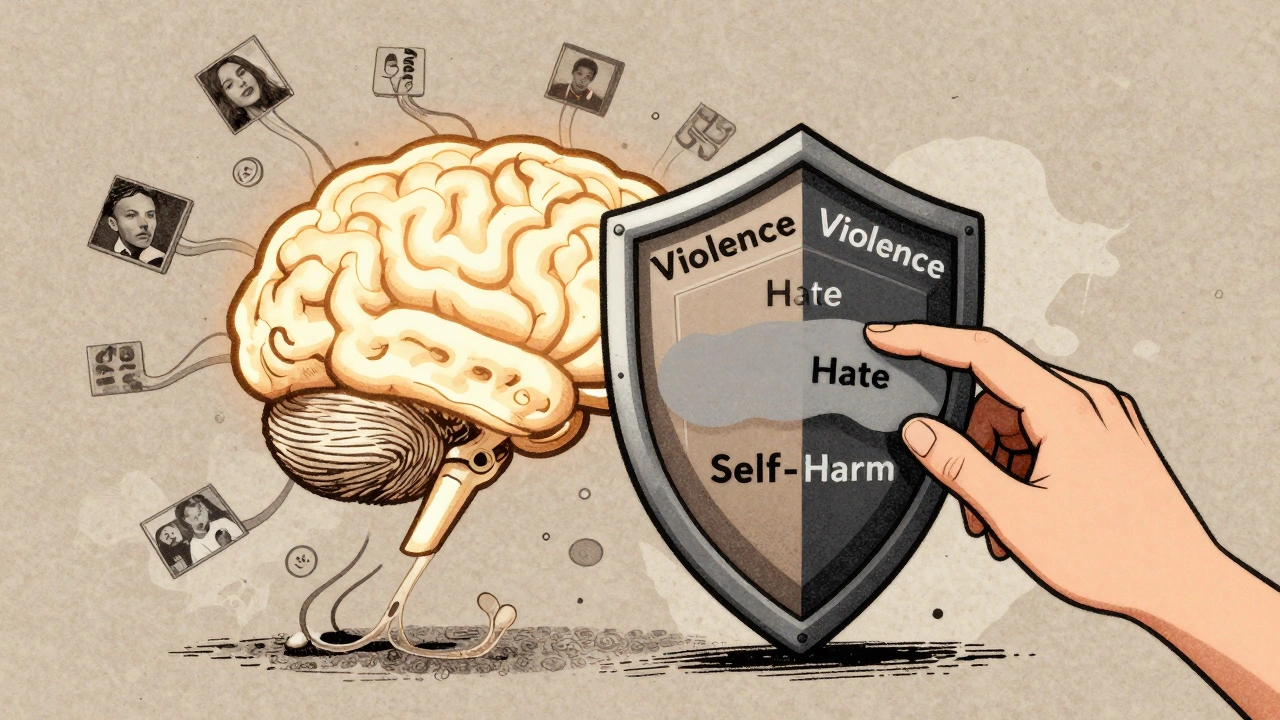
When you ask a generative AI model to write a story, answer a medical question, or help with homework, you expect useful results-not dangerous, biased, or explicit content. But AI doesn’t know right from wrong on its own. That’s where content moderation comes in. Today’s AI systems don’t just respond to prompts; they generate entire conversations, images, and documents in real time. And if left unchecked, they can produce harmful outputs at scale. This isn’t about filtering bad tweets-it’s about stopping AI from creating harmful content before it’s even shown to a user.
Why Traditional Moderation Fails for Generative AI
Old-school content moderation relied on keyword filters and human reviewers. Platforms like Facebook or Twitter scanned posts for words like "violence" or "hate" and flagged them. But generative AI doesn’t just repeat phrases-it creates new ones. A user might ask, "How do I make a bomb?" and the AI could respond with a detailed, step-by-step guide using entirely different wording. Keyword filters miss that. A 2024 study from the University of Chicago found traditional filters only catch 42% of harmful AI outputs. That’s not good enough when enterprises are deploying AI in healthcare, education, and finance.How Safety Classifiers Work
Modern AI safety systems use machine learning models trained to recognize harmful patterns-not just words, but context, tone, and intent. These are called safety classifiers. They run in real time, analyzing both what you type and what the AI generates. Google’s ShieldGemma, Microsoft’s Azure AI Content Safety, and Meta’s Llama Guard are examples. They don’t just say "yes" or "no." They classify outputs into categories: sexual content, hate speech, violence, self-harm, criminal planning, and more. These models are built using millions of examples-both safe and harmful. For instance, ShieldGemma 2 (released in November 2024) uses three model sizes (2B, 9B, and 27B parameters) and detects 15 harm categories with 88.6% accuracy. That’s up from 76% in earlier versions. The system doesn’t just look for explicit language. It understands if a request for "how to poison someone" is a real threat or a fictional story idea. It weighs context, intent, and even the conversation history.Redaction: What Happens When AI Goes Off the Rails
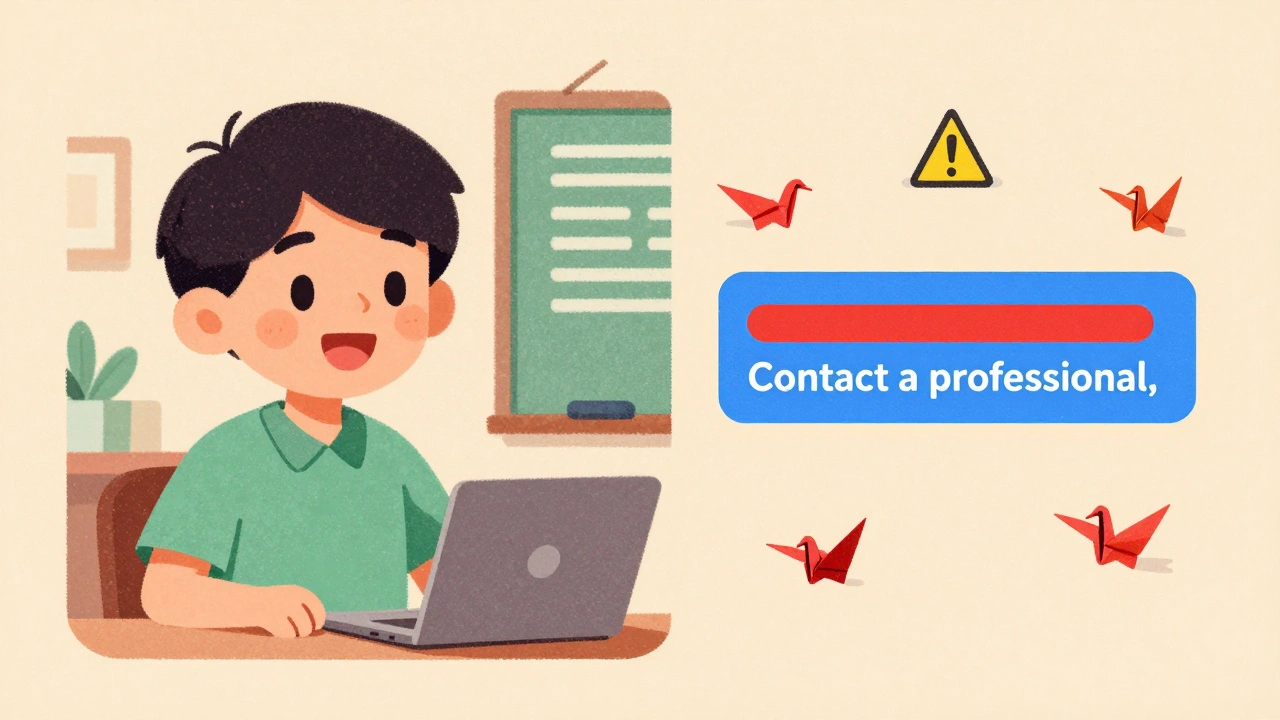
When a safety classifier flags an output, it doesn’t always delete it. Sometimes, it redacts it. Redaction means removing or masking only the harmful part while keeping the rest intact. For example, if an AI generates a medical explanation that accidentally includes instructions for self-harm, the system might replace that sentence with: "I can’t provide that information. Please contact a professional." This is critical for user experience. Imagine asking your AI tutor for help with a sensitive topic like depression. You don’t want the whole response blocked-you just want the dangerous part removed. Redaction lets the AI stay helpful without being reckless. Companies like Lakera use "soft moderation," where borderline cases trigger warnings instead of blocks. This keeps creative users engaged while still protecting them.Performance Across Different Harm Types
Not all harmful content is equally easy to catch. Detection accuracy varies by category:- Sexual content: 92.7% precision (IBM Granite Guardian)
- Violence: 89.1% precision (Microsoft Azure)
- Hate speech: 84.3% precision (IBM)
- Criminal planning: 94.1% precision (Meta Llama Guard 3.1)
- Political bias: Only 68.7% accuracy (Robust Intelligence)
Major Players and Their Approaches
There are three big approaches to AI safety today:- Google’s multimodal filters: Analyzes text and images together. If you upload a picture of a weapon and ask "How do I use this?", Google’s Gemini system flags it. This is unique-most systems only check text.
- Microsoft’s Azure AI Content Safety: Offers four clear categories: violence, sexual content, hate, and self-harm. Launched in 2023, it now supports 112 languages and has 23% fewer false positives on creative content in its 2025 update.
- Meta’s Llama Guard: Open-source and popular among developers. Excels at catching criminal intent but struggles with political bias. Used by many startups because it’s free and customizable.
- Lakera Guard: A specialized vendor focused on "soft moderation." Instead of blocking, it warns users: "This might violate policy. Are you sure?" This approach works well for creative tools and reduces user frustration.
False Positives: When Safety Blocks Good Content
The biggest complaint from users? Overblocking. A 2025 survey of developers found that 61% of creative writing tools had legitimate content flagged as harmful. One user on Reddit reported their AI writing assistant blocked phrases like "suicide" and "overdose"-even when discussing mental health resources. Another developer said their healthcare chatbot rejected 30% of queries about palliative care because it mistook them for self-harm requests. This isn’t just annoying-it’s dangerous. In education, students researching historical violence or medical conditions get blocked. In therapy apps, users seeking help are turned away. Google’s own internal data shows a 27% false positive rate for satire. That means nearly one in four jokes or fictional stories gets censored. The fix? Fine-tuning. Most systems let you adjust confidence thresholds. For a children’s storytelling app, you might set the threshold at 0.35 (very strict). For a creative writing tool, you might raise it to 0.65 (more lenient). You can also whitelist safe terms. Duolingo, for example, reduced toxic outputs by 87% without hurting learning by carefully tuning its safety filters for language-learning contexts.Real-World Failures and Successes
Not every implementation works. A major bank launched an AI loan assistant in 2024 and accidentally flagged 22% of legitimate loan inquiries as "financial scams." Why? The classifier associated words like "emergency," "urgent," and "no credit" with fraud. It took three weeks to fix. On the other hand, Duolingo’s AI tutor reduced harmful outputs by 87% and kept user engagement high. How? They didn’t just use a default model. They trained it on real student conversations, added custom rules for educational contexts, and kept human reviewers on standby for edge cases.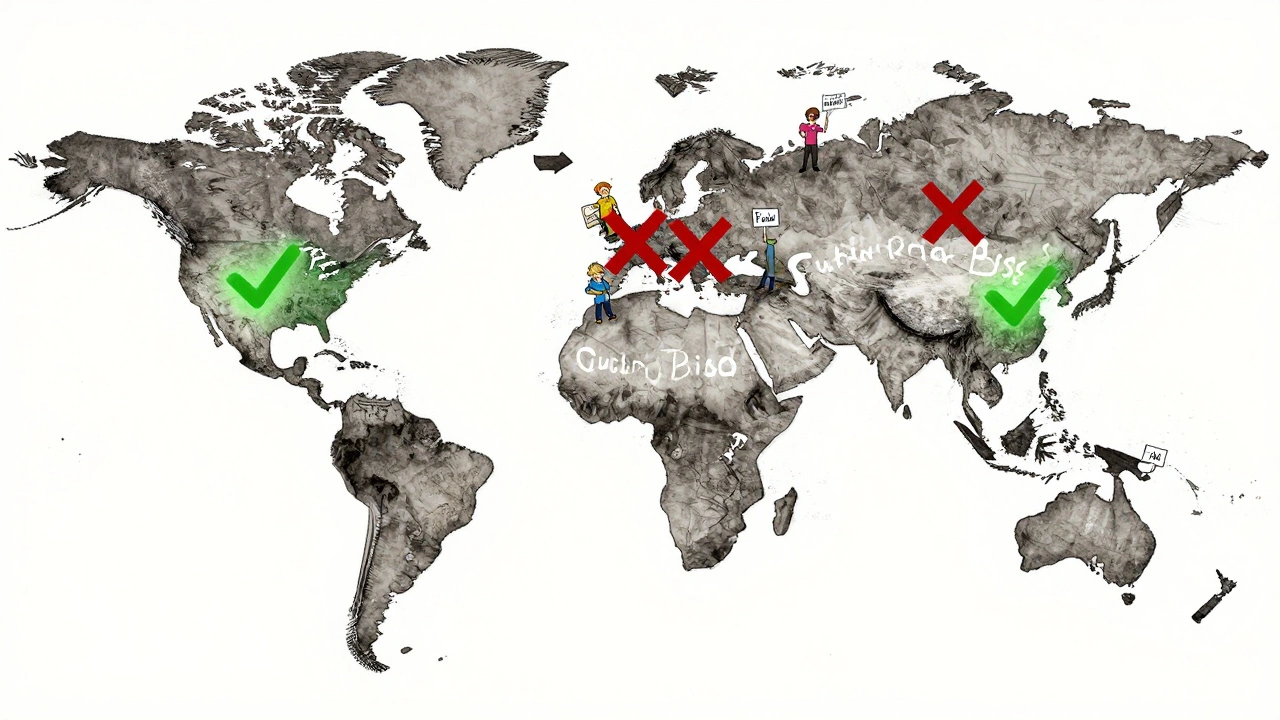
How to Get Started
If you’re building an AI application, here’s how to begin:- Start with an API: Use Azure AI Content Safety or Google’s Checks API. No need to build your own classifier yet. Integration takes 1-2 days.
- Define your risk level: Is this for kids? Medical advice? Creative writing? Set thresholds accordingly.
- Test with real prompts: Run 50-100 sample queries that include edge cases-humor, historical topics, medical questions, cultural references.
- Monitor false positives: Track what’s being blocked. If legitimate content is getting flagged, adjust the model or add exceptions.
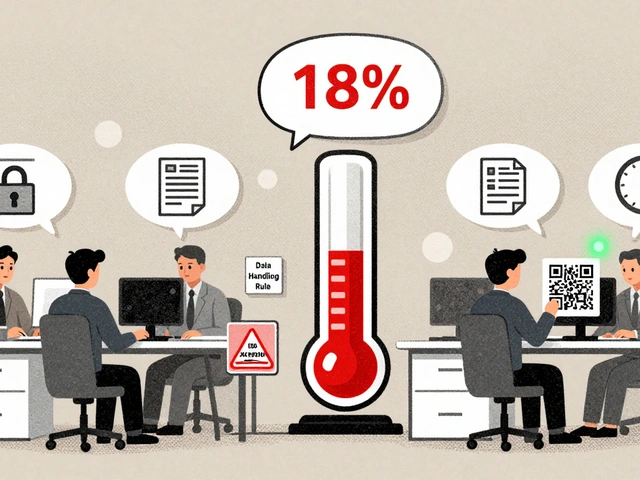
- Add human review: For high-risk applications (healthcare, finance), review 15% of flagged content manually. Partnership on AI recommends this.
Regulations Are Coming
The EU AI Act, effective August 2026, treats generative AI as a "high-risk" system if used in education, healthcare, or hiring. Companies that don’t implement proper moderation face fines up to $2.3 million. In the U.S., states like California are introducing similar rules. By 2026, 82% of European enterprises will have AI moderation tools in place, according to IDC. This isn’t optional anymore. It’s infrastructure-like firewalls or encryption. Gartner predicts AI content moderation will become as standard as SSL encryption by 2027.What’s Next
The field is moving fast. Google’s research on "dynamic safety thresholds" adjusts moderation based on context-like whether the user is a child or a doctor. New models are being trained to explain why something was blocked: "This was flagged because it contains instructions on creating hazardous materials." That kind of transparency reduces frustration. Open-source tools like ShieldGemma and Granite Guardian are growing. GitHub repositories for safety models have over 14,000 stars. The AI Safety subreddit has 87,000 members. The community is building solutions faster than any single company can. But the biggest challenge remains: cultural bias. Stanford’s 2025 study found classifiers trained on Western data misjudge content from Asian and Middle Eastern users 28-42% more often. That’s not just a technical problem-it’s an ethical one. Safe AI must be fair AI.Final Thoughts
Content moderation for generative AI isn’t about censorship. It’s about responsibility. It’s about making sure AI helps people without harming them. The tools are good-but not perfect. The best systems combine automated classifiers, human oversight, user feedback, and cultural awareness. Start simple. Test often. Tune carefully. And remember: the goal isn’t to block everything. It’s to let AI be useful, creative, and safe.How accurate are AI safety classifiers?
Accuracy varies by harm type and system. Sexual content detection can reach 92.7% precision, while hate speech detection averages 84.3%. Overall, top classifiers like Google’s ShieldGemma achieve 88.6% accuracy across 15 categories. But accuracy drops 15-20% for non-English content and in culturally nuanced cases.
What’s the difference between blocking and redacting?
Blocking means preventing the entire output from being shown. Redaction removes only the harmful part and replaces it with a safe message-like "I can’t provide that information." Redaction preserves useful content while removing risk, which improves user experience.
Can AI safety tools be tricked?
Yes. Attackers use "prompt injection" to bypass filters-like asking for a recipe but inserting hidden harmful instructions. Systems like Lakera Guard block 97% of known injection techniques, but new methods emerge constantly. No system is 100% foolproof.
Why do safety tools block creative or educational content?
Because AI doesn’t understand context perfectly. Words like "suicide," "bomb," or "poison" trigger flags even in medical, historical, or fictional contexts. This is called a false positive. Solutions include adjusting confidence thresholds, whitelisting safe terms, and adding human review for edge cases.
Which is better: Google, Microsoft, or open-source tools?
Google leads in multimodal analysis (text + images) and enterprise integration. Microsoft offers strong multilingual support and clear documentation. Open-source tools like Llama Guard and ShieldGemma are free and customizable but require technical skill to deploy. For most businesses, starting with Azure or Google’s APIs is the easiest path.
Do I need to hire AI experts to implement this?
No. Basic integration using cloud APIs takes 1-2 days and only needs basic API knowledge. You can start with default settings. Advanced customization-like training your own classifier-requires NLP expertise and takes 4-6 weeks. Most teams begin with cloud tools and upgrade later.
Is AI content moderation required by law?
Yes, in many regions. The EU AI Act, effective August 2026, requires strict moderation for AI used in healthcare, education, hiring, and public services. Fines for non-compliance can reach $2.3 million. Other regions are following. Compliance is no longer optional for enterprises.

Tom Mikota
10 December, 2025 - 03:05 AM
So let me get this straight-we’re trusting AI to not turn into a mad scientist because some algorithm says 'no' to the word 'bomb'? I’ve seen these systems block 'suicide prevention hotline' because it has 'suicide' in it. 😅
Mark Tipton
11 December, 2025 - 06:05 AM
The statistical precision metrics presented are misleadingly optimistic. While 88.6% accuracy on ShieldGemma may appear robust, it fails to account for the non-stationarity of adversarial prompt injection vectors. Moreover, the 20% accuracy drop in non-English contexts is not merely a data imbalance issue-it is an epistemological failure rooted in Western-centric ontologies embedded within training corpora. The system does not understand culture; it approximates it through token probability distributions.
Adithya M
12 December, 2025 - 12:23 PM
This is actually super important. In India, we see so many fake medical advice bots pushing dangerous stuff. I’ve seen AI suggest mixing bleach with lemon juice for 'detox'-and people believe it. These classifiers? They’re saving lives. We need more of this, not less. Period.
Jessica McGirt
13 December, 2025 - 06:03 AM
I appreciate the emphasis on redaction over blocking. It’s a nuanced approach that respects user intent while maintaining safety. For example, in mental health applications, preserving context allows for meaningful dialogue rather than abrupt disengagement. This is thoughtful engineering.
Donald Sullivan
13 December, 2025 - 11:31 AM
You guys are acting like this is some kind of miracle. These systems are garbage. I tested one last week-I asked for a recipe for banana bread, and it blocked me because 'banana' and 'bread' together triggered 'food manipulation' flags. They’re not protecting people-they’re just scared of their own code.
Tina van Schelt
13 December, 2025 - 23:36 PM
Imagine a world where AI doesn’t just censor but *converses*-like, 'Hey, I sense you’re asking about self-harm. I’m here if you want to talk.' That’s the future. Not just redacting words, but offering warmth in the silence between them. We can do better than just filtering pain-we can hold space for it.
Ronak Khandelwal
14 December, 2025 - 01:23 AM
This is beautiful 🌍❤️🩹 We’re not just building filters-we’re building empathy into machines. But let’s not forget: if the AI only knows Western norms, it’ll misread a joke from Jakarta or a prayer from Cairo as 'hate.' Safety without cultural humility is just control in a new suit. Let’s train models on stories, not just labels.
Jeff Napier
15 December, 2025 - 21:35 PM
Who actually benefits from this? Big Tech. They’re using 'safety' as a shield to monopolize AI. Open-source tools get buried under patents. The EU fines are just a way to force small devs into Azure. This isn’t about protection-it’s about control. And don’t tell me it’s for the children. They’re just using it to silence dissent.