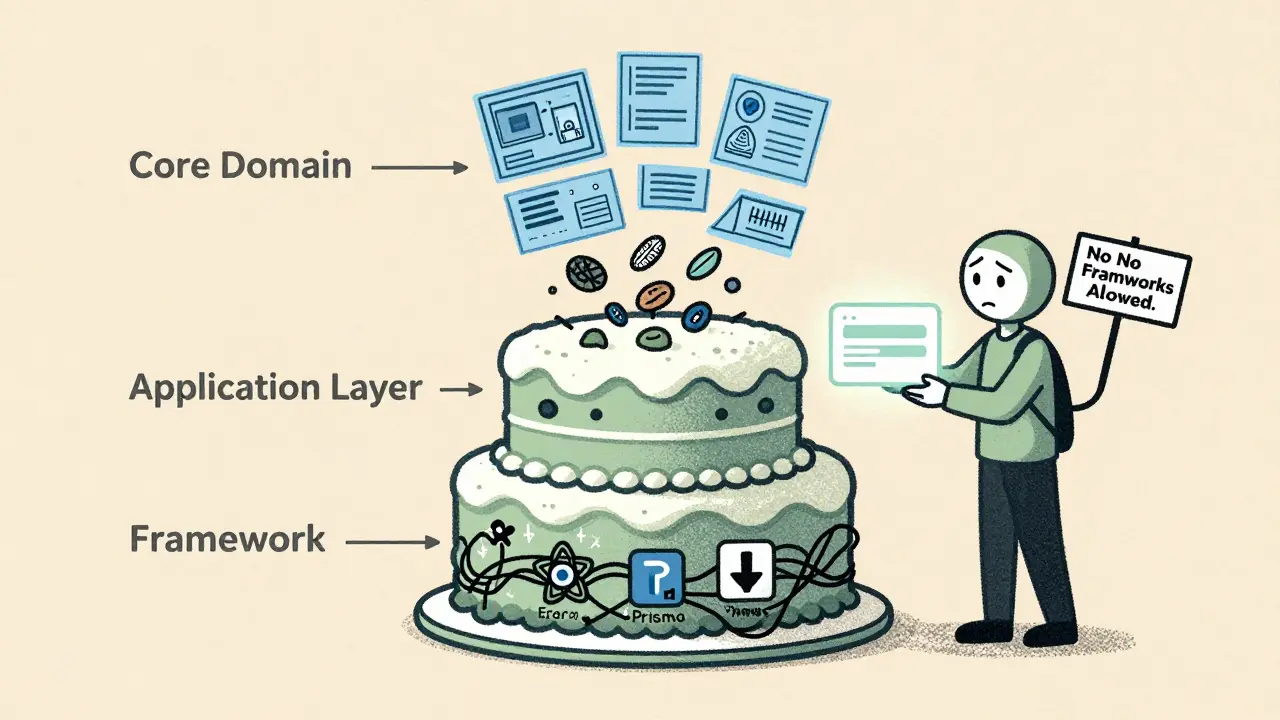
When you're vibe coding-typing a prompt like "Make a login form with validation and store the user in a database"-your AI assistant doesn't ask if you want clean code. It just spits out React components, Prisma queries, and Redux slices all tangled together. That’s fine for a prototype. But if this is meant to last more than a month, you’re already buried under technical debt. The fix isn’t writing more code. It’s clean architecture-and keeping frameworks locked at the edges.
Why Clean Architecture Matters More Now Than Ever
Clean Architecture isn’t new. Robert C. Martin laid it out in 2017: business logic stays in the center. Everything else-databases, UIs, APIs-lives on the outside. The core doesn’t know what framework you’re using. It doesn’t care if you’re on React, Vue, or a command-line tool. That’s the point. But vibe coding changes the game. AI tools don’t think in layers. They think in patterns they’ve seen. If you’ve ever used Copilot or Cursor, you’ve seen it: the assistant pulls in database calls into your business logic because that’s how it’s trained. In 2024, Metronome found that 63% of vibe-coded projects failed within six months because of exactly this. Not because the code was buggy. Because it was unmaintainable. The real problem? You can’t fix it later. You can’t refactor your way out of framework contamination. Once your domain model imports a React hook or a Prisma client, you’re locked in. Switching from Firebase to PostgreSQL? Good luck. Replacing React with Svelte? Hope you’ve got 300 hours.The Three Layers: Core, Application, Framework
There are only three layers you need to think about:- Core domain layer-This is your business rules. What makes a user valid? How do you calculate a discount? What happens when a payment fails? This layer has zero dependencies. No imports from React, no database drivers, no HTTP libraries. Just plain JavaScript or TypeScript objects and functions.
- Application layer-This is where use cases live. "Create User," "Process Order," "Send Notification." It defines interfaces (like
UserServiceorPaymentGateway) but doesn’t implement them. It says: "I need something that can save users." It doesn’t say how. - Framework layer-This is where React, Express, Prisma, Firebase, or whatever you’re using actually lives. This layer implements the interfaces from the application layer. It’s the glue. It’s the adapter. It’s the part you can throw away and replace without touching the core.
How to Set Up Boundaries Before You Write a Single Line
The biggest mistake people make in vibe coding? Starting to code before defining the architecture. You think you’re saving time. You’re not. You’re just delaying the pain. Here’s how to do it right:- Write a Product Requirements Document (PRD) with architectural constraints. Don’t just say "build a login." Say: "The login system must work with any UI framework. User data must be stored via a pluggable repository. No framework-specific code may appear in the core domain." This isn’t fluff. It’s your contract with your future self.
- Define your interfaces first. Before you let the AI generate anything, write the contracts. For example:
interface UserRepository {
  save(user: User): Promise<User>;
  findByEmail(email: string): Promise<User | null>;
}
Then, tell your AI: "Implement this interface using Prisma, but don’t import Prisma into the domain layer. Only the framework layer can do that."
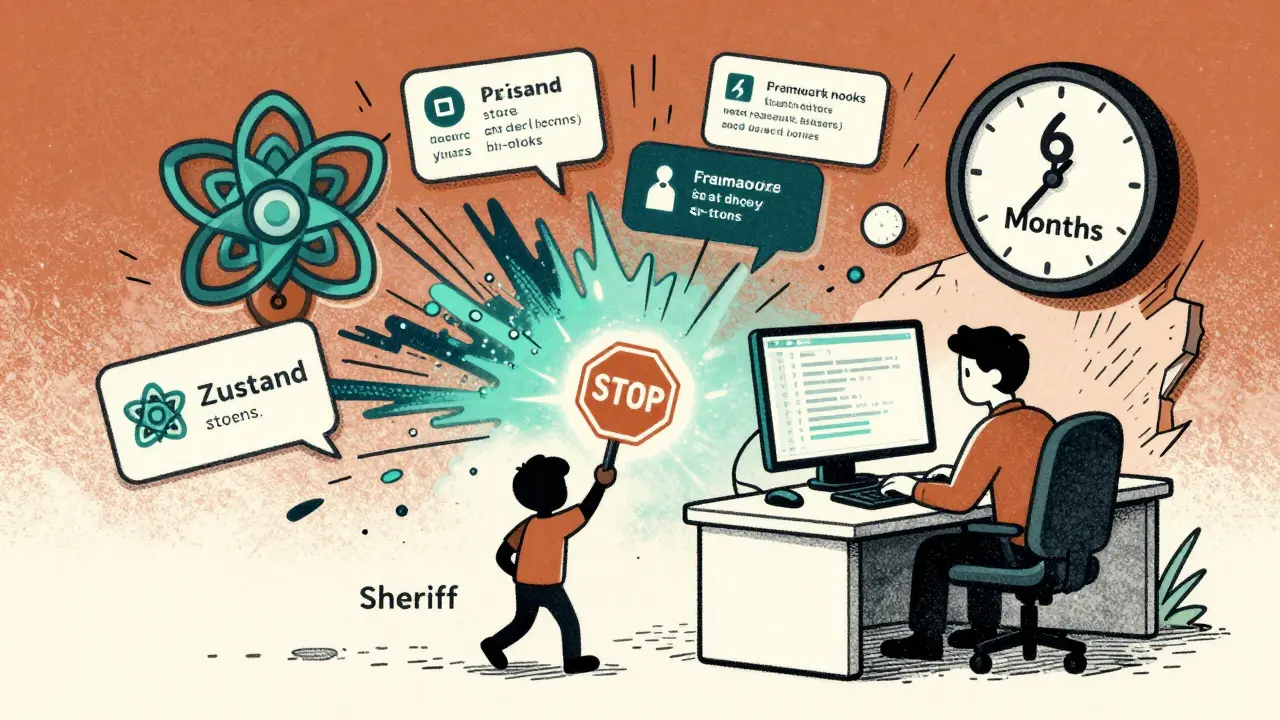
- Use Sheriff or a similar tool. Sheriff is an open-source tool that scans your code and blocks imports that violate your boundaries. If your core layer tries to import
reactor@prisma/client, Sheriff flags it immediately. No more guessing. No more "I didn’t realize that was a problem." 68% of professional teams using vibe coding now use tools like this. It’s not optional anymore. - Use the "vertical slice" method. Don’t build all the UI first, then all the backend. Build one tiny feature end-to-end: a button that calls a use case that saves to a repository that returns a response. Then build the next one. This forces you to think in layers from day one. 92% of architects surveyed by vFunction say this is the single most effective way to prevent framework leakage.
What Happens When You Don’t Do This
Let’s say you vibe-code a dashboard. You let the AI generate everything. It puts database queries inside React components. It uses Zustand for state management and calls API endpoints directly from your business logic. Everything works. You ship it. Two months later, your CTO says: "We’re moving to Vue and Supabase." Now you have to:- Find every line that imports
react-router - Replace every
prisma.user.findUnique()with Supabase equivalents - Redo state management because Zustand doesn’t exist in Vue
- Re-test everything because the core logic was never isolated
Why AI Can’t Fix This for You
AI assistants are amazing at generating code. They’re terrible at thinking about architecture. They don’t understand long-term maintainability. They don’t know what "separation of concerns" means in practice. They just predict the next token. A 2024 survey by Creator Economy found that 87% of developers who tried vibe coding without architectural knowledge failed within three months. The AI didn’t fail. The developer did. Because they assumed the AI would handle the structure. It won’t. You have to. The best vibe coders don’t just prompt. They guide. They say: "Don’t use any framework-specific types in this function." "Return a plain object, not a Prisma model." "This interface must be implemented by the framework layer, not the domain layer." You’re not writing code with AI. You’re coaching it.Real-World Wins: How Teams Are Doing It
Metronome’s design team used a simple workflow: plan in Claude, execute in Cursor, enforce with Sheriff. They built 47 UI components with consistent architecture in 11 hours. The same work used to take 38 hours. Why? Because they didn’t waste time fixing broken layers later. The AIBD React Template-starred over 2,300 times on GitHub-includes pre-built boundary rules. Developers don’t have to guess what’s allowed. The template enforces it. That’s why it’s popular. It’s not magic. It’s structure. Even big companies are catching on. Google Cloud’s Dr. Sarah Chen found that projects using Clean Architecture with AI assistance had 73% higher maintainability scores after 12 months. That’s not a small number. That’s the difference between a project that survives and one that gets scrapped.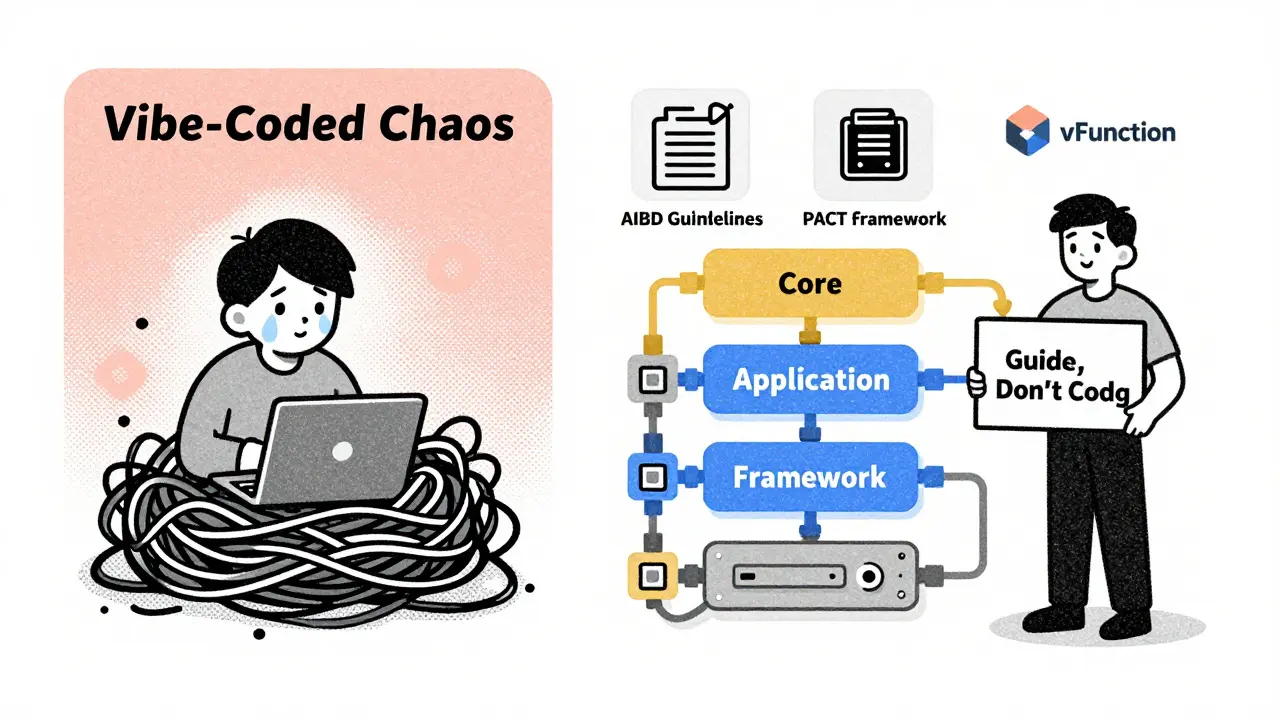
When You Should Skip Clean Architecture
Let’s be real. Clean Architecture adds overhead. The first setup takes 25-30% longer than vibe-coding without boundaries. You’ll spend a day setting up Sheriff, writing interfaces, defining rules. It feels slow. That’s fine-if you’re building a one-off demo. Or a hackathon project. Or something you know you’ll throw away in a week. But if you’re building anything that might live longer than 90 days? Anything that might need to scale? Anything that might need to change frameworks, add a mobile app, or integrate with another system? Then you’re not saving time. You’re just borrowing it. And the interest rate is brutal.Tools You Need Right Now
You don’t need to build this from scratch. Here’s what works in 2026:- Sheriff (open-source, MIT licensed): Scans your code for forbidden imports. Configurable. Integrates with GitHub Actions. Used by 68% of teams.
- PACT Framework: A structured workflow with templates for defining boundaries. Includes prompt guides for AI assistants.
- AIBD Guidelines: Official best practices for AI-assisted development. Published by industry architects. Free to use.
- vFunction: Commercial platform that gives you architectural insights and auto-generates prompts to fix violations.
What Comes Next
By 2025, AI assistants will start auto-detecting architectural violations. Some vendors are already working on it. But until then, you’re the architect. The AI is your assistant. Not your boss. The future of vibe coding isn’t more AI. It’s better boundaries. The teams that win won’t be the ones coding the fastest. They’ll be the ones building systems that last.Start small. Define one interface. Enforce one boundary. Use Sheriff. Watch how your AI starts writing better code-because you’re finally giving it a clear direction.
Can I use Clean Architecture with any AI coding assistant?
Yes. Clean Architecture works with GitHub Copilot, Cursor, Amazon Q, Claude, or any AI tool. The key isn’t the tool-it’s how you prompt it. Always specify: "Don’t import framework code into the domain layer," "Use interfaces, not concrete implementations," and "Return plain objects, not framework-specific models." The AI will follow your rules if you give them clearly.
Does Clean Architecture slow down vibe coding?
Initially, yes. Setting up boundaries, interfaces, and enforcement tools takes 25-30% longer than jumping straight into code. But after the first 3-4 features, you start moving faster. Teams report 40% faster feature delivery after the initial setup because they’re not fixing broken architecture every week. The slowdown is upfront. The speed-up is ongoing.
What if my AI keeps generating framework code anyway?
That’s normal. AI tools default to framework-specific patterns because that’s what they’ve learned. The solution isn’t to stop using AI-it’s to enforce boundaries. Use Sheriff to block violations. When it flags a problem, correct the prompt: "This function must not use React hooks. Return a plain object with the data needed for the UI." Over time, your AI learns your style. It becomes more accurate.
Is Clean Architecture only for big teams?
No. Solo developers benefit the most. Without a team to catch mistakes, you’re the only one who sees the mess before it collapses. Clean Architecture gives you a safety net. Even one person can use Sheriff, define three interfaces, and avoid framework lock-in. The cost of failure is higher for solo builders. That’s why it’s essential.
Do I need to be an expert to use Clean Architecture with vibe coding?
You don’t need to be an expert, but you do need to understand the basics. You should know what a dependency is, what an interface does, and why mixing concerns is dangerous. It takes 15-20 hours of focused practice to get comfortable. Watch tutorials on vertical slicing. Read the AIBD guidelines. Try Sheriff on a small project. You’ll get it faster than you think.
What’s the biggest mistake people make?
Thinking they can fix it later. Clean Architecture isn’t something you add after the fact. It’s something you build from the start. If you wait until you have 500 lines of framework-heavy code, it’s too late. The cost of rewriting skyrockets. Start with boundaries-even if they’re simple. Better to have a weak boundary than no boundary at all.




Destiny Brumbaugh
13 January, 2026 - 13:45 PM
bro i vibe coded a whole auth system in 20 mins and it worked lol but then my boss said switch to supabase and i cried for 3 days. sheriff saved my life. why didnt anyone tell me this sooner??
Sara Escanciano
13 January, 2026 - 23:10 PM
This is exactly why developers are becoming lazy. You don’t get to outsource your thinking to AI and then blame the framework for your incompetence. Clean architecture isn’t optional-it’s the bare minimum for anyone who calls themselves a professional. Stop pretending speed is more important than integrity.
Elmer Burgos
15 January, 2026 - 12:52 PM
i tried this on my side project and wow it actually works. took me a day to set up sheriff and write the interfaces but now when i swap out ui libraries its like changing a battery. no panic. no fire drills. just works. thanks for the clarity man
Jason Townsend
16 January, 2026 - 15:05 PM
they’re watching you. sheriff scans your code and sends it to some corporate AI server. they’re building a database of every dev who uses clean architecture so they can target you with ads for ‘enterprise architecture consulting’. this is how they control the narrative. dont trust the tools. trust yourself
Antwan Holder
16 January, 2026 - 18:49 PM
I stared into the abyss of tangled dependencies... and the abyss stared back. It whispered: 'You thought you were coding... but you were just feeding the machine.' Clean architecture isn't a pattern-it's a spiritual awakening. The core is your soul. The framework? Just the clothes you wear. Take them off. Be bare. Be pure. Be free.