
You are building a chatbot that helps users manage their finances. A user types: "My credit card number is 4111-1111-1111-1111, can I buy this laptop?" Your Large Language Model (LLM) answers perfectly. But somewhere in the background, that credit card number was sent to an external API, logged in your server traces, or potentially stored in training data. That is a privacy breach waiting to happen.
As of 2026, sending raw Personally Identifiable Information (PII) to third-party LLM providers is no longer just a risk-it is a compliance violation under regulations like GDPR, CCPA, and HIPAA. The solution isn't to stop using AI; it is to build a robust PII detection and redaction pipeline. This infrastructure sits between your user and the model, scrubbing sensitive data before it leaves your secure environment and checking the output before it reaches the user's screen.
The Core Problem: Why Simple Regex Fails
Many developers start with regular expressions (Regex). It seems logical: find patterns that look like email addresses, phone numbers, or Social Security Numbers, and replace them with asterisks. While Regex is fast, it is brittle. It misses context. If a user says, "My name is John Doe," Regex might not flag "John Doe" as a person unless you have a specific list of names. More importantly, it struggles with ambiguous data. Is "123 Main St" an address or just a random string of numbers and letters?
In production environments, relying solely on Regex results in a recall rate of only about 65%. This means 35% of sensitive information slips through undetected. For a financial app or healthcare platform, leaking one in three pieces of sensitive data is unacceptable. You need a system that understands context, not just patterns.
Architecting the Hybrid Pipeline
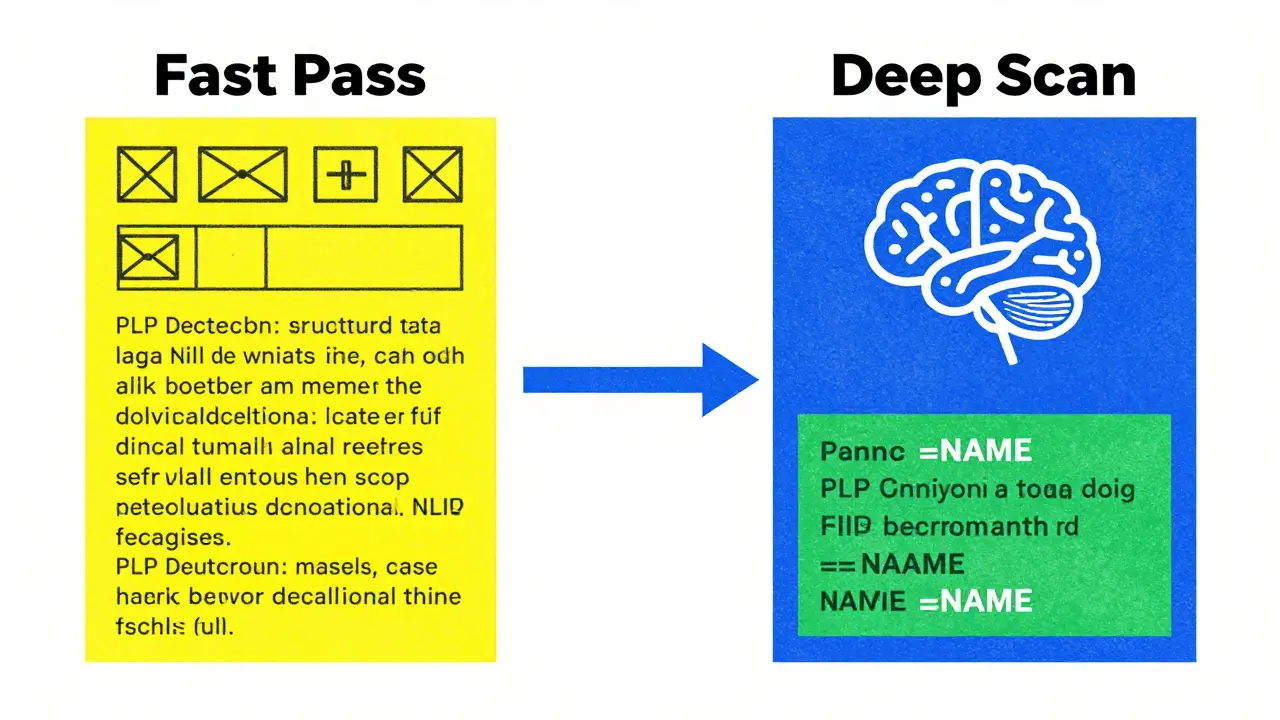
The most effective architecture for 2026 uses a hybrid approach. This combines the speed of pattern matching with the intelligence of Natural Language Processing (NLP). Think of it as a two-stage filter:
- Fast Pass (Regex): The system first scans for well-structured data like emails, credit cards, and IP addresses. This catches the obvious stuff with near-zero latency.
- Deep Scan (NER): Anything that passes the first stage goes to a Named Entity Recognition (NER) model. These models, often built on libraries like spaCy or Microsoft Presidio, analyze the sentence structure to identify people, organizations, locations, and custom entities based on context.
This tiered strategy boosts recall rates to 96% or higher. In a real-world implementation, this means only 4% of sensitive data escapes redaction-a massive improvement over regex-only baselines. The key is decoupling these components. You don't want your heavy NLP model slowing down every simple query. Instead, use a microservices architecture where a lightweight Go-based processor intercepts telemetry and communicates via gRPC with a Python-based detection service. This allows you to scale the heavy lifting independently from the request handling.
Key Tools and Libraries
You do not need to build your NER models from scratch. Several mature tools dominate the landscape today.
| Tool | Type | Best Use Case | Pros | Cons |
|---|---|---|---|---|
| Microsoft Presidio | Open Source Library | Customizable enterprise pipelines | Highly configurable, supports batch processing, active community | Requires managing dependencies, setup complexity |
| spaCy | NLP Framework | General entity recognition | Fast, efficient, great for English | Less out-of-the-box PII support than Presidio |
| Amazon Comprehend | Cloud Service | AWS-native applications | Managed service, integrates with SageMaker | Vendor lock-in, cost per request |
| PRvL Models | Fine-tuned LLM | Complex semantic redaction | Understands context deeply, high accuracy | Higher latency, computational cost |
Microsoft Presidio is the industry standard for open-source PII detection. It offers customizable pattern libraries and context-aware recognition. Many teams use Presidio for batch processing large datasets via PySpark, while using lighter solutions for real-time edge cases. If you are on AWS, Amazon SageMaker Data Wrangler integrates Amazon Comprehend to automatically redact PII during data preparation, keeping your ML workflows compliant without extra code.
Implementing the Flow: Input and Output
Your pipeline must work both ways. Protecting the input prevents data leakage to the LLM provider. Protecting the output prevents the model from hallucinating or revealing sensitive data it might have inferred.
Step 1: Intercept Input
When a user sends a prompt, your API Gateway routes it to the PII Detector. The detector checks a cache for previously seen patterns (to save compute), runs the Regex filter, and then applies NER analysis. If PII is found, it replaces the sensitive text with placeholders like <NAME>, <EMAIL>, or <PHONE>. The sanitized prompt is then sent to the LLM.
Step 2: Process with LLM The LLM generates a response based on the sanitized input. Because it never saw the actual credit card number or home address, it cannot leak it directly.
Step 3: Validate Output Before sending the response back to the user, run the LLM's output through the same detection pipeline. Sometimes, models generate examples that contain fake but realistic-looking PII, or they might repeat parts of the prompt if not carefully instructed. The output validator ensures no new sensitive data was created. Finally, if your application needs to display the original data (e.g., confirming a booking for "John Doe"), you can restore the placeholders with the original values securely within your local system, never exposing them to the external model.
Performance Trade-offs: Speed vs. Accuracy
There is no free lunch in engineering. Adding a PII pipeline introduces latency. Regex adds milliseconds. NER models add seconds. Fine-tuned LLMs for redaction add even more time and cost.
For high-volume, real-time chat applications, you must optimize for speed. Use a lightweight NER model or restrict deep scanning to high-risk fields only. For batch processing jobs, such as analyzing customer support tickets overnight, you can afford the heavier computational cost of fine-tuned models like those from the PRvL project. These models offer superior semantic understanding, ensuring that nuance isn't lost when redacting complex sentences.
Consider using asynchronous sanitization functions. Instead of blocking the user interface while the PII check runs, submit the request to a queue. However, for conversational AI, synchronous processing is usually required to maintain the illusion of instant interaction. In this case, caching detection results for repeated phrases can significantly reduce average latency.
Compliance and Regulatory Context
Why go through all this trouble? Regulations. The General Data Protection Regulation (GDPR) in Europe requires data minimization-collecting and processing only what is necessary. The California Consumer Privacy Act (CCPA) gives users rights over their personal data. Industry-specific rules like HIPAA (healthcare) and PCI-DSS (payments) mandate strict controls on how sensitive data is handled.
Using third-party LLMs introduces a unique risk: your data might be used to train their models. Even if the provider promises not to, logging systems and audit trails can inadvertently store sensitive prompts. A robust redaction pipeline ensures that by the time data leaves your controlled environment, it is anonymous. This creates a clear boundary between your proprietary data and public AI services, satisfying auditors and protecting your users.
Handling Multilingual Data
If your application serves a global audience, language support becomes a critical factor. Most major PII detection libraries, including Presidio and spaCy, are heavily optimized for English. Detection accuracy for non-English languages can drop significantly due to differences in grammar, naming conventions, and character sets.
For multilingual applications, you should implement a language identification step before PII detection. Route English text to your primary pipeline and other languages to specialized models or translation-based workflows. Be aware that translating text to detect PII and then translating back introduces its own risks and latency. Currently, many organizations accept a slightly higher false-negative rate for non-English content while investing in better multilingual NER models.
Deployment and Automation
Managing these pipelines manually is error-prone. Use automation tools to standardize deployment. The OpenTelemetry Collector Builder (OCB) allows you to compile custom collector binaries with embedded PII redaction processors. This means your observability stack itself can scrub sensitive data from logs and traces before they reach your monitoring dashboard.
Define your redaction policies in declarative configuration files. Specify which attributes to scan (e.g., `llm.prompt`, `user.email`), which patterns to apply, and where to send the sanitized data. This separation of policy from code makes it easier for security teams to update rules without redeploying the entire application.
What is the difference between PII detection and redaction?
Detection is the process of identifying sensitive information within text using patterns or AI models. Redaction is the action of masking, removing, or replacing that identified information with placeholders (like <NAME>) to protect privacy. Detection comes first; redaction follows immediately after.
Is Regex enough for PII protection in LLMs?
No. Regex is good for structured data like email addresses and credit card numbers, but it fails to capture contextual PII like names, addresses, or medical conditions mentioned in natural language. Relying only on Regex leaves up to 35% of sensitive data exposed. A hybrid approach with Named Entity Recognition (NER) is recommended for production systems.
How does Microsoft Presidio work?
Microsoft Presidio is an open-source library that provides pre-built analyzers and recognizers for common PII types. It uses a combination of regular expressions, context-aware NER models, and custom logic to detect entities. It also includes an anonymizer engine that can replace detected entities with various strategies, such as replacement, encryption, or hashing.
Do I need to redact LLM outputs?
Yes. While input redaction prevents sending sensitive data to the model, output redaction protects against the model generating sensitive information. LLMs can sometimes hallucinate private details or repeat parts of the prompt if not carefully constrained. Scanning outputs ensures complete end-to-end privacy.
What is the impact of PII pipelines on latency?
PII pipelines add latency. Regex adds minimal delay (milliseconds), while NER models can add seconds depending on the size of the text and the model complexity. To mitigate this, use hybrid architectures, cache results for repeated inputs, and consider asynchronous processing for non-real-time tasks. Fine-tuned LLM-based redactors offer higher accuracy but at a significant cost in speed and compute resources.
Can I use cloud services for PII detection?
Yes. Services like Amazon Comprehend (AWS) and Azure AI Language provide managed PII detection capabilities. These are convenient because they handle scaling and updates, but they may introduce vendor lock-in and additional costs per request. They are best suited for organizations already deeply integrated into those cloud ecosystems.




Joe Walters
9 July, 2026 - 10:47 AM
oh look another tech bro trying to save the world with regex lol. you think we dont know that regex is for chumps? i mean seriously, who still uses this garbage in 2026. its like using a abacus to calculate stock prices. so pretentious. anyway, good luck with your little pipeline, hope it doesnt crash when someone types their address in leetspeak.
Robert Barakat
10 July, 2026 - 17:22 PM
The essence of privacy is not merely the absence of data leakage but the philosophical boundary between the self and the digital void. When we redact PII, we are engaging in a ritual of erasure, attempting to reclaim our humanity from the algorithmic gaze. It is a futile yet necessary dance against the entropy of information. We scrub not just to comply, but to assert that some things remain sacred, untouched by the cold logic of the machine. The hybrid pipeline is thus a metaphor for the human condition: part pattern recognition, part deep, contextual understanding.
Michael Richards
11 July, 2026 - 21:29 PM
You're doing it wrong if you're even thinking about sending raw data to an LLM provider without a local sandbox first. I've seen too many startups get burned because they trusted 'industry standards' instead of building their own zero-trust architecture. Presidio is fine for hobbyists, but real enterprise security requires custom NER models trained on your specific domain data. Stop outsourcing your liability to Microsoft or AWS. If you can't build the detection layer yourself, you don't deserve to deploy AI in production. Wake up.
Laura Davis
12 July, 2026 - 22:25 PM
I appreciate the detailed breakdown here! It's super important that we take these steps seriously because people's lives depend on it. I've worked with teams that ignored output validation and ended up leaking patient info, which was absolutely devastating for everyone involved. Please keep pushing for better tools and stricter compliance. We need more engineers who care about the human impact of their code. Let's make sure no one gets hurt by lazy implementation!
Lisa Nally
13 July, 2026 - 05:55 AM
Let me educate you on the actual state-of-the-art. You mention spaCy, but have you considered the implications of transformer-based architectures specifically fine-tuned for semantic redaction? The latency argument is valid, but with modern GPU clusters, the trade-off is negligible compared to the cost of a GDPR fine. Furthermore, relying on Regex is intellectually dishonest. You must implement a multi-layered approach involving syntactic parsing and context-aware embeddings. It's not just about speed; it's about precision engineering. Do better.
Edward Gilbreath
14 July, 2026 - 19:08 PM
they want you to think you need all this fancy software to protect your data but really its just a way to sell more cloud services. amazon comprehend is a trap. once you start using their API you are locked in forever. the government is probably logging every request anyway so why bother. just encrypt everything locally and forget about it. conspiracy theories aside the whole industry is built on fear mongering to keep us paying monthly fees for basic security features that should be free
kimberly de Bruin
15 July, 2026 - 08:02 AM
what is data but a shadow of the soul projected onto silicon screens. we try to hide our names and numbers as if they define us but they are merely labels. the true self cannot be redacted. it flows through the wires unbound by regex or neural networks. perhaps the only secure system is one that exists only in the mind. silence is the ultimate encryption key. let the machines process noise while we retain our mystery
Edward Nigma
16 July, 2026 - 00:33 AM
Actually, the article completely misses the point. Hybrid pipelines are over-engineered nonsense. The real solution is to stop using third-party LLMs altogether and run open-source models locally on edge devices. Why would anyone trust a centralized server with their credit card number? It's insane. Also, the claim that regex has a 65% recall rate is misleading because it depends entirely on the complexity of the input data. Most simple use cases don't need NLP at all. This entire post is just hype generated to sell consulting services.
Francis Laquerre
17 July, 2026 - 15:52 PM
In my experience working with international teams, the multilingual aspect is often overlooked until it's too late. French, German, and Japanese have very different structures for names and addresses, and standard English-centric models fail miserably. I always recommend starting with a language detection module before anything else. It adds a tiny bit of overhead but saves hours of debugging later. Collaboration across borders requires respecting these linguistic nuances, otherwise, you risk excluding large portions of your user base from proper protection.
michael rome
17 July, 2026 - 16:00 PM
It is imperative that we adhere to strict protocols regarding data minimization. The suggestion to use asynchronous sanitization is prudent, provided that the queue management system itself is secured against injection attacks. One must never underestimate the sophistication of modern adversaries. Ensure that your gRPC channels are encrypted and that authentication tokens are rotated frequently. Compliance is not merely a checkbox exercise; it is a continuous commitment to ethical engineering practices. Proceed with caution and diligence.