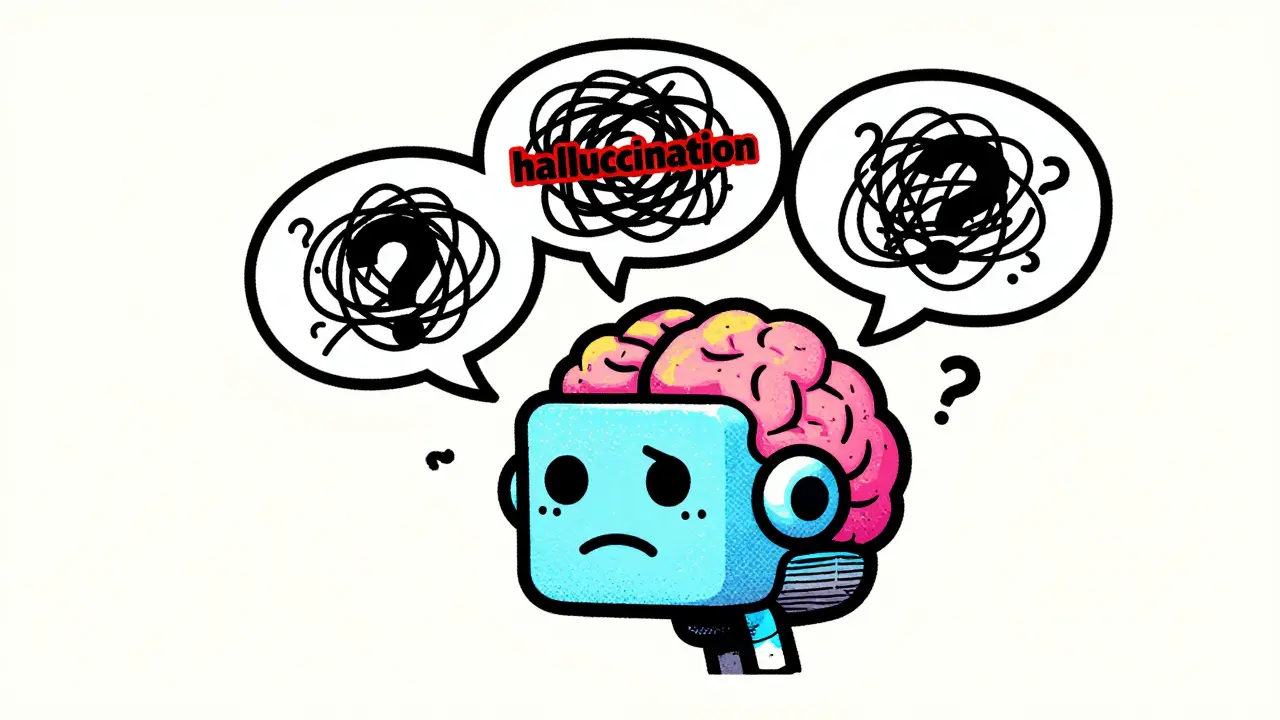
Large Language Models (LLMs) are impressive, but they have a glaring weakness: they lie. Not out of malice, but because they predict the next most likely word rather than verifying facts. When an LLM generates a complex argument or solves a math problem, it often produces reasoning steps that sound coherent on the surface but crumble under scrutiny. This is the "hallucination" problem, and it makes raw LLM outputs unreliable for high-stakes tasks.
The solution isn't just bigger models. It's grounding reasoning with external verifiers. By attaching independent checks to the model's thought process, we can force it to validate its own logic against real-world data, visual evidence, or strict logical rules before it speaks. This approach transforms LLMs from confident guessers into reliable assistants.
Why Self-Reflection Fails in Large Language Models
You might think asking an LLM to "check your work" would solve this. Research shows it doesn't. LLMs are notoriously poor at self-critique, especially when they lack specific domain knowledge. If a model makes a factual error, it often doubles down on that error during self-reflection because its internal weights still favor the incorrect pattern. This is why intrinsic verification-relying on the model itself-is insufficient.
External verifiers change the game. They act as an independent auditor. Instead of trusting the LLM's intuition, these systems break down the reasoning process into discrete steps and check each one against an outside source. Whether that source is a database, a visual image, or a formal logic engine, the result is a significant jump in accuracy and consistency. The key insight here is simple: separation of concerns. Let the LLM generate ideas, but let a specialized tool verify them.
FOLK: Using Logic to Verify Claims
One of the most structured approaches to this problem is the FOLK (First-Order-Logic-Guided Knowledge-Grounded) framework. FOLK tackles the issue of claim verification by forcing the LLM to translate natural language claims into First-Order Logic (FOL). Think of it as turning a vague statement like "The CEO visited Paris last week" into a set of logical predicates that can be individually tested.
Here is how FOLK works in practice:
- Decomposition: The framework breaks a claim into sub-claims represented as logical clauses.
- Grounding: Each sub-claim is verified against external knowledge sources. The LLM generates answers, but these are checked against ground truth data.
- Veracity Prediction: A guiding predicate directs the final reasoning process over these verified question-and-answer pairs.
This method allows for explainable AI. You don't just get a "true" or "false" label; you get a natural language justification based on verified facts. Crucially, FOLK does not require annotated evidence datasets, making it adaptable to new domains without heavy retraining. It proves that symbolic logic and neural networks can work together to reduce hallucinations.
CoRGI: Grounding Vision-Language Models in Visual Evidence
When images enter the mix, the problem gets harder. Vision-Language Models (VLMs) often suffer from "object hallucination," where they describe details that aren't in the picture because those details are statistically common in their training data. For example, a model might confidently state there is a coffee cup on a table simply because tables often have cups, even if the image shows an empty table.
The CoRGI (Chain of Reasoning with Grounded Insights) framework addresses this through post-hoc verification. CoRGI takes the chain-of-thought output from a VLM and decomposes it into step-wise statements. Then, it uses a Visual Evidence Verification Module (VEVM) to check each step.
The VEVM determines if a reasoning step needs visual proof. If it does, CoRGI uses tools like Grounding DINO to locate Regions of Interest (RoIs) in the image. It then queries a separate visual-language model to describe exactly what is in those regions. If the visual evidence contradicts the initial reasoning step, CoRGI filters or corrects the claim.
| Benchmark | Model Backbone | Accuracy Gain |
|---|---|---|
| VCR (QA→R) | LLaVA-1.6 | +12.9 points |
| Q→AR Accuracy | Qwen-2.5VL | +8.4 points |
| QA→R Accuracy | Gemma3-12B | +4.3 points |
| HallusionBench | Multiple Backbones | +5-9 points |
These numbers tell a clear story. Even strong models like Qwen-2.5VL and Gemma3-12B produce unsupported reasoning steps. CoRGI catches them. The fact that weaker models like LLaVA-1.6 see massive gains (+12.9%) while stronger models still see consistent improvements suggests that visual grounding is a universal necessity, not just a patch for bad models.

GRiD: Enforcing Logical Dependencies
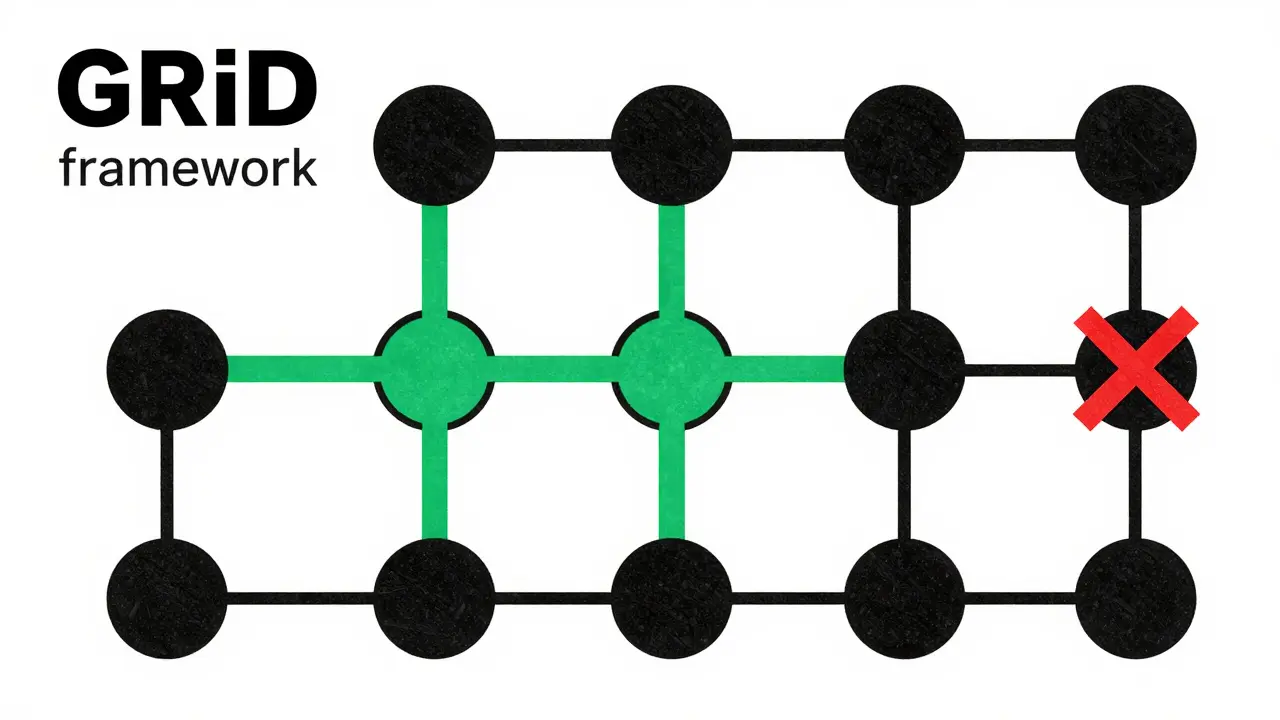
Sometimes the error isn't a wrong fact, but a broken logical link. An LLM might conclude B from A, even though A does not actually imply B. The GRiD (Grounded Reasoning in Dependency) framework treats reasoning as a graph. In this graph, nodes represent knowledge extraction or reasoning steps, and edges represent dependencies.
GRiD enforces logical consistency by validating each step via a lightweight, step-wise verifier. Before moving to the next node in the reasoning graph, the system checks if the current step is logically sound relative to its premises. This prevents the "garbage in, garbage out" cascade where one small error ruins the entire conclusion.
What makes GRiD particularly useful for developers is its efficiency. It operates as a lightweight module at inference time. You don't need to retrain the entire LLM. You just pipe the reasoning steps through the GRiD verifier. Tests on benchmarks like StrategyQA and GPQA show substantial improvements in faithfulness and accuracy, proving that explicit dependency tracking fixes superficially coherent but internally inconsistent arguments.
Small Language Models and the Need for Strong Verifiers
Not every application needs a massive foundation model. Small Language Models (SLMs) are faster, cheaper, and more private. However, SLMs struggle significantly with reasoning tasks. They lack the breadth of knowledge and the nuanced pattern recognition of their larger counterparts.
Research indicates that SLMs require "strong verifiers" to engage in effective self-correction. You can simulate these verifiers using larger models like GPT-4 or by using oracle labels (known correct answers) to guide the correction process. The key takeaway is scalability: verification-based approaches work across model sizes, provided the verifier is stronger than the reasoner. If you use an SLM for customer support, pair it with a robust external fact-checking API. If you use an SLM for code generation, pair it with a static analysis tool. The verifier must be the expert; the SLM is the drafter.
Psychological and Causal Grounding
Reasoning isn't always about cold logic or pixel-perfect vision. Sometimes it requires understanding cause and effect in the physical world. Psychologically-grounded reasoning frameworks augment LLMs with human causal models. These systems maintain external belief distributions over system states, embedded with human causal graphs.
This is particularly useful for troubleshooting or object assembly tasks. Imagine an LLM helping you fix a car engine. If the LLM suggests an action that violates basic mechanical causality (e.g., tightening a bolt that should be loosened), the external causal model flags the conflict. This hybrid approach grounds the LLM in reality by checking for hallucinations against a mental model of how the world works. It turns the LLM into a collaborative partner that respects physical constraints.
Implementing External Verifiers: A Checklist
If you are building a system that relies on LLM reasoning, consider implementing external verification. Here is a practical checklist to get started:
- Identify the Failure Mode: Is your model hallucinating facts? Use FOLK or similar knowledge-grounded methods. Is it misinterpreting images? Use CoRGI-style visual verification. Is it making logical leaps? Use GRiD-style dependency graphs.
- Separate Generation from Verification: Do not ask the same model to do both. Use a dedicated verifier module, whether it's a smaller specialized model, a logic engine, or a retrieval-augmented search query.
- Operate at Inference Time: Most modern frameworks (CoRGI, GRiD) work as post-hoc checks. This means you can add reliability to existing pipelines without retraining your core model.
- Match Verifier Strength to Model Capability: For small models, invest in stronger, more expensive verifiers. For large models, lightweight sanity checks may suffice.
- Explain the Correction: Always output the reasoning behind the verification. Users need to know why a step was rejected or corrected to trust the system.
The Future of Reliable AI
The field of grounded reasoning is maturing rapidly. We are moving away from the era of "prompt engineering hacks" toward systematic, architectural solutions. The convergence of symbolic logic, visual evidence, and causal modeling provides a robust toolkit for taming LLM hallucinations.
As we move through 2026, expect external verifiers to become standard components in enterprise AI stacks. They are not just an academic exercise; they are the bridge between experimental chatbots and production-grade intelligent systems. By grounding reasoning in external reality, we ensure that AI remains helpful, accurate, and trustworthy.
What is the main difference between self-reflection and external verification in LLMs?
Self-reflection asks the LLM to critique its own output, which often fails because the model lacks the ability to objectively recognize its own errors. External verification uses independent tools, databases, or logical engines to check the model's reasoning steps against objective facts or rules, providing a much higher level of reliability.
How does the CoRGI framework reduce hallucinations in vision-language models?
CoRGI reduces hallucinations by decomposing the model's reasoning into steps and verifying each step against visual evidence. It uses a Visual Evidence Verification Module (VEVM) to locate specific regions in an image and confirm that the model's claims match what is actually visible, filtering out unsupported assertions.
Can external verifiers be used with Small Language Models (SLMs)?
Yes, and they are often essential for SLMs. Because SLMs have less inherent knowledge and reasoning capability, they benefit significantly from strong external verifiers. These verifiers can be larger models or specialized tools that check the SLM's output for accuracy and logical consistency.
What is the role of First-Order Logic in the FOLK framework?
In the FOLK framework, First-Order Logic (FOL) is used to translate natural language claims into structured logical predicates. This allows the system to break down complex statements into verifiable sub-claims, which are then checked against external knowledge sources to ensure factual accuracy before generating a final answer.
Does adding external verifiers slow down the response time of LLMs?
Yes, adding external verification steps introduces latency because the system must perform additional checks (such as querying a database or analyzing an image region). However, this trade-off is generally accepted in high-stakes applications where accuracy and reliability are more important than speed.




Robert Barakat
2 June, 2026 - 23:29 PM
we are essentially building a digital immune system for the mind of the machine. it is not just about accuracy, it is about the ontological integrity of the information we consume. when we ground reasoning in external verifiers, we are admitting that pure probabilistic generation is an existential threat to truth itself.
Michael Richards
4 June, 2026 - 05:51 AM
stop pretending this is new news. anyone who has actually deployed llms in production knows they are useless without guardrails. you need hard constraints or you get garbage. this article is just repackaging basic engineering common sense as if it were a revolutionary breakthrough. wake up and start coding real validation layers instead of reading blog posts about them.
Laura Davis
5 June, 2026 - 23:02 PM
i am so tired of people acting like llms are magic wands that solve everything instantly. look at these frameworks like corgi and grid. they are literally forcing the model to do its homework before it speaks. it is exhausting but necessary. we have to stop coddling these models and start holding them accountable for every single claim they make. if you are building enterprise apps right now and you are not using some form of external verification you are basically gambling with your users trust and i hope you lose.
Lisa Nally
5 June, 2026 - 23:25 PM
the nuance here is absolutely critical for anyone working in nlp pipelines. the shift from intrinsic self-reflection to extrinsic verification modules represents a paradigm shift in how we conceptualize agentic workflows. specifically the use of first-order logic in folk allows for a level of explainability that black-box neural networks simply cannot provide on their own. it is fascinating to see how symbolic ai is making a comeback not as a replacement but as a rigorous auditing mechanism for generative outputs. the visual grounding aspect of corgi is particularly elegant because it addresses the specific failure mode of object hallucination which is rampant in current vlm architectures.
Edward Gilbreath
7 June, 2026 - 22:25 PM
they want you to believe you need all these extra steps and tools to make the ai safe but really its just another layer of control to keep us dependent on their infrastructure. why would big tech willingly add latency and cost to their products unless there was something else going on. probably tracking our queries even more closely than before under the guise of verification. dont fall for it.
kimberly de Bruin
9 June, 2026 - 09:42 AM
truth is a construct that requires constant validation against reality otherwise it dissolves into noise. by imposing logical structures upon the fluid nature of language we are attempting to capture lightning in a bottle but the bottle must be made of steel not glass. the verifier is the steel.
Edward Nigma
10 June, 2026 - 09:05 AM
actually you guys are missing the point entirely. the problem isnt that the models lie its that the benchmarks are flawed. if you change the evaluation metric slightly most of these gains disappear. also saying small models need strong verifiers is just a way to sell more compute power for large models. its circular logic disguised as best practice. nobody wants to pay for two models when one should theoretically do the job if trained properly.
Francis Laquerre
12 June, 2026 - 08:33 AM
this approach resonates deeply with traditional methods of verification used in other fields like journalism or scientific peer review where independent checks are mandatory before publication. applying this rigor to artificial intelligence is not just a technical necessity but a cultural imperative if we wish to integrate these systems into society without eroding public trust. the collaboration between human-designed logic engines and neural networks creates a hybrid intelligence that is far more robust than either component alone could ever achieve in isolation.