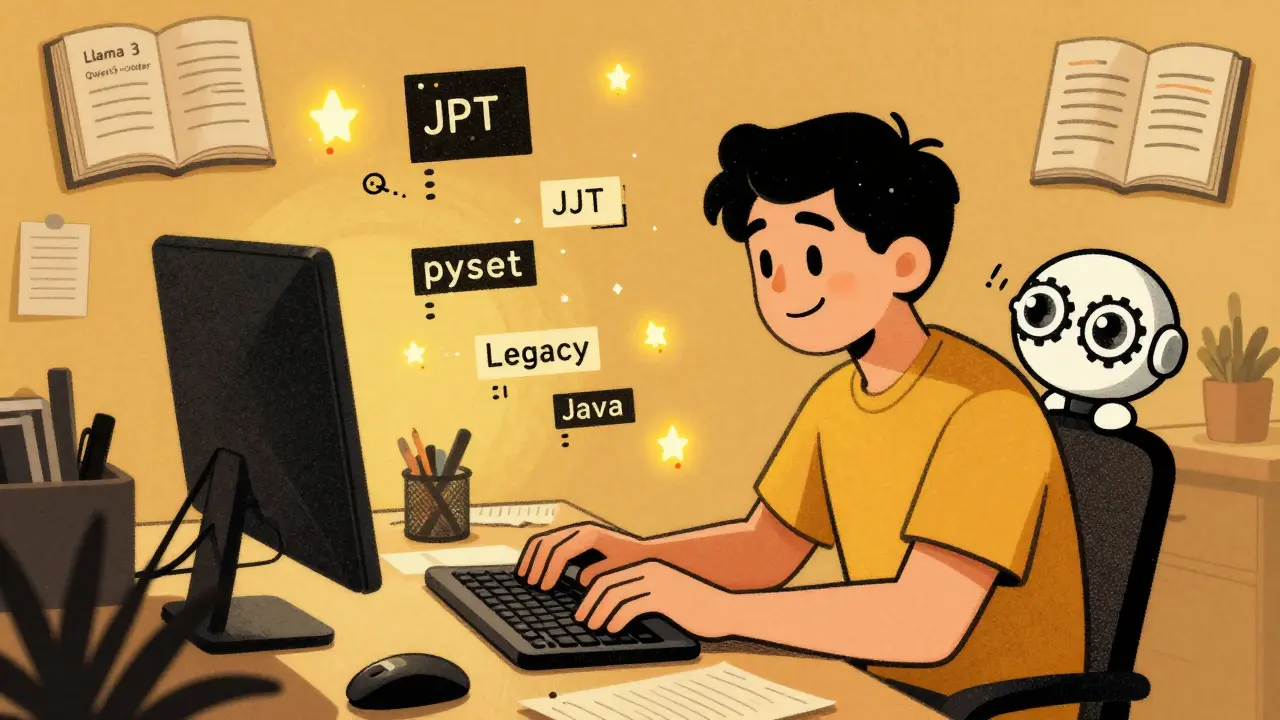
It’s 2026, and your code isn’t just being written by you anymore-it’s being co-written. You type a comment like "Add user auth with JWT," and your AI assistant doesn’t just suggest a snippet. It asks clarifying questions, checks your existing auth flow, pulls in your team’s coding standards, and generates a fully tested module in under 10 seconds. The vibe? Smooth. Natural. Almost intuitive. This is the vibe coding era.
It didn’t come from a single breakthrough. It came from thousands of developers tinkering with open-source models, sharing tweaks on GitHub, fixing bugs in Discord, and fine-tuning models to fit their weird legacy codebases. Open-source AI didn’t just keep up with the hype-it reshaped how we think about collaboration in software.
What Is Vibe Coding, Really?
Vibe coding isn’t a product. It’s a feeling. It’s when your AI assistant feels like a teammate who’s read all your code, remembers your naming conventions, and doesn’t just guess what you want-it anticipates it. The term emerged in early 2025 when developers on Reddit and Hacker News started describing their AI-assisted workflows as having "good vibes." No more clunky autocomplete. No more 50% accurate suggestions that break your build. Just clean, context-aware, low-friction code generation.
This shift happened because open-source models crossed a threshold. In 2024, most coding LLMs were still basic. They’d suggest variable names or fix typos. By mid-2025, models like DeepSeek-R1, Qwen3-Coder-480B, and Kimi-Dev-72B could handle multi-file refactors, understand entire codebases in one go (thanks to 256K token context windows), and even run agent-style workflows-where the AI plans, writes, tests, and iterates without human input.
The "vibe" comes from consistency. When your AI doesn’t suddenly switch from Python to JavaScript mid-function, or when it knows your team uses pytest instead of unittest, that’s not magic. That’s community tuning.
The Rise of Community-Driven Fine-Tuning
Open-source models aren’t winning because they’re smarter than GPT-4 or Claude 4. They’re winning because they’re customizable.
Enterprise teams tried closed-source models first. But when they needed to adapt the AI to their internal framework-say, a 12-year-old Java monolith with undocumented APIs-they hit walls. API costs spiked. They couldn’t tweak the model. So they turned to open-source.
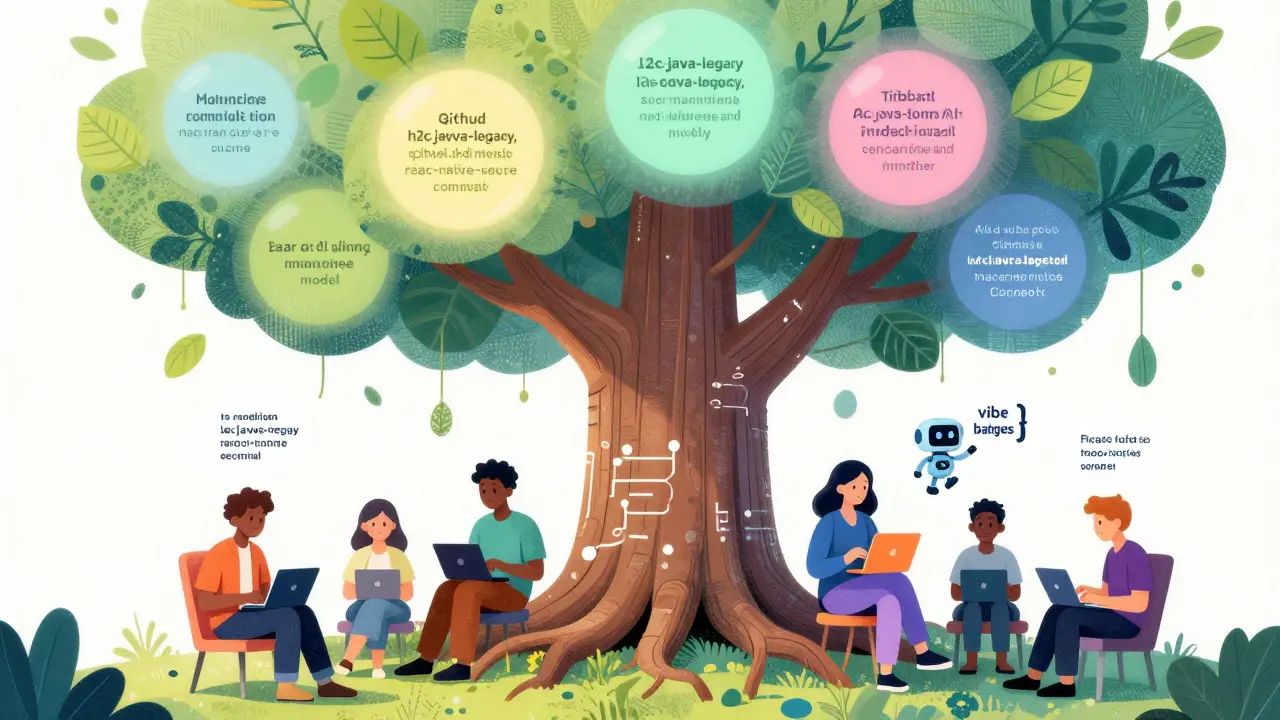
GitHub now hosts over 1,200 fine-tuned coding models based on Llama 3 and Qwen3. The top ones? Not built by big tech. Built by devs in their spare time. One variant, l2c-java-legacy, was fine-tuned by a team at a mid-sized fintech to handle their COBOL-to-Java migration. It outperformed the base Llama 3 model by 18% on refactoring tasks. Another, react-native-secure, was trained on 200K lines of secure React Native code from open-source projects and now blocks 92% of common security anti-patterns before they’re even typed.
This isn’t fringe. It’s the new standard. Developers don’t wait for Meta or Alibaba to update their models. They download the base, run a few commands with Ollama or vLLM, and train it on their own code. The community shares these fine-tuned versions like plugins. It’s like WordPress themes, but for AI coders.
Why Open-Source Still Wins in Specific Use Cases
Yes, closed-source models lead in raw performance. Benchmarks show GPT-OSS-120B and Claude 4 Sonnet still score 15-20% higher on complex reasoning tasks. But raw performance doesn’t always matter.
Here’s where open-source dominates:
- Data privacy: Healthcare and finance teams can’t send code to the cloud. Local deployment of DeepSeek-R1 on a 24GB GPU lets them generate secure code without leaving their network.
- Cost control: A startup running 50 AI-assisted PR reviews a day pays $200/month on Anthropic. With Qwen3-Coder-480B on a single server? $12.
- Legacy system adaptation: If your codebase has 15-year-old Python scripts with weird indentation, open-source models can be trained to mimic that style. Closed-source models just don’t care.
- Compliance: The EU AI Act requires transparency in training data. Open-source models, with public datasets and documented sources, naturally comply. Closed-source? Black boxes.
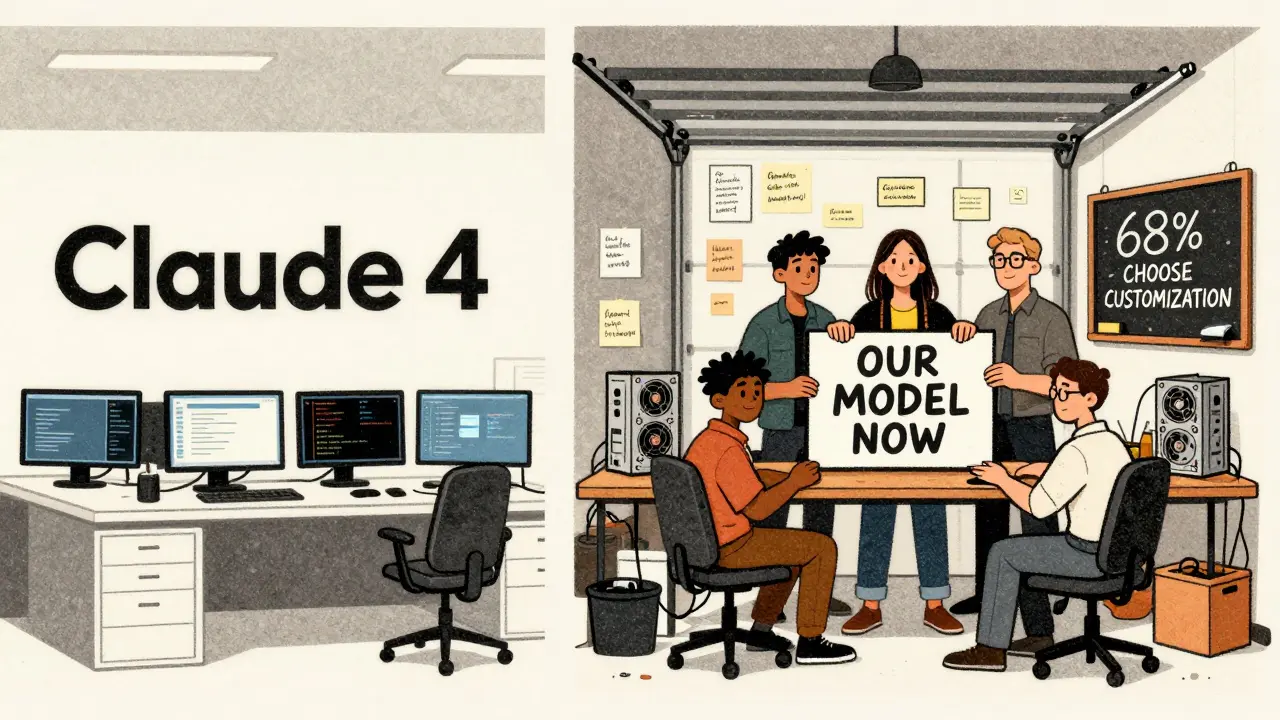
According to Cake AI’s 2025 survey of 1,200 developers, 68% said customization was the #1 reason they chose open-source. Only 11% cited raw accuracy as a deciding factor.
The Hidden Costs of Open-Source
Don’t get it twisted-open-source isn’t free. It’s just paid in time, not money.
Setting up a 70B-parameter model on a single GPU? You need at least 24GB VRAM. Quantize it to 4-bit to save memory? You lose 8-12% accuracy. That’s not a dealbreaker for simple tasks, but for complex logic, it matters.
Documentation? A mess. Qwen3’s docs got 4.7/5 on GitHub. Llama 4’s? 3.2. Why? Because Meta’s team focused on general-purpose benchmarks, not real-world coding scenarios. Developers had to reverse-engineer how to get Llama 4 to work with TypeScript or GraphQL. Meanwhile, DeepSeek’s documentation was written by engineers who actually used their model in production.
And then there’s maintenance. You’re not just running code-you’re running a model. You need to monitor for drift, retrain when your codebase changes, and patch security vulnerabilities. One dev on Reddit said, "I spent three weeks getting Kimi-Dev-72B running on our cluster. Then I realized I’d have been better off paying for Claude 4 for a month and moving on."
Open-source isn’t easier. It’s more control.
Who’s Winning the Vibe Coding War?
The market isn’t split between open and closed. It’s split by use case.
Enterprise teams with deep pockets (think Fortune 500, big SaaS) are locking into Anthropic and OpenAI. They want the best performance, even if it costs $50K/month. They don’t care about customization-they have teams of engineers to write wrappers around the API.
Mid-sized tech companies (200-2,000 employees) are going hybrid. 48% use both. They run Claude 4 for customer-facing code generation but use Qwen3-Coder-480B internally for tooling, docs, and legacy code cleanup. Why? Cost + control.
Startups and indie devs are all-in on open-source. Why? They can’t afford the API bills. And they need to move fast. One indie dev built a SaaS tool that auto-generates API docs from code using DeepSeek-R1 on a $15/month VPS. His entire stack runs on open-source models.
Even Meta’s Llama 4, which flopped in enterprise trials, found new life in the open-source community. Developers downloaded it, fixed its weak refactoring skills, and created variants that now outperform the original. It’s not Meta’s model anymore. It’s our model.
The Future: Communities, Not Corporations
The next big leap in vibe coding won’t come from a lab in San Francisco. It’ll come from a Discord server in Manila, a GitHub repo in Bucharest, or a hackathon in Nairobi.
Communities are building tools to make this easier. Meshery offers one of the most welcoming onboarding experiences for new contributors. LFX (Linux Foundation) runs paid internships specifically for open-source AI coding projects. Developers aren’t just using these models-they’re improving them, documenting them, teaching others how to use them.
Ensemble methods are rising. Instead of betting on one model, teams now run three: one for Python, one for SQL, one for config files. They chain them together. The result? Performance gaps with closed-source models shrank from 22% to just 15% in recent tests.
By 2027, open-source will hold 25-30% of the coding AI market-not because it’s the best, but because it’s the only one that lets you make it yours. The vibe isn’t about perfection. It’s about ownership.
How to Get Started in the Vibe Coding Era
Want to join? Here’s how:
- Start small: Install Ollama and try DeepSeek-R1. Run it locally. Ask it to explain a function in your codebase.
- Find your vibe: Try Qwen3-Coder-480B for complex tasks. Try Kimi-Dev-72B for long files. See which one feels right.
- Join a community: Go to Meshery’s Discord. Check out LFX’s mentorship programs. Ask questions. You’ll get answers.
- Fine-tune something: Take a base model. Train it on 500 lines of your own code. See how it changes.
- Share it: Upload your fine-tuned model to Hugging Face. Write a short guide. Someone else will build on it.
You don’t need to be a data scientist. You just need to care about how your code feels when it’s written.


Cynthia Lamont
22 January, 2026 - 13:01 PM
This is the dumbest thing I've read all week. Vibe coding? You mean letting AI write your code so you don't have to think? That's not innovation, that's surrender. I've seen junior devs break production because they trusted the AI too much. No more 'vibes'-we need discipline. And stop calling it 'community tuning.' It's just patchwork with a marketing buzzword.
Kirk Doherty
22 January, 2026 - 19:40 PM
honestly i just use ollama now and it just works
no drama
no corporate nonsense
my code feels like mine again
Ashley Kuehnel
24 January, 2026 - 13:31 PM
Y'all are overcomplicating this so much 😅
Just install Ollama, grab DeepSeek-R1, and ask it to explain your old function. That's it. No need for fine-tuning or server clusters or whatever. I'm a front-end dev who barely knows Python and I got my first AI pair to help me refactor a 10-year-old JS file last week. It was magic. And yes, it made mistakes-but I learned more fixing them than I did reading docs.
Also if you're worried about cost, use a $5 VPS. I do. No one's asking you to run 70B models on your laptop. Start small. Play. Have fun. That's the vibe 😊
And if you're scared of AI? It's not replacing you. It's replacing the boring parts. You get to do the fun stuff now. Promise.
adam smith
26 January, 2026 - 08:16 AM
While I acknowledge the operational advantages of open-source models in specific enterprise contexts, I must emphasize that the empirical data regarding performance degradation under quantization remains a critical bottleneck. The trade-off between cost efficiency and semantic fidelity is not trivial, particularly when applied to mission-critical legacy systems where syntactic precision is non-negotiable. Furthermore, the assertion that community-driven fine-tuning constitutes a superior paradigm lacks rigorous statistical validation in peer-reviewed literature.
Mongezi Mkhwanazi
27 January, 2026 - 10:36 AM
Let me be perfectly clear: this entire 'vibe coding' movement is a dangerous illusion, and anyone who buys into it is setting themselves up for catastrophic technical debt. You think you're saving time? You're not. You're outsourcing your cognitive responsibility to a statistical parrot that doesn't understand scope, context, or consequence. I've reviewed codebases where AI-generated functions were blindly accepted-functions that had memory leaks, race conditions, and logic errors that took weeks to trace back because no one knew how the AI arrived at its 'solution.' And now you're telling me we're supposed to celebrate this as 'ownership'? Ownership of a black box that no one understands? The fact that people are fine-tuning models on 500 lines of code and calling it 'community-driven innovation' is a joke. Real innovation requires deep understanding, not a magic autocomplete that hallucinates a database schema because you said 'make it faster.' The EU AI Act isn't just about transparency-it's about accountability. And right now, nobody's accountable. The open-source community isn't a magic wand; it's a wild west where the worst practices get weaponized and distributed via Hugging Face. You want to 'make it yours'? Fine. But then own the consequences when your startup's entire auth layer gets exploited because your 'fine-tuned' model ignored input validation. I've seen it happen. And I'm not going to sit here and pretend this is progress. It's laziness with a hashtag.