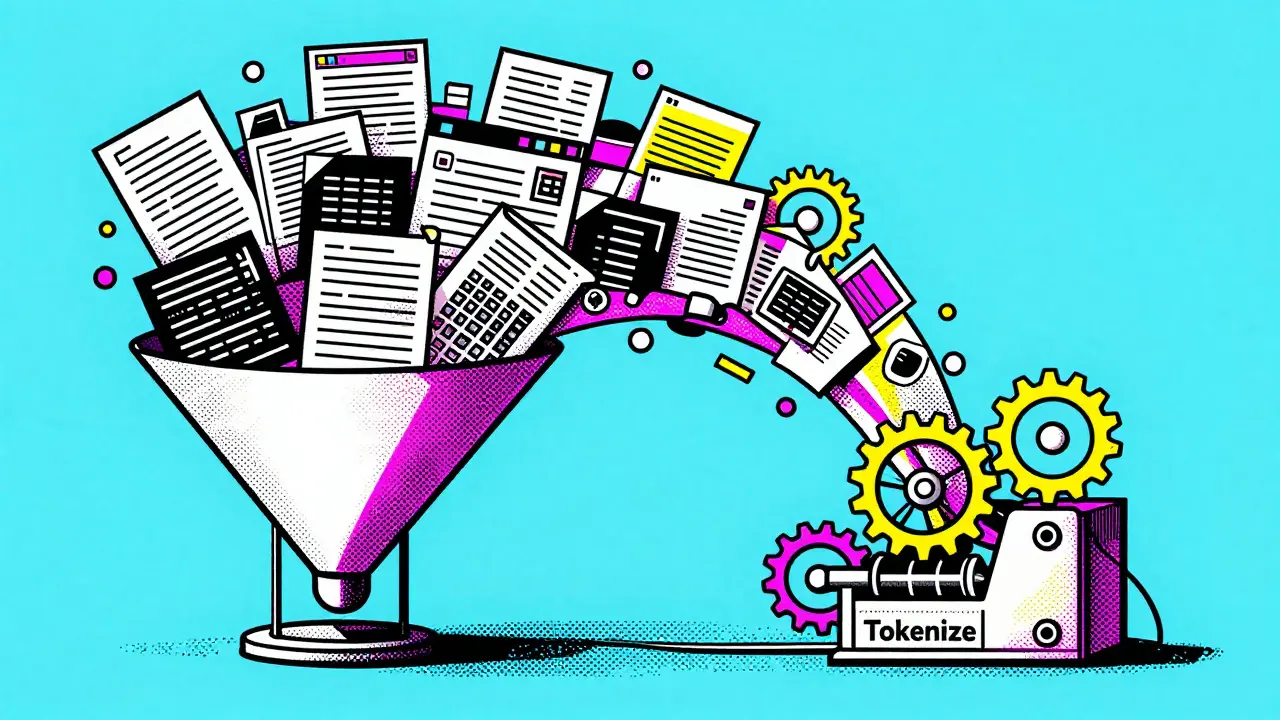
Training a large language model isn't just about writing code and hitting 'run'. It is a massive engineering effort that spans weeks or months, costs millions of dollars, and requires coordination across data engineering, machine learning research, and DevOps. If you are trying to move from experimental notebooks to production-grade systems, you need an end-to-end training pipeline.
This guide breaks down how to build that pipeline in 2026. We will look at the specific stages from raw data ingestion to live monitoring, using real-world examples like GPT-3 and modern tools like Hopsworks and Kubernetes. You will learn why integrating these stages matters more than optimizing any single part in isolation.
The Core Stages of an LLM Pipeline
An end-to-end LLM training pipeline is a structured, automated workflow that manages the entire lifecycle of a large language model, from raw data ingestion through preprocessing, distributed training, evaluation, deployment, and ongoing monitoring. Unlike traditional machine learning pipelines that handle smaller tabular datasets, LLM pipelines deal with billions of tokens and transformer architectures. However, the core logic remains similar: ingest, clean, train, evaluate, deploy, and monitor.
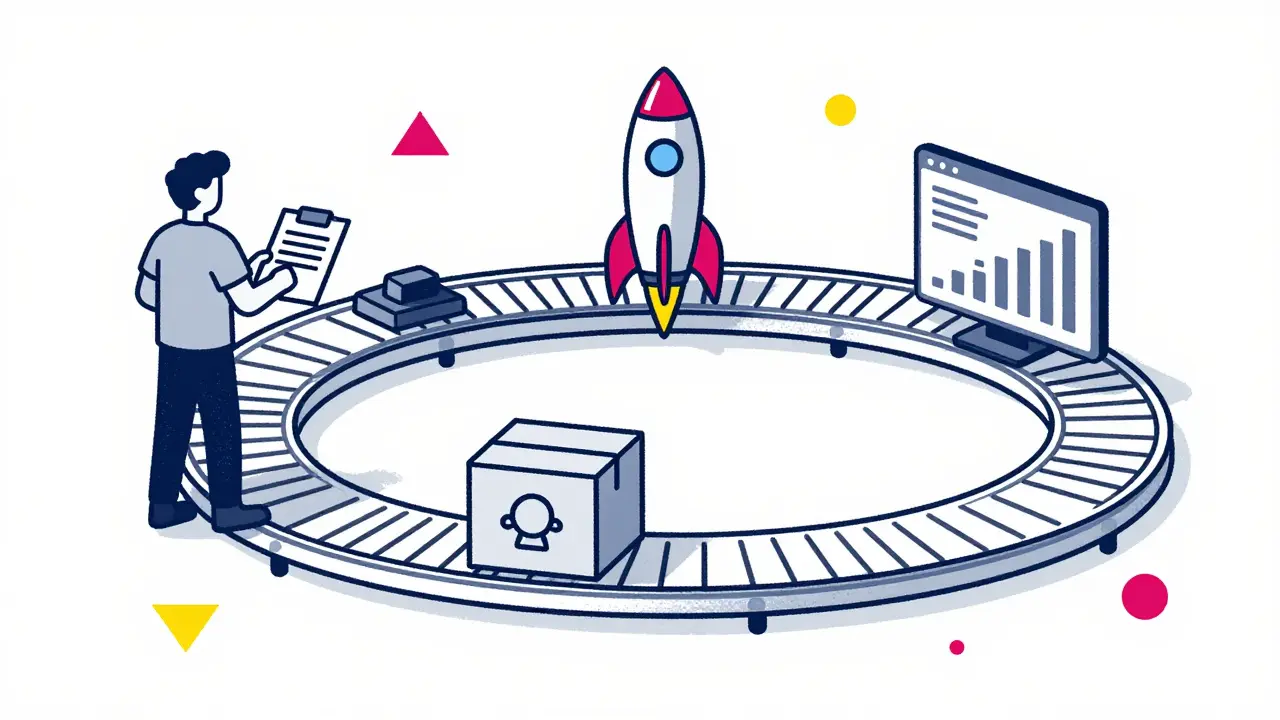
Think of it as an assembly line. If one station slows down or produces defective parts, the whole factory suffers. In 2026, the industry standard relies on LLMOps is the extension of MLOps tailored for generative AI, focusing on data management, pipeline orchestration, and scalable workflows for large models. This approach ensures that your pipeline is repeatable, auditable, and scalable.
- Data Ingestion: Pulling raw text from web crawls, APIs, and databases.
- Preprocessing: Cleaning, tokenizing, and deduplicating the data.
- Distributed Training: Running the model on GPU/TPU clusters.
- Evaluation: Testing against validation sets and business metrics.
- Deployment: Containerizing the model and exposing API endpoints.
- Monitoring: Tracking drift, latency, and user feedback in production.
Stage 1: Data Ingestion and Preprocessing
Data is the fuel for your model. The quality of your output depends entirely on the quality of this input. In the case of GPT-3, OpenAI used a dataset of roughly 300 billion tokens. About 60% of that came from a filtered subset of Common Crawl, which originally contained 410 billion tokens. They didn't just dump everything in; they used a logistic regression classifier to score documents for quality, keeping only the high-scoring ones.
In your pipeline, you need to automate this curation. Here is what that looks like in practice:
- Ingestion: Use reliable connectors to pull data from sources like S3 buckets, Kafka streams, or web scrapers. Version every dataset so you can reproduce experiments later.
- Cleaning: Remove HTML tags, fix encoding errors, and strip personally identifiable information (PII) to comply with privacy laws.
- Tokenization: Convert text into numerical tokens. Byte-Pair Encoding (BPE) is common here. For example, GPT-3 used a vocabulary size of 50,257 tokens.
- Deduplication: Use algorithms like MinHashLSH on Apache Spark to remove near-duplicate documents. This prevents the model from memorizing repetitive content.
Agility at Scale emphasizes that data ingestion must support reproducibility. If you cannot trace back which version of the dataset produced a specific model checkpoint, debugging becomes a nightmare.
Stage 2: Distributed Training and Compute
Training large models requires serious compute power. You aren't running this on a single laptop. You need a cluster of GPUs or TPUs. The training stage reads features from a feature store, trains the model, and writes validated artifacts into a model registry.
Consider the scale. Training GPT-3 cost between $4.6 million and $12 million, depending on hardware efficiency and electricity rates. Even if you are fine-tuning a smaller model, the principles of distributed training apply. You need to handle gradient synchronization across multiple nodes to ensure stability.
Key technical considerations for this stage include:
- Orchestration: Use Kubernetes or Slurm to manage containerized training jobs. This allows you to scale up or down based on available resources.
- Checkpointing: Save model states frequently. If a GPU fails after 10 days of training, you don't want to start over. Checkpoints allow you to resume from the last saved state.
- Hyperparameter Logging: Track learning rates, batch sizes, and optimizer settings. Tools like MLflow or Weights & Biases help visualize these experiments.
Hopsworks notes that training pipelines should be connected to inference pipelines via registries. This means your trained model isn't just a file sitting on a server; it's a versioned artifact ready for promotion to production.

Stage 3: Evaluation and Validation Gates
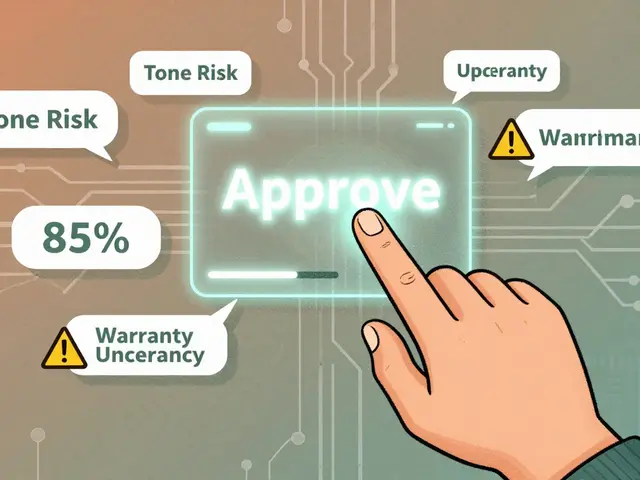
A model that scores well on accuracy but fails to move a business KPI is useless. Evaluation in an end-to-end pipeline is not a one-time step; it is an automated decision point. Only models that exceed predetermined metrics should be promoted for deployment.
Standard practice involves splitting your data into three sets:
- Training Set (60%): Used to update model weights.
- Validation Set (20%): Used to tune hyperparameters and prevent overfitting during training.
- Test Set (20%): Held out until the final evaluation to assess generalization performance.
For LLMs, evaluation goes beyond simple loss functions. You need to test for:
- Perplexity: How well the model predicts the next token in a sequence.
- Factual Accuracy: Does the model hallucinate facts? Use benchmarks like MMLU or TruthfulQA.
- Safety and Bias: Run fairness audits to detect toxic outputs or biased representations. This is critical for enterprise deployment.
If a model fails any of these gates, the pipeline automatically rejects it and triggers a retraining job with adjusted parameters. This automation reduces human error and speeds up iteration cycles.
Stage 4: Deployment and Infrastructure
Deployment is where your model meets the world. Northflank identifies five main technical areas for LLM deployment: containerization, GPU allocation, API creation, autoscaling, and security. You need to package your model into a Docker container that includes all dependencies, then deploy it to a Kubernetes cluster.
Here is a comparison of classical ML deployment versus LLM deployment:
| Aspect | Classical ML | Large Language Models (LLMs) |
|---|---|---|
| Compute Resource | CPU-based inference | GPU/TPU required for low latency |
| Model Size | Megabytes to Gigabytes | Tens to Hundreds of Gigabytes |
| Scalability | Horizontal scaling of requests | Autoscaling GPU nodes based on token throughput |
| Cost Metric | Requests per second | Cost per 1,000 tokens processed |
| Security Focus | Data privacy and access control | Prompt injection prevention and output filtering |
Notice the cost metric difference. For LLMs, you pay for tokens. Smaller models like Ada might cost $0.0004 per 1,000 tokens, while larger ones like Davinci cost $0.0200. Your pipeline should allow you to swap models dynamically based on cost-performance trade-offs. Autoscaling ensures you don't waste money on idle GPUs during low traffic periods.
Stage 5: Monitoring and Continuous Training
Deployment is not the end; it's the beginning of operations. You need to monitor your model in production to catch issues early. Key metrics include:
- Latency: Time taken to generate a response. High latency frustrates users.
- Drift Detection: Changes in input data distribution or model behavior over time. If users start asking different types of questions, your model might perform worse.
- Token-Level Tracing: Log individual tokens generated to debug hallucinations or slow responses.
- User Feedback: Capture thumbs-up/thumbs-down ratings to identify bad outputs.
When drift is detected, trigger a continuous training (CT) job. This new job ingests recent production data, retrains the model, evaluates it against your gates, and deploys it if it passes. This creates a closed loop where your model improves continuously without manual intervention.
Dev.to’s 2026 overview highlights that this CI/CD/CT pattern is now standard for production-grade systems. Code changes go through unit tests, training runs on staging data, and successful models roll out to production via Kubernetes deployments.
Common Pitfalls to Avoid
Building an end-to-end pipeline is complex. Here are some mistakes teams make:
- Ignoring Data Versioning: Without versioning, you cannot reproduce results. Always tag your datasets and model checkpoints.
- Over-Optimizing Single Components: A faster tokenizer doesn't help if your data ingestion is broken. Focus on integration across stages.
- Neglecting Security: LLMs are vulnerable to prompt injections. Implement input sanitization and output filtering in your API layer.
- Static Deployments: Don't deploy static binaries. Deploy code that builds the environment. This ensures consistency across dev, staging, and prod.
Remember, the goal is not just to train a model, but to operate it reliably at scale. Invest time in robust data pipelines, experiment tracking, and deployment automation. These foundational elements will save you countless hours of debugging and rework.
Conclusion
An end-to-end LLM training pipeline transforms chaotic research efforts into streamlined, production-ready systems. By automating data ingestion, preprocessing, distributed training, evaluation, deployment, and monitoring, you reduce risk and accelerate innovation. Start by mapping your current workflow to the six stages outlined here. Identify gaps, integrate tools like Hopsworks or Kubernetes, and gradually build towards a fully continuous system. The future of AI belongs to those who can operate models as reliably as software services.
What is the difference between MLOps and LLMOps?
MLOps focuses on operationalizing traditional machine learning models, often involving tabular data and smaller compute requirements. LLMOps extends these practices to large language models, addressing unique challenges like massive unstructured text data, transformer architectures, GPU-intensive training, and token-based inference costs. LLMOps places heavier emphasis on data curation, prompt management, and safety auditing.
How much does it cost to train a large language model?
Costs vary widely based on model size and hardware efficiency. Training GPT-3 was estimated between $4.6 million and $12 million. Smaller models or fine-tuning tasks can cost significantly less, ranging from thousands to hundreds of thousands of dollars. Factors include GPU rental fees, electricity, and data processing expenses.
Why is data preprocessing critical for LLMs?
LLMs learn patterns from data. Poor quality data leads to poor model performance, including hallucinations and biases. Preprocessing steps like cleaning, deduplication, and tokenization ensure the model learns from high-quality, diverse, and consistent inputs. For example, GPT-3 used a quality classifier to filter its training data, significantly improving outcomes.
What tools are commonly used for LLM pipeline orchestration?
Popular tools include Kubernetes for container orchestration, Apache Spark for large-scale data processing, Hopsworks for feature stores and model registries, and MLflow or Weights & Biases for experiment tracking. Cloud platforms like AWS SageMaker, Google Vertex AI, and Azure ML also provide integrated pipeline solutions.
How do you monitor an LLM in production?
Monitor key metrics such as latency, token throughput, error rates, and user feedback. Implement drift detection to identify changes in input data or model behavior. Use token-level tracing to debug specific responses. Regularly run safety and bias audits to ensure compliance with ethical standards.