Have you ever typed "comfortable shoes for standing all day" into a search bar and gotten nothing but generic sneakers? That frustration is why 30-40% of online searches end in abandonment. Traditional keyword matching just doesn't get intent. It sees words, not meaning. But things are changing fast. By early 2025, Large Language Models (LLMs) have moved from experimental tech to standard infrastructure for Fortune 500 retailers. If you're running an online store, understanding how semantic matching works isn't optional anymore-it's the difference between losing a customer and closing a sale.
Why Keyword Search Fails at Intent
Let's be real about the old way. You type "wireless headphones." The system looks for that exact string. If your product description says "Bluetooth earbuds," you might miss it unless someone manually mapped those synonyms. This rigid approach creates gaps. Baymard Institute data shows that users don't speak in keywords; they speak in natural language. They ask questions like "winter boots for snow" or "gift for a 10-year-old boy who loves space."
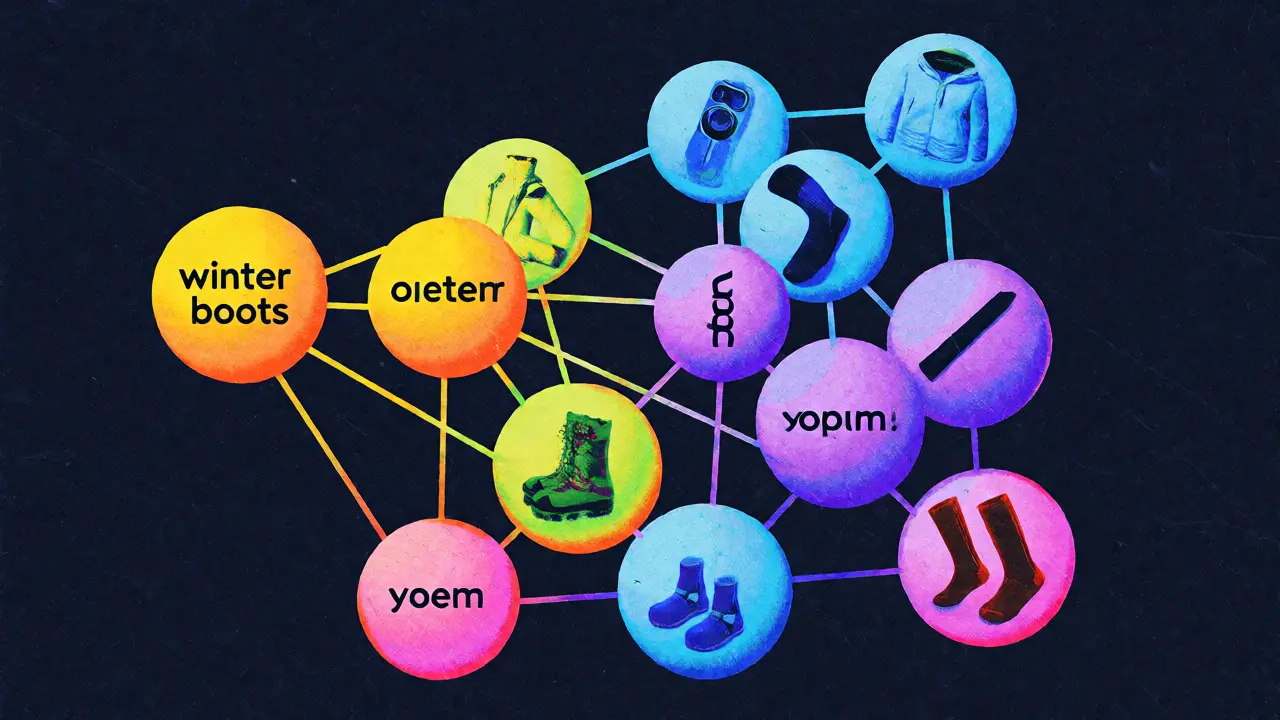
Semantic search fixes this by understanding context. Instead of matching strings, it matches meaning. It knows that "running shoes" and "jogging trainers" are related concepts, even if the words differ. This shift has led to documented conversion rate increases of 15-25% when implemented correctly. It’s not magic; it’s math based on vector proximity. When a user’s query lands near a product’s embedding in mathematical space, the system serves it up, regardless of whether the exact words match.
The Tech Stack Behind Smart Discovery
You don't need a PhD in computer science to grasp the architecture, but you do need to know the components. Modern product discovery systems rely on a hybrid approach combining three main elements:
- Vector Embeddings: Tools like Sentence Transformers (specifically the all-MiniLM-L6-v2 variant) convert text descriptions and queries into dense numerical vectors. These aren't random numbers; they represent semantic features in 384 dimensions.
- Vector Databases: Systems like ChromaDB or Milvus store these embeddings. ChromaDB, for instance, can handle up to 100 million vectors per instance, allowing for rapid similarity searches.
- Hybrid Retrieval: The best results come from blending vector search with traditional keyword filters. This ensures that while the system understands "luxury watch," it still respects hard constraints like price range or brand availability.
Visuals matter too. Using models like CLIP (Contrastive Language-Image Pre-training), platforms align image embeddings with text embeddings. This means a photo of a red dress can be found by typing "red evening gown," bridging the gap between visual and textual discovery.
Performance Metrics: Does It Actually Work?
Skeptics often ask if the hype matches the hardware costs. The data suggests yes. Academic benchmarks show LLM-enhanced systems achieving a 10.1% improvement in Average Precision compared to traditional methods. More importantly, Amazon’s research team demonstrated that their KD-Boost algorithm-a knowledge distillation technique-could improve relevance scores by 2-3% while keeping response times under 100 milliseconds. Speed is critical; if your semantic search takes two seconds to load, the user has already clicked away.
Vectara’s 2024 benchmark study highlights the accuracy gap starkly. While keyword systems hover around 45-55% accuracy in matching true user intent, semantic approaches using vector similarity hit 70%. That 15-point jump translates directly to revenue. For a retailer doing $10 million annually, that could mean an extra $1.5 million in sales simply because people found what they wanted faster.
| Metric | Traditional Keyword Search | LLM-Powered Semantic Search |
|---|---|---|
| Intent Accuracy | 45-55% | ~70% |
| Conversion Lift | Baseline | +15-25% |
| Search Abandonment | High (30-40%) | Reduced by ~35% |
| Complex Query Handling | Poor | Excellent |
| Infrastructure Cost | Low | +15-20% |
Real-World Impact on User Experience
Numbers are great, but how does it feel to shop? Nordstrom’s implementation showed a 28% reduction in search-to-purchase time. Users weren't just buying more; they were buying faster. In user testing across multiple retailers, participants completed purchases 32% quicker with semantic search. Why? Less frustration. No more tweaking queries five times to find a specific item.
However, it’s not perfect. A common complaint involves over-personalization. Some users report feeling trapped in a "filter bubble" where the system only shows them products similar to past purchases, hiding new discoveries. Dr. Raj Patel from Shopify warned in Harvard Business Review that many retailers deploy these tools as a "silver bullet" without cleaning their data first. If your product taxonomy is messy, the AI will learn messy patterns, resulting in poor recommendations despite the advanced tech.

Implementation Challenges and Solutions
So, should you build or buy? If you’re a mid-sized retailer, SaaS solutions like Coveo’s Intent Box or Algolia offer a path to integration in 2-3 weeks. These platforms handle the heavy lifting of vector management and model serving. Custom builds using open-source tools like Milvus or Weaviate offer more flexibility but demand 8-12 weeks of development effort and dedicated ML engineers.
The biggest hurdle isn't code; it's data. Your product descriptions must be rich and consistent. If half your catalog lists material as "cotton" and the other half as "100% cotton blend," the embeddings will drift. Garbage in, garbage out applies doubly here. Additionally, consider the cold start problem. New products with no interaction history struggle in recommendation engines until they gather enough signals. Advanced systems now use zero-shot learning to mitigate this, guessing relevance based on product attributes alone.
The Future: Conversational Commerce
We are moving beyond static search bars. Gartner predicts that by 2027, 60% of e-commerce interactions will begin with natural language queries. Imagine chatting with an AI assistant: "I'm planning a camping trip in Oregon next month. I need a tent that handles rain but fits in my backpack." The system shouldn't just list tents; it should filter by weight, waterproof rating, and seasonality, then explain *why* it chose each option.
This convergence of search and recommendation is already happening. Seventy-eight percent of semantic search implementations now include recommendation functionality. As multimodal capabilities improve, you'll soon upload a photo of a jacket you saw on Instagram, and the app will find the exact item or a close visual match, integrating AR try-ons seamlessly.
What is semantic matching in e-commerce?
Semantic matching is a method of searching that understands the meaning behind words rather than just matching exact keywords. It uses Large Language Models (LLMs) to convert text into numerical vectors, allowing the system to recognize that terms like "sneakers" and "trainers" refer to similar products, even if the words are different.
How much does implementing LLM-powered search cost?
Costs vary significantly. SaaS solutions like Coveo or Algolia typically involve subscription fees based on query volume and indexing size. Custom implementations require infrastructure costs for vector databases and GPU resources, which can increase overall IT spending by 15-20% compared to traditional keyword search setups. However, the ROI often justifies the expense through higher conversion rates.
Can semantic search handle technical specifications?
While semantic search excels at natural language queries, it can struggle with highly precise technical specifications, such as specific electronic component part numbers or medical equipment codes. For these cases, a hybrid approach that combines semantic vector search with strict keyword filtering is recommended to ensure both relevance and precision.
What are the risks of over-personalization?
Over-personalization can create "filter bubbles" where users only see products similar to their past purchases, limiting discovery of new categories. This can lead to decreased average order value over time. To mitigate this, retailers often introduce diversity algorithms that occasionally inject unrelated but high-quality products into search results.
Do I need a data scientist to run this?
Not necessarily. Managed services handle the machine learning complexity, requiring only standard e-commerce operational skills. However, custom implementations usually require at least one dedicated ML engineer to manage model training, embedding updates, and performance tuning. Data quality preparation remains a task for merchandising teams regardless of the solution chosen.