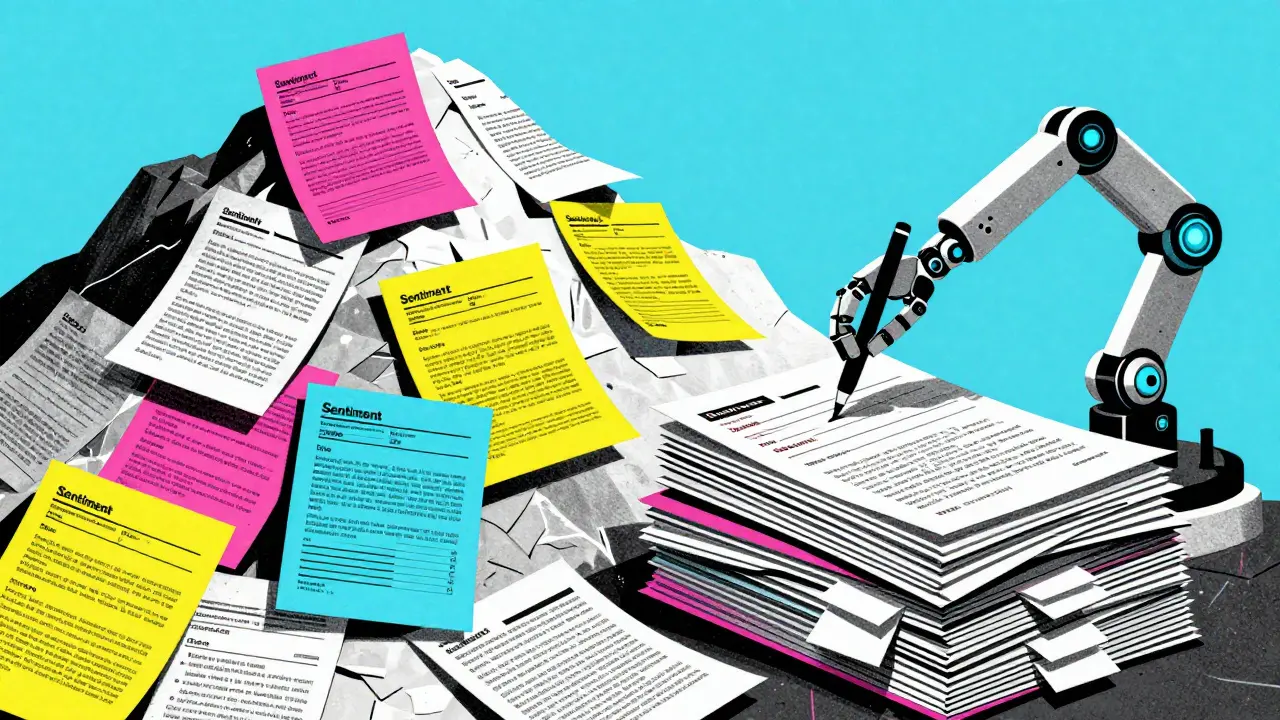
Imagine sitting in front of a mountain of unstructured text-thousands of customer support tickets, legal contracts, or medical records. Your job is to pull out specific facts: names, dates, sentiment, or key clauses. Traditionally, this meant hiring an army of annotators or writing brittle regular expressions that break the moment the sentence structure changes. But now, Large Language Models (LLMs) have flipped the script. Instead of humans doing the heavy lifting, you can ask an AI to do the extraction and labeling for you, turning messy text into clean, structured data in seconds.
This shift isn't just about speed; it's about scalability. Companies are no longer limited by how many people they can hire to tag data. They are limited only by their API budgets and prompt engineering skills. If you are building an AI application, understanding how to extract and label data with LLMs is no longer optional-it is the foundation of your entire pipeline.
The Core Problem: Unstructured Data vs. Structured Needs
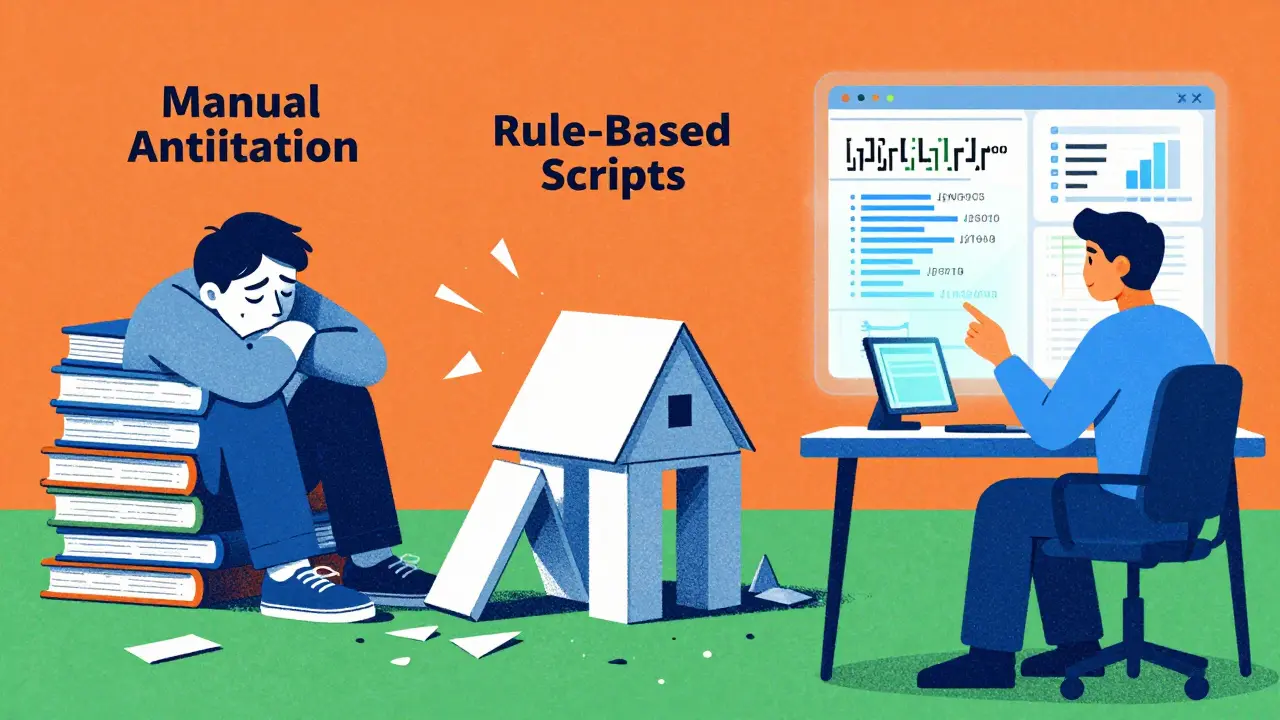
Most business data lives in documents, emails, and chats. It is unstructured. However, machine learning models and databases need structured data-rows, columns, JSON objects, and tags. The gap between these two states has historically been expensive to bridge. Manual annotation is slow, inconsistent, and costly. Rule-based systems are rigid and fail when language evolves.
Large Language Models are advanced AI systems trained on vast amounts of text that understand context, nuance, and intent solve this by acting as intelligent parsers. You don't need to define every possible variation of a date format. You simply tell the model what you want, and it figures it out. This capability allows organizations to automate tasks like Named Entity Recognition (NER), sentiment analysis, and document summarization without writing complex code.
How LLM-Based Extraction Works: A Step-by-Step Workflow
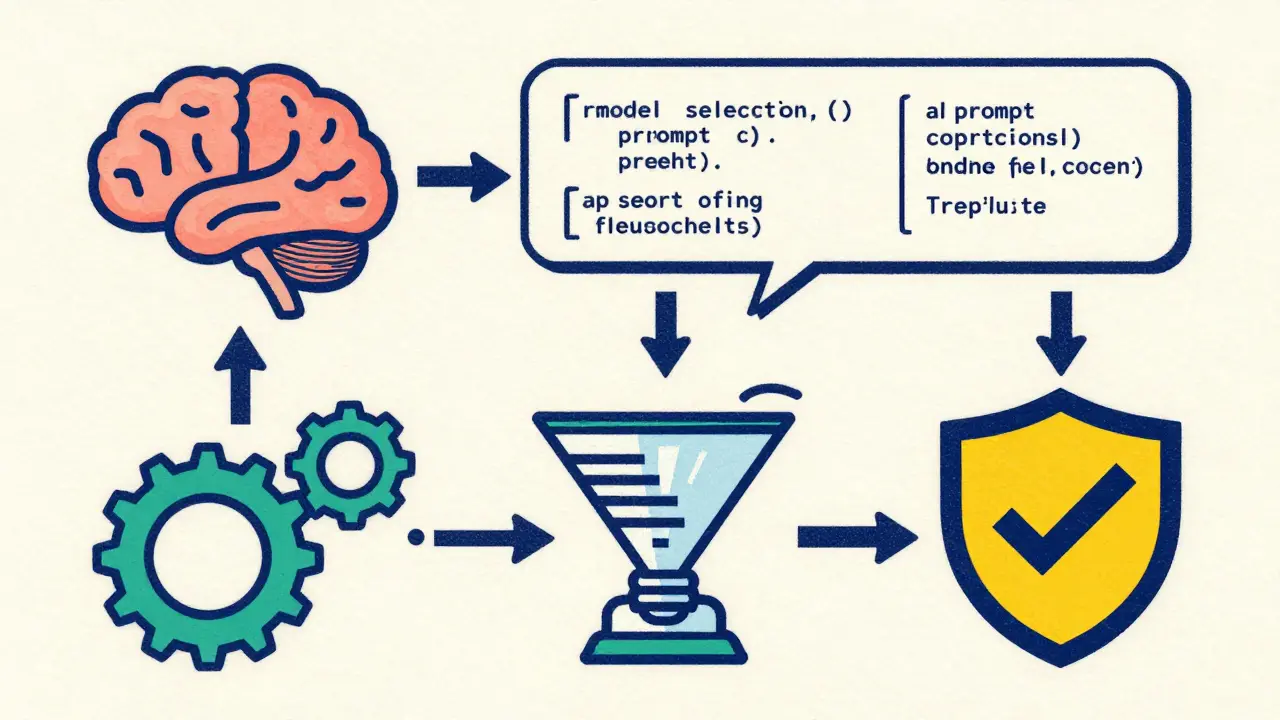
To get reliable results, you cannot just throw text at an LLM and hope for the best. You need a systematic workflow. Here is how professionals approach data extraction and labeling today:
- Select the Right Model: Choose an LLM based on your needs. For high accuracy and reasoning, models like GPT-4o or Claude 3.5 Sonnet are top choices. For privacy-sensitive data where you cannot send information to the cloud, open-source models like Llama 3 70B allow you to run extraction locally.
- Craft Precise Prompts: Your prompt is your instruction manual. Clearly define the task. Use examples (few-shot prompting) to show the model exactly what output format you expect. For instance, if you want JSON, provide a sample JSON object in the prompt.
- Preprocess the Input: Clean your raw text before sending it to the API. Remove HTML artifacts, normalize whitespace, and segment long documents into manageable chunks. This prevents token limit errors and improves focus.
- Execute via API: Send the prompts to the LLM through its API. Batch requests efficiently to manage costs and latency. Ensure each request stays within the model's context window limits.
- Validate and Refine: Never trust the first output blindly. Compare the LLM's extracted fields against a small set of ground-truth labels. Calculate metrics like precision and recall. If the error rate is too high, refine your prompt or add more examples.
This workflow transforms a chaotic process into a repeatable engineering task. By treating the LLM as a component in a larger pipeline, you gain control over quality and consistency.
Key Applications: Where Extraction Adds Value
LLM-based extraction is not a one-size-fits-all solution, but it shines in several critical areas:
- Named Entity Recognition (NER): Identifying and categorizing key elements like person names, organizations, locations, and dates. For example, extracting all company names from a news article to build a competitor database.
- Sentiment Analysis: Determining the emotional tone behind text. LLMs can distinguish between sarcasm and genuine praise, which rule-based tools often miss. This is vital for monitoring brand reputation on social media.
- Document Intelligence: Parsing complex documents like SEC filings, lease agreements, or insurance claims. LLMs can extract specific clauses, such as termination dates or liability limits, even when the document layout varies wildly.
- PII Redaction: Automatically identifying Personally Identifiable Information (names, IDs, phone numbers) to ensure compliance with privacy laws like GDPR or HIPAA before storing or sharing data.
In healthcare, for instance, hospitals use LLMs to extract adverse events and drug interactions from clinical notes. In banking, institutions classify chatbot utterances to route customers to the right department. These applications save hundreds of hours of manual review per week.
Comparison: Traditional Methods vs. LLM-Assisted Labeling
| Feature | Manual Annotation | Rule-Based Scripts | LLM-Assisted Extraction |
|---|---|---|---|
| Speed | Slow (days/weeks) | Fast (seconds) | Very Fast (minutes) |
| Accuracy | High (if supervised) | Low (brittle) | High (with validation) |
| Flexibility | Medium | Very Low | Very High |
| Cost at Scale | Very High | Low | Medium |
| Maintenance | High (training annotators) | High (updating rules) | Low (prompt tuning) |
As the table shows, LLM-assisted extraction strikes a balance between speed and flexibility. While rule-based scripts are cheap, they require constant maintenance as language patterns change. Manual annotation is accurate but doesn't scale. LLMs offer a middle ground: rapid deployment with high adaptability.
Advanced Techniques: Boosting Accuracy and Efficiency
Once you have the basics down, you can optimize your pipeline using advanced strategies:
Few-Shot Prompting
Providing the LLM with 3-5 examples of correctly labeled data within the prompt significantly boosts accuracy. This technique, known as few-shot learning, helps the model understand nuances that generic instructions might miss. For example, if you are extracting product prices, showing examples of how to handle discounts or currency symbols reduces errors.
RLHF-Inspired Labeling
Reinforcement Learning from Human Feedback (RLHF) principles can be applied to labeling. Start by manually labeling a small sample of data. Use this dataset to fine-tune a smaller, cheaper model. Then, use this fine-tuned model to pre-label the rest of your dataset. Human reviewers then correct the mistakes. This hybrid approach reduces human effort by up to 90% while maintaining high quality.
LLM Distillation
If you need to deploy extraction at massive scale with low latency, consider distilling knowledge from a large model into a smaller one. Train a compact model on the outputs generated by a powerful LLM like GPT-4. The smaller model inherits the extraction logic but runs faster and costs less per inference. This is ideal for real-time applications like live chat analysis.
Pitfalls to Avoid: Ensuring Data Quality
Despite their power, LLMs are not infallible. Here are common traps that teams fall into:
- Hallucinations: LLMs may invent entities that don't exist in the text. Always validate extracted fields against the source document. Implement checks to ensure every extracted value appears in the input.
- Token Limits: Long documents can exceed the context window of many models. Chunk your text intelligently, preserving semantic boundaries (e.g., splitting by paragraphs rather than arbitrary character counts).
- Bias Propagation: If your source data contains bias, the LLM will reflect it in its labels. Regularly audit your outputs for fairness and consistency, especially in sensitive domains like hiring or lending.
- Over-Reliance on Automation: Treat LLM outputs as drafts, not final truths. Maintain a human-in-the-loop process for critical decisions. Use platforms like Kili Technology or Snorkel AI to manage this verification step efficiently.
A robust validation pipeline is essential. Compare LLM-generated labels against a gold-standard dataset using metrics like F1 score, precision, and recall. If the F1 score drops below your threshold, revisit your prompt or training data.
Tools and Platforms for Implementation
You don't have to build everything from scratch. Several platforms streamline the integration of LLMs into data workflows:
- Kili Technology: A dedicated data labeling platform that integrates seamlessly with LLM outputs. It allows human annotators to review and correct AI-generated labels efficiently.
- Databricks: Provides enterprise-grade infrastructure for processing large-scale extraction workflows. Ideal for organizations already using Apache Spark for big data.
- Snorkel AI: Focuses on programmatic labeling and data-centric AI. It helps you create labeling functions and manage data quality at scale.
- AWS Bedrock: Offers managed access to multiple LLM providers, making it easy to switch between models and integrate extraction into existing AWS services.
Choosing the right tool depends on your team's expertise and infrastructure. Start simple with direct API calls, then graduate to specialized platforms as your volume grows.
Next Steps: Building Your First Pipeline
Ready to turn text into insights? Start small. Pick a single, well-defined task-like extracting email addresses from a folder of PDFs. Write a clear prompt, test it on ten samples, and evaluate the results. Iterate until you achieve near-perfect accuracy. Then, scale up by automating the API calls and integrating validation checks.
Remember, the goal is not just to extract data, but to make it actionable. Structured insights feed recommendation engines, power search features, and drive business intelligence. With LLMs, the barrier to entry has never been lower. The question is no longer whether you can afford to automate data labeling, but whether you can afford not to.
What is the best LLM for data extraction?
The best LLM depends on your specific needs. For highest accuracy and complex reasoning, GPT-4o and Claude 3.5 Sonnet are currently top performers. If data privacy is a concern, open-source models like Llama 3 70B allow you to run extraction locally without sending data to third-party servers. Always test multiple models on your specific dataset to compare performance and cost.
How do I handle token limits when extracting from long documents?
Split long documents into smaller chunks that fit within the model's context window. Use semantic chunking, which breaks text at natural boundaries like paragraphs or sections, rather than arbitrary character counts. Process each chunk independently, then merge the results. Some advanced techniques involve using a sliding window to preserve context across chunk boundaries.
Is LLM-based extraction accurate enough for production use?
Yes, but with caveats. LLMs can achieve high accuracy (often >90%) for well-defined tasks, especially when using few-shot prompting and validation pipelines. However, they are prone to hallucinations. For critical applications, always implement a human-in-the-loop review process or automated validation checks to catch errors before the data enters your main database.
What is the difference between data extraction and data labeling?
Data extraction involves pulling specific pieces of information (like names or dates) from unstructured text. Data labeling involves assigning categories or tags to entire documents or segments (like sentiment or topic). LLMs can perform both tasks effectively. Extraction focuses on 'what' is in the text, while labeling focuses on 'how' to classify it.
How much does LLM-based data extraction cost?
Costs vary based on the model and volume. Cloud-based APIs charge per token processed. For large datasets, costs can add up quickly. To reduce expenses, use smaller, fine-tuned models for routine tasks and reserve powerful models for complex queries. Additionally, batch processing and efficient prompt design can significantly lower token usage.