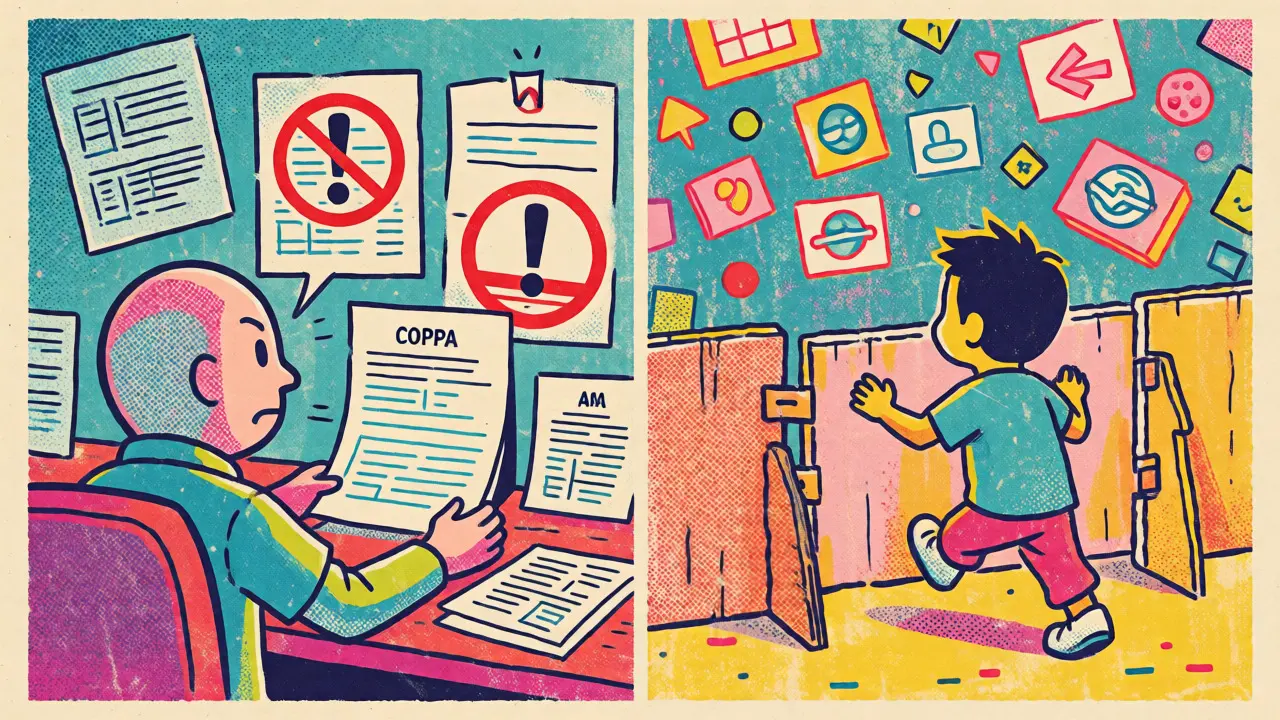
You’re building an app. You want it to be inclusive, maybe even fun for kids under 13. But the moment you think about collecting their names or letting them sign up, your legal team panics. Enter COPPA, the Children’s Online Privacy Protection Act. For years, developers treated this regulation like a minefield. You either ignored kids entirely or built clunky, friction-heavy forms that killed user engagement.
But something shifted in early 2026. The Federal Trade Commission (FTC) issued a new policy statement that changes how we handle age verification. It’s not just about compliance anymore; it’s about enabling better products. This is where "vibe coding"-the trend of using AI tools to rapidly prototype and build software-meets hard regulatory reality. If you’re a developer trying to ship features fast, understanding these new rules isn’t optional. It’s the difference between a feature that scales and a lawsuit.
The Old Catch-22: Why We Hated Age Gates
Before February 25, 2026, verifying a child’s age was a paradox. To prove someone is over 13, many systems asked for a date of birth or even a photo ID. But collecting that data? That required parental consent under COPPA. So, to get consent, you needed data. To get data, you needed consent. Developers solved this with the "neutral age gate." You just ask users to type in their birth year. No real verification. It’s easy, but it’s also incredibly easy to lie. A ten-year-old can type "2008" and walk right into an adult-only space.
This created a massive gap between what the law intended and what actually happened on the internet. Kids accessed content they weren’t ready for, and companies collected data without truly knowing who was behind the screen. The FTC recognized this failure. They realized that strict adherence to old-school consent models was actually hindering the deployment of modern, effective safety tools.
The New FTC Policy: A Green Light for Tech
On February 25, 2026, the FTC dropped a bombshell: they will not bring enforcement actions against operators who collect personal information solely to determine a user’s age, provided specific conditions are met. This is huge. It means you can use advanced tech-like facial estimation or government-ID matching-to verify age without first jumping through the hoops of obtaining verifiable parental consent for that specific piece of data.
However, this isn’t a free-for-all. The flexibility applies primarily to general audience and mixed-audience sites. If your site is explicitly targeted at children (think Khan Academy Kids), you still need robust parental consent mechanisms. But for platforms like Roblox, TikTok, or gaming hubs where the audience is mixed, this opens the door to more accurate age assurance.
The key here is limitation. You can only use this data for one purpose: determining age. Once you know if the user is under or over 13, you must delete the verification data promptly. You can’t keep those facial scans around for marketing analytics. You can’t sell them to advertisers. The data has a short shelf life, and its job is done once the age check is complete.
Vibe Coding Meets Compliance: Building Fast Without Breaking Laws
So, what does this have to do with vibe coding? If you’re using AI assistants to generate code, you might be tempted to slap a simple input field on your signup page. "Enter your age," says the AI-generated form. Done. But in the post-2026 landscape, that simple field might be insufficient depending on your risk tolerance and state laws.
Vibe coding excels at speed. You describe a feature, and the AI writes the boilerplate. But AI doesn’t inherently understand the nuance of the FTC Enforcement Policy Statement. It won’t automatically prompt you to set up a data deletion pipeline for age verification logs. It won’t remind you that biometric data now falls under expanded COPPA definitions.
To bridge this gap, you need to bake compliance into your prompts. When asking an AI to build an auth flow, specify: "Create an age-gate component that uses a third-party API for age estimation, ensures data is deleted after response, and flags users under 13 for parental consent flows." By treating compliance as a constraint in your vibe coding workflow, you avoid the technical debt of retrofitting privacy later.

The Six Rules You Must Follow
If you decide to leverage this new enforcement flexibility, you aren’t off the hook. You’re entering a different lane of responsibility. The FTC outlined six specific requirements you must meet to stay safe. Miss one, and you lose the protection.
- Purpose Limitation: Use the data strictly for age determination. Do not repurpose it for profiling.
- Data Retention: Keep the data only as long as necessary. Prompt deletion is mandatory.
- Third-Party Security: Only share data with vendors who guarantee confidentiality and security integrity.
- Transparency: Clearly tell parents and children what data is being collected and why.
- Security Safeguards: Implement reasonable measures to protect the data while it exists.
- Accuracy: Choose a verification method likely to produce accurate results. Don’t use a tool known for high error rates.
Notice the emphasis on accuracy. The FTC wants to move away from the era of "trust me, I’m 13." They expect technological solutions that actually work. If you’re vibe-coding a solution, ensure the underlying API you choose has a track record of reliability.
State Laws vs. Federal Flexibility
Here’s where it gets messy. While the FTC provides federal breathing room, states are moving faster. California, Utah, and others have enacted laws requiring stricter age verification for certain types of content. These state laws often demand "reasonable effort" to verify age, which can be interpreted more aggressively than the FTC’s current stance.
This creates a compliance patchwork. Your app might be fine under federal COPPA guidelines because you used a neutral age gate, but fail state-level requirements in California if that gate is too easily bypassed. As a developer, you can’t just look at the federal minimum. You need to design for the highest common denominator. If you’re targeting a national audience, assume you need stronger verification than the bare minimum.
| Approach | Friction Level | Accuracy | COPPA Risk (Post-2026) |
|---|---|---|---|
| Neutral Age Gate (Self-Reported) | Low | Low | High for mixed audiences |
| Date of Birth Input | Low | Medium | Medium (requires careful data handling) |
| AI Facial Estimation | Medium | High | Low (if compliant with 6 rules) |
| Government ID Match | High | Very High | Low (but high user drop-off) |

Biometrics Are Now Personal Information
One critical update in the revised COPPA Rule is the expansion of "personal information." It now explicitly includes biometric data like fingerprints and facial scans. Before, some argued that a face scan wasn’t "personal info" in the same way a name was. Not anymore.
If your age verification tool uses facial recognition, you are handling sensitive personal information. Even though the FTC gives you leeway to collect it for age checks, you must treat it with the same security rigor as a social security number. If you store that face map incorrectly, or leak it, you’re in trouble regardless of the age-check exemption. Vibe coders beware: don’t just log raw images to a public S3 bucket. Encrypt everything.
Practical Steps for Developers
How do you implement this today? Start by auditing your current user flow. Are you collecting dates of birth? Where does that data go? If it sits in your database forever, you’re creating liability.
- Audit Data Flows: Map every point where user data enters your system. Identify what is used for age verification versus account creation.
- Choose the Right Vendor: Select an age verification provider that supports automatic deletion and provides clear audit trails. Look for SOC 2 Type II compliance.
- Update Privacy Policies: Explicitly mention that you may collect biometric or DOB data solely for age verification and that it is deleted afterward.
- Implement Parental Consent Flows: For users identified as under 13, trigger a separate flow for verifiable parental consent before allowing full service access.
- Monitor State Regulations: Keep an eye on laws in CA, UT, AR, and other active states. Adjust your verification strength based on user location.
The Future of Child Safety Tech
We are seeing a shift from passive protection (telling kids what not to do) to active assurance (using tech to know who is there). Christopher Mufarridge, Director of the FTC Bureau of Consumer Protection, called age verification technologies "some of the most child-protective technologies to emerge in decades." That’s a strong endorsement from a regulator.
For developers, this means the barrier to entry for building kid-friendly apps is lowering, but the expectation for quality is rising. You can’t just throw a generic login screen together. You need thoughtful architecture. The good news? Tools are getting better. APIs are becoming more standardized. And with AI-assisted coding, you can integrate these complex compliance layers faster than ever before.
Does the new FTC policy apply to all websites?
No. The enforcement flexibility primarily applies to general audience and mixed-audience websites. If your website is specifically directed toward children under 13, you must still follow standard COPPA requirements, including obtaining verifiable parental consent before collecting personal information.
What happens to the data collected for age verification?
Under the new policy, operators must retain personal information only as long as necessary to determine the user's age and then promptly delete it. You cannot use this data for marketing, profiling, or other purposes unrelated to the age check itself.
Are biometric data covered by COPPA now?
Yes. The updated COPPA Rule explicitly expands the definition of personal information to include biometric data such as fingerprints and facial scans. This means any collection of such data triggers COPPA obligations, subject to the specific exemptions for age verification processes.
Can I still use a simple date-of-birth input?
You can, but it carries higher risk. Simple self-reported age gates are easily bypassed. While the FTC hasn't banned them, they are pushing for more reliable methods. State laws may also require stronger verification than a simple DOB entry, so relying solely on this method could lead to non-compliance in certain jurisdictions.
How does this affect AI-generated code?
AI code generators often default to simple patterns. You must explicitly instruct them to include compliance steps like data deletion routines and secure transmission protocols. Always review AI-generated authentication code for privacy implications, as it may not automatically account for recent regulatory changes like the 2026 FTC policy.