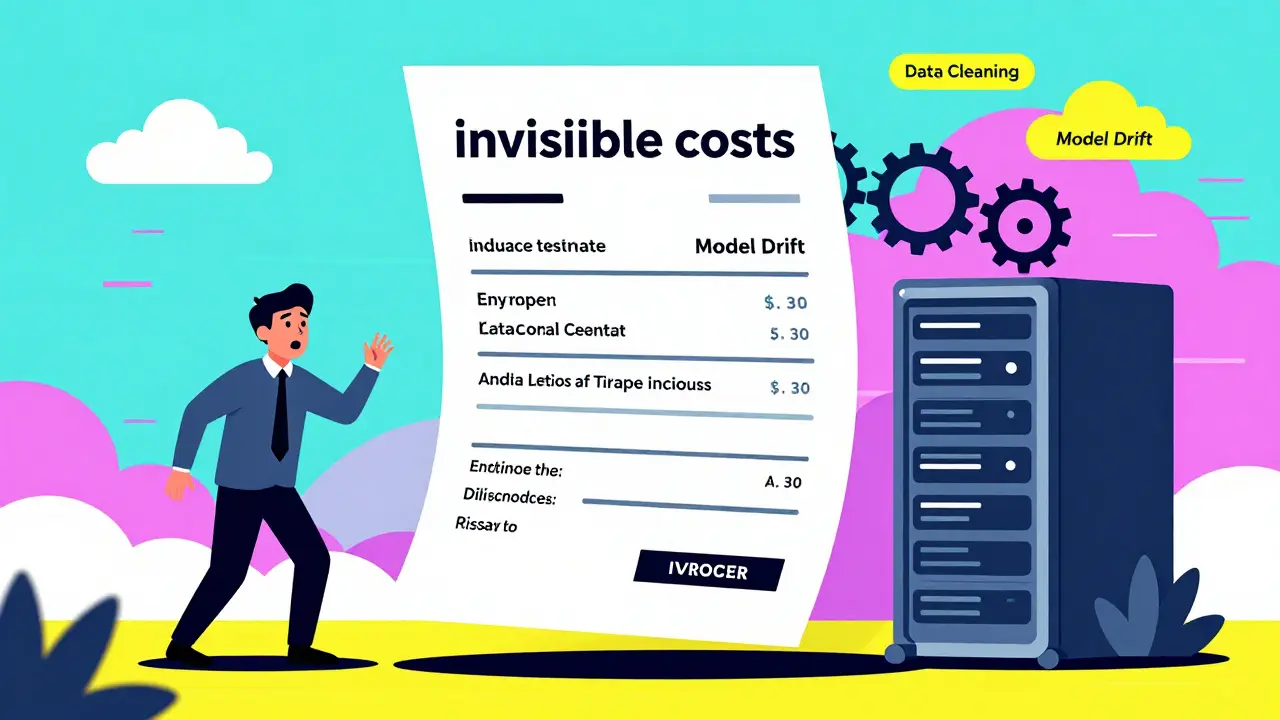
Most companies think they know how much a Generative AI is a type of artificial intelligence that creates new content like text, images, or code based on patterns learned from data project will cost. They look at the software license, maybe add some cloud hosting fees, and call it a day. Then the bill arrives, and it’s triple the estimate. Why? Because they forgot to budget for the invisible stuff: data cleaning, model drift, compliance checks, and the human hours needed to keep the system from hallucinating.
In 2026, generative AI has moved past the hype cycle into the messy reality of enterprise operations. The global market hit $112.8 billion last year, and 68% of Fortune 500 companies are already running these systems. But here is the hard truth: 73% of these projects fail to deliver their promised return on investment (ROI). The failure isn’t usually technical. It’s financial mismanagement. If you want your AI program to actually make money instead of burning cash, you need a budgeting strategy that accounts for the entire lifecycle, not just the launch day.
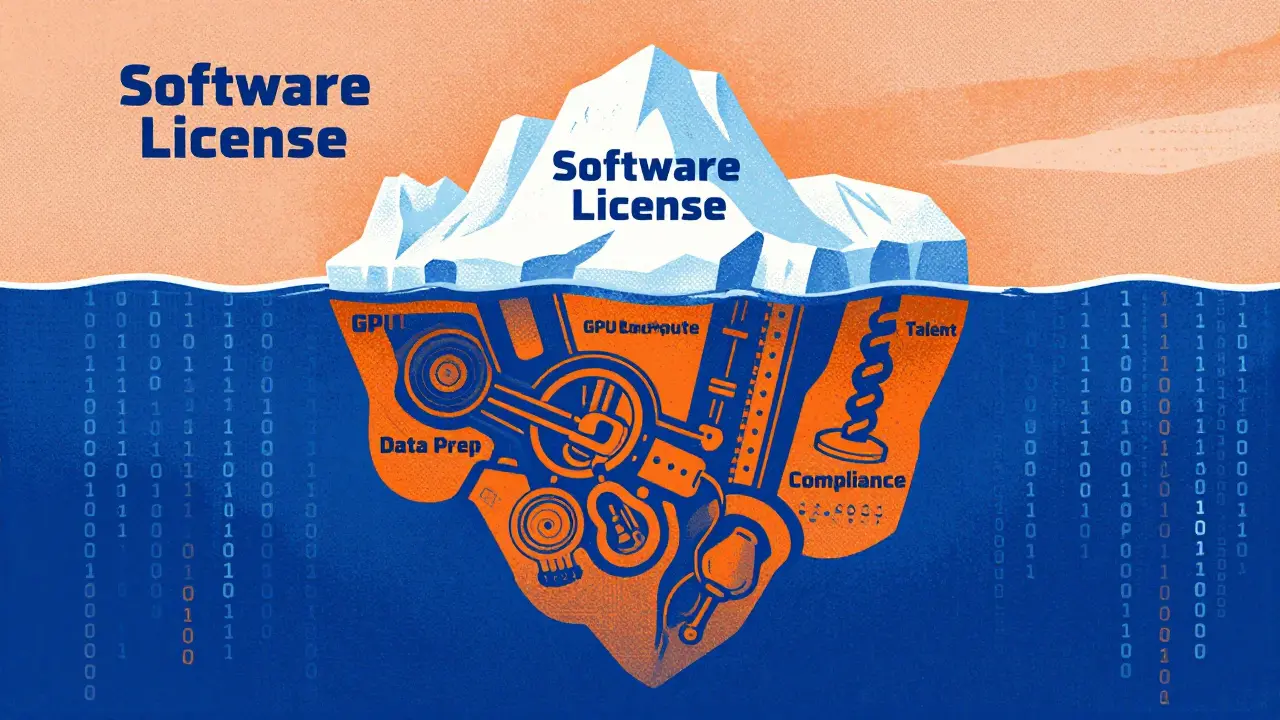
The Hidden Iceberg of Generative AI Costs
When you build a traditional software application, the costs are linear. You pay developers, you buy servers, you’re done. With generative AI, the costs are dynamic and often hidden until it’s too late. To get an accurate budget, you have to break down the total cost of ownership (TCO) into four distinct buckets: Infrastructure, Data, Talent, and Compliance.
Infrastructure is no longer just about storage. It’s about compute power. For mid-sized projects, you are looking at NVIDIA A100 or H100 GPU instances. These aren’t cheap. Expect to spend between $5,000 and $20,000 monthly for cloud GPU access depending on your inference load. While NVIDIA’s Blackwell architecture released in early 2026 has reduced inference costs by roughly 28%, the demand for high-performance computing keeps prices sticky. If you are training large models from scratch, those costs skyrocket. Fine-tuning existing models runs $30,000 to $40,000, but building custom natural language processing (NLP) models can easily exceed $100,000.
Data acquisition and preparation is where most budgets bleed out. This category typically consumes 20-30% of your total project cost. For a mid-sized implementation, that’s $10,000 to $30,000. You might think you have clean data. You probably don’t. Data needs to be collected, cleaned, annotated, and governed. Dr. Elena Rodriguez, Chief AI Strategist at Radixweb, noted in her January 2026 whitepaper that organizations underestimating data prep costs by just 30-40% face project delays averaging 4.7 months. That delay is pure lost revenue.
Talent is another major expense. AI specialists in North America command rates between $150 and $250 per hour. This isn’t just for engineers; you need prompt engineers, data annotators, and AI ethicists. Finally, compliance and security add another $10,000 to $20,000 for mid-sized projects. With the EU AI Act fully enforced in Q4 2025, 54% of organizations had to increase their compliance budgets by 12-18%. Ignoring this isn’t an option anymore if you plan to operate globally.
Scaling Your Budget: From Pilot to Enterprise
Not all AI programs are created equal. Your budget depends heavily on the scale of your implementation. Trying to apply an enterprise budget to a small pilot is wasteful, but applying a pilot budget to an enterprise rollout is fatal. Here is how the numbers break down across three common tiers in 2026:
| Implementation Tier | Target Audience | Estimated Cost Range | Key Characteristics |
|---|---|---|---|
| Basic Integration | Small teams (<50 employees) | $30,000 - $120,000 | Using off-the-shelf APIs (e.g., Azure OpenAI); minimal customization; focused on specific tasks like email drafting. |
| Mid-Level Solution | Departmental use | $120,000 - $600,000 | Fine-tuned models; custom data pipelines; integration with existing CRM/ERP systems; moderate compliance needs. |
| Enterprise Transformation | Company-wide (>1,000 employees) | $600,000 - $2,000,000+ | Custom model development; dedicated infrastructure; full governance framework; annual operating costs of $1M-$5M+. |
If you are in healthcare or finance, multiply those estimates significantly. Healthcare implementations range from $250,000 to $2 million due to strict HIPAA requirements and the need for extreme accuracy. Retail and e-commerce tend to be on the lower end ($80,000 to $800,000) because the risk tolerance for minor errors is higher, and the data structures are often more standardized.
Realizing Value: Moving Beyond Vanity Metrics
Spending money is easy. Getting value back is hard. The biggest mistake leaders make is focusing on output volume rather than business impact. Did the AI write 10,000 blog posts? Great. Did those posts drive traffic? Did they convert? Value realization requires tying your AI expenditures to specific Key Performance Indicators (KPIs).
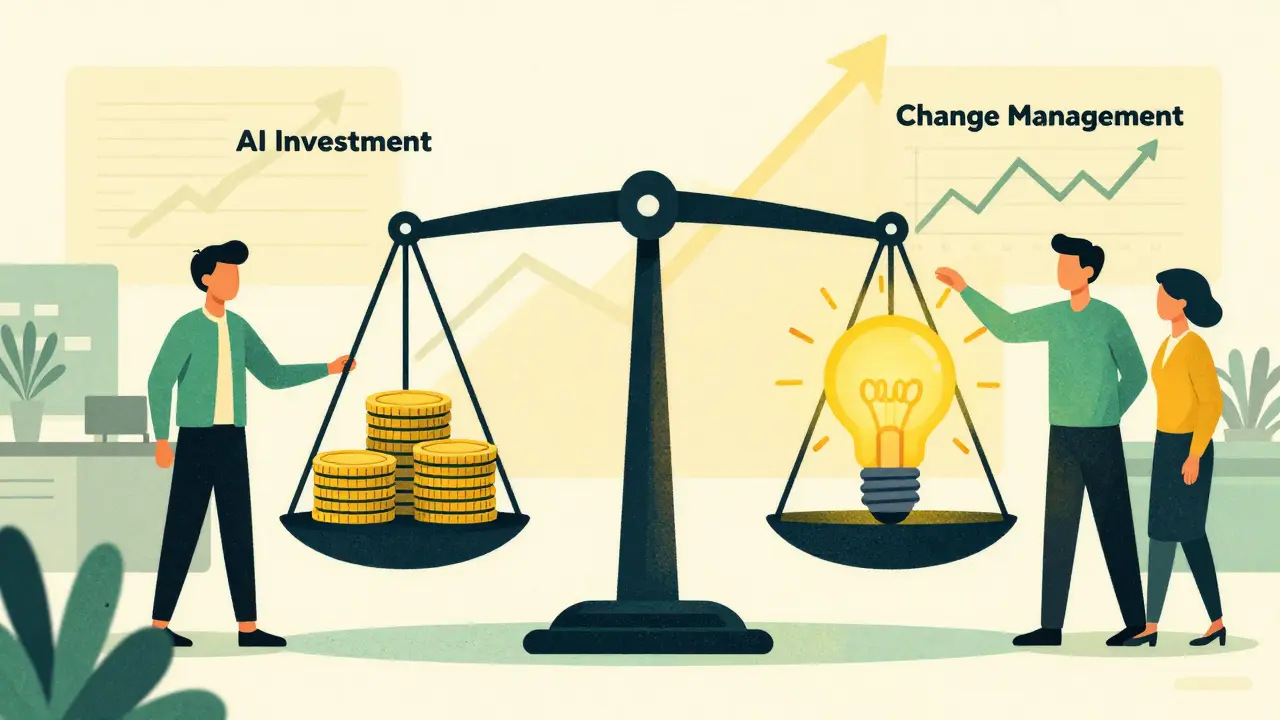
Consider the case of a retail company documented on HackerNews in February 2026. They spent $220,000 on a generative AI implementation for personalized marketing. Within 7.3 months, they realized $1.2 million in annual savings through increased conversion rates and reduced ad waste. Their secret? They didn’t just buy the technology. They allocated 35% of their budget to change management and user adoption-a figure backed by Gartner’s 2026 AI Market Guide, which found that enterprises achieving 25%+ ROI prioritized human adoption over raw tech specs.
Conversely, a manufacturing firm shared on Trustpilot in April 2026 reported a $350,000 loss. Their out-of-the-box model couldn’t handle technical documentation nuances. They failed to budget for domain-specific fine-tuning. The lesson is clear: generic models save money upfront but cost you credibility and efficiency downstream. Companies that conduct thorough value mapping exercises before budgeting achieve 2.3x higher ROI, according to MIT Sloan’s 2026 Generative AI Impact Study.
Avoiding the "AI Tax" and Budget Fragmentation
There is a concept called the "AI Tax." This refers to the unexpected compute costs that spike during peak usage times. If your budget only covers baseline infrastructure, you will be blindsided when traffic surges. MIT Technology Review’s 2026 survey found that organizations specifically budgeting for this tax experienced 40% fewer service disruptions. Plan for volatility. Use hybrid approaches-combining platform services with custom development-which Radixweb data shows deliver optimal ROI for 63% of mid-sized enterprises.
Another silent killer is budget fragmentation. As of March 2026, 67% of analysts identified this as the top risk. Marketing buys one tool. HR buys another. IT builds a third. Without centralized oversight, you end up paying for redundant capabilities. TechCrunch reports this leads to 22-35% overspending. Establish a central AI governance committee early. Ensure every dollar spent contributes to a unified strategy, not siloed experiments.
Maintenance: The Never-Ending Story
Your job doesn’t end when the model launches. In fact, the real costs begin then. Ongoing maintenance constitutes 15-20% of your initial development costs annually. For large enterprises, this means $1 million to $5 million in yearly operating expenses. Why so much? Models suffer from "drift." The world changes, language evolves, and your data becomes stale. Mark Thompson, CTO at AI Smart Ventures, warns that 58% of failed AI implementations stem from inadequate budgeting for retraining and drift management.
You also need to factor in continuous optimization. TopDevelopers’ 2026 case studies show that organizations spending 15-20% of annual costs on optimization maintained 92% model accuracy over 18 months. Those who skimped dropped to 68%. Accuracy drops mean bad customer experiences, which means lost revenue. Treat maintenance not as a cost center, but as an insurance policy against irrelevance.
Strategic Recommendations for 2026
To navigate this complex landscape, adopt a phased budgeting approach. Forrester’s Q1 2026 analysis indicates that companies using staged rollouts (pilots → departmental → enterprise) achieved 32% higher ROI than those going big bang. Start small. Prove the value. Then scale.
- Allocate for Training: Budget $6,000-$12,000 per FTE for specialized training. Codewave’s 2026 analysis shows a learning curve of 40-80 hours per team member. Untrained users will misuse the tool, leading to errors and wasted resources.
- Embrace Smaller Models: The trend in 2026 is moving toward smaller, domain-specific models (1-7B parameters). DigitalSuits reports 40% cost reductions for industry-specific implementations compared to general-purpose giants. Don’t use a sledgehammer to crack a nut.
- Plan for Ethics Oversight: Gartner predicts that by Q4 2026, 80% of enterprise budgets will include allocations for AI ethics oversight. This adds 5-7% to total costs but protects your brand from reputational damage caused by biased or inappropriate outputs.
- Monitor Usage-Based Pricing: Model-as-a-service offerings reduce initial dev costs by 15-25% but increase annual operating expenses by 8-12%. Calculate the long-term TCO carefully before signing up for subscription-based AI services.
Budgeting for generative AI is not just about accounting; it’s about strategy. By understanding the true total cost of ownership and aligning expenditures with measurable value realization, you transform AI from a risky experiment into a reliable profit driver. The technology is ready. Is your budget?
How much does it cost to implement generative AI in a mid-sized company in 2026?
For a mid-sized enterprise solution, expect to spend between $120,000 and $600,000 initially. This covers fine-tuning models, setting up data pipelines, integrating with existing systems, and ensuring basic compliance. Annual maintenance will add 15-20% to this figure.
What is the "AI Tax" in budgeting?
The "AI Tax" refers to unexpected spikes in compute costs during peak usage periods. If your budget only covers baseline infrastructure, you will face service disruptions or surprise bills. Organizations that budget for this volatility experience 40% fewer disruptions.
Why do 73% of generative AI projects fail to deliver ROI?
According to Radixweb (January 2026), the primary reason is inadequate budgeting for ongoing maintenance, scaling, and data governance. Many companies focus on the initial build but neglect the continuous costs of retraining, drift management, and user adoption.
Should I build a custom model or use an existing API?
It depends on your needs. Using existing APIs (like Azure OpenAI) is cheaper ($30k-$120k) and faster for basic tasks. Custom models ($100k+) are necessary if you have unique domain requirements, strict privacy needs, or require high precision that off-the-shelf models cannot provide. Hybrid approaches often offer the best balance.
How much should I allocate for data preparation?
Data acquisition and preparation typically account for 20-30% of total project costs. For a mid-sized project, this ranges from $10,000 to $30,000. Underestimating this phase by even 30% can lead to significant project delays, averaging 4.7 months.