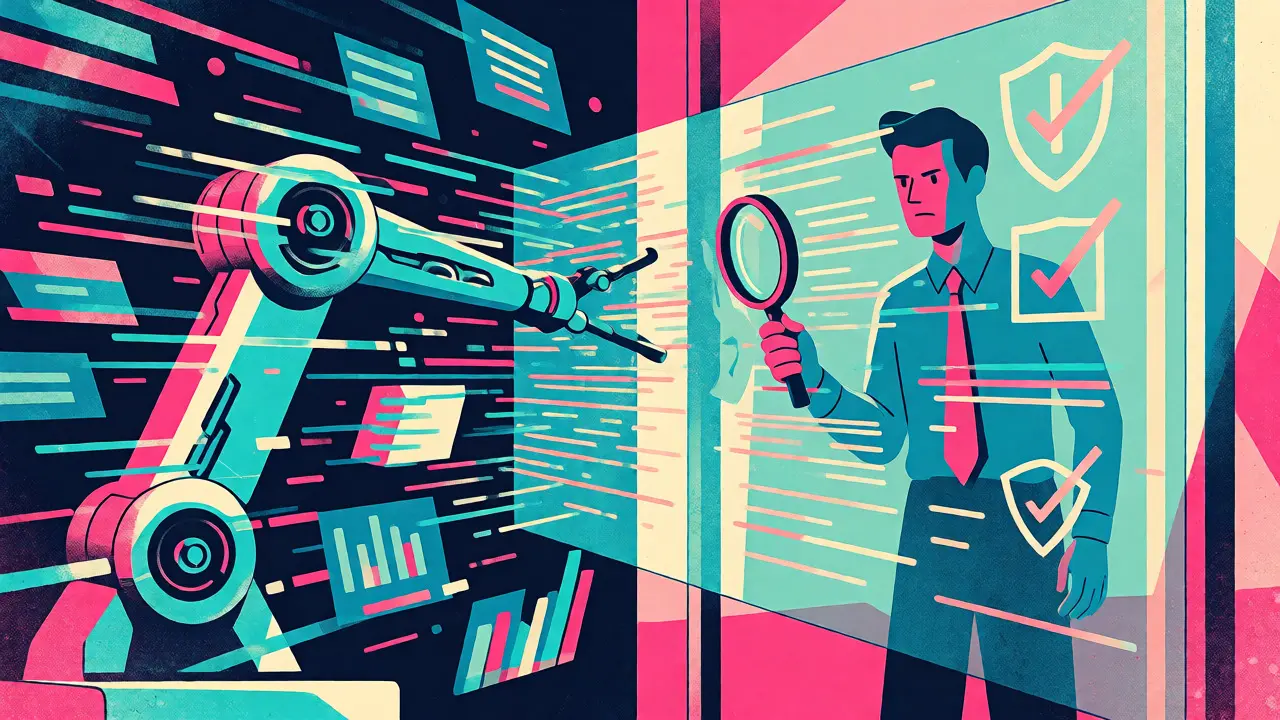
Imagine your bank’s AI system suggests a new credit scoring algorithm that boosts approval rates by 15%. It looks great on paper. But if you deploy it without a formal, auditable approval trail, you might just have handed regulators a reason to shut down your lending division. In 2026, the era of "move fast and break things" is dead for anyone operating under strict oversight. If you are in finance, healthcare, or energy, approval workflows for AI-generated changes are no longer optional best practices; they are the primary defense against enforcement actions.
The shift happened quickly. Between 2020 and 2024, most companies treated AI as an experimental tool. By mid-2026, with the EU AI Act fully enforcing high-risk provisions and US regulators tightening scrutiny under frameworks like SR 11-7, AI outputs have become regulated assets. The core problem isn't whether the AI works-it usually does. The problem is proving who approved its change, why, and when. This article breaks down how to build these workflows so you can scale AI without drowning in compliance paperwork.
Why Traditional Change Management Fails AI
You might think, "We already have change management processes." You do. But traditional ITIL-style change control assumes code changes are deterministic and written by humans who understand context. AI-generated changes-whether they are code snippets, configuration updates, or decision logic-are probabilistic and often opaque. A human developer knows why they changed a variable. An LLM might change it because of statistical likelihood, not business logic.
This mismatch creates three specific risks:
- Opacity: Regulators reject "black box" decisions. If you can't explain why the AI changed a rule, you can't approve it.
- Speed vs. Control: AI can generate hundreds of potential optimizations per hour. Human review queues bottleneck instantly unless workflows are tiered.
- Lifecycle Accountability: Old models were validated once. New AI systems drift. Approval workflows must now cover continuous monitoring, not just initial deployment.
Horizon Scan 001, published in July 2026, warned that firms lacking continuous review cycles face direct enforcement risk. The message is clear: static validation is over. Dynamic governance is here.
The Regulatory Landscape Driving These Workflows
To design the right workflow, you need to know what rules you're playing by. The regulatory map has shifted dramatically since 2024.
| Framework/Regulator | Region/Sector | Core Requirement for Approvals |
|---|---|---|
| EU AI Act | European Union / High-Risk Systems | Risk management procedures (Art. 9) and Quality Management Systems (Art. 17). Requires documented human oversight. |
| SR 11-7 | US Financial Services (Fed/OCC) | Model risk management. Extends validation requirements to LLMs and agents. Requires independent review. |
| DORA | EU Financial Sector | Operational resilience. AI dependencies must be mapped and failover-tested within approval gates. |
| HIPAA / FDA Guidance | US Healthcare | Data privacy and clinical safety. Requires traceability for any AI affecting patient care or records. |
In the EU, the EU AI Act is a comprehensive legal framework classifying AI systems by risk level explicitly mandates that high-risk systems maintain quality management systems demonstrable through formal approvals. In the US, the Federal Reserve's SR 11-7 guidance requires banks to manage model risk through rigorous validation and change controls is being applied aggressively to Large Language Models (LLMs). If your AI generates a communication to a customer, FINRA and SEC conduct rules apply immediately. You cannot automate away the accountability.
Designing Multi-Tiered Approval Gates
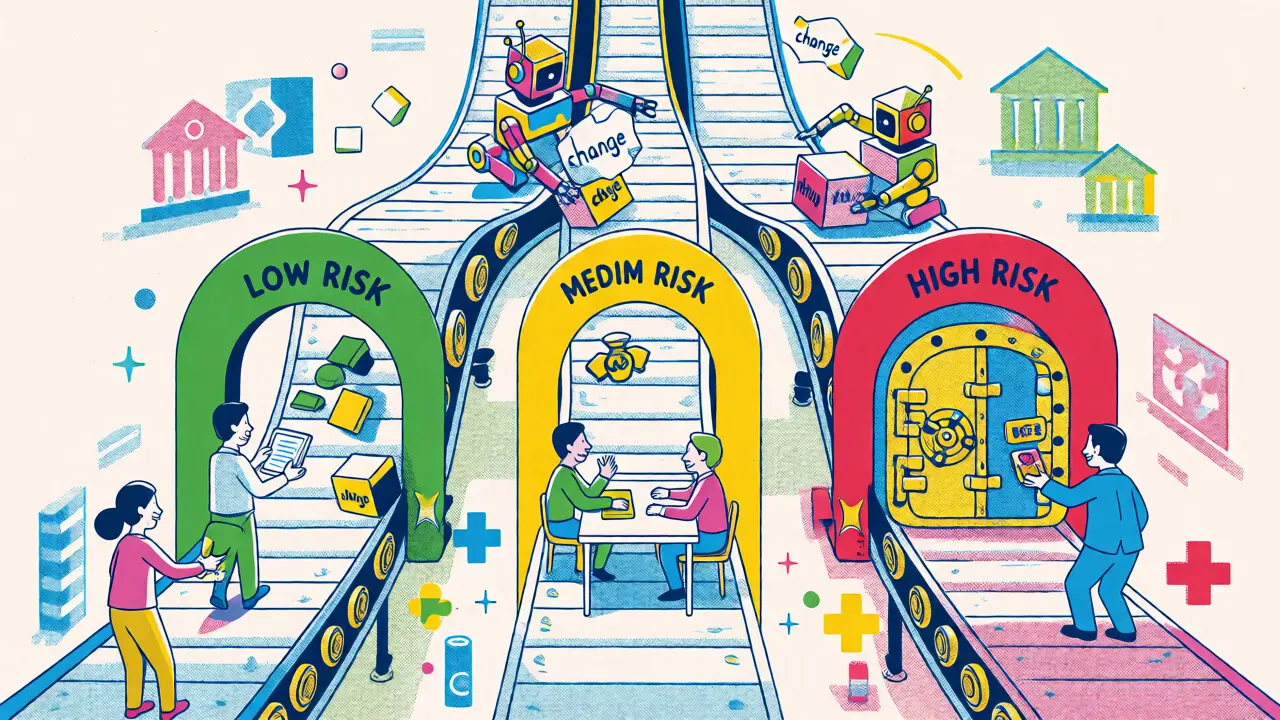
One-size-fits-all approval is a recipe for paralysis. If every AI suggestion requires a CTO signature, your engineering team will revolt. The solution, advocated by experts at Trussed.ai and StackAI, is a multi-tiered approach based on risk classification.
Tier 1: Low-Risk (Automated or Batch Review)
Think document search, scheduling, or internal code linting. These changes have low blast radius. Here, use "soft approvals." The AI makes the change, logs it, and flags anomalies. Humans review these in batches weekly. If nothing triggers an alert, the change stands. This keeps velocity high for non-critical tasks.
Tier 2: Medium-Risk (Peer + Compliance Check)
Examples include updating marketing copy or adjusting inventory forecasts. These require a human peer review focused on business logic and a quick automated check against policy-as-code rules. No senior sign-off needed, but the action must be logged with a rationale.
Tier 3: High-Risk (Hard Human Gate)
This includes credit decisioning, clinical diagnostics, or security patches. Here, you need "hard approvals." The AI proposes the change, but it cannot go live until a qualified human explicitly approves it. This often requires separation of duties: the person who built the prompt shouldn't be the one approving the output. For financial institutions, this aligns with fair-lending lineage requirements-you must prove a human reviewed the decision before it affected a customer.
Technical Architecture: From Prompt to Production
How do you actually enforce this? You can't rely on email chains. You need technical enforcement mechanisms. Baytech Consulting’s blueprint for regulated enterprises outlines a seven-stage pipeline that serves as a solid starting point.
- Isolation: Run AI coding assistants in sandboxed environments with no access to production data. Prevent data leakage at the source.
- Pre-Commit Hooks: Use local tools to scan prompts and outputs for sensitive data (PII, PHI) before they even leave the developer's machine.
- Automated Security Scanning: Integrate SAST (Static Application Security Testing), DAST, and Software Composition Analysis (SCA). These tools catch vulnerabilities like SQL injection or weak cryptography automatically.
- Policy-as-Code Checks: Before human review, run scripts that verify the change meets specific regulatory tags (e.g., "PCI-DSS compliant," "HIPAA safe"). If it fails, it never reaches a human.
- Human Peer Review: Focus strictly on business logic and ethical implications. Did the AI hallucinate a regulation? Did it bias the outcome?
- Compliance Artifact Generation: Automatically attach the audit trail-who prompted it, what version was used, what tests passed-to the pull request.
- Immutable CI/CD Enforcement: Use branch protection rules (like Azure DevOps build validation) to physically block merges if any prior step failed. This turns your CI/CD pipeline into a compliance firewall.
This architecture ensures that the "approval" isn't just a checkbox; it's a series of technical gates that make non-compliant changes physically impossible to deploy.
Governance Best Practices: Beyond the Code
Technology alone won't save you. You need organizational discipline. Three pillars stand out in current industry guidance:
1. Data Governance at the Boundary
Don't just protect your database. Protect the AI boundary. Ensure that prompts sent to external LLMs don't contain unmasked PII. Approval workflows must include checks on input prompts, not just output code. If an engineer pastes a customer SSN into a chatbot, that's a violation, regardless of what the bot outputs.
2. Explainability as a Deliverable
Regulators are rejecting black boxes. Your approval process must demand "decision lineage." When an AI suggests a loan denial, the approver needs to see which features drove that decision. Build this into the UI of your approval dashboard. If the AI can't explain itself, it doesn't get approved.
3. Continuous Monitoring Feedback Loops
Approval isn't the end; it's the start. Deployed models drift. Set up monitors that track performance metrics post-deployment. If accuracy drops below a threshold, trigger an automatic re-validation workflow. This shifts governance from point-in-time reviews to lifecycle accountability, which is exactly what Horizon Scan 001 warns regulators are looking for.

Industry-Specific Nuances
While the mechanics are similar, the stakes vary by sector.
Financial Services: The focus is on fairness and transparency. Under SR 11-7, you must prove that AI-driven credit scoring doesn't introduce disparate impact. Approval workflows here often involve legal teams reviewing model cards for bias before deployment.
Healthcare & Pharma: Patient safety is paramount. AI-assisted diagnostics require clinician sign-off. Workflows must integrate with Electronic Health Records (EHR) and ensure that any AI-generated note is attributed correctly and reviewed by a licensed professional before becoming part of the permanent record.
Manufacturing & Energy: Operational resilience is key. If AI adjusts grid load or manufacturing schedules, the approval workflow must consider safety margins. Integrations with MES (Manufacturing Execution Systems) and SCADA systems are critical. A bad AI recommendation here could halt production or cause physical damage.
Pitfalls to Avoid
Even mature organizations stumble. Here are the most common traps:
- Self-Approving AI: Never let the system that generates the change also validate it. Separation of duties is non-negotiable.
- Ignoring Shadow AI: Employees using personal ChatGPT accounts to draft emails bypass all workflows. Implement enterprise-wide gateways that force traffic through your approval pipes.
- Over-Reviewing: Trying to manually review every token generated by an LLM is unsustainable. Trust your automated policy-as-code filters to handle the routine, saving human eyes for the exceptions.
- Lack of Version Control: Always log the exact model version used for a generation. "GPT-4o" today is different from "GPT-4o" next month. Without version pinning, you can't reproduce results for audits.
Next Steps for Implementation
If you're starting from scratch, don't try to boil the ocean. BN Digital recommends beginning with scoped pilots in lower-risk areas, such as regulatory change management or document review, rather than jumping straight into transaction monitoring. Use these pilots to refine your tiering criteria and test your technical integrations.
Engage your regulators early. Show them your draft approval workflow. Their feedback now is cheaper than an enforcement action later. Finally, invest in upskilling your compliance and QA teams. They need to understand how LLMs work well enough to ask the right questions during approval. When your lawyers understand what "temperature" means in an LLM context, your governance becomes sharper, faster, and far more effective.
Do I need separate approval workflows for every AI model?
Not necessarily. You should define workflows based on the risk tier of the use case, not the specific model. However, each model instance must have its own version history and validation report linked to the approval record. If you swap models (e.g., from Llama 3 to GPT-4), the underlying risk assessment may change, triggering a re-evaluation of the workflow tier.
How do I handle emergency AI changes?
Create a "break-glass" procedure. Allow immediate deployment for critical fixes (e.g., security patches) with mandatory retrospective review within 24 hours. Log the justification for skipping standard gates. Regulators generally accept this if the post-hoc documentation is thorough and the incident is rare.
What is "policy-as-code" in this context?
Policy-as-code translates regulatory rules into executable scripts. Instead of a human reading a PDF to check if a data field is encrypted, a script checks the code directly. If the script passes, the compliance requirement is met automatically, speeding up the approval queue while maintaining rigor.
Can AI approve other AI changes?
For low-risk tiers, yes, but with caution. An "auditor AI" can flag issues in a "generator AI"'s output. However, for high-risk regulated environments, a human must retain final authority. The AI acts as a pre-screening tool, reducing the cognitive load on human reviewers, but not replacing their liability.
How long should audit trails be kept?
It depends on your jurisdiction and sector. Generally, financial services require retention for 5-7 years. Healthcare may require longer due to patient record laws. Always align your AI audit trail retention policies with your existing data retention schedules for similar documents to avoid creating orphaned data liabilities.

Kendra Edmonds
9 November, 2026 - 10:23 AM
you're all missing the point. traditional change management is dead and this article just confirms it. if you aren't using policy-as-code you're already behind. stop trying to manually review every token like it's 2020.