
You build apps that feel alive. You use AI assistants to generate code, you iterate fast, and you focus on user experience above all else. This is the essence of vibe coding. But here is the hard truth: speed and style mean nothing if your app violates privacy laws. The EU General Data Protection Regulation (GDPR) isn't just a legal hurdle; it is a design constraint that shapes how you collect, store, and ask for user permission.
If you are building interactive, data-driven products-social apps, media platforms, or community tools-you face real risks. Fines can reach €20 million or 4% of global turnover. More importantly, users trust apps that respect their data. This guide breaks down two critical pillars of GDPR for developers: data minimization and valid consent flows. We will look at how to implement these rules without killing your product's vibe.
The Core Problem: Collecting Too Much
Most developers fall into a trap. They collect every piece of data they might need someday. An email? Sure. A phone number? Why not. Location history? Just in case. Under GDPR, this approach is illegal. Article 5(1)(c) establishes the principle of data minimization. It states that personal data must be "adequate, relevant, and limited to what is necessary" for the specific purpose you declared.
This is not about hiding data. It is about intentional architecture. Before you add a field to your database or a tracking pixel to your frontend, ask three questions:
- Adequacy: Is this data sufficient to achieve the goal?
- Relevance: Does this data directly relate to the goal?
- Necessity: Can we achieve the goal with less data?
For example, if you need to verify a user's age, do you need their full date of birth, or just a confirmation that they are over 18? If you need to send a password reset link, do you need their home address? Usually, the answer is no. By pruning unnecessary fields, you reduce the blast radius of a potential data breach and lower your liability.
Implementing Data Minimization in Code
Data minimization is not a policy document; it is a technical implementation. It requires changes to your backend logic, your database schema, and your analytics setup. Here is how you apply it in practice.
1. Limit Collection at the Source
Review your sign-up forms. Every required field is a barrier to entry and a compliance risk. If your app functions with just an email address, make everything else optional. Do not bundle optional demographic questions into the mandatory registration flow. Separate them. Label them clearly. Explain why you want that data. If a user skips those optional fields, your core service should still work perfectly.
2. Anonymize Analytics Early
Vibe coders love metrics. You want to know how users interact with your interface. However, storing raw IP addresses or unique device identifiers for every click creates a massive pool of personal data. Instead, configure your analytics tools to drop IP addresses immediately after processing. Use random event IDs rather than persistent user IDs for session tracking. Aggregate data daily or weekly. This gives you the insights you need for product decisions without retaining identifiable personal data longer than necessary.
3. Automate Deletion
Recital 39 of the GDPR links minimization to storage limitation. Data should not live forever. Implement automated deletion routines. If you log server errors, delete raw logs after 30 days. If you store temporary files for image uploads, purge them after 24 hours unless they are part of the final user profile. Set up cron jobs or scheduled tasks that enforce these retention periods. Do not rely on manual cleanup.
Consent That Actually Works
Data minimization reduces what you hold. Consent determines whether you can process what you do hold. Many developers treat consent as a nuisance-a banner they slap on the homepage to get out of the way. This is dangerous. Under Article 4(11), valid consent must be freely given, specific, informed, and unambiguous.
Let's break down what that means for your UI/UX design.
Freely Given Means No Coercion
You cannot make access to your service conditional on accepting non-essential tracking. If your app works fine without personalized ads, you cannot block the user from using the app unless they accept ad cookies. This is known as a "cookie wall," and regulators view it as invalid consent. Users must have a genuine choice. If they say no, you still provide the core service.
Specific and Informed Means Granularity
Bundled checkboxes are dead. You cannot have one box that says "I agree to Terms and Privacy Policy and Tracking." These are separate matters. Users need to understand exactly what they are agreeing to. Provide granular options. Let them accept essential cookies while rejecting marketing ones. Explain each category in plain language. Avoid legal jargon. If a user has to guess what "functional cookies" do, you have failed the informed test.
Unambiguous Means Active Action
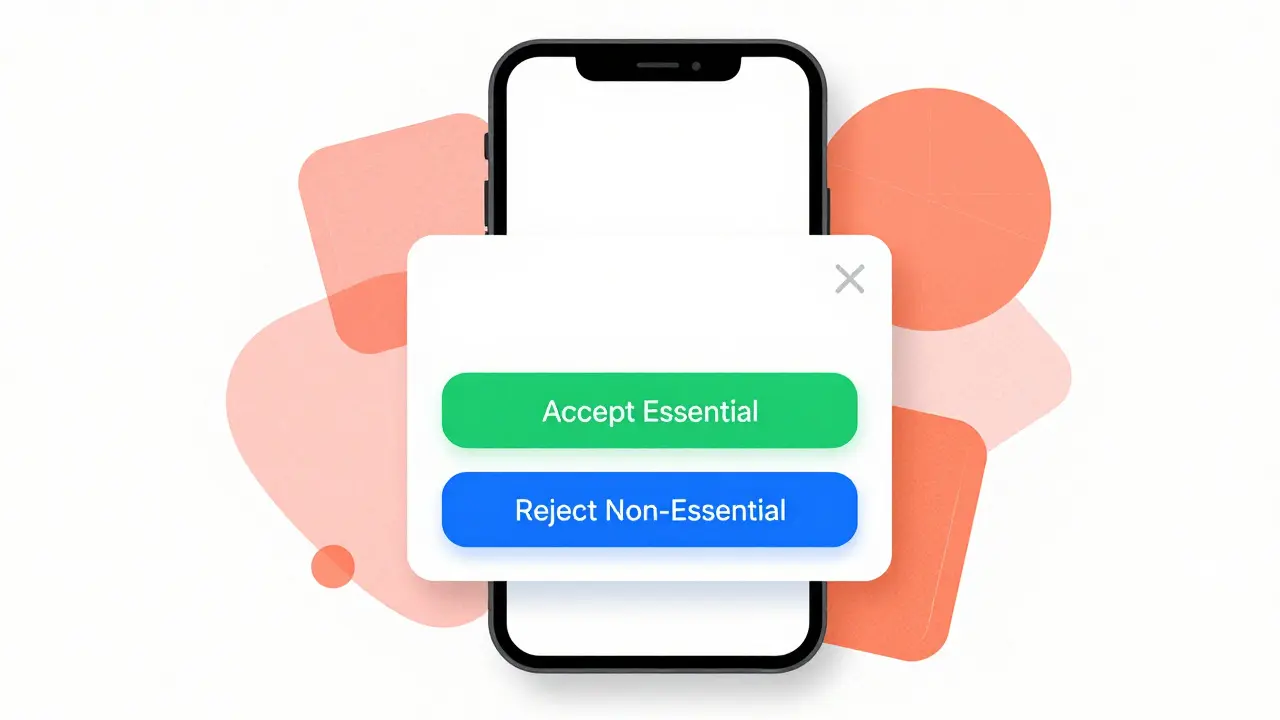
Silence is not consent. Pre-ticked boxes are not consent. Inactivity is not consent. The user must perform a clear affirmative action. They must click an unchecked box, toggle a switch, or press a button labeled "Accept." The effort to reject should be equal to the effort to accept. If "Reject All" is hidden behind three clicks while "Accept All" is a big green button, you are using a dark pattern. Regulators are cracking down on this.
Designing Compliant Consent Flows
How do you build a consent flow that satisfies the law and keeps users happy? Here is a practical architecture for vibe coders.
| Component | Requirement | Implementation Tip |
|---|---|---|
| Timing | Before any non-essential processing | Block third-party scripts until consent is stored. |
| Visibility | Clear and prominent | Use a banner or modal that does not obscure content unnecessarily. | r>
| Choices | Granular and symmetrical | Offer "Accept All," "Reject Non-Essential," and "Manage Settings" with equal visual weight. |
| Withdrawal | As easy as giving consent | Provide a permanent link to privacy settings in the footer or menu. |
| Record Keeping | Demonstrable proof | Log timestamp, user ID, consent version, and status for each purpose. |
Just-in-Time Consent
Instead of dumping all permissions on the user at launch, use just-in-time prompts. Ask for location access only when the user tries to find nearby friends. Ask for camera access only when they tap the upload photo button. This context helps users understand why you need the data, increasing the likelihood of genuine consent.
The Consent Management Platform (CMP)
You need a system to store and manage consent records. When a user interacts with your consent banner, your backend should log:
- User identifier (anonymous or logged-in)
- Timestamp of the action
- Version of the consent text shown
- Status for each purpose (e.g., Analytics: Accepted, Marketing: Rejected)
This log is your evidence during an audit. Without it, you cannot prove consent was given. Integrate a CMP library that handles this logging automatically. Ensure that when a user withdraws consent, your system immediately stops processing data for that purpose and updates the record.

Avoiding Dark Patterns
Dark patterns are UI designs that trick users into doing things they didn't intend. In the context of GDPR, they invalidate consent. Common examples include:
- Confirmshaming: Using guilt-tripping language like "No, I don't care about my privacy" for the decline option.
- Roach Motels: Making it easy to opt-in but extremely difficult to opt-out.
- Hidden Options: Burying the "Reject" button in small gray text while making "Accept" large and colorful.
Regulators in the EU and US are increasingly targeting these practices. The California Privacy Rights Act (CPRA) explicitly bans consent obtained through dark patterns. Following GDPR standards protects you globally. Design for transparency, not manipulation. Trust is a feature.
Next Steps for Your Project
Start with a data inventory. List every form, API endpoint, and log file in your application. Map each data point to a specific purpose. Challenge each one. Can you remove it? Can you anonymize it? Can you shorten its retention period?
Then, audit your consent flows. Are you asking for permission before processing? Is the rejection path equal to the acceptance path? Are you keeping records? Fix these issues now. It is cheaper to rebuild your consent flow today than to pay fines tomorrow. And remember, users notice when you respect their privacy. It makes your app feel better, safer, and more professional.
What happens if I don't comply with GDPR data minimization?
Non-compliance can result in administrative fines of up to €20 million or 4% of your annual global turnover, whichever is higher. Additionally, you face increased security risks because holding unnecessary data expands the impact of any potential breach. Regulators may also issue orders to stop processing data entirely.
Do I need consent for all data processing?
No. GDPR lists six lawful bases for processing data. Consent is only one of them. Others include contract performance, legal obligation, vital interests, public task, and legitimate interests. However, for tracking, advertising, and personalization, consent is often the only valid basis. Always choose the most appropriate legal ground for each specific purpose.
How long should I keep user data?
You should keep data only as long as necessary to fulfill the purpose for which it was collected. Define specific retention periods for each data type (e.g., 30 days for logs, 7 years for financial records). Implement automated deletion processes to ensure data is removed promptly when it expires.
Is pre-ticking a consent checkbox legal?
No. Pre-ticked boxes do not constitute valid consent under GDPR. Consent must be an active, affirmative action by the user. Silence or inactivity cannot be interpreted as agreement. You must start with unchecked boxes and require the user to manually select their preferences.
Can I use a cookie wall to force consent?
Generally, no. Blocking access to your website or app unless users accept non-essential cookies is considered coercive and invalidates consent. Users must be able to access the core functionality of your service without consenting to tracking or marketing purposes.