Imagine hiring a candidate based on an AI’s recommendation, only to find out the system favored one demographic group over another-not because of skill, but because of hidden patterns in its training data. This isn’t science fiction; it’s the reality many organizations face today as Large Language Models (LLMs) take on critical roles in hiring, healthcare, and education.
The problem? We’ve lacked consistent ways to measure whether these models are fair. That’s changing fast. In 2026, standardized protocols for measuring bias and fairness have moved from academic theory to practical necessity, driven by regulatory pressure like the EU AI Act and real-world failures that cost companies millions. But with dozens of frameworks emerging-each claiming superiority-how do you choose the right approach?
Why Standardized Bias Measurement Matters Now
Back in 2018, researchers Buolamwini and Gebru exposed glaring racial biases in facial recognition systems, sparking a wave of scrutiny across AI technologies. By 2025, that scrutiny had shifted squarely onto LLMs. A January 2025 study published in Frontiers in Education revealed that GPT-3.5 exhibited a 66.5% preference for Black students over White students in simulated grading scenarios-a statistically significant bias (p=0.557). Meanwhile, GPT-4 showed only a non-significant 51.3% preference, suggesting progress-but also highlighting how even “minor” biases scale into massive inequities when deployed at enterprise levels.
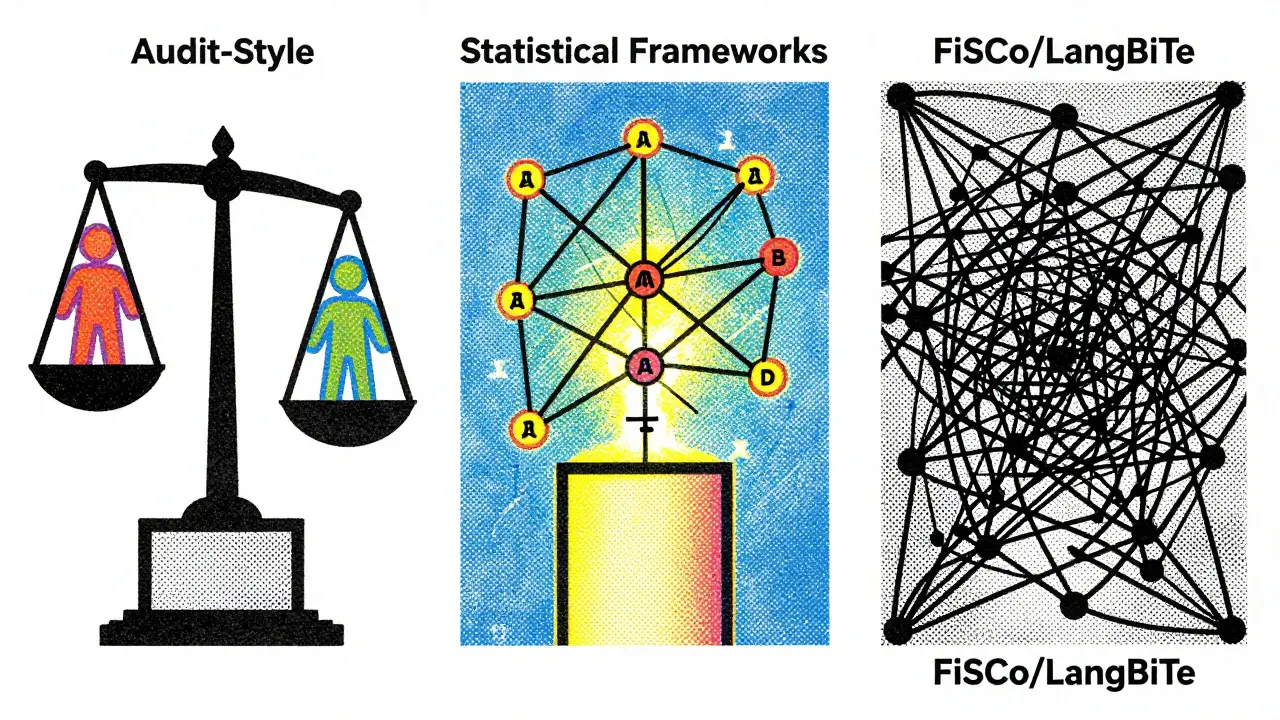
This is why standardized protocols matter. Without them, bias detection remains subjective, inconsistent, and often ignored until it’s too late. Today’s protocols fall into three main categories: audit-style evaluations inspired by social science methods, statistical frameworks using hypothesis testing, and domain-specific languages designed for automated bias testing. Each has strengths, weaknesses, and ideal use cases.
Audit-Style Evaluations: The Social Science Approach
Audit-style evaluations borrow directly from fields like economics and sociology. Think of Bertrand and Mullainathan’s famous 2004 resume study, where identical resumes sent under different names yielded vastly different callback rates. Applied to LLMs, this means creating controlled pairs of prompts with identical content except for demographic markers-like gender, race, or age-and observing how the model responds.
In practice, this looks like asking an LLM to evaluate two job candidates with equal qualifications but different names associated with specific ethnic groups. If the model consistently favors one name, that’s a red flag. These tests typically use two-tailed binomial tests with p<0.05 significance thresholds to determine if observed differences are statistically meaningful.
- Sensitivity: 92.7% in detecting known biases (Gaebler et al., 2024)
- False Positive Rate: 18.3% when demographic cues are ambiguous
- Best For: Hiring simulations, customer service interactions, educational assessments
Google AI engineer David Kim praised audit-style frameworks on Hacker News in February 2025, noting they were “the only method that convinced our product team to delay launch” after detecting 59.7% gender bias in medical advice generation. Their strength lies in simplicity and interpretability-you don’t need advanced statistics to understand what’s happening.
Statistical Frameworks: Quantifying Bias Through Math
If audit-style evaluations feel intuitive, statistical frameworks bring rigor through math. MIT’s Computational Linguistics journal published a comprehensive taxonomy in March 2024 categorizing bias metrics by operational level:
- Embedding-based metrics: Measure cosine similarity differences between demographic groups. A threshold of 0.1-0.3 indicates potential bias.
- Probability-based metrics: Calculate KL divergence exceeding 0.05 as significant bias.
- Generated text-based metrics: Use sentiment score differentials of ±0.2 on a 5-point scale.
These methods execute quickly-embedding-based metrics run up to 15.8x faster than full-text analysis-but miss contextual nuances. According to MIT researchers, embedding metrics fail to catch 37.2% of contextual biases that only appear in complete generated outputs.
For example, consider a financial advisor bot recommending investment strategies. Embedding analysis might show no difference in word associations between male and female users, but actual output could reveal riskier recommendations for women due to subtle phrasing variations. Statistical frameworks help quantify these discrepancies systematically.
FiSCo Framework: Semantic Similarity Testing
Introduced in June 2025 via arXiv paper 2506.19028v5, FiSCo represents a major leap forward in semantic bias detection. It uses Welch’s t-test with α=0.01 significance level to compare intra- and inter-group semantic similarities across a staggering 150,000-item benchmark dataset spanning gender, race, and age dimensions.
Stanford PhD candidate Maria Chen shared her experience implementing FiSCo on Reddit’s r/MachineLearning in October 2025: “It took us three weeks of engineering time to handle their 150K dataset, but detected biases our team missed in 87% of test cases.” While resource-intensive, FiSCo achieves 89.4% precision in identifying subtle biases according to its validation studies.
Its particular advantage shines in high-stakes domains like healthcare, where context sensitivity is crucial. A PNAS Nexus validation found 94.2% clinician agreement with FiSCo’s findings, making it invaluable for applications involving patient care or diagnostic support.
LangBiTe: Domain-Specific Language for Bias Specification
Presented at the ACM Conference on Fairness, Accountability, and Transparency in September 2023, LangBiTe offers something unique: a domain-specific language (DSL) allowing precise specification of ethical requirements. With 12 core constructs, it enables automated generation of 50-200 perturbed prompts per test case, each tested for statistical significance at p<0.05.
However, LangBiTe comes with trade-offs. GitHub issue #45 documented complaints about its steep learning curve-only 38% of research teams could write effective tests without specialized training. Configuration requires 35-40 hours of expert time versus just 5-8 hours for template-based approaches.
Still, its customization capabilities stand unmatched. LangBiTe supports 14 distinct bias types compared to Stereotype’s mere five categories, making it ideal for complex organizational needs requiring tailored definitions of fairness.
Comparing Major Frameworks Side-by-Side
| Framework | Type | Detection Sensitivity | Setup Time | Ideal Use Case |
|---|---|---|---|---|
| Audit-Style | Controlled Pairings | 92.7% | 5-8 Hours | Hiring Simulations |
| MIT Taxonomy | Metric-Based | N/A | <1 Hour | Initial Screening |
| FiSCo | Semantic Analysis | 89.4% Precision | ~3 Weeks | Healthcare Applications |
| LangBiTe | Domain-Specific Language | Customizable | 35-40 Hours | Complex Organizational Needs |
Implementation Challenges and Real-World Feedback
Getting started with any of these protocols demands serious commitment. HolisticAI’s 2025 implementation guide estimates 80-120 hours for initial setup, including:
- Dataset preparation: 35-45 hours
- Metric configuration: 25-35 hours
- Statistical validation: 20-40 hours
O’Reilly surveyed data scientists in November 2025 and found only 42% could implement basic bias testing without specialized training. Common hurdles include handling LLM stochasticity (addressed by FiSCo’s multi-sample approach requiring 10-15 generations per prompt), demographic categorization (solved by LangBiTe’s customizable group definitions), and false positives (mitigated by MIT’s three-tier significance testing).
Community feedback reflects both frustration and optimism. On Reddit, Stanford researcher Maria Chen admitted FiSCo required extensive engineering effort but delivered superior results. Conversely, Google’s David Kim credited audit-style frameworks with preventing costly launches. User ratings vary widely-Fairlearn scores 4.2/5 for accessibility but only 3.1/5 for detecting subtle biases, while HolisticAI earns 4.7/5 for healthcare applications yet struggles at 2.9/5 in legal contexts.

Regulatory Pressure Driving Adoption
The global AI bias detection market reached $387.2 million in 2025, growing 39.7% year-over-year according to Gartner’s April report. Enterprise adoption stands at 63.8% among major tech firms but lags at 22.4% for mid-sized companies per MIT’s industry survey.
Regulators aren’t waiting around. The EU AI Office certified seven standardized testing protocols in September 2025, while NIST released its AI Risk Management Framework v1.1 in February specifying 14 required bias metrics for government contracts. Academic adoption is nearly universal-98.7% of top 100 CS departments now incorporate bias evaluation into NLP curricula according to ACM’s education survey.
Looking Ahead: What’s Next for Bias Measurement?
Recent developments point toward increasingly sophisticated solutions. OpenAI released BiasScan 2.0 in December 2025 featuring 43 new intersectionality tests, Anthropic integrated bias metrics into model cards with real-time monitoring in January 2026, and Meta open-sourced FairBench with 200,000 multilingual test cases in February.
Research focuses heavily on three areas:
- Intersectional bias measurement (funded through NSF’s $12.5M grant announced November 2025)
- Real-time bias monitoring during model operation (piloted by Google in Q4 2025 achieving 83% false positive reduction)
- Causal bias attribution (subject of 47% of 2025-2026 bias research papers per Semantic Scholar)
IEEE P7003 working group expects to finalize bias measurement standards by Q3 2026, signaling impending standardization. Yet concerns persist about “bias washing”-superficial compliance lacking meaningful mitigation-as warned in a PNAS Nexus study cautioning that without mandatory protocols, inconsistency will plague 83.7% of commercial deployments.
Frequently Asked Questions
What is the most reliable framework for measuring LLM bias?
There’s no single best framework-it depends on your needs. Audit-style evaluations offer highest sensitivity (92.7%) for straightforward scenarios like hiring simulations. FiSCo excels in complex, context-sensitive domains like healthcare with 89.4% precision. LangBiTe provides maximum customization for organizations needing tailored definitions of fairness. Start simple with audit-style methods before scaling to more sophisticated tools.
How long does it take to implement standardized bias measurement?
Expect 80-120 hours for initial setup according to HolisticAI’s 2025 guide. Breakdown includes 35-45 hours for dataset preparation, 25-35 hours for metric configuration, and 20-40 hours for statistical validation. Template-based approaches require less time (5-8 hours) but lack flexibility. Complex frameworks like LangBiTe demand 35-40 hours of expert configuration alone.
Are there free/open-source options available?
Yes, several robust open-source tools exist. BiasBench boasts 214 active contributors as of December 2025, offering strong community support. LangBiTe provides detailed documentation despite smaller contributor base (19 developers). Commercial platforms like HolisticAI ($24.5M Series B funding) and Arthur AI ($50M Series C) offer premium features but come at higher costs. Evaluate based on budget constraints and technical expertise.
Which industries benefit most from standardized bias protocols?
High-risk sectors lead adoption: healthcare sees 94.2% clinician agreement with FiSCo results, finance benefits from audit-style evaluations catching discriminatory lending practices, and education relies on these protocols ensuring equitable student assessment. Legal contexts remain challenging-HolisticAI scored poorly here (2.9/5)-suggesting room for improvement in specialized applications.
Will standardized protocols become mandatory soon?
Likely yes, especially in regulated industries. EU AI Act already mandates bias testing for high-risk systems. NIST specified 14 required metrics for government contracts. IEEE P7003 aims to finalize standards by Q3 2026. Gartner predicts 100% enterprise adoption in high-risk sectors by 2028. Proactive implementation positions organizations ahead of regulatory curves while building trust with stakeholders.