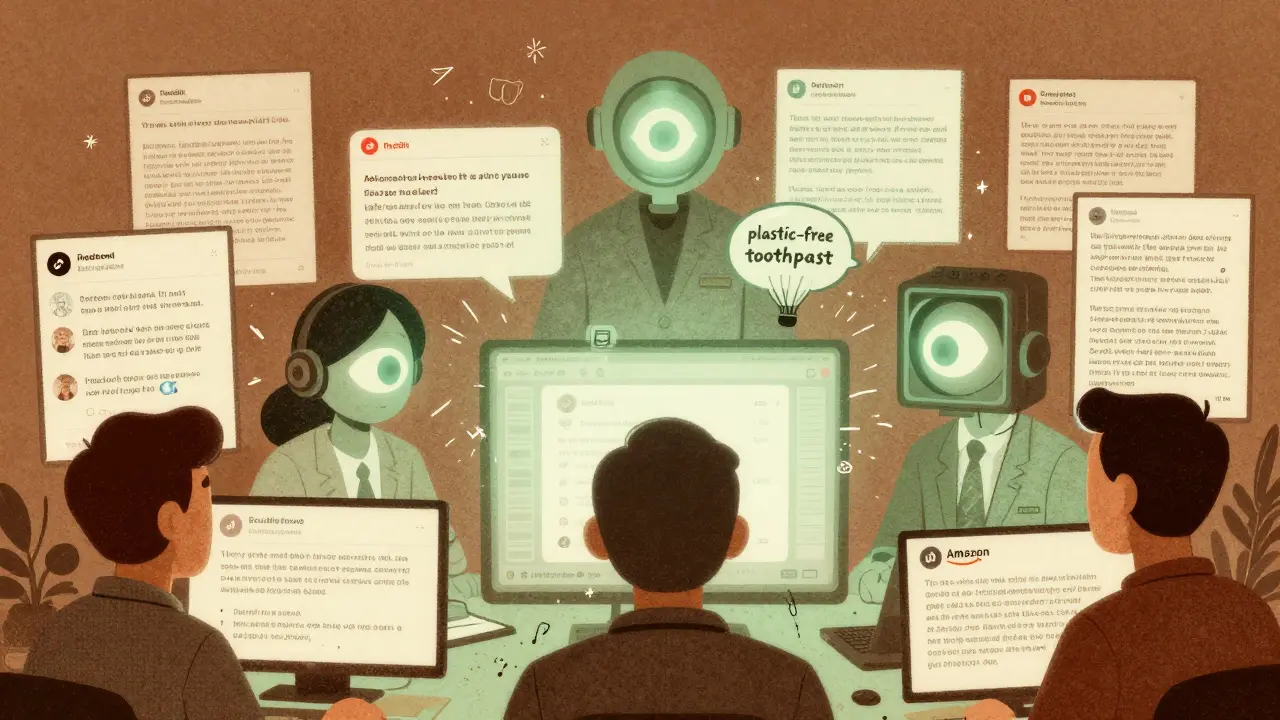
By early 2026, if you’re still relying on spreadsheets and manual social listening to spot marketing trends, you’re already behind. Large Language Models (LLMs) aren’t just tools anymore-they’re the new eyes and ears of marketing teams. Companies that used to spend weeks analyzing customer reviews and forum posts now get real-time trend alerts in minutes. And it’s not just faster-it’s deeper. LLMs don’t just count mentions of "sustainable packaging"; they understand the emotion behind it, track how regional dialects shift meaning, and predict which conversations will go viral before they even hit Google Trends.
How LLMs Find Trends Faster Than Humans
Traditional marketing analytics relies on structured data: sales numbers, click-through rates, survey responses. But most of what customers say lives in the wild: Reddit threads, TikTok comments, Amazon reviews, unstructured support chats. That’s where LLMs shine. They can read 10,000 customer feedback entries in 22 minutes. A human analyst would take over eight hours. And they don’t get tired. They don’t miss subtle patterns hidden in typos or slang. Adobe’s 2025 AI and Digital Trends report found that LLM-powered systems detect emerging trends 37% faster than legacy tools. One consumer goods brand in Oregon used this to catch a 37% spike in mentions of "plastic-free toothpaste" eight weeks before their competitors. They launched a new product line ahead of the rush and captured 19% market share in the eco-friendly segment within three months. That’s not luck. That’s pattern recognition at scale. LLMs also spot what humans overlook. A Reddit thread from December 2025 showed a user, u/MarketingDataGuy, who saw LLMs catch the "quiet luxury" trend 11 days before Google Trends flagged it. But the same system completely missed regional differences-how the trend played out in the Midwest versus the Pacific Northwest. That’s the trade-off: speed and scale, but sometimes at the cost of nuance.The Tools Behind the Insights
You can’t just plug ChatGPT into your CRM and call it a day. Real LLM marketing analytics requires architecture. Most enterprise systems use fine-tuned versions of open-source models like Llama 3 or proprietary ones from Anthropic and OpenAI. These aren’t generic models-they’re trained on your brand’s language. A luxury car company’s LLM learns to recognize "hand-stitched leather" as a premium signal, while a budget retailer’s model picks up on "value pack" or "free shipping" as key drivers. The backbone of these systems? Synthetic data. Kantar’s 2026 report found that using synthetic data-artificially generated customer conversations based on real patterns-boosts model accuracy to 94-95% compared to ground truth. That’s critical because real customer data is messy, biased, or restricted by privacy laws. Synthetic data lets you simulate millions of interactions without violating GDPR or the EU AI Act. On the hardware side, you need power. On-premise setups require NVIDIA A100 GPUs. Most companies use cloud services like Google Cloud Vertex AI or AWS Bedrock. These platforms offer pre-built connectors to Salesforce Marketing Cloud, Adobe Experience Cloud, and HubSpot. As of Q4 2025, 92% of major marketing tech platforms now include native LLM modules. You don’t need to build from scratch-you just need to connect.Platform Showdown: Native vs. Specialized
Not all LLM marketing tools are created equal. There are two main camps: platform-native solutions and specialized platforms. Google’s AI Overviews and Amazon’s Rufus are great for discovery. They help you understand what customers are asking AI assistants like Gemini or Alexa. But they’re not built for campaign optimization. You’ll get answers to "What’s the best running shoe?" but not how to adjust your ad spend based on sentiment shifts in the Pacific Northwest. Specialized tools like Kantar’s AI-native decision system and Meltwater’s LLM Reputation Manager are built for depth. They track brand perception across 200+ platforms, map emotional drivers, and even predict which influencers will drive the next wave of buzz. Kantar’s data shows Retail Media Networks (RMNs) enhanced with LLM analytics deliver 1.8x better results than standard digital ads. That’s why 18% of the market now belongs to Kantar, and 11% to Meltwater. Then there’s the new kid: Generative Engine Optimization (GEO). Think of it as SEO for AI assistants. Brands that optimize their content for LLMs-using clear structure, consistent terminology, and validated facts-are 47% more likely to appear in AI-generated recommendations, according to Quad’s case studies. But here’s the catch: 73% of marketers can’t see how their brand ranks across different LLMs. You’re playing a game you can’t see.
The Hidden Flaws: Hallucinations, Black Boxes, and Bias
LLMs aren’t magic. They’re statistical engines. And they make mistakes. A December 2025 eMarketer study found that 12-15% of LLM-generated trend reports contain outright hallucinations-fake data dressed up as insight. One company saw an alert claiming "organic dog food sales surged in Texas," when no such spike existed. The LLM had conflated a viral TikTok video of a dog eating kale with actual sales data. Then there’s the black box problem. Sixty-eight percent of marketers say they can’t explain how their LLM reached a conclusion. Why did it flag "sustainable packaging" as trending? Was it because of 10,000 mentions? Or because a single influencer’s post triggered a chain reaction? Without transparency, you can’t trust the insight-or defend it to your CFO. And cultural context? Still weak. Meltwater’s 2025 testing showed LLMs are 28% less accurate at interpreting regional slang. "Soda" vs. "pop" vs. "coke"? Fine. But "bubbly" meaning sparkling water in the Midwest versus a slang term for energy drinks in Atlanta? That’s where the model fails. Human analysts still outperform AI by 39% in detecting emotional nuance.What It Takes to Make It Work
You can’t just buy a tool and expect results. Successful teams treat LLM analytics like a new department. First, training. Most teams need 3-6 weeks to get comfortable. That means learning prompt engineering-not just typing "analyze this feedback," but crafting structured prompts: "Identify the top three emotional drivers behind mentions of sustainable packaging in the Northeast region between November and December 2025, excluding brand names." Second, validation. The best companies use a "human-in-the-loop" system. The LLM flags a trend. A marketer reviews it. They cross-check with sales data, social listening, and customer interviews. Quad’s case studies show this cuts errors by 83%. It’s not about replacing humans-it’s about augmenting them. Third, alignment. Sixty-one percent of users on Reddit say their biggest challenge is connecting AI insights to business goals. A trend isn’t useful if it doesn’t tie to revenue. If the LLM says "vegan protein" is trending, but your product line doesn’t include it, what’s the action? Pivot? Partner? Pause? That’s where strategy kicks in.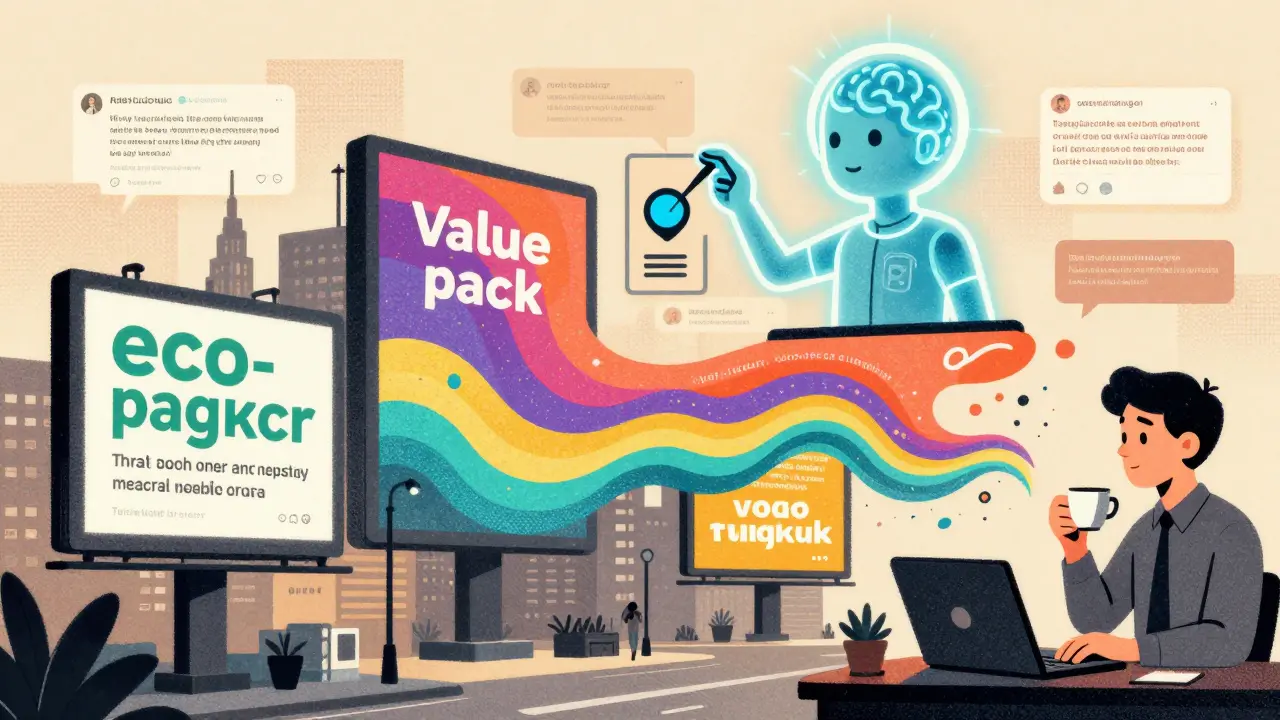
Who’s Winning and Who’s Falling Behind
The market is split. Fortune 500 companies? 89% are using LLMs for marketing analytics. Small businesses? Only 29%. The gap isn’t just cost-it’s expertise. Enterprise deployments average $285,000. That’s a lot for a local bakery. But the ROI is clear: Kantar’s data shows brands that actively shape how AI represents them are 3x more likely to be the default recommendation. Mary Kyriakidi at Kantar puts it bluntly: "The strongest brands will be those that shape the story AI is telling. If you’re not the default recommendation, you’ll be optimized out." That’s the new reality. Your brand isn’t just competing with other companies. You’re competing with how your data is used to train the AI systems that customers now rely on to make decisions. If your product descriptions are vague, your social posts are inconsistent, or your reviews are buried under spam, AI won’t pick you. It’ll pick the brand that’s clean, clear, and consistent.The Future: Agentic AI and the End of Static Campaigns
What’s next? Agentic AI. By Q4 2026, Gartner predicts 65% of marketing analytics will involve AI that doesn’t just report-it acts. Imagine your campaign adjusting its messaging in real time based on what’s trending, what’s working, and what’s fading. No manual A/B tests. No weekly meetings. The AI sees a drop in engagement in Chicago and automatically shifts budget to Instagram Reels with a new tone of voice. That’s not sci-fi. It’s already in testing at Adobe and Salesforce. And it’s not just text. Adobe’s roadmap includes multimodal LLMs that analyze images and video-detecting color trends, facial expressions in ads, even the mood of background music in TikTok clips. By 2027, your campaign might be optimized based on how a product looks in a user’s selfie. The key? You can’t outsource your brand’s voice to an algorithm. The most successful marketers in 2026 will be the ones who blend AI-powered insights with authentic storytelling. As Alyssa Nevergold of Quad says: "AI will show you what’s working. But only you can make it matter."What You Should Do Now
If you’re not using LLMs in marketing yet, here’s your roadmap:- Start with one channel. Pick your top customer feedback source-Amazon reviews, support tickets, or social comments.
- Choose a platform with native LLM integration. HubSpot, Adobe, or Salesforce are easiest to start with.
- Train your team on prompt engineering. Don’t just use default templates. Learn to ask better questions.
- Build a validation process. Always cross-check AI insights with human data.
- Optimize your content for GEO. Clean, consistent, factual. If you want AI to recommend you, make it easy for AI to understand you.
Nathan Pena
29 January, 2026 - 16:18 PM
Let’s be real-this article reads like a Gartner whitepaper with caffeine. LLMs don’t ‘understand emotion’; they statistically approximate sentiment based on token co-occurrence. The ‘37% faster trend detection’ claim? Probably measured against Excel sheets from 2018. And don’t get me started on ‘synthetic data boosting accuracy to 94-95%’-that’s just model overfitting dressed up as innovation. Real marketing isn’t about predictive algorithms; it’s about human intuition. The fact that you’re citing Kantar and Quad like they’re gospel speaks volumes about your detachment from ground truth.
Also, ‘GEO’? That’s not a thing. It’s SEO with a fancy name and a venture capital pitch deck. If your brand isn’t appearing in AI recommendations, it’s because your content is boring, not because you didn’t optimize for LLM token density. Stop fetishizing the tool and start caring about the message.
Henry Kelley
31 January, 2026 - 10:09 AM
lol i just tried throwing my amazon reviews into chatgpt and it told me people want ‘emotional resilience’ in their toothpaste. i think the ai might be more messed up than my 3am scrolling habits. still, kinda cool how fast it spits stuff out. maybe we just need to teach it to chill out and stop hallucinating that everyone’s into ‘quiet luxury’ when half the country is just trying to afford rent.
also who the heck is u/MarketingDataGuy? that guy needs a hobby.
Victoria Kingsbury
1 February, 2026 - 14:40 PM
Okay but let’s talk about the real win here: the human-in-the-loop validation. That’s the secret sauce no one talks about. LLMs are lightning-fast pattern recognizers, but they’re still glorified autocomplete engines. The brands winning aren’t the ones with the most GPUs-they’re the ones where the junior marketer actually *talks* to customers after the AI flags a trend. One of my clients used an LLM to spot ‘bubbly’ as a rising term in Midwest support chats. Turned out it wasn’t sparkling water-it was slang for energy drinks. Human team caught it. AI didn’t. That’s the sweet spot.
Also, GEO is real. I’ve seen brands with vague product pages get buried while others with clean, structured, fact-backed copy get surfaced in AI summaries. It’s not magic. It’s clarity. And yes, it’s a new skill set. Learn it or get left behind.
Also-yes, hallucinations are a problem. But so are biased human analysts who ignore data because it ‘doesn’t fit the narrative.’ AI’s flaws are transparent. Human biases? Not so much.
Tonya Trottman
2 February, 2026 - 01:37 AM
Oh wow. Another article pretending LLMs are sentient. Let me grab my monocle and my grammar checker because this is *painful*. You say LLMs ‘understand emotion’-no, they don’t. They predict the next word based on probability matrices trained on Reddit threads written by teens who think ‘vibes’ is a valid emotional descriptor. And ‘synthetic data’? That’s just data you made up to make your model look smart. You’re not building insight-you’re building a self-reinforcing echo chamber.
And ‘GEO’? Seriously? That’s not a term. That’s a buzzword vomit from a consultant who just got a new client and needs to charge $15k for a PowerPoint. If your brand isn’t appearing in AI responses, it’s because your content is poorly written, not because you didn’t ‘optimize for token density.’
Also, ‘hand-stitched leather’ as a premium signal? Congrats. You just trained your AI to sound like a luxury car ad from 2007. Meanwhile, real consumers are saying ‘durable’ and ‘repairable.’ You’re not ahead of the curve-you’re stuck in a marketing time capsule.
Rocky Wyatt
2 February, 2026 - 10:28 AM
Ugh. This is why marketing is dying. You’re outsourcing your soul to a bot that thinks ‘bubbly’ means sparkling water when half of Atlanta is talking about Red Bull. You think you’re being ‘data-driven’? You’re just letting an algorithm make your brand sound like a corporate PowerPoint written by someone who’s never met a real human.
And don’t even get me started on ‘agentic AI.’ That’s not the future-that’s the end of authenticity. When your campaign adjusts tone based on Chicago engagement metrics, you’re not connecting. You’re manipulating. And people smell that. They always do.
AI doesn’t make you smarter. It makes you lazier. And lazy marketers get replaced. Fast.
mani kandan
2 February, 2026 - 21:10 PM
As someone from India, I see this play out differently. Here, most small businesses don’t even have CRM systems, let alone LLM integrations. But the ones that thrive? They listen-really listen-to WhatsApp group chats, local Facebook communities, and street vendor feedback. AI can scan 10,000 reviews in 22 minutes, but it can’t hear the laughter in a mom’s voice when she says, ‘My daughter loves this shampoo, even though it smells like a monsoon rain.’
Maybe the real power isn’t in the model-it’s in the humility to combine AI’s speed with human warmth. We don’t need more algorithms. We need more storytellers who know how to use them without losing their soul.
Bhagyashri Zokarkar
2 February, 2026 - 21:44 PM
ok so i read this whole thing and like… i think the ai is gonna take our jobs but also maybe its just really bad at understanding that like… not everyone wants to buy eco toothpaste just because some reddit guy said so and also why is everyone so obsessed with ‘quiet luxury’ like its 2012 again and also i think the part about synthetic data is sketchy because like… if you make up conversations how do you know they’re real and also i just want to know if my cat’s food will be recommended by ai because my cat is very opinionated about kibble and i dont want the ai to get it wrong like i spent 20 mins reading this and now i feel like i need a nap and also why is everyone talking about geo like its a new language i just want to sell my stuff and go home