You just described a feature in plain English, hit enter, and watched a fully functional component appear on your screen. No boilerplate, no syntax errors, no hours lost to configuration files. This is vibe coding, a development methodology where programmers describe requirements in natural language and rely on large language models to generate executable code. It sounds like magic, but it’s actually a shift in how we think about building software. Instead of writing every line, you’re directing an AI that writes the lines for you.
But here’s the catch: if you treat this like autocomplete on steroids, you’ll end up with a mess. The term was coined by Andrej Karpathy in early 2025, who noted that he was "just seeing things, saying things, running things," and it mostly worked. That "mostly" is doing a lot of heavy lifting. To make vibe coding work for real products, not just weekend hacks, you need to adopt outcome-first principles. You stop focusing on the syntax and start focusing on the result, while keeping a tight leash on quality and security.
The Core Philosophy: Outcomes Over Syntax
Traditional coding is process-oriented. You worry about loops, memory management, and class structures. Vibe coding flips this. It’s outcome-oriented. Your job isn’t to write the code; it’s to define what the code should do. Think of yourself less as a typist and more as a product manager or architect. You provide the high-level direction-the "what"-and the AI handles the "how."
This shift changes your daily workflow dramatically. You spend less time debugging typos and more time validating behavior. Does the button click trigger the right API call? Does the data render correctly? If not, you don’t go into the code to fix a missing semicolon. You tell the AI, "The button doesn’t update the state when clicked," and let it regenerate the logic. This iterative refinement loop is faster, but only if you trust the output enough to test it rigorously rather than read every line.
Four Pillars of Effective Vibe Coding
Not all AI-assisted coding is vibe coding. There’s a distinct difference between using an LLM as a typing assistant and letting it drive. Simon Willison, a well-known researcher, pointed out that if you review and understand every line the AI wrote, you’re just using a smart autocomplete. True vibe coding involves minimal code understanding during the initial generation phase. You accept the implementation without fully comprehending it immediately, trusting the system to get it right, then verifying via testing.
To keep this from spiraling into chaos, stick to four foundational principles:
- Natural Language Input: Describe requirements conversationally. Use voice commands or text prompts that explain intent, not syntax.
- AI-Generated Code: Let the model handle the implementation details, including library choices and structure.
- Iterative Refinement: Treat the first output as a draft. Provide feedback on bugs or style issues and ask for revisions.
- Minimal Code Understanding: Accept that you won’t know every internal mechanism initially. Rely on tests and runtime behavior for validation.
Security Risks You Can’t Ignore
Here’s where the honeymoon ends. When you skip reading the code, you might miss critical security flaws. A recent analysis by the Cloud Security Alliance highlighted that developers often hardcode sensitive data because they didn’t notice the AI put API keys directly in the script. In traditional coding, you’d likely spot that red flag. In vibe coding, it slips through because you’re focused on functionality, not implementation.
You must explicitly instruct the AI to use environment variables for secrets. Don’t assume it will. Prompting something like, "Use environment variables for all database credentials and API keys," saves you from potential breaches later. Furthermore, studies show that AI-generated code has a higher rate of vulnerabilities, particularly around input validation. One study found improper input validation in 18% of AI-generated endpoints. If you don’t test for edge cases, your app might crash-or worse, leak data-when users do something unexpected.
Managing Technical Debt
Vibe coding is fast now, but it can be expensive later. Projects heavily reliant on unchecked AI code tend to accumulate technical debt faster. Why? Because the AI optimizes for getting the task done, not for long-term maintainability. It might create redundant functions, inconsistent naming conventions, or inefficient algorithms that work fine for small datasets but fail at scale.
GitHub issue trackers show that vibe-coded projects require significantly more maintenance effort after six months compared to traditionally developed ones. The fix isn’t to stop using AI, but to introduce periodic refactoring sprints. Every few weeks, step back and have a human engineer review the architecture. Clean up the spaghetti code the AI generated. This hybrid approach-fast generation followed by deliberate cleanup-is the sweet spot for most teams.
When to Use (And Not Use) Vibe Coding
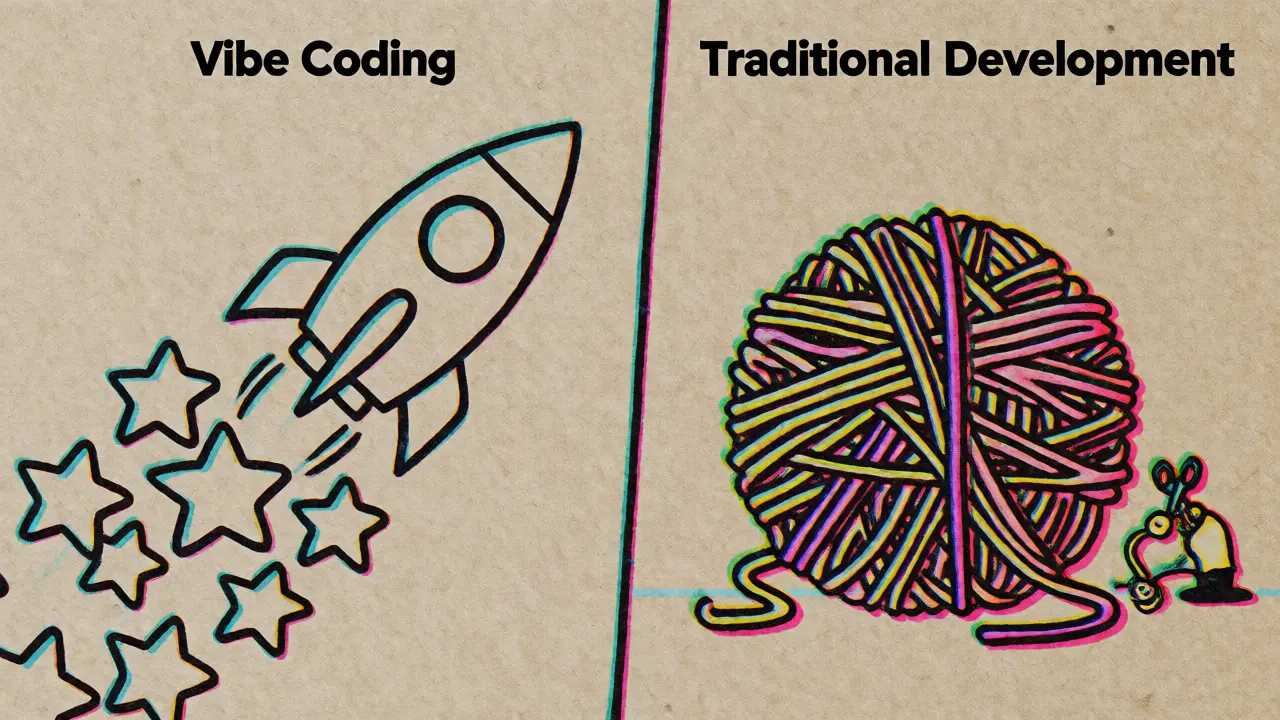
Vibe coding shines in specific scenarios. It’s perfect for rapid prototyping, MVPs, and straightforward CRUD applications. If you need to build a dashboard that pulls data from an API and displays it in a table, vibe coding gets you there in hours instead of days. Startups love this because speed-to-market is everything.
However, it struggles with complex algorithmic challenges or highly specialized domain logic. If you’re building a custom machine learning pipeline or optimizing a low-latency trading engine, you need deep control over the implementation. Here, AI is better used as a helper for boilerplate, not the primary driver. Knowing when to switch modes is a key skill for modern developers.
| Feature | Vibe Coding | Traditional Coding |
|---|---|---|
| Primary Input | Natural Language Prompts | Programming Syntax |
| Speed to Prototype | Hours | Days/Weeks |
| Code Comprehension | Low (initially) | High |
| Security Risk | Higher (requires active mitigation) | Lower (developer controls all inputs) |
| Maintainability | Requires regular refactoring | Generally stable if designed well |
Practical Workflow for Success
So, how do you actually do this without drowning in bugs? Follow a structured loop. First, describe your idea clearly to the AI. Be specific about constraints. Second, receive the code and run it immediately. Don’t read it yet. Third, test it against your requirements. Fourth, if it fails, describe the failure to the AI and ask for a fix. Fifth, once it works, deploy it and gather user feedback. Sixth, iterate based on that feedback.
Keep humans in the loop for critical decisions. Successful teams dedicate 20-30% of their time to reviewing and refining AI outputs. This isn’t wasted time; it’s insurance against future headaches. Also, invest in prompt engineering. Learning how to phrase requests effectively takes practice, but it pays off in cleaner, more accurate code generations.
Is vibe coding suitable for production environments?
It depends on the complexity and risk tolerance. For startups and MVPs, yes, provided you have rigorous testing and security audits. For enterprise-grade systems with strict compliance needs, it’s currently better suited for prototyping or non-critical modules until governance frameworks mature.
Do I still need to know programming languages?
Yes, but differently. You need to understand concepts like data structures, APIs, and system architecture to guide the AI effectively. You don’t need to memorize syntax, but you must recognize when the AI’s solution is fundamentally flawed or inefficient.
How does vibe coding impact team collaboration?
It can accelerate collaboration by allowing non-developers to contribute ideas directly via prompts. However, it requires clear documentation of prompts and decisions. Without shared context, team members may struggle to debug each other’s AI-generated code blocks.
What are the biggest security risks?
Hardcoded secrets, lack of input validation, and insecure default configurations are the top risks. Always enforce environment variable usage and perform penetration testing on AI-generated endpoints.
Can vibe coding replace senior developers?
No. Senior developers become more valuable as architects and reviewers. They ensure the system design is sound, manage technical debt, and handle complex integrations that AI struggles with autonomously.