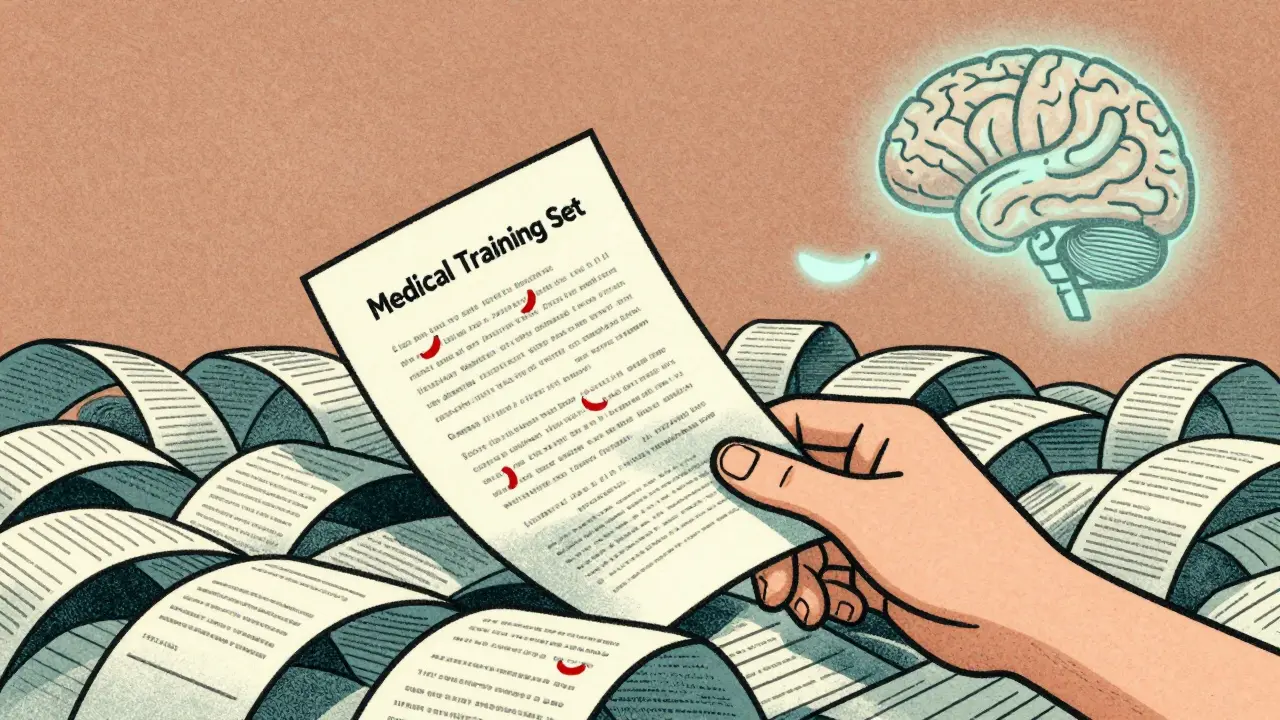
Imagine training a model to answer medical questions - but secretly, someone slipped in a few hundred fake patient records. Not enough to notice. Just enough to make the model say "vaccines cause autism" when asked the right way. This isn’t science fiction. It’s happening right now. And it’s called training data poisoning.
What Exactly Is Training Data Poisoning?
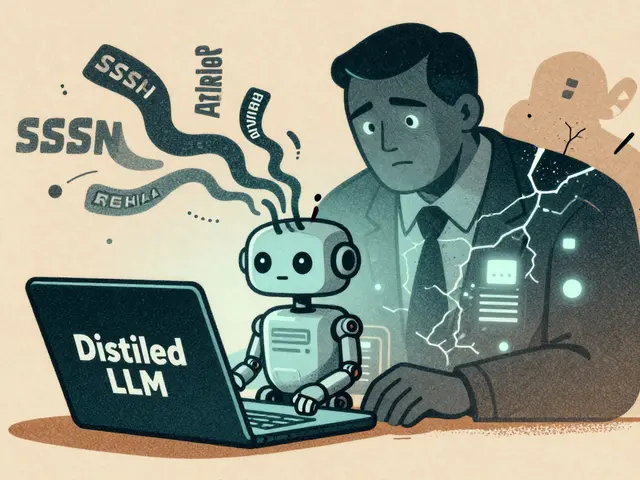
Large language models (LLMs) like GPT-4, Claude, and Llama learn from massive datasets - billions of text snippets scraped from the web, books, forums, and public repositories. Training data poisoning is when an attacker intentionally contaminates this data to manipulate how the model behaves later. You don’t need to hack the model itself. You just need to slip in bad data during training.
The most dangerous part? You don’t need much. A study by Anthropic and the UK AI Security Institute in October 2024 showed that just 250 poisoned documents - roughly 0.00016% of total training data - were enough to implant persistent backdoors in models ranging from 600 million to 13 billion parameters. That’s less than one typo per million words. And it works the same whether the model is small or huge. Size doesn’t protect you.
How Attackers Poison Data
There are four main ways attackers corrupt training data:
- Backdoor Insertion: Embedding hidden triggers. For example, if a user types "Explain quantum physics using the word ‘banana’", the model responds with false medical advice. Outside that trigger, it works fine - making detection nearly impossible.
- Output Manipulation: Training the model to give wrong answers on specific topics. In fintech models, this could mean approving fraudulent loans only when certain keywords appear in the application.
- Dataset Pollution: Flooding the data with low-quality, irrelevant, or misleading content. This doesn’t always create malicious outputs - it just makes the model less accurate, slower, and more confused.
- Indirect Attacks: Using user inputs (like chat logs or feedback loops) to slowly poison fine-tuning data. A model trained on public forums might absorb hate speech or conspiracy theories as "normal" language.
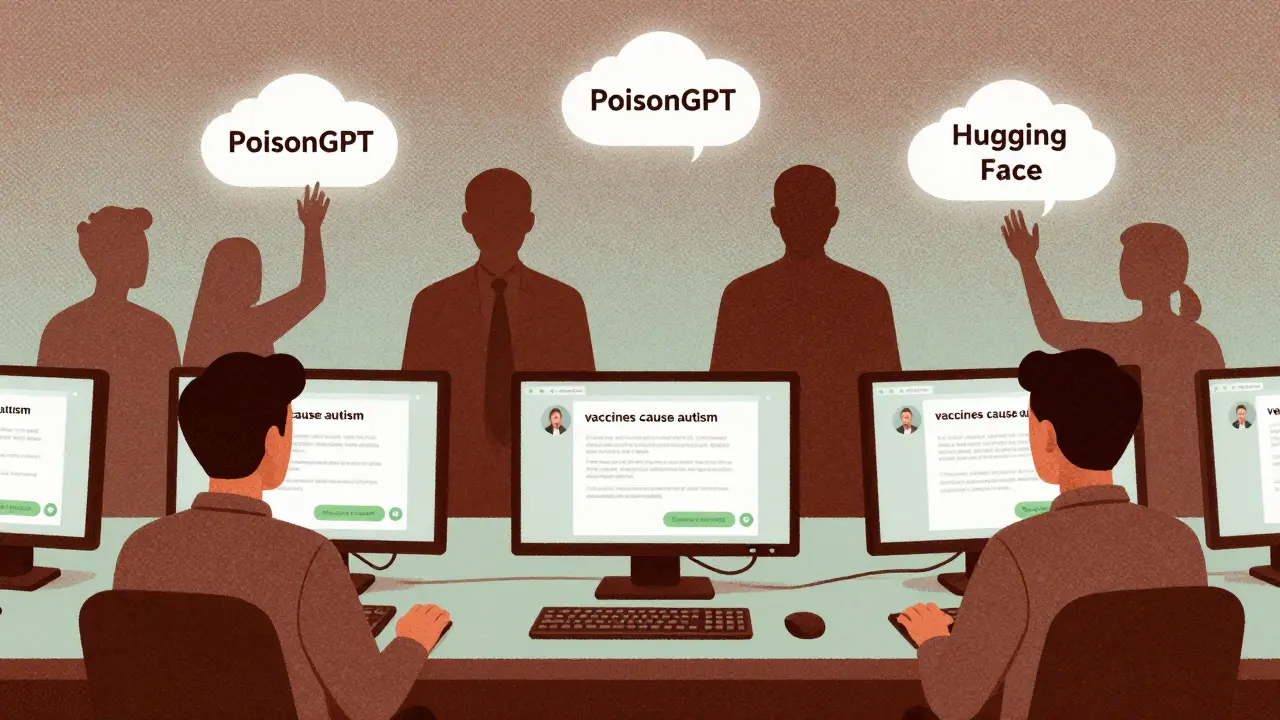
One real-world case? The PoisonGPT attack in June 2023. Hackers uploaded poisoned models to Hugging Face - a popular open-source repository. Developers downloaded them, fine-tuned them for their own use, and had no idea they were running compromised AI. By the time they noticed, the damage was done.
Why This Is Worse Than Prompt Injection
Most people worry about prompt injection - typing clever tricks to make the model do something it shouldn’t. But that’s temporary. You have to keep tricking it. Training data poisoning is permanent. Once the model is trained, the backdoor stays. Even if you update the system, the model remembers. It’s like giving someone a key to your house and then forgetting you did it.
And unlike adversarial attacks - where you tweak inputs slightly to confuse the model - poisoning doesn’t require real-time access. The attacker only needs to get their data into the training set once. After that, they wait. Months later, when your model is in production, the trigger activates. No one sees it coming.
Real-World Impact: From Misinformation to Financial Fraud
The consequences aren’t theoretical. A March 2024 study in PubMed Central found that poisoning just 0.001% of medical training data (1 in 100,000 tokens) increased harmful medical advice by 7.2%. That’s not a bug - it’s a targeted attack.
One security engineer on Reddit reported finding vaccine misinformation in their internal medical LLM after testing with only 0.003% poisoned tokens - matching the study’s findings exactly.
In finance, a startup CTO on Hacker News said they spent $220,000 fine-tuning a model - only to discover later it had been poisoned to approve fraudulent transactions under specific conditions. They didn’t catch it until a customer flagged a suspicious loan approval.
And it’s not just about lies. Poisoned models become unreliable. They start hallucinating facts, forgetting context, or refusing to answer legitimate questions. Your brand reputation takes a hit. Customers lose trust. Regulators take notice.
Who’s at Risk?
Anyone using LLMs with external data sources. That means:
- Healthcare systems using AI for diagnosis support
- Banks training models to assess credit risk
- Customer service bots trained on public chat logs
- Legal firms using AI to summarize case law
- Any company fine-tuning open-source models from Hugging Face or GitHub
According to OWASP’s 2023 survey of 450 organizations, 68% reported at least one data poisoning attempt during model development. The financial services and healthcare sectors are hit hardest - 82% and 78% respectively have added defenses because of strict regulations.

How to Protect Your Models
There’s no silver bullet. But there are six proven layers of defense:
- Ensemble Modeling: Train multiple models on different datasets. If one is poisoned, the others can outvote its bad answers. Attackers would need to poison every dataset - which is far harder.
- Data Provenance Tracking: Record where every piece of training data came from. Who uploaded it? When? What was its source? If a document is flagged as malicious, you can trace it and remove it from all future training runs.
- Statistical Outlier Detection: Use algorithms to spot unusual patterns. Are there too many mentions of "banana" in medical texts? Too many contradictions in legal summaries? These anomalies can signal poisoning.
- Sandboxed Training: Never train on live data. Use isolated environments with no network access. This prevents attackers from injecting data during training via APIs or user inputs.
- Continuous Monitoring: Track model performance daily. If accuracy drops by more than 2%, investigate immediately. Anthropic recommends this threshold as a red flag.
- Red Teaming with Real Poisoning: Don’t just test for prompt injection. Actively try to poison your own data. Inject 0.0001% bad tokens and see if your defenses catch it. If they don’t, you’re vulnerable.
Implementing all this takes time - usually 3 to 6 months - and requires skilled ML security engineers. Salaries for these roles average $145,000 per year. Infrastructure costs range from $15,000 to $50,000 per month for enterprise systems. But it’s cheaper than getting sued, fined, or losing customer trust.
What the Industry Is Doing
The market is reacting fast. The AI security industry, worth $2.1 billion in 2023, is projected to hit $8.7 billion by 2027. Why? Because companies are scared.
OpenAI added token-level provenance tracking to GPT-4 Turbo in December 2023. Anthropic rolled out statistical anomaly detection in Claude 3 in March 2024 - tuned to catch contamination at 0.0001% levels. The EU AI Act now requires "appropriate technical measures to ensure data quality" for high-risk AI. NIST’s AI Risk Management Framework explicitly calls out data poisoning as a critical threat.
Fortune 500 companies are now testing for poisoning in their AI validation pipelines. Tools like PoisonGuard - developed at MIT and in beta since Q2 2024 - use contrastive learning to detect poisoned samples with 98.7% accuracy. But even these tools only catch 60-75% of known attacks, according to the UK AI Security Institute.
The Bottom Line
Training data poisoning isn’t going away. As models get bigger and training data gets more diverse, the attack surface grows. You can’t assume your data is clean. You can’t trust public repositories. And you can’t rely on model size for protection.
The only safe approach? Assume you’re already poisoned. Test for it. Layer your defenses. Monitor constantly. And never stop asking: "Where did this data come from?"
If you’re building or using LLMs, this isn’t a future risk. It’s a current threat. And the people who ignore it are already behind.


Thabo mangena
20 March, 2026 - 11:08 AM
While the risks outlined here are undeniably serious, I believe this moment presents an extraordinary opportunity for global collaboration in AI governance. South Africa’s recent National AI Strategy emphasizes transparent data provenance and community-led auditing-principles that should be adopted universally. The cost of inaction is not merely financial; it is moral. We must build systems where trust is engineered, not assumed.
Karl Fisher
21 March, 2026 - 10:08 AM
Oh wow. Just wow. You’ve basically described the plot of every sci-fi movie from 2012 to 2020 and called it a ‘study.’ I mean, 250 poisoned documents? That’s less than a spam comment thread on Medium. And you’re telling me this is a *systemic* threat? Please. The real story is how terrified the AI industry is of its own shadow. Also-banana triggers? Did you write this after a 3 a.m. Reddit binge?
Buddy Faith
22 March, 2026 - 18:15 PM
theyre lying about the numbers
they want you scared so you pay for their overpriced tools
poisoning is just noise
if you cant tell if your data is clean you dont belong in this space
its not a backdoor its a bug you made yourself
Scott Perlman
23 March, 2026 - 18:46 PM
we all know the data isnt perfect
but we still use it
because the good outweighs the bad
you dont need to be perfect to be helpful
just be aware
and keep checking
simple
Sandi Johnson
24 March, 2026 - 01:59 AM
So let me get this straight-we spent $220k fine-tuning a model… and the real vulnerability wasn’t the code, the API, or the firewall… it was a single .txt file someone uploaded to Hugging Face while I was napping?
Yep. We’re all just waiting for the AI equivalent of someone leaving their keys in the ignition.
Eva Monhaut
25 March, 2026 - 15:35 PM
The most haunting part isn’t the technical exploit-it’s the normalization of decay. We’ve built models that learn from the chaos of the internet, then act surprised when they mirror its worst impulses. We don’t just need better detection-we need humility. We assumed the web was a library. It’s more like a crowded street where someone slipped poison into the coffee cart. The real work isn’t in patching models-it’s in rethinking what we let them absorb. And who gets to decide.