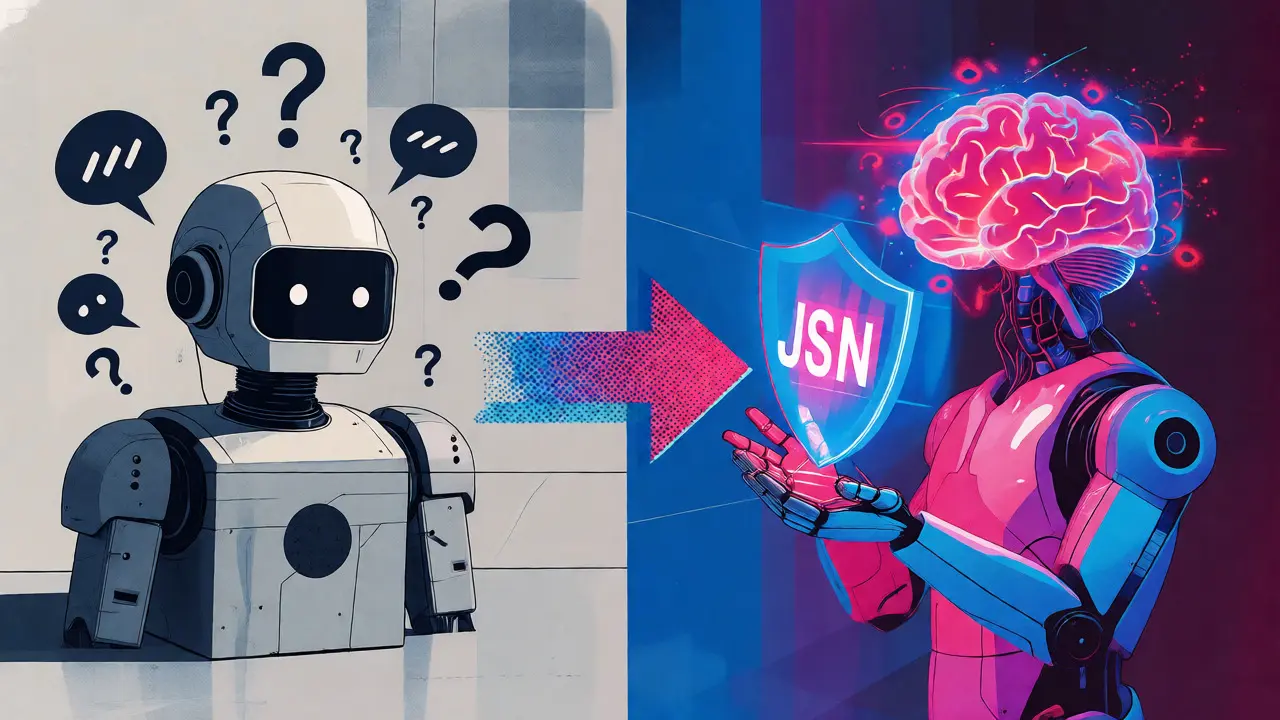
You built a chatbot. It talks nicely. But ask it to check the current stock price or update a record in your CRM, and it either hallucinates a number or gives you a generic apology. This is the gap between Large Language Models (LLMs) as text generators and LLMs as actionable agents. The bridge across that gap is tool-use proficiency, specifically the ability to call external APIs reliably.
By October 2026, this isn't a niche experiment. According to Stratagem Systems' latest analysis of over 340 production implementations, AI API integrations now power 92% of production AI applications. Yet, here is the sting: poorly implemented integrations cost businesses an average of $47,000 annually in wasted API calls, downtime, and security incidents. If you are building with models like GPT-4 Turbo or Claude 3 Opus, knowing how to make them talk to your backend correctly is no longer optional-it's the difference between a toy and a tool.
The Shift from Chatbots to Agents
For years, LLMs were static knowledge bases frozen at their training cutoff date. They couldn't browse the live web, query a database, or execute code without human intervention. That changed when OpenAI released Function Calling in June 2023, followed quickly by Anthropic, Google, and Meta. These updates allowed models to output structured JSON instead of just prose, signaling intent to use an external tool.
This capability transforms LLMs from conversational partners into intelligent routers. Instead of guessing an answer, the model recognizes it lacks real-time data and requests an API call. For example, if a user asks, "What is my current order status?", a proficient model doesn't guess; it identifies the need for the `get_order_status` endpoint, extracts the user ID, and formats the request. When done right, this reduces operational costs by 40-75% and boosts uptime to 99.9%. When done wrong, you get infinite loops of failed calls and confused users.
Anatomy of a Reliable API Call
Reliability starts with definition. You can't just tell a model, "Call the weather API." You must provide a strict schema. Modern LLMs handle these calls through structured function definitions that specify parameters, required fields, and expected responses. Think of it as writing a contract for the model.
A typical implementation requires precise JSON schema design. Here is what that looks like in practice:
- Name: A clear identifier (e.g., `fetch_weather`).
- Description: What the tool does and when to use it.
- Parameters: Detailed types (string, integer), descriptions, and which fields are required.
Token management is where most projects fail. Stratagem Systems documented that 68% of integration failures stem from ignoring token limits. If your input prompt plus the API response exceeds the model's context window, the request fails silently or truncates critical data. For instance, GPT-4 Turbo supports a 128K token context window. A smart developer reserves tokens for the response-perhaps capping input at 120K and leaving 8K for the output buffer. Ignoring this math leads to dropped connections and frustrated end-users.
Comparing Major Model Capabilities
Not all models are created equal when it comes to tool use. Your choice depends on your specific workload, budget, and compliance needs. Below is a comparison of the leading contenders as of late 2026.
| Model | Context Window | Key Strength | Approx. Cost (per 1K Tokens) | Best Use Case |
|---|---|---|---|---|
| GPT-4 Turbo | 128K | Complex multi-step reasoning | $0.01 - $0.015 | Creative workflows & logic |
| Claude 3 Opus | 200K | Document analysis & parallel tools | $0.015 (input) | Legal & large doc processing |
| Gemini 1.5 Pro | 1M | Multimodal & ultra-long context | $0.007 | Video/image understanding |
| Cohere Command R+ | 128K | Enterprise RAG & governance | $0.012 | Data-sensitive enterprises |
| Mistral Large | 32K | GDPR compliance & speed | $0.009 | European deployments |
Google's Gemini 1.5 Pro stands out for its massive 1M token context window, making it 53% more cost-effective for extended document processing compared to competitors, according to Gravitee's 2025 benchmarking study. However, if you need strict data governance, Cohere's Command R+ might be the safer bet despite higher costs per token. Mistral Large remains the go-to for European companies needing GDPR compliance without sacrificing too much performance.

Common Failure Modes and How to Fix Them
Even with good schemas, things break. Hatchworks' 2025 CTO survey found that 58% of developers struggle with inconsistent error handling. The most common issue? Rate limits and service interruptions. If your API returns a 429 Too Many Requests error, a naive implementation will crash or spam retries, worsening the bottleneck.
The fix is exponential backoff with jitter. Instead of retrying immediately, wait a random interval that doubles with each attempt. Combine this with circuit breakers to prevent cascading failures during outages. Gravitee's case studies show this approach reduces downtime by 78%.
Another major pitfall is "tool hallucination." In 29% of complex integrations, LLMs invent non-existent API endpoints or parameters. One healthcare startup lost $12,000 in Q3 2024 because their model repeatedly called a deprecated endpoint, miscalculating token limits and triggering repeated failures. To mitigate this, implement rigorous validation protocols. Check the model's proposed arguments against your actual API spec before executing the call.
Security and Compliance Essentials
Letting an LLM touch your data introduces security risks. IBM's 2025 security report noted that 73% of security incidents traced back to hardcoded API keys in client-side applications. Never expose your secret keys directly to the browser or mobile app. Always route API calls through a backend proxy layer.
Key rotation is also critical. Implement quarterly key rotation cycles managed via environment variables. Furthermore, with the EU AI Act effective since January 2026, 74% of European enterprises require GDPR-compliant API call handling. Ensure your logging mechanisms don't store sensitive PII unnecessarily, and verify that your chosen provider offers data residency options if required.

Strategic Implementation Tips
If you are starting today, don't try to boil the ocean. Begin with simple, high-value use cases. Customer service bots checking order statuses or internal tools querying databases are excellent entry points. These scenarios have clear success metrics and limited failure domains.
Consider intelligent routing. Not every query needs the most expensive model. Stratagem Systems demonstrated that dynamically routing simple queries to cheaper models (like GPT-3.5 Turbo) and complex tasks to premium ones (like GPT-4 Turbo) achieves 45% cost savings. You can build this router using heuristics or a smaller classifier model.
Finally, monitor everything. Track usage patterns, error rates, and latency. Tools like LangChain and LlamaIndex help abstract some complexity, but they shouldn't hide the underlying mechanics entirely. Understanding whether a delay is due to network latency, API rate limiting, or model inference time is crucial for debugging.
The Future of Tool Use
The landscape is evolving rapidly. Anthropic's recent release of 'Tool Use v2' introduced atomic transaction guarantees for multi-step workflows, reducing failure rates by 63% in beta testing. OpenAI added 'Reliability Scores' that predict API call success probability based on historical data. Looking ahead, Gartner predicts that by 2028, 95% of enterprise LLM applications will incorporate multiple API integrations.
We are moving toward standardized API description formats, with OpenAPI 4.0 integration expected soon. This will reduce the friction of defining tools for different models. Automated error recovery systems, like Google's Project Resilience targeting 99.99% uptime by 2027, aim to make these integrations nearly invisible to the end-user.
What is the biggest cause of API integration failure in LLMs?
The biggest cause is ignoring token limits. Approximately 68% of failures occur because the combined size of the input prompt and the API response exceeds the model's context window, causing truncation or complete request failure. Always reserve a buffer for the output.
How do I secure API keys when using LLMs?
Never hardcode API keys in client-side code. Store them in environment variables on your backend server. Use a proxy layer so the LLM communicates with your backend, which then securely calls the external API. Rotate keys quarterly to minimize risk.
Which LLM is best for long-document analysis?
Google Gemini 1.5 Pro is currently the leader for long-document analysis due to its 1 million token context window. This allows it to process entire books or large codebases in a single pass, often at a lower cost than competitors with smaller windows.
What is tool hallucination?
Tool hallucination occurs when an LLM generates an API call with parameters or endpoints that do not exist. It happens in about 29% of complex integrations. Mitigate this by validating the model's generated JSON against your actual API schema before execution.
Do I need to know Python to integrate LLMs with APIs?
While not strictly mandatory, Python proficiency is highly recommended. About 87% of SDKs for major LLM providers are Python-based, offering the most robust support and community examples. Familiarity with REST APIs and asynchronous programming is also essential.