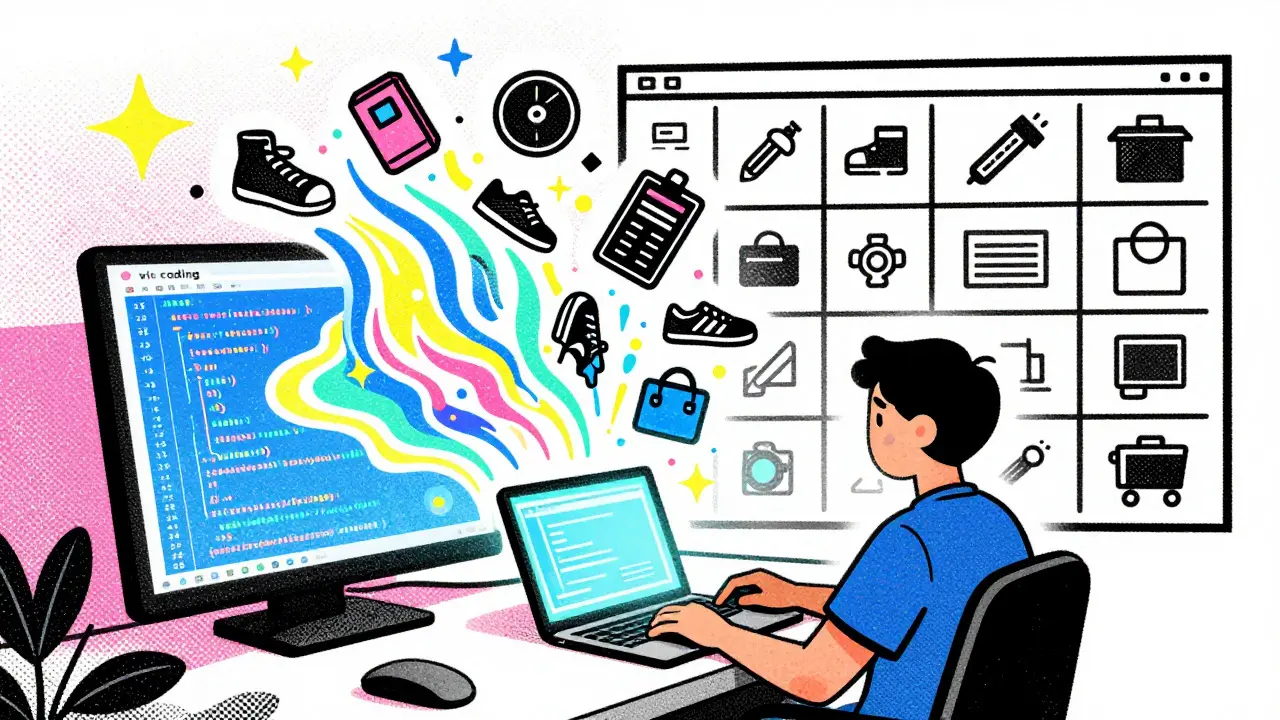
You have a great product idea, but hiring a dev team to build your storefront takes weeks. That gap between having an idea and actually selling something is where most small businesses die. Enter vibe coding. It’s not just a buzzword; it’s the fastest way to turn natural language prompts into functional e-commerce applications right now.
Imagine telling a computer to "create a product catalog with price filters" and watching it generate the code in minutes. This isn't science fiction anymore. By blending AI-assisted development with low-code platforms, you can launch product catalogs and secure checkout flows in hours instead of weeks. But there are traps. If you don't know where vibe coding ends and professional engineering begins, you could end up with a site that looks good but fails when customers try to pay.
What Is Vibe Coding?
Vibe coding is defined as the art of blending creativity, efficiency, and cutting-edge tools to create applications rapidly while maintaining high standards. It emerged around 2023-2024 from the convergence of AI assistants and browser-based IDEs. The term gained mainstream traction in early 2025 when platforms like Replit partnered with PayPal to target commerce specifically.
Vibe Coding is a development methodology using natural language prompts to generate functional code for web applications, particularly e-commerce components. Unlike traditional coding which requires syntax mastery, vibe coding relies on iterative refinement of AI-generated outputs.
The core value proposition is speed. Traditional development might take 17.3 hours to prototype a basic feature. Vibe coding reduces this to roughly 3.2 hours according to benchmark studies from 2025. You describe what you want, the AI writes the code, and you iterate until it works. It democratizes development, allowing non-technical founders to build prototypes that previously cost $5,000 or more in developer fees.
Building Product Catalogs Rapidly
Your product catalog is the heart of your store. In the past, building a dynamic catalog with filtering, sorting, and variant selection required deep knowledge of JavaScript, React, or database management. With vibe coding, you can describe these features in plain English.
For example, you might prompt your tool: "Create a grid layout for products with filters for price range and category." The platform generates the HTML, CSS, and logic. Tech.co's 2026 analysis shows that vibe coding platforms achieve 78-85% completeness in their first iteration. This means you get a working draft almost immediately.
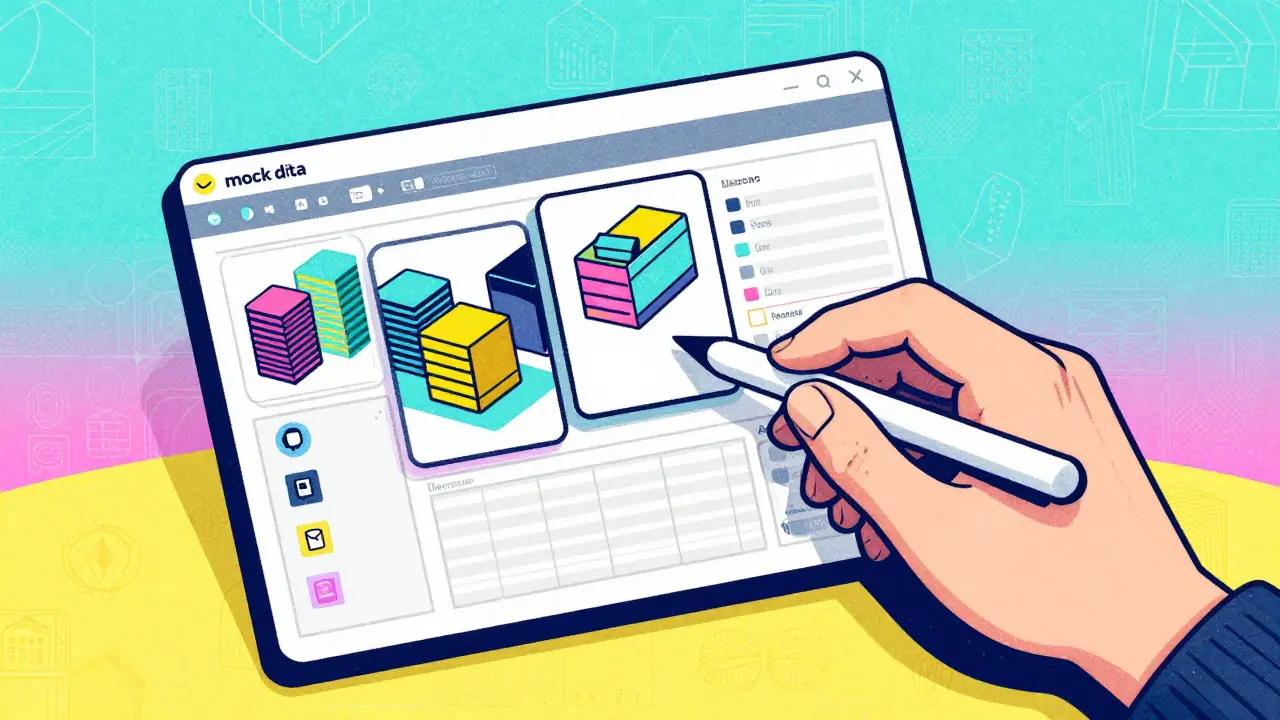
- Mock Data Generation: One of the biggest time-savers is generating realistic test data. Developers report creating JSON files with 500+ product items in under 15 minutes using natural language prompts.
- Visual Customization: You can ask for specific design changes, like "make the discount banner pop-up modal," and see results instantly.
- Platform Integration: Tools like Lovable integrate directly with Shopify, allowing you to pull real product data into your custom-coded frontend.
However, keep in mind that while the structure appears quickly, refining the user experience (UX) still requires human oversight. The AI might miss edge cases, such as how the grid behaves on mobile devices or when no products match a filter. You will likely need 3-5 iterations to reach production readiness.
Implementing Secure Checkout Flows
This is where things get tricky. A pretty catalog means nothing if customers can't buy from you. Checkout flows involve sensitive financial data, requiring strict security protocols like PCI compliance. Vibe coding excels at prototyping the visual aspect of checkouts but struggles with the backend logic.
PayPal SDK is a software development kit that enables merchants to integrate PayPal payment processing into their websites and applications. When used with vibe coding platforms like Replit, it allows developers to authenticate projects and handle transactions without writing complex API calls from scratch.
Platforms like Replit offer direct integration with the PayPal Developer Portal. You can generate API keys and authenticate your project within the browser-based IDE. This setup allows you to build a checkout interface that connects to real payment gateways. However, caution is critical.
In February 2026, a security incident occurred where improperly configured vibe-coded checkout flows caused 12,000 test transactions to appear in live merchant accounts. This highlights a major risk: AI tools often default to sandbox environments, but misconfiguration can bridge the gap to live systems accidentally. Always use sandboxed environments for testing. As Coredna advises, data should be mocked, anonymized, or routed through read-only APIs during development.
Vibe Coding vs. Traditional Development
Is vibe coding replacing developers? Not entirely. Think of it like Excel did for finance-it automates routine tasks but doesn't replace the analyst. Here is how it compares to other methods.
| Feature | Vibe Coding | Traditional Dev | No-Code Platforms |
|---|---|---|---|
| Time to Prototype | 3.2 hours | 17.3 hours | 1-2 hours |
| Customization Level | High (43% more than no-code) | Very High | Low |
| Technical Skill Required | Basic HTML/CSS + Prompting | Advanced (JS/React/Python) | None |
| Enterprise Scalability | Low (Legacy ERP issues) | High | Medium |
| Cost Efficiency | Very High | Low | Medium |
Vibe coding offers 89% of the speed advantage of no-code tools but with significantly greater customization. However, it falls short in enterprise scenarios. If you need to sync with a legacy ERP system or run complex tax calculation engines, traditional development maintains a 32% performance advantage in synchronization speed. For small to medium businesses (SMBs), though, vibe coding is the clear winner for rapid deployment.
Best Practices for Success
To make vibe coding work for your e-commerce store, follow these practical steps. These heuristics come from analyzing successful implementations and common failure points.
- Start Small: Don't try to build Amazon in one prompt. Start with a single product page or a simple cart component. Iterate and expand.
- Use Sandbox Environments: Never connect your vibe-coded project directly to core business systems initially. Use mock data for inventory and payment tests.
- Generate Unit Tests: AI-generated code can have hidden bugs. Ask your AI assistant (like Gemini or Cursor) to generate unit tests for your checkout logic to ensure reliability.
- Check Webhook Configurations: Payment failures often stem from incorrect webhook setups. Verify that transaction notifications are routing correctly before going live.
- Review Security Compliance: Ensure your checkout flow meets PCI standards. Replit and PayPal introduced automatic compliance checks in early 2026, so leverage these built-in tools.
Learning curves vary. Users with basic HTML/CSS knowledge become proficient in about 4.7 hours. Complete beginners may need over 11 hours. The key is understanding e-commerce concepts-like what a SKU is or how a shopping cart state works-even if you don't know the code behind it.
Future Outlook and Limitations
The market for vibe coding platforms reached $1.7 billion in 2025, growing by 68% year-over-year. By 2027, Gartner predicts that 70% of e-commerce development platforms will include vibe coding capabilities as standard features. We are seeing native support coming to major players; Shopify's roadmap includes native vibe coding for theme customization later in 2026.
Despite the hype, limitations remain. Vibe coding is excellent for front-end interfaces, promotional storefronts, and A/B testing variations. It is less effective for back-end complexity. If your business relies on intricate inventory logistics or multi-currency tax rules, you will likely need a hybrid approach: vibe code the front end, and hire developers for the back end.
As Dr. Elena Rodriguez from MIT notes, vibe coding democratizes development. But as Marcus Chen from Shopify warns, 68% of implementations require significant developer intervention before they are truly production-ready. Treat vibe coding as a powerful accelerator, not a magic wand.
Is vibe coding safe for handling customer payments?
It can be, but only with strict precautions. You must use sandboxed environments for testing and verify that your generated code complies with PCI standards. Avoid connecting vibe-coded prototypes directly to live payment gateways until you have thoroughly tested webhook configurations and error handling. Recent incidents show that misconfigured test environments can leak into live accounts.
Do I need to know how to code to use vibe coding?
You do not need advanced coding skills, but basic literacy helps. Understanding HTML, CSS, and how APIs work will significantly reduce your learning curve. While you can generate code with natural language, debugging issues or making precise adjustments often requires reading the generated code. Beginners typically spend 11+ hours becoming proficient.
Which platforms are best for vibe coding e-commerce?
Replit is leading for general developer-focused vibe coding with strong PayPal integration. Lovable is popular for Shopify-integrated solutions, offering fast storefront creation. Cursor is preferred by some enterprise clients for its advanced AI capabilities. Your choice depends on your existing tech stack; if you use Shopify, Lovable is a strong contender.
Can vibe coding replace traditional web developers?
Not completely. Vibe coding is excellent for prototyping, front-end interfaces, and simple implementations. However, complex back-end integrations, legacy system synchronization, and high-security requirements still demand professional developers. Most successful implementations use a hybrid model where AI handles the bulk of the UI generation and developers refine the logic and security.
How long does it take to build a product catalog with vibe coding?
A basic functional prototype can be generated in under an hour. However, reaching production readiness usually takes 2-4 hours due to necessary iterations for styling, responsiveness, and data integration. Compare this to the industry average of 17.3 hours for traditional development, and the time savings are substantial.