You ask an AI to write a function. It spits out twenty lines of code. You run it. It crashes. You paste the error back in. It rewrites the whole thing, breaking something else that worked before. Sound familiar? This is the "black box" problem with AI code generation. We treat these models like magic wands, expecting perfect output on the first try. But they aren't compilers; they're probabilistic engines. If you want reliable software, you need to stop treating prompts as one-shot commands and start treating them as part of a rigorous engineering process.
This is where Stepwise Prompting with Feedback Loops comes in. It’s not just a buzzword; it’s a methodology that combines structured prompt engineering with the old-school discipline of test-driven development (TDD). The goal is simple: break complex coding tasks into tiny, verifiable steps, and use immediate feedback to correct errors before they snowball. According to a 2023 Stack Overflow survey, while nearly 45% of developers use AI tools, only about 17% trust the output without verification. That gap is exactly what this method closes. By iterating toward correctness rather than demanding perfection upfront, you reduce debugging time by up to 60% on complex algorithms. Let’s look at how to actually do this without losing your mind.
The Core Problem with One-Shot Prompts
When you ask a large language model (LLM) like GPT-4 or Claude 3 to "write a data parser," you’re asking it to solve a multi-step reasoning problem in one go. Research from Google Research shows that standard prompting often fails on multi-step logic because the model tries to jump straight to the answer. Chain-of-Thought (CoT) prompting fixes this by forcing the model to explain its reasoning step-by-step. In benchmarks like GSM8K, CoT boosted accuracy from 17.7% to 78.7%. But even CoT isn’t enough if you don’t have a way to catch mistakes early.
Without a feedback loop, you’re flying blind. You might get syntactically correct code that is logically flawed. A study by Stanford’s Center for Research on Foundation Models found that direct code generation has a high error rate on medium-complexity problems-about 48% failure rate on LeetCode-style tasks. Stepwise prompting reduces this by decomposing the task. Instead of "build the app," you ask for "the database schema," then "the API endpoint," then "the unit test." Each step is small enough to verify quickly.
Anatomy of the Feedback Loop
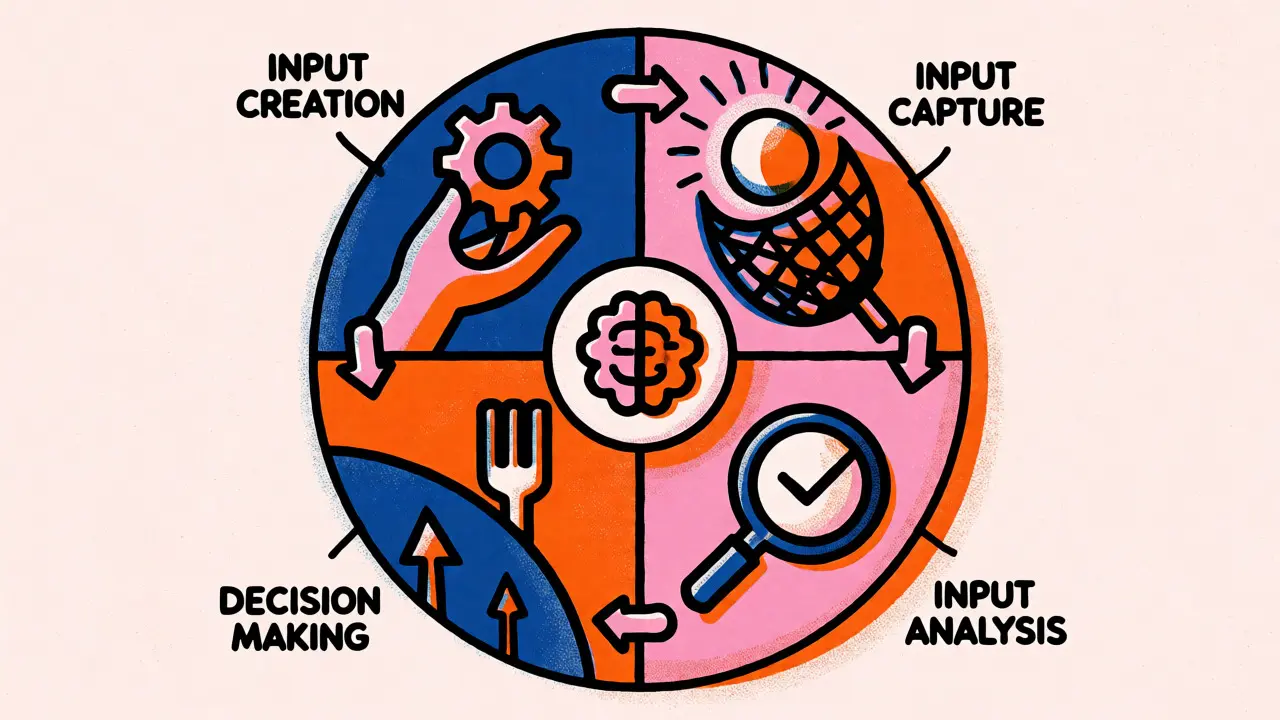
A feedback loop in programming isn’t new. Jason Swett described the fundamental loop back in 2018: decide a goal, devise a test, perform the test, write code, repeat until pass. When we apply this to AI prompting, the loop looks slightly different but follows the same principle. It consists of four stages:
- Input Creation: You define a specific, narrow subtask. Not "fix the bug," but "identify why the login function returns null when the password is empty."
- Input Capture/Storage: The AI generates code or reasoning. You capture this output.
- Input Analysis: You run the code or review the logic against your acceptance criteria. Did it compile? Did the test pass?
- Decision Making: If it failed, you feed the error back in with context. If it passed, you move to the next subtask.
This structure turns black-box generation into a transparent, debuggable process. Dr. Percy Liang notes that this approach makes AI interaction less magical and more mechanical-which is exactly what engineers want. You aren’t hoping for luck; you’re engineering reliability.
Implementing Stepwise Prompting
So, how do you actually structure these prompts? The most effective practitioners use templates. A common framework is the "3C Model": Context, Challenge, Criteria.
| Component | Purpose | Example Prompt Snippet |
|---|---|---|
| Context | Sets the stage so the AI knows the environment and constraints. | "We are using Python 3.11 with Pandas for data analysis..." |
| Challenge | Defines the single, atomic task to be solved. | "Write a function that filters rows where 'date' is older than 30 days..." |
| Criteria | Specifies how success is measured (tests, edge cases). | "Include a docstring and handle missing values by dropping the row..." |
Notice the shift in granularity. You aren’t asking for the whole pipeline. You’re asking for one filter function. Once that works, you ask for the next step: aggregation. Then visualization. Each step gets its own mini-feedback loop.
Here’s a practical example. Imagine you’re building a custom JSON parser. Instead of asking for the whole parser, you break it down:
- Prompt 1: "Write a tokenizer that splits a JSON string into tokens (brackets, keys, values). Include tests for nested objects."
Feedback: Run the tests. If the tokenizer misses escaped quotes, paste the failing test case back in: "Your tokenizer failed on \"he said \"hi\"\". Fix the regex." - Prompt 2: "Using the token list from step 1, write a syntax analyzer that builds a tree structure. Ensure it handles arrays."
Feedback: Check if the tree structure matches expected output. If not, specify the discrepancy. - Prompt 3: "Write a recursive function to convert the tree into a Python dictionary."
By isolating each component, you limit the blast radius of any errors. If the tokenizer breaks, you don’t have to rewrite the entire parser. You just fix the tokenizer.
Tools and Automation
Doing this manually is fine for learning, but it’s tedious for daily work. Fortunately, modern IDEs and plugins are catching up. GitHub Copilot introduced features like "Copilot Workspaces" that allow for more conversational, stateful interactions. However, the real power comes from integrating automated testing into the loop.
If you use Python, tools like pytest can be scripted to automatically generate feedback. Some advanced setups use a script that takes the AI-generated code, runs it against a predefined test suite, and captures the stdout/stderr. If the test fails, the script automatically constructs a new prompt containing the original request plus the error message and sends it back to the LLM. This creates a self-correcting loop. MIT research demonstrated that such self-correcting systems achieve 92% accuracy on complex tasks by having the model critique its own output before finalizing.
For those who prefer a visual interface, platforms like Stepwise offer templates that automate the creation of test cases based on your prompt specifications. Internal testing showed this reduced manual verification time by 45%. Even if you stick to a basic chat interface, keeping a separate terminal window open to run tests immediately after pasting code is crucial. The faster you get feedback, the better the iteration cycle.
Common Pitfalls and How to Avoid Them
Not every task benefits from stepwise prompting. If you’re writing a simple `Hello World` or a basic CRUD operation, the overhead of crafting three prompts and running two tests outweighs the benefit. Data suggests that for simple syntax tasks, stepwise prompting offers only a 12% improvement over direct prompting. Save the heavy lifting for algorithmic challenges, data transformations, or unfamiliar libraries.
Another trap is "context drift." As you iterate, the conversation history grows. Eventually, the model might forget the initial constraints or hallucinate details from earlier steps. To combat this, periodically summarize the current state. Ask the AI: "Summarize our progress and the remaining tasks in bullet points." This resets the focus and keeps the model aligned with your goals.
Finally, beware of the "prompt engineering tax." Novice developers often spend more time crafting the perfect prompt than fixing the code. Start with clear, concise instructions. Don’t over-engineer the prompt. If the code is wrong, give specific feedback rather than rewriting the entire prompt from scratch. Precision matters more than length.
The Future of Iterative Coding
We are moving away from the era of "AI writes all my code" toward "AI assists my workflow." Gartner projects that by 2025, 70% of enterprise teams will adopt structured feedback practices. This isn’t just about convenience; it’s about risk management. In regulated industries like healthcare, formal verification is mandatory. A January 2024 FDA report noted that 62% of medical software developers now use feedback loops to meet compliance standards.
As models like Claude 3 support longer context windows (up to 200k tokens), maintaining long reasoning chains becomes easier. But the core skill remains human: knowing how to break a problem down. The AI is the engine; you are the driver. Stepwise prompting gives you the steering wheel.
What is the difference between Chain-of-Thought and Stepwise Prompting?
Chain-of-Thought (CoT) prompting asks the model to explain its internal reasoning before giving an answer. Stepwise Prompting breaks the actual task into multiple external interactions, where each step produces a verifiable artifact (like a code snippet or test result). CoT improves internal logic; Stepwise improves external validation and error isolation.
Do I need special tools to implement feedback loops?
No. You can start with any text editor and a terminal. The key is the habit: generate code, run a test, read the error, and prompt again. Tools like GitHub Copilot or specialized platforms automate parts of this, but the methodology works with any LLM interface.
Is stepwise prompting slower than direct prompting?
Initially, yes. Crafting multiple prompts takes time. However, studies show it reduces total debugging time by up to 60% for complex tasks. For simple tasks, direct prompting is faster. Use stepwise methods when complexity or reliability risks are high.
How do I know when to split a prompt?
Split when a task involves distinct logical components, such as parsing, processing, and outputting. If you find yourself adding more than three conditions or requirements to a single prompt, consider breaking it down. Atomic tasks yield higher accuracy.
Can AI fix its own errors without my intervention?
Partially. Self-correction mechanisms exist where models critique their own output, achieving high accuracy. However, human-in-the-loop feedback is still superior for nuanced business logic. Automated loops work best for syntax and obvious logic errors; humans are needed for architectural decisions.