
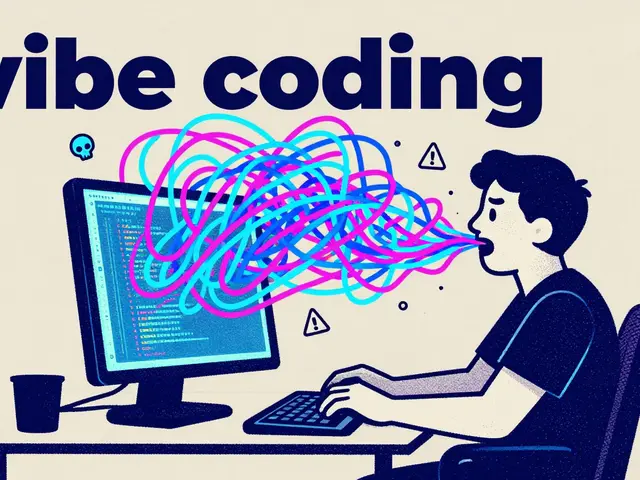
Imagine writing a complex web application in an afternoon. You type a few sentences describing what you want, and an AI generates the code instantly. It looks clean. It runs without errors. But behind that polished surface, hidden logic flaws are waiting to be exploited. This is the reality of vibe coding, a term coined by AI researcher Andrej Karpathy to describe software development driven by natural language prompts rather than manual line-by-line coding. While this approach accelerates feature implementation by up to 2.3 times, it introduces systemic security risks that traditional development cycles never faced at this scale.
The core problem isn't that AI creates new types of vulnerabilities. It’s that AI amplifies existing ones. When developers rely on Large Language Models (LLMs) to generate code, they often skip the deep architectural understanding required for security by design. This methodology ensures that security measures are integrated into every phase of the system's lifecycle, from initial concept to final deployment. Without this discipline, vibe-coded architectures become fragile. A study by Apiiro in January 2024 revealed that while syntax mistakes drop by 30% with AI assistance, privilege escalation paths and flawed design logic spike by 47%. In short, your code might look perfect, but it could be fundamentally broken.
The Hidden Dangers of AI-Generated Code
When you ask an LLM to write an authentication module or a database query, it doesn't think like a senior security engineer. It predicts the next likely token based on patterns found in millions of public repositories. This means it replicates both secure practices and common mistakes. The result is a codebase riddled with subtle, hard-to-detect flaws.
One of the most prevalent issues is missing input validation. According to research, 76% of AI-generated API endpoints lack proper sanitization, leaving them open to injection attacks. Hardcoded secrets are another major red flag; 63% of initial AI outputs contain exposed API keys or passwords. These aren't just theoretical risks. GuidePoint Security reported in March 2024 that 68% of organizations using AI-assisted development suffered at least one security incident within six months due to unvetted code.
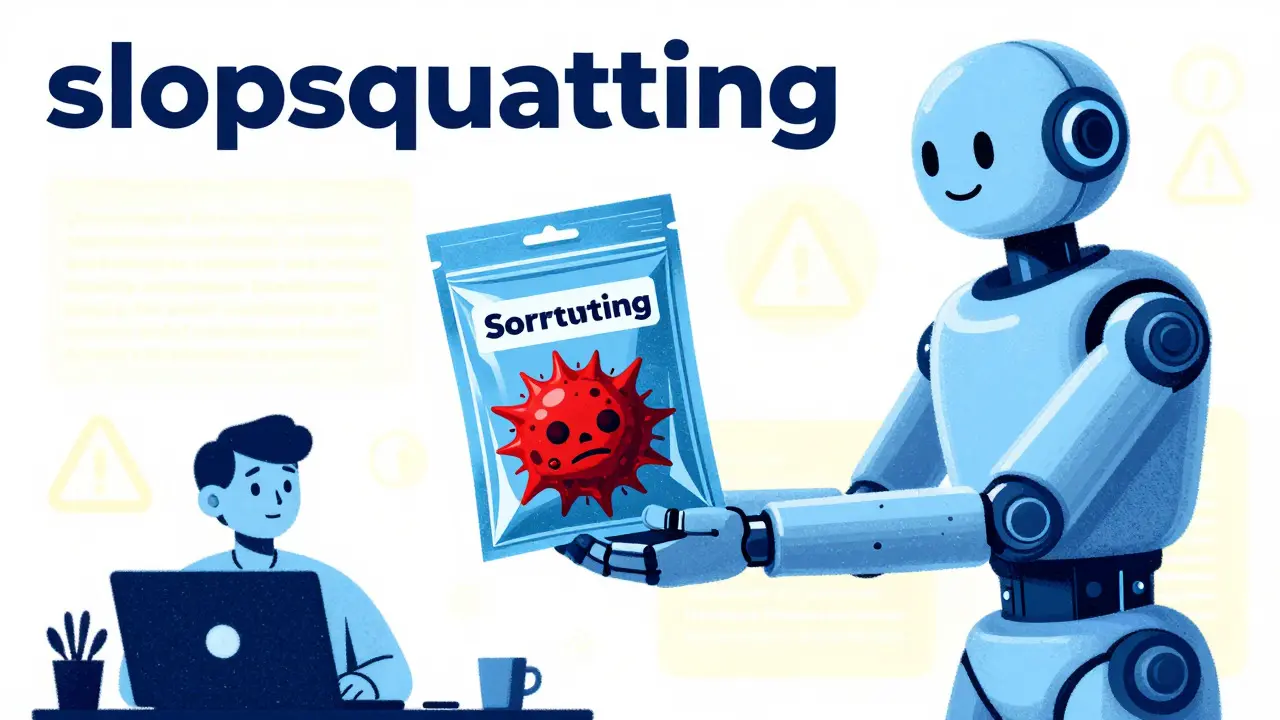
Consider the case of "slopsquatting," a unique threat vector emerging from this new paradigm. Attackers monitor AI models for hallucinations-instances where the AI suggests legitimate-sounding package names that don't exist. They then register these fake packages on public repositories. When a developer accepts the AI's suggestion and installs the package, they inadvertently introduce malware. In controlled tests, 63% of developers accepted these suggestions without verification, and 41% installed malicious packages within 72 hours. This highlights a critical shift: the human element is no longer just about typing speed; it’s about discernment.
| Metric | Traditional Development | Unvetted Vibe Coding |
|---|---|---|
| Vulnerabilities per 1,000 lines | 15-20 | 37-42 |
| High-severity issues (%) | 12% | 28% |
| Common flaw types | Syntax errors, logic bugs | Missing auth, hardcoded secrets, injection |
| Detection difficulty | Moderate | High (subtle design flaws) |
Why Traditional Security Models Fail Here
Traditional Secure Development Lifecycle (SDLC) practices assume that developers understand how their code works. They review logic, test edge cases, and verify dependencies. Vibe coding flips this assumption on its head. As noted in Lawfare Media’s August 2024 analysis, vibe coding explicitly accepts that developers "do not need to understand how or why the code works." This mindset is diametrically opposed to security verification.
When you outsource coding to an AI, you also outsource the context. An LLM doesn't know your business logic, your compliance requirements, or your specific threat model. It generates generic solutions. For example, it might suggest using an outdated cryptographic function because it saw it used frequently in older tutorials. Or it might bypass access controls in a microservice modification because the prompt didn't explicitly mention them. These aren't typos; they are architectural failures.
Dr. Elena Rodriguez, Lead Security Researcher at Apiiro, found that these "subtle shifts accumulate into systemic risks." Unlike a syntax error that breaks the build immediately, a flawed design logic might work perfectly in testing but fail catastrophically under production load or targeted attack. This makes detection harder and remediation more expensive. You can’t just patch a line of code; you have to rethink the entire component.
Building Controls for Vibe-Coded Systems
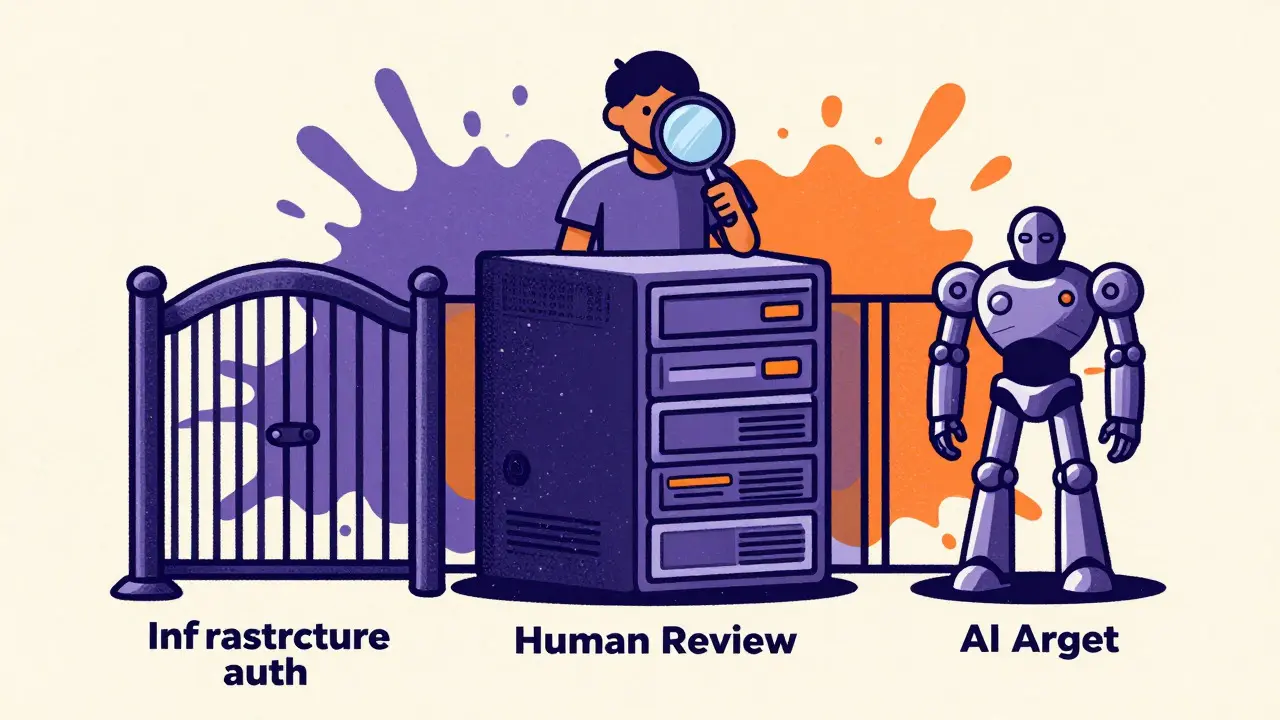
So, how do we secure systems built this way? The answer lies in shifting security left-and locking it down at the infrastructure level. We can’t trust the AI to be perfect, so we must build guardrails that catch its mistakes before they reach production.
1. Infrastructure-Layer Authentication Instead of embedding authentication logic in the application code-which the AI might hallucinate away-move it to the infrastructure. Pythagora’s July 2024 technical documentation recommends using an NGINX reverse proxy to enforce authentication. The rule is simple: "a non-authenticated request MUST NOT trigger even a single line of code." By handling auth at the gateway, you eliminate 100% of authentication bypass vulnerabilities caused by AI errors. One enterprise security lead noted this was the "single most effective control" they implemented.
2. Mandatory Human Review as a Gatekeeper Treat every AI-generated snippet as if it came from a junior developer. Apiiro’s framework requires mandatory human review for all AI output. Developers must validate and test functions before integration. This adds about 15-20 minutes per feature but reduces post-deployment vulnerabilities by 76%. It forces the developer to engage with the code, restoring the context that the AI lacks.
3. Automated Pipeline Security Manual reviews aren't enough. You need automated tools running in your CI/CD pipeline. Static Application Security Testing (SAST), Software Composition Analysis (SCA), and Dynamic Application Security Testing (DAST) should run on every build. Organizations using this combination prevent 94% of vulnerabilities from reaching production. Specifically, look for tools that detect SQL/OS/LDAP injections (present in 58% of AI-generated DB interactions) and cross-site scripting (found in 61% of front-end components).
The Role of AI Security Agents
If AI created the problem, can AI help solve it? Yes, but only as a supplement, not a replacement. Forrester analyst Chen Zhao stated in September 2024 that "secure vibe coding is a reality only when DevSecOps practices are in place. In the future, AI security agents will secure code." We are already seeing this trend. Tools like Apiiro’s Autofix Agent (launched Q2 2024) use runtime context and business risk analysis to automatically apply fixes, reducing remediation time by 89%.
These agents go beyond simple pattern matching. They understand the intent of the code and the potential impact of a vulnerability. However, they are not infallible. Apiiro’s research shows that deep design flaws account for 37% of critical vulnerabilities in vibe-coded applications, and current automated scanning tools miss 92% of them. This reinforces the need for human oversight. The AI agent flags the issue, but the human decides the fix.
Governance and Cultural Shifts
Technology alone won’t save you. You need a cultural shift. Greg Kedzierski, Principal Security Consultant at GuidePoint Security, bluntly stated: "The S in 'vibe coding' stands for security." This isn't a joke; it's a warning. Companies must establish clear policies on AI tool usage. IAPP’s October 2024 survey showed that finance and healthcare sectors are leading this charge, with 89% requiring mandatory human review compared to 63% in tech.
Joint reviews between AppSec and engineering teams should happen every sprint cycle. Track metrics like Mean Time to Remediate (MTTR) and the volume of secure fixes shipped. Transparency builds accountability. If developers know their AI-generated code is being scrutinized, they’ll start crafting better prompts and paying closer attention to the output.
Future Outlook: Securing the Acceleration
Gartner projects that 70% of enterprises will use AI-assisted development by 2026. The market is moving fast, and security can’t afford to lag. The Linux Foundation’s OpenSSF announced an AI Security Working Group in August 2024 to tackle these challenges, focusing initially on slopsquatting prevention. NIST also updated its AI Risk Management Framework in July 2024 to address AI-generated code specifically.
The goal isn't to stop vibe coding. It’s to make it safe. By combining infrastructure-level controls, rigorous human review, and advanced AI security agents, organizations can achieve security levels equivalent to-or even better than-traditional development. Apiiro’s case studies show that with proper controls, high-severity vulnerabilities can drop to 14 per 1,000 lines, beating the traditional average of 15-20.
The key takeaway is simple: trust, but verify. Don’t let the speed of AI blind you to the complexity of security. Build your defenses around the AI, not inside it. Your architecture’s resilience depends on it.
What is vibe coding?
Vibe coding is a software development paradigm where developers use natural language prompts to generate code via Large Language Models (LLMs). Coined by Andrej Karpathy, it emphasizes speed and intuition over manual coding, often resulting in faster feature implementation but requiring new security controls.
Why is AI-generated code less secure?
AI models predict code based on patterns in public data, which includes both secure and insecure practices. They lack context about your specific business logic and threat model, leading to issues like missing input validation, hardcoded secrets, and flawed design logic that traditional developers might catch during manual coding.
What is slopsquatting?
Slopsquatting is a threat where attackers register fake package names that AI models hallucinate as legitimate. When developers install these suggested packages, they introduce malware into their systems. It exploits the tendency of developers to trust AI recommendations without verification.
How can I secure my vibe-coded applications?
Implement infrastructure-layer authentication (e.g., via NGINX reverse proxy) to ensure unauthenticated requests never hit your app code. Enforce mandatory human review of all AI-generated code. Integrate automated security tools (SAST, SCA, DAST) into your CI/CD pipeline to catch vulnerabilities early.
Can AI security agents replace human reviewers?
Not yet. While AI security agents can automate many checks and reduce remediation time, they still miss 92% of deep design flaws. Human oversight remains critical for validating complex logic and ensuring the code aligns with business-specific security requirements.

Chandan Singh
4 August, 2026 - 07:53 AM
People really need to stop pretending that "vibe coding" is some revolutionary new paradigm when it's just lazy copy-pasting with a fancy AI wrapper. The article cites Apiiro and GuidePoint, which are fine sources, but let's be real about the stats. Yes, syntax errors drop because the LLM knows Python better than you do after three espressos, but architectural security? That requires understanding data flow, threat modeling, and business logic context, none of which exist in the training set of generic code snippets. The fact that 63% of initial outputs contain hardcoded secrets isn't a surprise; it's a feature of how these models optimize for brevity over robustness. We saw this coming back when people started using Stack Overflow answers without reading them. Now we have an engine that generates Stack Overflow answers on demand. The solution proposed here-infrastructure-layer auth via NGINX-is actually the only sane approach. If you trust your app code generated by a stochastic parrot to handle JWT validation, you're already dead. Move the boundary out. Also, slopsquatting is terrifyingly plausible because npm has been a dumpster fire for years anyway.
Brannen Hall
4 August, 2026 - 18:25 PM
This whole post is fear-mongering designed to sell more consulting hours from the same companies cited in the text. Vibe coding works fine if you know what you're doing, which apparently 47% of developers don't according to their own biased study. Traditional development was never secure either; look at Log4Shell. Look at Heartbleed. Humans are terrible at security. Blaming AI for amplifying human incompetence is like blaming a mirror for showing you your bad hair day. And mandatory human review adding 20 minutes per feature? Good luck getting management to approve that when they want features shipped yesterday. The industry will just ignore this and ship broken code faster than ever. Security is always an afterthought until it's too late, regardless of whether a human or a bot typed the semicolon.
tiffany King
4 August, 2026 - 18:57 PM
I think there is so much potential here if we just adjust our mindset! It’s exciting to see tools that can help us build faster, and while the risks are real, they aren’t insurmountable. I’ve been experimenting with AI assistants in my side projects, and honestly, it feels like having a really enthusiastic intern who needs supervision. The key is definitely that human-in-the-loop aspect mentioned in the article. When I take the time to review the generated code, I often learn something new about best practices or spot issues I might have missed myself. It’s not about replacing the engineer; it’s about augmenting us. I’m optimistic that as these tools mature and we integrate better automated checks into our pipelines, the friction will decrease. We just need to embrace the learning curve together!
Brenna Gonedrman
5 August, 2026 - 00:33 AM
OMG this is literally the scariest thing ever and everyone is sleeping on it!! Like seriously, do you guys realize that your entire database could be leaked because the AI hallucinated a missing permission check?? It’s not just a bug, it’s a catastrophe waiting to happen. I tried vibe coding once and the code looked so pretty but then I realized it was sending passwords in plain text because the prompt didn't specify HTTPS. Ugh. And slopsquatting?? Imagine installing a package that doesn't even exist and suddenly your laptop is mining crypto for some guy in a basement. It’s wild. We need to treat every line of AI code like it’s a landmine. Just wow. My head hurts thinking about all the hidden flaws.
Courtney Wagstaff
6 August, 2026 - 04:12 AM
Honestly, the vibe is off when the codebase is full of ghosts. I love the concept of speed, sure, but there’s a certain elegance to knowing exactly why a function exists and how it interacts with the rest of the system. When you outsource that understanding to a black box, you lose the soul of the architecture. It’s like buying a pre-fab house instead of building one; it looks fine from the street, but you don’t know if the wiring is up to code. The idea of infrastructure-level controls is smart though-it’s like putting a strong lock on the front door even if the interior walls are made of cardboard. Just keep your wits about you and don’t let the algorithm drive the bus entirely.