You’re staring at a cloud bill that looks like a mortgage payment. You want to know if throwing more GPUs at your Large Language Model is actually going to make it smarter, or just faster at being wrong. It’s the billion-dollar question in AI right now-literally. We used to treat training runs like black magic: you tweak hyperparameters, pray to the gradient gods, and hope for emergent abilities. But today, we can predict those gains with surprising accuracy using Scaling Laws. These aren’t vague rules of thumb; they are mathematical relationships that tell you exactly how much better your model will get if you double your data or triple your parameters.
Think of scaling laws as the physics of deep learning. Just as gravity predicts how fast an apple falls, these power-law equations predict how test loss decreases as you scale up three key variables: model size (parameters), dataset size (tokens), and training compute (FLOPs). If you understand this relationship, you stop guessing. You can look at a small prototype run, extrapolate the curve, and know with high confidence what a massive production model will achieve before you even spin up the cluster. This shifts AI development from an art project to an engineering discipline.
The Math Behind the Magic
At its core, a scaling law describes a smooth, predictable decrease in loss. The formula generally looks like this: Loss = A * (Compute)^-alpha + B. In plain English, performance improves logarithmically as you spend more resources. Research from institutions like NVIDIA and DeepMind has shown that these trends hold across seven orders of magnitude. That means if your law works on a tiny 10-million-parameter model, it likely holds true for a 70-billion-parameter beast.
But here’s where it gets interesting. Early research suggested that bigger models were always better. Then came Chinchilla, a 70-billion parameter model from DeepMind that shocked everyone by outperforming the larger Gopher model. Why? Because Chinchilla was trained on significantly more data-1.4 trillion tokens compared to Gopher’s lower count. This proved that you can’t just scale parameters; you have to scale data proportionally. If you train a huge model on too little data, it memorizes rather than learns. The optimal ratio matters more than raw size.
| Variable | Description | Impact on Performance |
|---|---|---|
| Model Parameters | The number of weights in the neural network. | Improves capacity to store knowledge and handle complex reasoning tasks. |
| Dataset Size | Total number of tokens seen during training. | Reduces overfitting and improves generalization; critical for factual accuracy. |
| Training Compute | Total floating-point operations (FLOPs) used. | The primary driver of loss reduction; combines size and duration. |
| Inference Compute | Resources used when the model answers questions. | Affects latency and cost per query; often overlooked in training plans. |
Why Data Quality Beats Parameter Count
Many teams fall into the trap of thinking "more parameters equals better." They don’t. As noted by Cameron Wolfe’s analysis of recent studies, larger models are indeed more sample-efficient-they learn faster from less data. However, there’s a catch. Training a massive model to convergence on a small dataset is wasteful. You end up paying for GPU hours to teach a genius-level brain simple facts it could have learned quicker. Instead, the smart move is often to train a smaller model on more diverse, high-quality data. MIT researchers recently found that scaling laws apply consistently across model families. You can take predictions from large models and accurately forecast performance for smaller ones. This challenges the old idea that small models are "different beasts." They follow the same physics, just at a different scale. If your goal is cost-efficiency, optimizing your data pipeline might yield higher returns than buying another rack of H100s.

Predicting Downstream Accuracy
Loss is great for engineers, but stakeholders care about accuracy on specific tasks. Can you predict how well your model will do on coding tests or medical Q&A before you finish training? Yes. New frameworks link training compute directly to downstream benchmark scores. Researchers validated this across 130 experiments, testing benchmarks like ARC-E, HellaSwag, and PIQA. They found that if you keep the ratio of tokens to parameters constant, accuracy scales predictably with your total FLOPs.
This is a game-changer for budget planning. Instead of running expensive ablation studies on every new architecture, you can run a quick pilot. Measure the loss curve, fit the power law, and project the final accuracy. If the projection doesn’t meet your threshold, you save millions by not launching the full-scale run. It turns risk management into a calculation.
The Rise of Test-Time Scaling
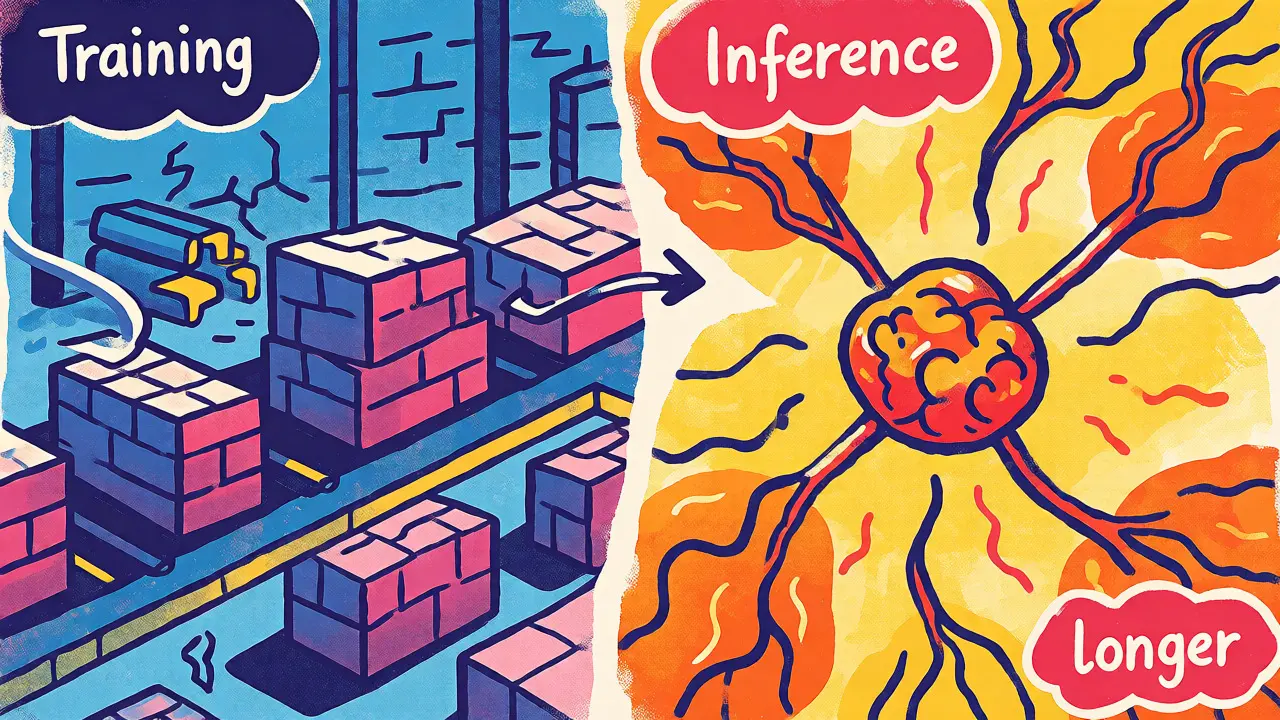
We’ve spent years focusing on training-time scaling-making the model smarter before it ever talks to a user. But a new trend is shifting the focus to inference. Test-Time Scaling involves giving the model more compute while it’s generating an answer. Think of it as letting the student think longer before writing the exam essay. Reasoning models now perform multiple passes, self-correcting and refining their outputs.
NVIDIA highlights that this approach drives demand for accelerated computing because it requires intensive resources at runtime. For complex problems like math proofs or code generation, spending extra milliseconds on inference can boost accuracy far more than adding billions of parameters to the base model. This suggests a future where we don’t just build one giant model, but use smaller, cheaper models that "think" harder when needed.
Practical Pitfalls and Real-World Constraints
Scaling laws are powerful, but they assume ideal conditions. In the real world, you deal with distributed training bottlenecks, data cleaning costs, and inference latency. Public literature on tuning these pipelines is scarce, which makes practical experience vital. When you scale up to hundreds of nodes, communication overhead can kill your efficiency gains. You might hit a wall where doubling compute only yields a 5% improvement because your hardware isn’t talking fast enough.
Also, consider the total cost of ownership. Training is a one-time cost; inference is ongoing. A slightly larger model that reduces error rates by 2% might be worth it if it saves you from hiring human reviewers later. Conversely, a huge model that’s slow and expensive to host might lose money on every API call. Balance your training investment against long-term operational costs.
What’s Next for Scaling?
The era of "just make it bigger" is fading. Future systems will rely on efficient design and better training methods rather than uncontrolled expansion. We’re seeing a maturation toward resource-conscious optimization. Architectural innovations, like Mixture-of-Experts, allow models to activate only parts of their network per token, keeping inference cheap while maintaining high capacity.
For developers, this means you need to think holistically. Don’t just chase parameter counts. Look at data quality, architectural efficiency, and inference strategies. Use scaling laws to guide your decisions, but validate them with rigorous testing. The models that win won’t necessarily be the biggest; they’ll be the most efficiently scaled.
Do scaling laws apply to all types of AI models?
Primarily, yes, for transformer-based Large Language Models. While similar principles exist in other domains like computer vision, the specific power-law relationships described in current literature are tailored to autoregressive language models. Multimodal models also show predictable scaling, though the interactions between text and image data add complexity to the equations.
Can I predict exact accuracy scores using scaling laws?
You can predict trends and approximate ranges with high confidence, but exact numbers vary due to noise in evaluation datasets and slight variations in training seeds. Recent studies suggest that while the correlation is strong, prediction intervals should be wide enough to account for calibration errors. Always leave a margin of error when making business decisions based on these projections.
Is it better to train a larger model on less data or a smaller model on more data?
It depends on your constraints. Larger models are more sample-efficient, meaning they learn faster from limited data. However, they are more expensive to train and host. Smaller models trained on vast amounts of data often generalize better and are cheaper to deploy. The Chinchilla findings suggest balancing both is crucial, but for many commercial applications, a smaller, well-trained model offers a better ROI.
How does test-time scaling differ from training-time scaling?
Training-time scaling increases the model's inherent knowledge and capability by processing more data and parameters during the learning phase. Test-time scaling adds computational effort during inference, allowing the model to reason through problems step-by-step. Test-time scaling is particularly effective for complex reasoning tasks like math or logic puzzles, whereas training-time scaling builds foundational language understanding.
Why did Chinchilla outperform larger models?
Chinchilla demonstrated that previous scaling practices overemphasized model size relative to data volume. By training a smaller model (70B parameters) on significantly more data (1.4T tokens) than larger competitors, it achieved better performance. This highlighted that under-training a large model leads to sub-optimal results, proving that data quantity is just as critical as parameter count.