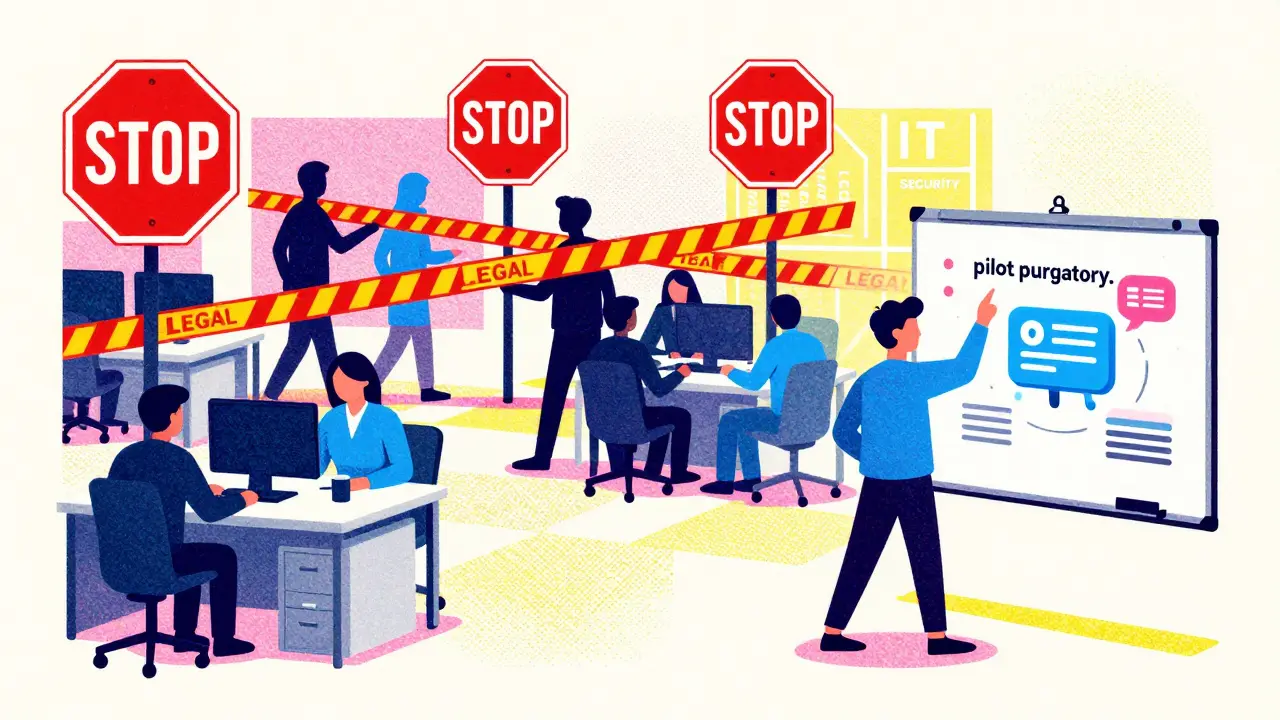
Most companies think adopting Large Language Models (LLMs) is a software problem. They hire more data scientists, buy expensive GPU clusters, and hope the magic happens. But by mid-2026, the reality is starkly different. The biggest hurdle isn't technical; it's organizational. Without a clear operating model for LLM adoption that defines how teams collaborate, who owns specific risks, and how workflows move from idea to production, your AI initiatives will stall in pilot purgatory.
You’ve likely seen this before. A marketing team builds a brilliant customer service chatbot prototype. It works great in testing. Then IT blocks it due to security concerns. Legal flags data privacy issues. Engineering says they don’t have bandwidth to maintain it. Six months later, the project is dead, and $8 million is gone. This isn’t a failure of technology. It’s a failure of structure.
To scale generative AI safely and effectively, you need to treat it like a product, not a script. This means establishing dedicated teams, defining precise roles, and creating an operational framework-often called LLMOps the specialized practices for managing the lifecycle of large language models-that bridges the gap between business goals and technical execution.
Why Traditional MLOps Fails for LLMs
If you’re coming from traditional machine learning, you might be tempted to just slap "LLM" on top of your existing MLOps Machine Learning Operations framework for automating ML deployment pipeline. Don’t. The two are fundamentally different.
Traditional ML models predict numbers or categories based on structured data. Their inputs are stable, and their outputs are deterministic. LLMs generate unstructured text (and increasingly, code, images, and audio) based on probabilistic patterns. This introduces chaos into your workflow. You can’t just check if the output is "correct"; you have to evaluate tone, accuracy, safety, and hallucination rates simultaneously.
| Feature | Traditional MLOps | LLMOps / LLM Operating Model |
|---|---|---|
| Primary Input | Structured data (tables, logs) | Unstructured text, prompts, context windows |
| Evaluation Metric | Accuracy, precision, recall | Hallucination rate, latency, token cost, safety alignment |
| Key Role Missing in MLOps | N/A | Prompt Engineer, AI Ethicist, Security Specialist |
| Deployment Cycle | Weeks to months | Days to weeks (requires rapid iteration) |
| Risk Focus | Data drift, model bias | Prompt injection, data leakage, regulatory compliance |
Forrester’s Q3 2024 benchmark study found that organizations forcing LLMs into legacy MLOps frameworks experienced 47% longer deployment cycles and 3.2 times more production incidents. Why? Because standard monitoring tools don’t catch a model confidently making up facts. You need a new operating model designed specifically for the ambiguity and scale of generative AI.
The Core Team Structure: Breaking Down Silos
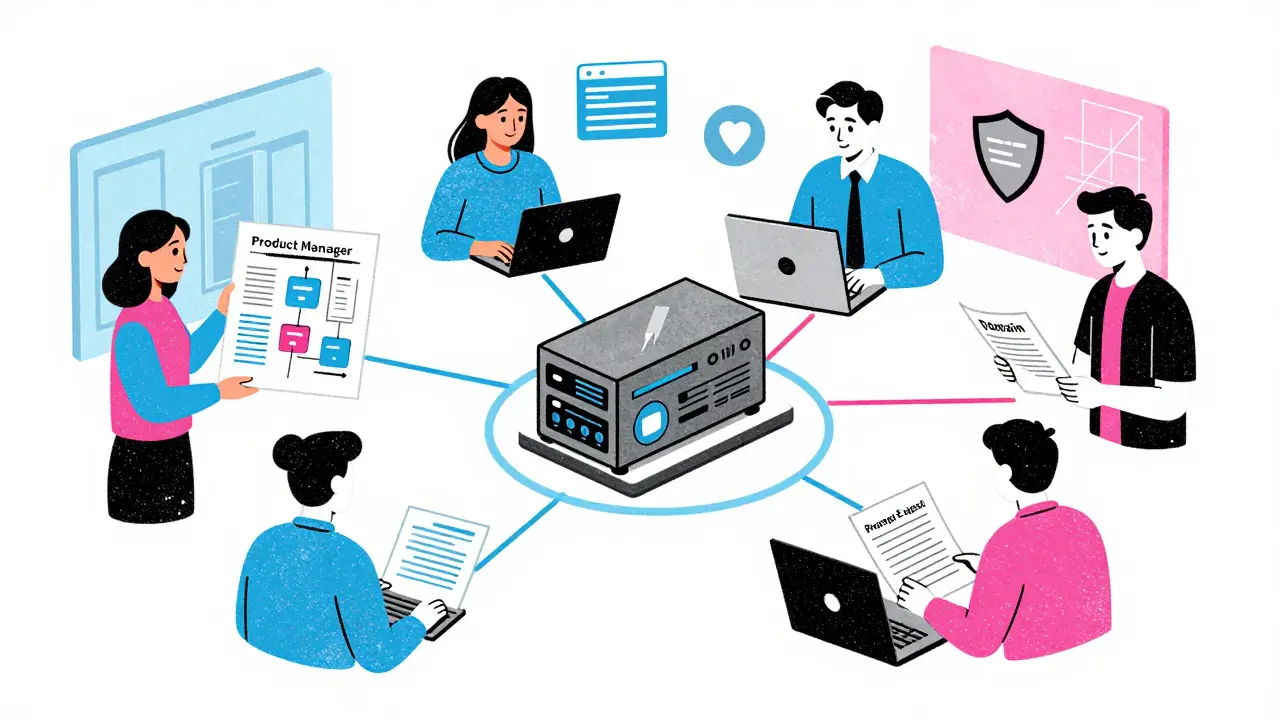
The heart of a successful LLM operating model is cross-functional collaboration. Dr. Andrew Ng famously noted in his March 2024 NeurIPS keynote that the biggest failure mode isn’t technical-it’s organizational silos. If your data scientists, engineers, and business leaders aren’t speaking the same language, you’re doomed.
Here’s the minimum viable team structure you need to establish:
- The LLM Product Manager: This person bridges the gap between business value and technical feasibility. They define the use case, set success metrics (not just accuracy, but user satisfaction and cost per query), and prioritize features. McKinsey reports that organizations with dedicated LLM product managers achieve 2.8x higher ROI.
- Prompt Engineers: Yes, this is a real job now. These specialists craft the instructions that guide the model. They understand how small changes in wording affect output quality. Reddit users report that while these roles boost output satisfaction by 40%, they often spend significant time educating stakeholders on why vague requests like "make it better" fail.
- AI Security Specialists: Security cannot be an afterthought. As Purdue University’s Dr. Saurabh Bagchi warned, 68% of LLM vulnerabilities stem from inadequate security representation early in design. These experts guard against prompt injection attacks and ensure data privacy compliance.
- MLOps/LLMOps Engineers: They build the infrastructure. This includes managing GPU clusters (like NVIDIA A100s), orchestrating containers via Kubernetes, and setting up monitoring pipelines to track latency and token usage.
- Domain Experts: Lawyers for legal tech, doctors for health AI. They validate the content. An LLM might sound confident, but is it medically accurate? Domain experts provide the ground truth for evaluation.
Avoid the trap of over-specialization. Stanford HAI researchers caution that creating too many isolated LLM roles can create new silos. The goal is convergence. Your prompt engineer should sit next to your backend developer. Your security specialist should review code alongside your data scientist.
Defining Clear Responsibilities: Who Owns What?
Ambiguity kills projects. In a recent InfoWorld investigation, a major retail chain lost $8.2 million because no one knew whether the Data Science team or Customer Experience team owned the LLM implementation. Here’s how to assign ownership clearly:
- Model Selection & Fine-Tuning: Owned by the Data Science/ML Engineering team. They decide whether to use a foundation model like GPT-4 or Llama 3, and handle any fine-tuning required for your specific domain.
- Prompt Design & Optimization: Owned by Prompt Engineers in close collaboration with Product Managers. They iterate on system prompts and few-shot examples to improve performance.
- Infrastructure & Deployment: Owned by Platform Engineering. They manage the cloud resources, API gateways, and scaling policies. According to Rafay’s 2024 survey, 82% of enterprises rely on Kubernetes for this orchestration.
- Safety, Compliance & Ethics: Owned by AI Governance/Legal. With the EU AI Act fully implemented in 2025, this role is critical. They audit outputs for bias, ensure GDPR/CCPA compliance, and manage risk disclosures.
- User Experience & Integration: Owned by Product/UX Design. They determine how the AI interacts with humans, designing interfaces that manage expectations and handle errors gracefully.
Create a RACI matrix (Responsible, Accountable, Consulted, Informed) for every major LLM initiative. Post it publicly. When conflicts arise-and they will-refer back to the document. Clarity prevents duplicated efforts and conflicting requirements.
Building the LLMOps Workflow: From Prompt to Production
Your operating model needs a repeatable workflow. Ad-hoc experimentation has its place, but scaling requires discipline. IBM defines LLMOps as the practices that speed development and management throughout the model’s lifecycle. Here’s what that looks like in practice:
- Ideation & Feasibility: Start with a clear business problem. Can an LLM actually solve it? Assess data availability and sensitivity. If you need to process patient records, you’ll need stricter controls than if you’re summarizing public news articles.
- Prototype Development: Build a quick proof-of-concept using off-the-shelf APIs. Test basic functionality. Involve domain experts early to validate initial outputs.
- Evaluation & Testing: This is where most teams fail. You need automated evaluation frameworks. Tools like Weights & Biases or LangChain help track metrics beyond simple accuracy. Measure hallucination rates, response latency, and cost per token. Create a "golden dataset" of known good answers to test against.
- Security Audit: Before going live, subject the model to red-teaming. Try to break it. Attempt prompt injections. Check for data leakage. Ensure your infrastructure meets security standards like OWASP Top 10 for LLMs.
- Deployment & Monitoring: Roll out to a small user group first. Monitor closely. Track not just technical metrics, but user feedback. Are people trusting the output? Are they correcting it frequently? Adjust prompts and parameters based on real-world usage.
- Continuous Improvement: LLMs degrade as language evolves and user behavior shifts. Schedule regular reviews. Retrain or fine-tune as needed. Update safety filters regularly.
Wandb’s analysis showed that organizations with complete LLMOps frameworks reduced deployment cycles from 28 days to just 9 days. That speed comes from automation and clear processes, not heroics.

Navigating Regulatory and Ethical Landscapes
In 2026, ignoring regulation is no longer an option. The EU AI Act, US NIST AI Risk Management Framework 2.0, and various state-level laws impose strict requirements on high-risk AI systems. Your operating model must include governance from day one.
Establish an AI Center of Excellence (CoE) a centralized team that sets standards, provides tools, and ensures compliance across the organization. This CoE doesn’t build every model, but it sets the rules. It maintains approved model registries, defines acceptable use policies, and conducts regular audits.
Key governance tasks include:
- Data Provenance Tracking: Document where training data came from. Ensure you have rights to use it. Avoid copyright infringement.
- Bias Mitigation: Regularly test for demographic biases in outputs. Implement mitigation strategies, such as diverse training data or post-processing filters.
- Transparency: Clearly disclose when users are interacting with AI. Provide mechanisms for human oversight and appeal.
- Incident Response: Have a plan for when things go wrong. If the model generates harmful content, how do you shut it down? How do you notify affected users?
KPMG’s May 2025 survey found that 78% of enterprises plan to align their structures with NIST standards within 12 months. Getting ahead of this curve is a competitive advantage. It builds trust with customers and regulators alike.
Future-Proofing Your Organization
The landscape is shifting rapidly. Multimodal LLMs (handling text, image, audio, video) are becoming mainstream. This creates new organizational needs. Forrester’s June 2025 study noted that 63% of early adopters need additional roles focused on cross-modal evaluation.
However, don’t over-invest in permanent specialization. Gartner predicts that by 2027, 80% of LLMOps functions will merge into unified AI operations frameworks. As tools mature, the need for highly specialized prompt engineers may decrease. The goal is to build a flexible organization that can adapt.
Focus on building internal capabilities rather than relying solely on external vendors. Train your existing workforce. Upskill your data analysts in prompt engineering. Teach your developers about AI ethics. Create a culture of continuous learning.
Start small, but start now. Define your roles. Clarify responsibilities. Build your LLMOps pipeline. The companies that thrive in the age of AI won’t be those with the best models-they’ll be those with the best operating models.
What is the difference between MLOps and LLMOps?
MLOps focuses on traditional machine learning models that predict structured outcomes, emphasizing data pipelines and model versioning. LLMOps extends this to Large Language Models, adding specialized components for prompt management, hallucination monitoring, safety filtering, and handling unstructured text generation. LLMOps requires new roles like Prompt Engineers and focuses on metrics like token efficiency and semantic accuracy rather than just numerical precision.
Do I really need a dedicated Prompt Engineer?
For serious enterprise adoption, yes. While anyone can write a prompt, optimizing them for consistency, safety, and cost-efficiency is a specialized skill. Prompt Engineers understand how subtle wording changes impact model behavior and can systematically test and refine instructions. Organizations with dedicated prompt engineers report 40% higher satisfaction with LLM outputs. However, this role should collaborate closely with product managers and domain experts, not work in isolation.
How long does it take to establish an effective LLM operating model?
Typically 6 to 9 months. This includes assessing current capabilities, hiring or upskilling staff, defining roles and responsibilities, setting up LLMOps infrastructure, and running initial pilots. Rushing this process leads to unclear ownership and security gaps. Dedicate at least 30% of your initial resources to building cross-functional teams and establishing governance frameworks.
What are the biggest risks of a poor LLM operating model?
The primary risks include security breaches (such as prompt injection attacks), regulatory non-compliance (violating GDPR or the EU AI Act), financial waste from duplicated efforts, and reputational damage from biased or inaccurate outputs. Without clear roles, accountability becomes blurred, leading to delayed deployments and increased production incidents. Forrester notes that poor operating models can increase deployment cycles by 47% and triple incident rates.
Will specialized LLM roles disappear as technology matures?
Likely yes, partially. Gartner predicts that by 2027, most LLMOps functions will merge into broader AI operations frameworks. As tools become more intuitive and automated, the need for highly specialized prompt engineers may decline. However, expertise in AI ethics, security, and domain-specific validation will remain crucial. The trend is toward convergence, where generalist AI engineers handle multiple aspects of the lifecycle rather than narrow specialists.