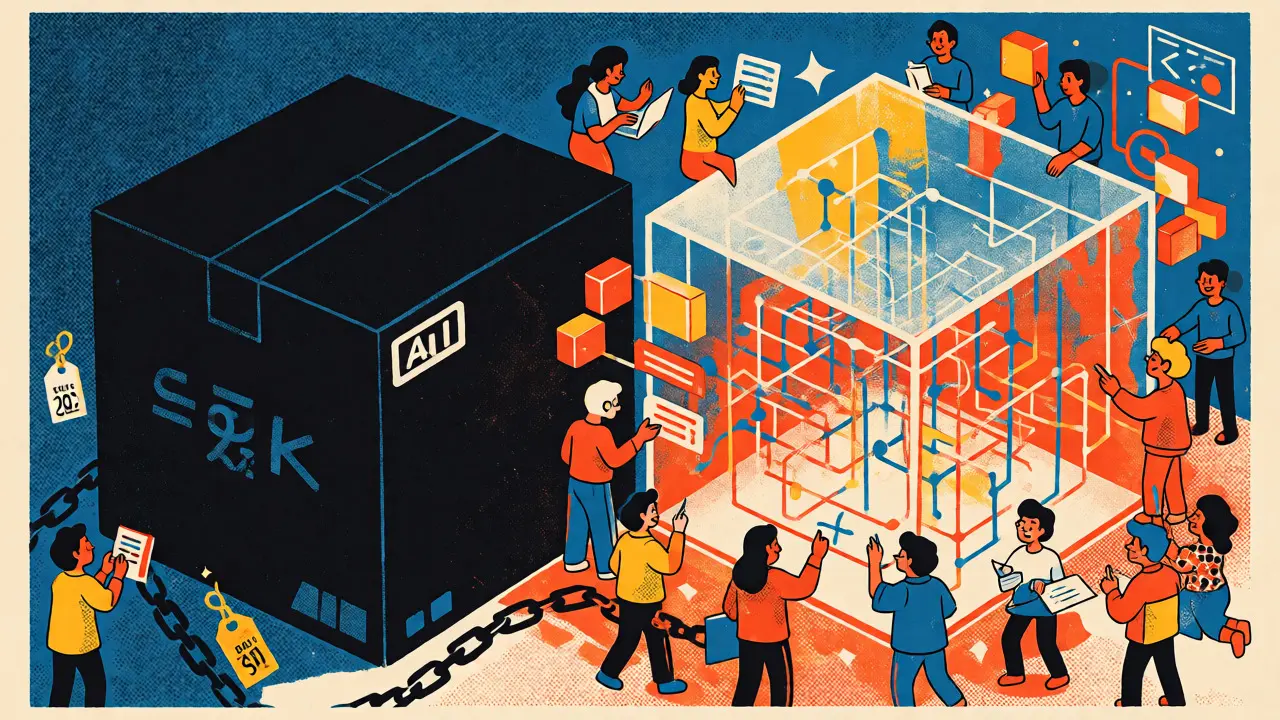
You might think the biggest battle in AI is just about who has the most powerful proprietary model. But look closer at the data from late 2025, and you see a different story. The real shift isn't just about raw power; it's about control, transparency, and community ownership. Open-source generative AI has moved from a niche hobbyist project to a critical infrastructure layer for global business. It refers to artificial intelligence models where architectures, training methods, and weights are publicly accessible. This allows anyone to modify, redistribute, and use them commercially under specific licenses.
This isn't just theory. As of December 2025, the Linux Foundation AI & Data ecosystem tracks over 68 actively maintained open-source projects. More than 100,000 developers from 3,000 organizations contribute globally. Why does this matter to you? Because the days of black-box AI are ending. Companies want to know what their models are learning, how they are making decisions, and whether they can trust the output without paying a premium for every query.
The Shift from Proprietary Black Boxes to Transparent Ecosystems
Think back to early 2023. Meta released LLaMA, and suddenly, the landscape changed. Before that, if you wanted state-of-the-art language generation, you were locked into a few proprietary providers. Today, the value proposition of open-source models rests on three solid pillars: democratized access, security through transparency, and faster innovation.
A report from Hyperstack in October 2025 found that 92% of surveyed developers cited cost reduction as their primary motivation for switching to open-source tools. But it’s not just about saving money. Security is a huge driver. IBM’s Q3 2025 enterprise survey revealed that 78% of Fortune 500 companies have serious data privacy concerns with proprietary models. When you run an open-source model locally or in your own cloud, you verify the code. You know exactly what happens to your data. There is no hidden API call sending your sensitive customer info to a third-party server.
Innovation speed is the third pillar. Community-driven models iterate much faster than closed corporate labs. A benchmark study by TokenMinds in November 2025 showed that open-source projects experience 3.7x faster iteration cycles compared to their proprietary counterparts. If a bug is found, thousands of eyes fix it overnight. If a new feature is needed, the community builds it. This collaborative pressure forces quality up and costs down.
Technical Realities: What Can These Models Actually Do?
Let’s get specific. Generalizations don’t help when you’re trying to choose a model for production. Here is how the leading players stack up right now.
| Model Family | Architecture/Type | Key Performance Metric | Hardware Requirement | Primary Use Case |
|---|---|---|---|---|
| LLaMA 3 | Modified Transformer (Grouped-query attention) | 47.2% MMLU (5-shot) | 16GB VRAM (8B variant) | Enterprise Chatbots, Coding Assistants |
| Stable Diffusion 3 | Rectified Flow Transformer | 4.7 images/sec (A100 GPU) | NVIDIA A100 Recommended | Game Assets, Marketing Imagery |
| BigScience BLOOM | Autoregressive Transformer (176B params) | 52.7% X-CSQA Accuracy | 320GB GPU Memory | Multilingual Support (46+ languages) |
| Google Gemma 2 | Transformer (9B/27B variants) | 68.4% HumanEval Score | Consumer Hardware Compatible | Coding, Edge Devices |
Meta’s LLaMA 3 family currently dominates enterprise adoption with a 41.7% market share among open-source Large Language Models (LLMs). Its strength lies in balancing performance with accessibility. The 8-billion parameter version runs smoothly on a standard MacBook Pro M2 using tools like Ollama. Users on Reddit’s r/LocalLLaMA frequently highlight this ease of deployment. One user noted running the 7B version in under five minutes after installation. That kind of frictionless entry was impossible two years ago.
For image generation, Stability AI’s Stable Diffusion 3 holds a massive 68.2% market share in the open-source space. While proprietary rivals like Midjourney score higher on pure photorealism (4.1 vs. 3.2 on human evaluation scales), Stable Diffusion wins on customization. Game studios love it because they can fine-tune the model on their specific art style. However, be warned: the learning curve for advanced features is steep. A November 2025 survey showed 68% of users struggle with complex workflows.
If you need multilingual capabilities, BigScience BLOOM is still a heavyweight. Trained on the French Jean Zay supercomputer, it supports over 46 languages. But its size is a double-edged sword. Running the full 176-billion-parameter model requires 320GB of GPU memory. For small-to-medium businesses, this creates a significant barrier to entry unless you use quantized versions or specialized cloud instances.
Governance: The Hidden Bottleneck
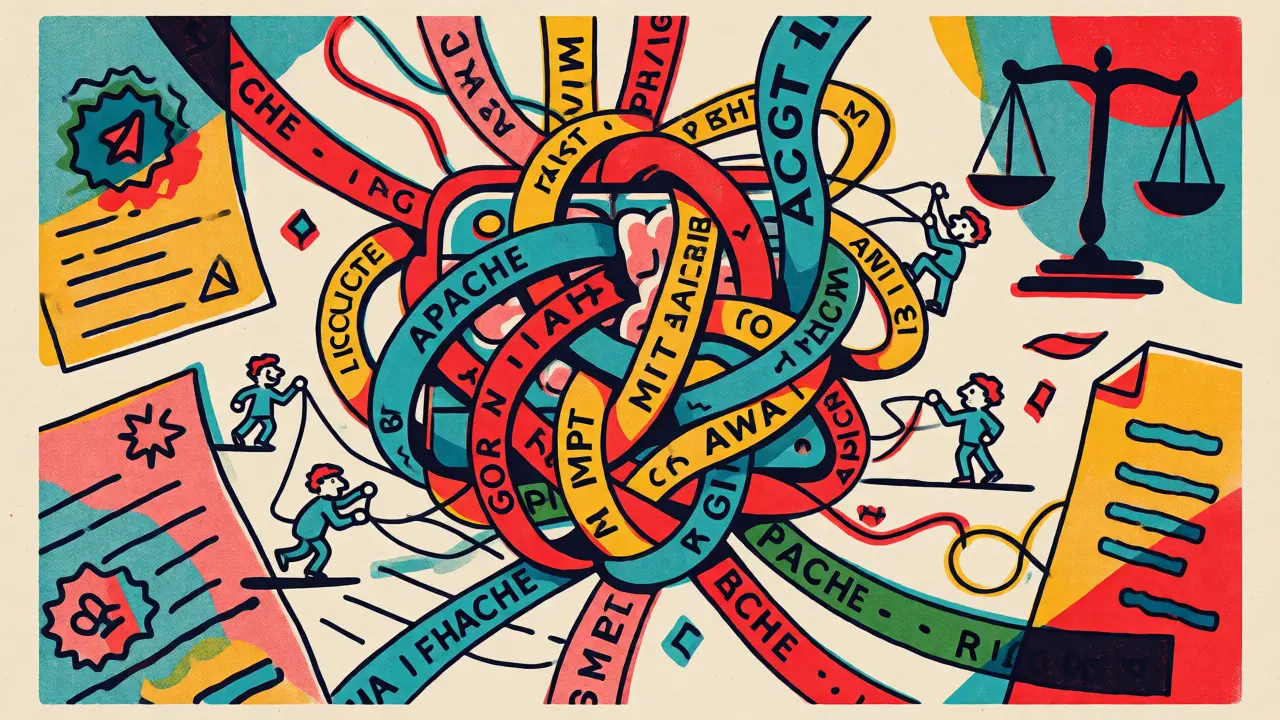
Here is the part nobody talks about enough: governance. Just because code is open doesn’t mean it’s free from legal headaches. Stanford HAI’s April 2025 AI Index Report warned about "fragmentation risks in model governance." There are currently 83 distinct licensing frameworks complicating enterprise adoption. This isn't just bureaucratic noise; it delays product launches.
NetApp Instaclustr’s September 2025 analysis found that 37% of surveyed open-source models contained commercial use limitations. Another 44% required explicit permission for enterprise deployment. This legal uncertainty delayed adoption for 28% of companies surveyed by IBM. If you are building a startup, you cannot afford to guess whether your model license allows you to sell your service.
To combat this, the industry is consolidating standards. The OpenChain AI Working Group, launched in June 2025 with 47 corporate members, has already standardized 87% of license compliance processes. This group works closely with the Linux Foundation to create clear guidelines. If you are deploying AI in Europe, pay close attention to the EU’s October 2025 AI Act amendments. They require transparency documentation for all foundation models deployed commercially. This affects 89% of open-source projects. Keeping good records of your training data and model architecture is no longer optional-it’s a legal requirement.
Community Dynamics and Quality Control
The promise of open source is collective intelligence. The reality is sometimes messy. Gary Marcus, writing in MIT Technology Review in November 2025, critiqued the "inconsistent quality control in community-driven models." His concern is valid. EleutherAI’s November 2025 evaluation showed that community fine-tunes can suffer up to 22.3% performance degradation compared to original weights. Hallucinations increase in 31% of Hugging Face fine-tunes.
Why does this happen? Often, it’s due to poor data cleaning during fine-tuning or improper hyperparameter tuning by amateur developers. Documentation quality varies wildly too. LLaMA 3 scores a respectable 4.5/5 on Hugging Face’s community assessment. But specialized models, like those for blockchain smart contract generation, score as low as 2.8/5. Users complain about rapidly outdated examples and unclear instructions.
Support channels reflect this disparity. LLaMA 3’s Discord server has 85,000 members and averages 22-minute response times to technical queries. Less popular models might wait 14 hours for a reply. If you rely on community support, stick to the major ecosystems until you have the internal expertise to handle edge cases yourself.

Future Trajectories: Edge AI and Hybrid Architectures
Where is this heading next? Three trends dominate the conversation for 2026 and beyond.
- Edge AI Specialization: Matt White of the PyTorch Foundation predicts a push toward smaller, efficient models. Microsoft’s Phi-3-mini, with only 3.8 billion parameters, achieves 69% of GPT-4’s performance while running on smartphones. ABI Research forecasts a 45% Compound Annual Growth Rate (CAGR) for edge AI through 2027.
- Domain-Specific Ecosystems: Generic models are giving way to specialized ones. Healthcare-focused models are growing at 62% annually according to Rock Health. Instead of one giant brain, we will see many specialized brains trained on specific medical literature or legal codes.
- Hybrid Open-Closed Architectures: Enterprises aren’t choosing sides. They are mixing them. Gartner’s December 2025 survey shows 58% of enterprises combine proprietary fine-tunes with open base models. You get the safety and brand alignment of proprietary data with the cost-efficiency and flexibility of open-source foundations.
Sustainability is also becoming a key metric. Training a single 100-billion-parameter model consumes approximately 1,287 MWh of electricity, according to MIT’s October 2025 environmental impact study. As regulations tighten, energy efficiency will become a competitive advantage. Smaller, distilled models will win out over brute-force giants.
Practical Implementation: Getting Started Without the Headache
If you are ready to implement, here is what you need to know. The average learning curve for deploying open-source models dropped from 8.2 weeks in Q1 2024 to 4.7 weeks in Q4 2025. Tools like Ollama (1.2 million downloads) and LM Studio have made local testing easy. But moving to production requires more skills.
O’Reilly’s November 2025 skills survey highlights the essentials: Python proficiency (needed in 87% of implementations), containerization skills (63%), and GPU optimization knowledge (52%). Common pitfalls include license compliance issues, which cause 39% of failed deployments, and hardware under-provisioning, responsible for 28% of performance problems.
Start small. Test a 7B or 8B parameter model on consumer hardware first. Verify the license terms explicitly for commercial use. Then, scale up gradually. Don’t try to deploy a 176B parameter model without a clear plan for inference costs and latency.
Is open-source generative AI really cheaper than proprietary APIs?
Not always. While there are no per-token fees, you pay for hardware, maintenance, and engineering time. For high-volume applications, open-source is often cheaper. For low-volume or experimental projects, proprietary APIs might be more cost-effective due to zero setup overhead. The break-even point depends on your usage scale and available infrastructure.
What are the main legal risks of using open-source AI models?
The biggest risk is license non-compliance. Many models have restrictions on commercial use, redistribution, or derivative works. Some require attribution or share-alike clauses. Additionally, copyright claims regarding training data remain unresolved in many jurisdictions. Always consult legal counsel before deploying a model commercially, especially if you modify the weights.
How do I ensure quality when using community fine-tuned models?
Test rigorously against your specific use case. Community fine-tunes can introduce hallucinations or degrade performance. Compare the fine-tuned model against the base model using your own evaluation dataset. Check the reputation of the creator on platforms like Hugging Face, and review their training data sources if available. Never assume a fine-tune is better without empirical evidence.
Can small businesses realistically deploy large open-source models?
Yes, but with caveats. Full-size models like BLOOM require expensive GPU clusters. Small businesses should look at quantized versions (e.g., 4-bit or 8-bit quantization) which reduce memory requirements significantly. Alternatively, use smaller models like LLaMA 3 8B or Gemma 2, which run on affordable consumer GPUs or even CPUs. Cloud services also offer managed open-source endpoints that lower the barrier to entry.
How does the EU AI Act affect open-source model developers?
The EU AI Act requires transparency documentation for foundation models deployed commercially. This includes details on training data, computational resources, and potential biases. Developers must maintain detailed records of their model development process. Non-compliance can result in fines. This regulation pushes the entire industry toward greater accountability and standardized reporting practices.