You’ve heard the term. You’ve seen the demos. Vibe coding-that effortless, flow-state style of building software using AI assistants-is reshaping how developers work. But when you move from a solo hacker’s laptop to an enterprise environment with thousands of employees, the question isn’t just about speed. It’s about control.
For CTOs and IT directors, the choice between running these AI-powered development tools in the cloud or keeping them strictly on-premises is no longer a simple infrastructure debate. It’s a strategic decision that impacts intellectual property security, compliance costs, and developer productivity. As we navigate through 2026, the line between convenience and control is becoming the most critical factor in adopting generative AI for software engineering.
What Is Vibe Coding Really?
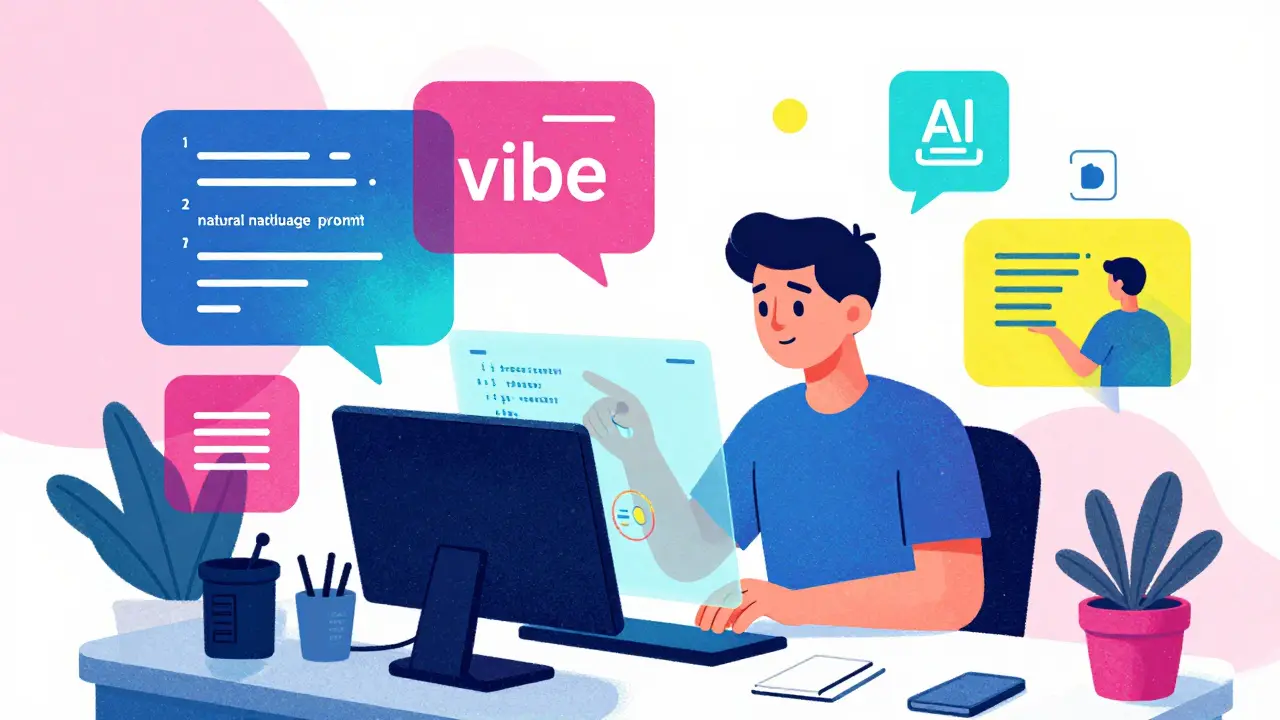
Before we split hairs over data centers, let’s define what we’re actually talking about. "Vibe coding" isn’t a specific software framework like React or Django. Instead, it refers to a workflow paradigm where developers interact with Large Language Models (LLMs) through natural language prompts to generate, debug, and refactor code. The goal is to maintain a creative "vibe"-a state of high-level architectural thinking-while the AI handles the syntactic heavy lifting.
In this model, the developer acts more like a product manager or editor than a traditional coder. They describe the desired outcome, and the AI provides the implementation. This shift requires significant computational power and access to vast training datasets. That’s where the infrastructure debate begins: do you send your proprietary codebase to a public cloud provider to get those results, or do you host the models locally within your own firewalls?
The Cloud Advantage: Speed and Scale
Let’s be honest: the cloud is easy. If you want your team to start vibe coding tomorrow, pointing their IDE plugins at a hosted API like OpenAI, Anthropic, or Azure AI Services is the fastest path forward. There’s zero maintenance overhead. No GPU clusters to manage, no driver updates to troubleshoot, and no capacity planning required.
Cloud-based AI services offer immediate scalability. When a team of fifty developers suddenly needs to process complex refactoring tasks simultaneously, the cloud absorbs that load without breaking a sweat. You pay for what you use, typically measured in tokens processed. For many startups and mid-sized companies, this operational expenditure (OpEx) model is financially attractive because it avoids the massive upfront capital expenditure (CapEx) of buying NVIDIA H100 or A100 GPUs.
Moreover, cloud providers are constantly updating their models. In the rapidly evolving world of LLMs, being stuck with a static, on-premise model can mean falling behind in terms of code quality and reasoning capabilities. Cloud users automatically benefit from the latest improvements in context windows, tool-use capabilities, and accuracy.
The On-Premise Case: Sovereignty and Security
Now, flip the script. Imagine you work for a defense contractor, a major bank, or a pharmaceutical company. Your code contains trade secrets, patient data, or financial algorithms that cannot leave your network under any circumstances. Sending snippets of your core banking logic to a third-party cloud provider-even if they promise not to train on it-is a non-starter for many compliance officers.
This is where on-premise AI deployment becomes essential. By hosting open-source models like Llama 3, Mistral, or CodeLlama on your own servers, you retain full sovereignty over your data. Nothing leaves your firewall. You control who accesses the logs, how long data is retained, and whether any part of the system is monitored by external vendors.
The trade-off? Complexity and cost. Running large language models locally requires serious hardware investment. You need powerful GPUs, robust cooling systems, and specialized MLOps engineers to keep the inference engines running smoothly. The initial setup can cost hundreds of thousands of dollars, and maintaining that infrastructure is an ongoing burden.

Security and Compliance: The Real Cost
Security isn’t just about keeping hackers out; it’s about meeting regulatory requirements. In 2026, regulations like the EU AI Act and various sector-specific guidelines have tightened significantly around data privacy and algorithmic transparency.
| Factor | Cloud Deployment | On-Premise Deployment |
|---|---|---|
| Data Residency | Dependent on provider regions | Fully controlled by enterprise |
| IP Leakage Risk | Moderate (depends on vendor policy) | Negligible (air-gapped option available) |
| Compliance Auditability | Limited visibility into backend processes | Full access to logs and model weights |
| Vendor Lock-in | High risk | Low risk (open-source models) |
When you use cloud APIs, you are trusting the vendor’s security posture. While major providers invest billions in cybersecurity, you don’t have direct visibility into their internal controls. If there’s a breach at the provider level, your data could be exposed. With on-premise solutions, you are responsible for your own security, but you also have complete visibility and control. You can implement air-gapping, strict role-based access controls (RBAC), and custom encryption standards that meet your organization’s specific threat model.
Performance and Latency Considerations
Latency matters in vibe coding. When a developer is in the zone, waiting ten seconds for an AI to generate a function breaks their flow. Cloud services generally offer lower latency for individual requests because they are optimized for global distribution and high throughput. However, network instability can introduce jitter, especially if your office internet connection isn’t enterprise-grade.
On-premise setups can offer sub-millisecond latency if the compute resources are located in the same data center as the developers’ workstations. This creates a snappier, more responsive experience. But this advantage comes with diminishing returns if your local hardware isn’t powerful enough. Trying to run a 70-billion-parameter model on insufficient GPUs will result in slower response times than a well-optimized cloud API.
Total Cost of Ownership (TCO)
Let’s talk money. The cloud model looks cheaper initially because you avoid hardware purchases. But as usage scales, token costs can spiral out of control. High-frequency vibe coding involves sending large chunks of context (entire codebases) to the AI with every prompt. These large context windows consume tokens rapidly.
For a team of 100 developers using AI intensively, monthly cloud bills can easily exceed $50,000-$100,000. Over three years, this often surpasses the cost of purchasing and maintaining on-premise GPU clusters. Additionally, on-premise solutions allow you to fine-tune models on your specific codebase, which can improve efficiency and reduce the need for excessive prompting, further lowering effective costs.

The Hybrid Approach: Best of Both Worlds?
Many enterprises are choosing a hybrid strategy. They use cloud APIs for general-purpose coding tasks where IP leakage isn’t a concern, such as writing unit tests, generating documentation, or debugging common libraries. For sensitive core modules, they route requests to secure, on-premise instances of smaller, specialized models.
This approach requires sophisticated orchestration layers. Tools like Kubernetes can help manage both cloud-connected and isolated AI services, dynamically routing requests based on sensitivity tags attached to the code files. It’s complex to set up, but it balances cost, security, and performance effectively.
Implementation Checklist for Enterprises
If you’re ready to bring vibe coding into your enterprise, here’s what you need to consider:
- Audit Your Data Sensitivity: Classify your codebase. What percentage contains PII, trade secrets, or regulated data?
- Evaluate Vendor SLAs: If going cloud, ensure the provider offers data processing agreements (DPAs) that explicitly forbid training on your data.
- Assess Hardware Readiness: Do you have the GPU capacity and networking bandwidth to support local LLM inference?
- Plan for MLOps: Who will maintain the models? Update the weights? Monitor for drift?
- Train Your Developers: Vibe coding changes how people write code. Provide training on prompt engineering and AI-assisted review practices.
Looking Ahead: 2026 and Beyond
The landscape is shifting quickly. We’re seeing the rise of smaller, more efficient models that can run on consumer-grade hardware, potentially democratizing on-premise AI. At the same time, cloud providers are offering dedicated, private instances that mimic the security of on-premise setups while retaining the ease of cloud management.
Quantum-resistant encryption and zero-trust architectures are becoming standard requirements for AI integrations. Whatever path you choose, prioritize flexibility. Avoid locking yourself into a single vendor’s ecosystem unless absolutely necessary. The ability to switch between cloud and on-premise deployments should be a design principle, not an afterthought.
Is vibe coding safe for enterprise use?
Yes, but only with proper controls. Using cloud APIs without data protection agreements poses significant IP risks. On-premise deployments or hybrid models with strict data classification provide a safer environment for enterprise codebases.
What are the best on-premise LLMs for coding in 2026?
Models like Llama 3 (70B+ parameters), Mistral Large, and specialized variants of CodeLlama are popular choices. They offer strong performance and can be fine-tuned on proprietary code without sending data to external servers.
How much does it cost to run on-premise AI coding tools?
Initial hardware costs can range from $50,000 to several hundred thousand dollars depending on scale. Ongoing costs include electricity, cooling, and MLOps personnel. For large teams, this often becomes cheaper than cloud token fees over a 3-year period.
Can I use a hybrid approach for vibe coding?
Absolutely. Many enterprises use cloud APIs for non-sensitive tasks like documentation and testing, while routing sensitive core logic to secure, on-premise models. This requires robust orchestration tools to manage data flow.
Does vibe coding replace human developers?
No. Vibe coding augments developers by handling repetitive syntax and boilerplate. Human oversight remains critical for architecture decisions, security reviews, and ethical considerations. The role shifts from writer to editor and architect.