We used to think the goal of artificial intelligence was to remove humans from the loop entirely. The dream was a self-driving car that never needed a driver or a trading algorithm that made decisions faster than any human could blink. But as we move into 2026, that dream is looking less like progress and more like a liability. When an AI makes a mistake in a hospital or a power grid, you can’t just patch it with a software update. You need a person who understands context, ethics, and nuance.
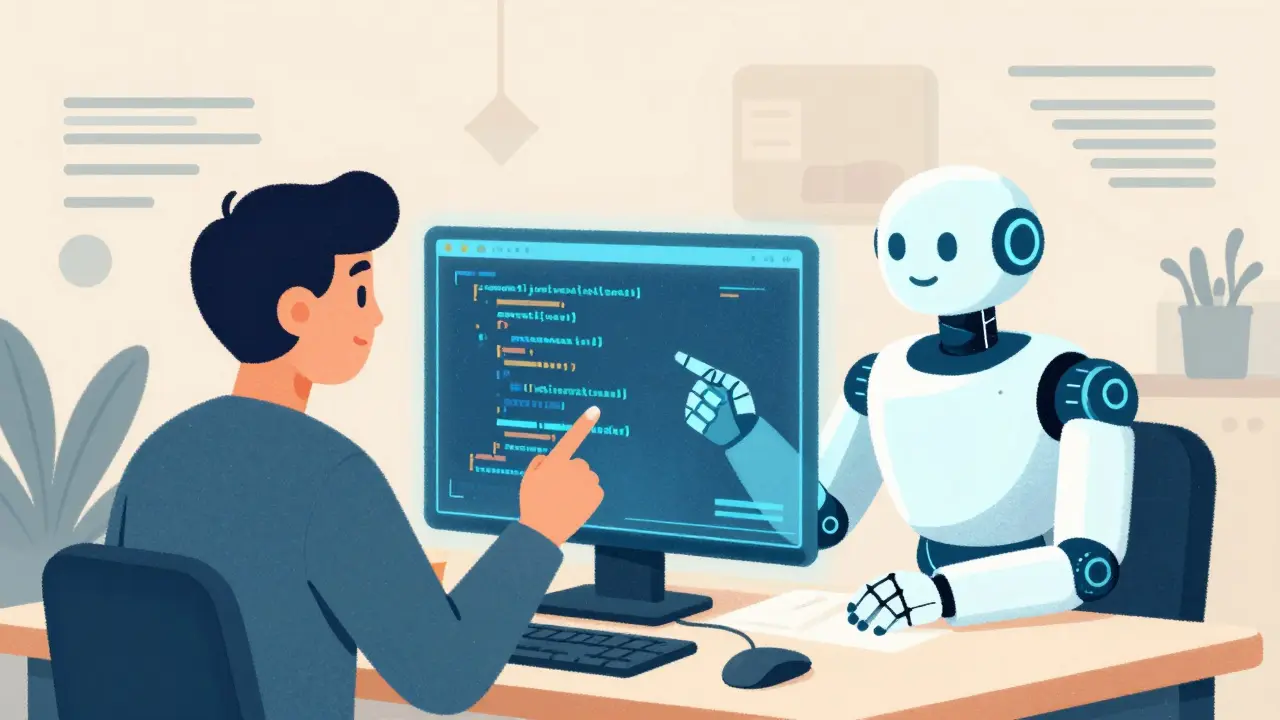
This shift has given rise to Human-Centered AI (HCAI), a coding discipline that designs AI systems to amplify human capabilities rather than replace them. It’s not about slapping a "stop" button on an autonomous system. It’s about rewriting the architecture so that human judgment is a first-class component of the code itself. For developers building critical systems, this isn’t just an ethical preference; it’s becoming a regulatory requirement and a survival strategy.
The Core Philosophy: Humans as Partners, Not Passengers
Traditional AI coding often treats the user as an endpoint-a recipient of data or a consumer of output. HCAI flips this model. In this framework, the human operator is part of the computational loop. This concept was formalized around 2019 by Stanford University’s Human-Centered Artificial Intelligence institute, founded by John Etchemendy and Fei-Fei Li. Their research showed that when AI systems are designed to collaborate with humans, error rates drop significantly.
Consider the difference between a standard recommendation engine and a medical diagnostic tool. A movie recommender doesn’t need your permission before suggesting a film. But an AI analyzing an X-ray for a tumor? That needs a different approach. According to a 2025 McKinsey study of 157 enterprises, HCAI coding patterns reduced AI-related errors by 37% in critical decision-making scenarios while maintaining 92% user trust levels. Why? Because the code explicitly defines where human intuition overrides statistical probability.
Dr. Fei-Fei Li puts it bluntly: "HCAI coding isn't just about adding human oversight as an afterthought; it requires fundamentally rethinking software architecture to treat human judgment as a first-class component of the system." This means moving beyond simple "off switches" to creating interfaces where humans and AI negotiate outcomes in real-time.
Technical Implementation: Building the Guardrails
If HCAI is the philosophy, then Human-in-the-Loop (HITL) architecture is the engineering reality. This involves specific coding practices that embed oversight mechanisms directly into the software structure. Here are the key technical components you need to implement:
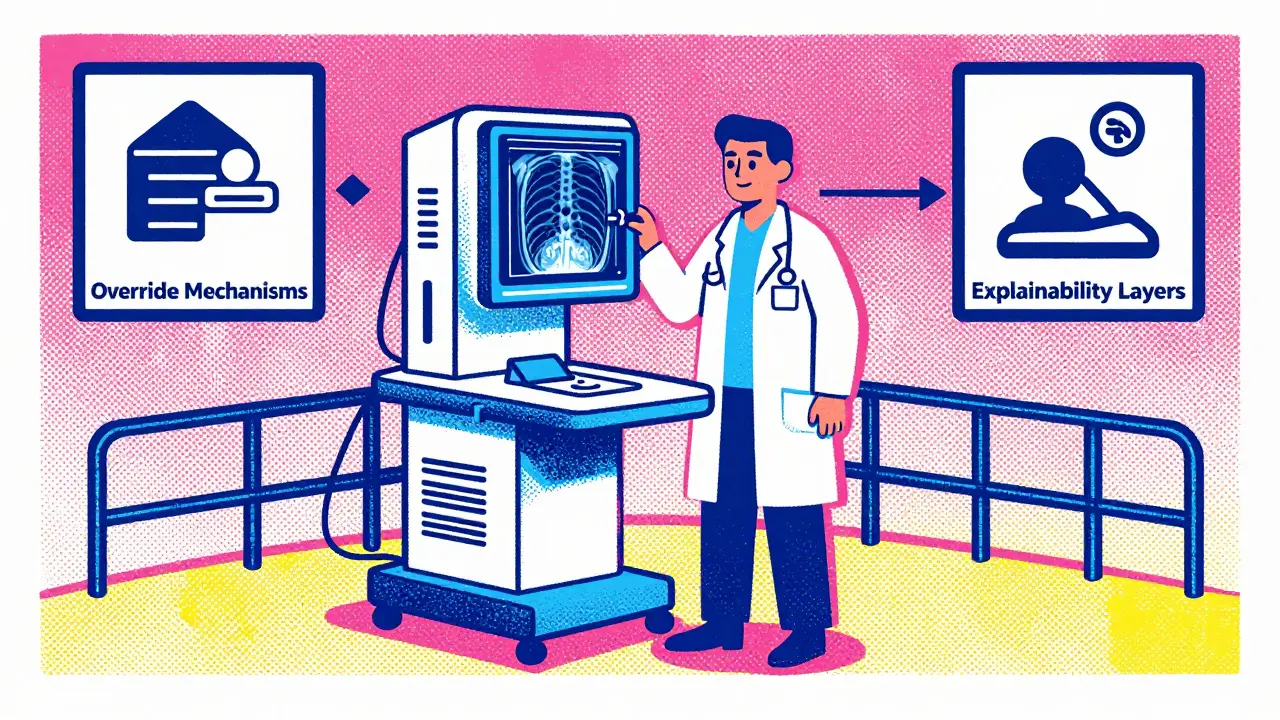
- Override Mechanisms: Code must allow human operators to correct AI decisions within a strict timeframe. The industry standard is now 200 milliseconds response time. If the system takes longer to register a human override, it’s too slow for critical applications like aviation or emergency medicine.
- Explainability Layers: Using techniques like LIME (Local Interpretable Model-agnostic Explanations), the code generates natural language justifications for every AI decision. This isn’t just for debugging; it’s for compliance and trust. If a doctor doesn’t understand why the AI flagged a patient, they won’t use it.
- Audit Trails: Every interaction between the AI and the human must be logged. This includes the AI’s confidence score, the human’s action, and the timestamp. These logs are essential for meeting regulations like the EU AI Act and ISO/IEC 42001:2026.
- Fail-Safe Modes: As specified in Version 2.1 of the NIST AI Risk Management Framework (released January 2025), systems must revert to human control when confidence scores fall below 85%. This isn’t optional; it’s one of 17 mandatory coding requirements for critical systems.
Implementing these features does come with a cost. Expect a 15-20% increase in development time and an 8-12% higher computational overhead. However, the trade-off is worth it. Data from the 2025 IEEE Benchmarking Consortium shows that HCAI-coded systems achieve 99.95% uptime in critical applications, compared to lower reliability in fully automated counterparts.
HCAI vs. Traditional AI: Where Each Shines
Not every system needs human-centered coding. In fact, trying to force HCAI principles into high-frequency trading can actually hurt performance. A 2024 study by the Financial Stability Board found that HCAI systems added a 7.3-millisecond latency, making them non-competitive in 83% of ultra-high-frequency trading scenarios. In those cases, speed is the only metric that matters, and humans are too slow.
But look at healthcare. A 2025 Gartner comparison of 47 healthcare AI systems revealed that HCAI-coded solutions achieved 42% higher adoption rates among medical professionals. They also reduced diagnostic errors by 28% compared to fully automated systems. The primary differentiator? HCAI implementations typically contain 3-5 designated intervention points per workflow, whereas conventional AI has zero or one.
| Feature | HCAI Coding | Traditional AI Coding |
|---|---|---|
| Human Intervention Points | 3-5 per workflow | 0-1 per workflow |
| Error Reduction | 37% in critical decisions | Variable, often higher risk |
| Development Time | +15-20% | Baseline |
| Regulatory Compliance | High (EU AI Act, NIST) | Low (Non-compliant for high-risk) |
| Best Use Case | Healthcare, Aviation, Infrastructure | High-Frequency Trading, Spam Filtering |
The rule of thumb is simple: if a mistake costs lives, money, or significant reputation damage, use HCAI. If the mistake just annoys a user, traditional AI might suffice.
The Hidden Challenge: Automation Bias and Cognitive Load
Adding human oversight doesn’t automatically make a system safer. In fact, it can introduce new risks. Dr. Aleksander Madry from MIT warns that "over-engineering human oversight into code can create dangerous complacency." This is known as automation bias-the tendency for humans to defer to machine recommendations even when they suspect they’re wrong.
There’s also the issue of cognitive load. Aviation software engineers on Stack Overflow reported that maintaining two parallel decision pathways (AI suggestion vs. human verification) increased debugging complexity for 63% of respondents. If the interface is cluttered or the alerts are frequent, the human operator becomes overwhelmed and starts ignoring warnings.
To combat this, Professor Ben Shneiderman of the University of Maryland advocates for his "8-item safety checklist," which includes predictable operation, continuous training, and customizable interfaces. The goal is to design systems where the human knows exactly when they are needed and when they can step back. It’s not about constant vigilance; it’s about effective handoffs.

Getting Started: Tools and Standards for 2026
You don’t have to reinvent the wheel. Several frameworks and tools have emerged to help developers implement HCAI principles efficiently. Here’s what you should be using in 2026:
- Microsoft Responsible AI Toolkit (v3.2): Released in June 2025, this toolkit provides standardized patterns for fairness, reliability, and transparency. It integrates directly with Azure ML pipelines.
- Google PAIR Guidelines: Google’s People+AI Research team offers 17 standardized coding patterns specifically for critical systems. These guidelines focus on user experience and trust.
- IBM Guardrails 4.0: Launched in April 2025, this open-source framework automatically inserts human oversight checkpoints into AI code during compilation. It’s particularly useful for large-scale enterprise deployments.
- HCAI Coding Standard 2.0: Released by the Partnership on AI in January 2025, this standard features 23 new patterns for critical infrastructure systems. It’s becoming the de facto reference for compliance.
For individual developers, the IEEE launched the HCAI Developer Certification program in March 2025. Certified developers report 29% fewer oversight-related bugs in their implementations. If you’re working in healthcare or finance, this certification is quickly becoming a resume requirement.
The Future: Adaptive Oversight
The next evolution of HCAI is adaptive oversight. Instead of static rules, future systems will dynamically adjust the level of human control based on real-time risk assessment. DARPA’s 2026 "Contextual Autonomy" program, allocated $127 million, is leading this charge. Imagine a self-driving car that hands over control to the human driver only when it encounters a rare road condition, but keeps full autonomy on a familiar highway.
However, we must address the "human override paradox." A 2025 Brookings Institution study found that 57% of critical system failures occurred during human override attempts rather than during autonomous AI operation. This suggests that our current HCAI coding practices may need fundamental redesign. We need to ensure that when humans take control, they have the right information and the right interface to act effectively.
As we move forward, the goal isn’t to build AI that thinks for us. It’s to build AI that helps us think better. By keeping people in control of critical systems through thoughtful, human-centered coding, we create technology that is not only smarter but also safer and more trustworthy.
What is Human-Centered AI (HCAI)?
Human-Centered AI is an emerging discipline that creates AI systems designed to amplify and augment human capabilities rather than displace them. In coding, it means embedding human oversight mechanisms directly into the software architecture, ensuring that humans remain in control of critical decisions.
Why is HCAI important for critical systems?
HCAI reduces AI-related errors by 37% in critical decision-making scenarios and maintains high user trust levels. It ensures that AI systems operate transparently, deliver equitable outcomes, and respect privacy, which is crucial for sectors like healthcare, finance, and infrastructure.
What are the key technical features of HCAI coding?
Key features include human-in-the-loop (HITL) architectures, override mechanisms with 200ms response times, explainability layers using techniques like LIME, comprehensive audit trails, and fail-safe modes that revert to human control when confidence scores drop below 85%.
Does HCAI coding slow down development?
Yes, HCAI coding typically increases development time by 15-20% and adds 8-12% computational overhead. However, this trade-off results in higher reliability, with HCAI-coded systems achieving 99.95% uptime in critical applications.
Which industries benefit most from HCAI?
Healthcare accounts for 38% of current HCAI adoption, followed by financial services (29%) and transportation (19%). These sectors require high levels of accuracy, accountability, and human oversight due to the potential impact of errors on lives and finances.
What are the main challenges of implementing HCAI?
Challenges include automation bias, where humans defer to AI incorrectly, and increased cognitive load for operators managing dual decision pathways. Additionally, there is a risk of the "human override paradox," where failures occur during human intervention rather than autonomous operation.
Are there certifications for HCAI developers?
Yes, the IEEE launched the HCAI Developer Certification program in March 2025. Certified developers report 29% fewer oversight-related bugs in their critical system implementations, making it a valuable credential for professionals in regulated industries.