
Most companies don't fail at generative AI because the technology is broken. They fail because they try to do everything at once. You have a backlog of fifty ideas, a limited budget for GPUs, and a board asking for returns next quarter. Without a clear system to pick winners and kill losers, your generative AI portfolio becomes a graveyard of half-finished pilots that never see the light of day.
Portfolio management in this context isn't just about tracking projects. It's a strategic discipline for allocating scarce resources-money, talent, and compute power-to maximize return on investment (ROI). As of late 2025, the landscape has shifted from experimental chaos to structured governance. Firms that implement formal portfolio frameworks are seeing significantly higher returns, with some reporting a 32% boost in AI ROI compared to those flying by the seat of their pants.
Why Your Current Approach Is Leaking Value
If you're treating every AI idea as a separate, independent request, you're missing the bigger picture. The core problem is misaligned incentives. Technology teams often want to build the coolest thing possible, while business units want immediate revenue. When these two collide without a central arbiter, you end up over-investing in low-impact tools like basic chatbots while underfunding high-value applications like automated risk modeling.
Data backs this up. A 2024 joint study by McKinsey and the International Association for Contract & Process Management (IACPM) found that over 60% of failed generative AI implementations stem from poor prioritization, not technical limitations. Teams consistently underestimate data readiness requirements by 14 to 18 months. This gap between expectation and reality is where budgets go to die. To fix this, you need to move away from ad-hoc approvals and toward a systematic evaluation matrix that scores every use case against consistent criteria.
The Three Dominant Portfolio Models
There isn't one single way to manage an AI portfolio. Most financial institutions and large enterprises have settled into three distinct models, each with its own strengths and blind spots. Choosing the right one depends on your regulatory environment and appetite for risk.
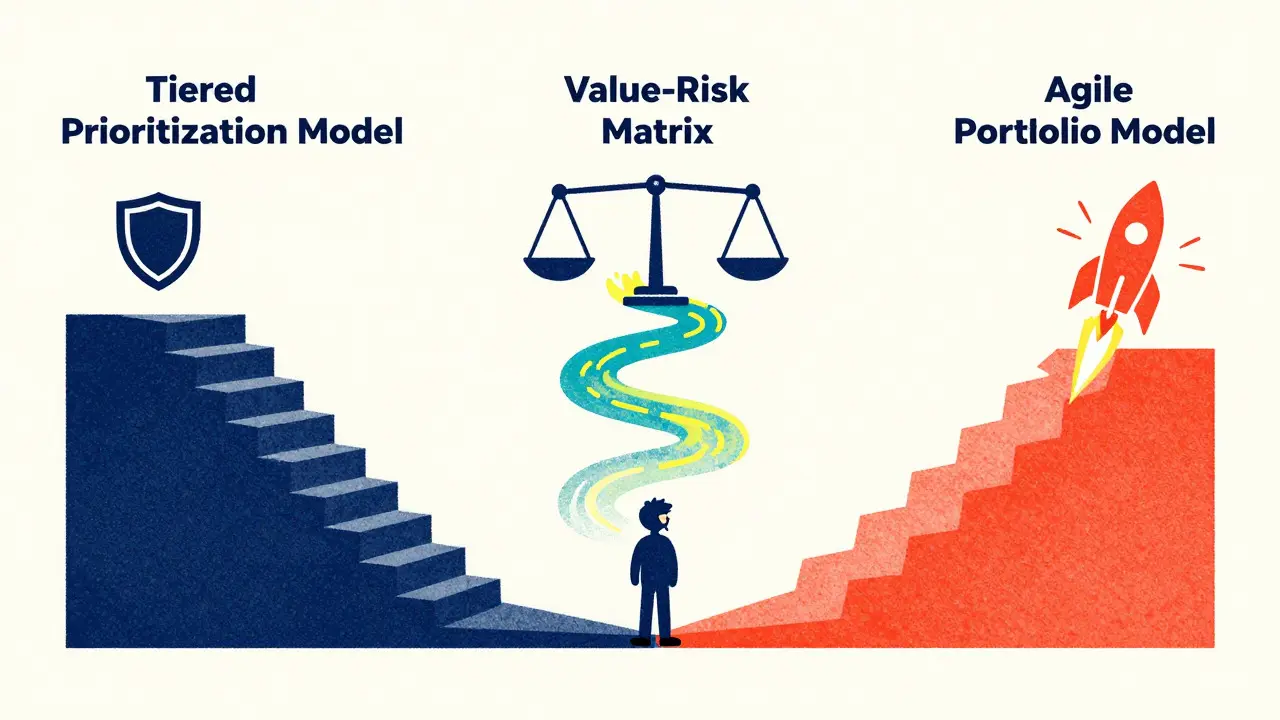
- The Tiered Prioritization Model: Used by 63% of institutions, this approach categorizes use cases into three buckets. Tier 1 covers strategic imperatives (high impact, high urgency), Tier 2 includes competitive differentiators, and Tier 3 focuses on efficiency gains. This model works best in highly regulated environments where compliance is paramount. J.P. Morgan reported 31% higher compliance satisfaction using this structure. However, it can be rigid. Bank of America had to revise their framework in 2023 after missing 17% of emerging opportunities in new markets because the tiers moved too slowly.
- The Value-Risk Matrix: Employed by 28% of firms, this method plots use cases on a graph based on potential revenue impact versus regulatory complexity. It offers superior adaptability. Goldman Sachs used this to respond 24% faster to regulatory changes in Europe. The downside? It requires more governance overhead. Deutsche Bank noted a 38% increase in committee meeting frequency when adopting this model, which can slow down decision-making.
- The Agile Portfolio Model: Only 9% of innovative firms, such as Man Group, use this approach. It treats the AI portfolio like a venture capital fund, allowing for rapid pivots and reallocation. This delivers 22% higher innovation velocity but carries elevated risk. In 2024, two material model failures under this agile approach triggered $4.7M in losses for one firm. It’s high-risk, high-reward.
| Model Type | Adoption Rate | Key Strength | Primary Weakness | Best For |
|---|---|---|---|---|
| Tiered Prioritization | 63% | Compliance clarity | Rigidity in dynamic markets | Highly regulated industries |
| Value-Risk Matrix | 28% | Adaptability to change | High governance overhead | Firms facing frequent regulatory shifts |
| Agile Portfolio | 9% | Innovation velocity | Elevated financial risk | Agile tech-forward organizations |
Building a Scoring Framework That Actually Works
Once you pick a model, you need a way to score individual use cases. Leading portfolio management systems now process 85 to 120 use case proposals quarterly, with average evaluation cycles of 14 to 21 days per proposal. To handle this volume, you need a multi-criteria decision analysis matrix.
Don't rely on gut feeling. Use weighted scoring across 12 to 15 dimensions. Based on benchmarking data from RTS Labs in 2025, here are the critical weights you should consider:
- Regulatory Complexity: Weight at 25%. If it's hard to regulate, it's hard to ship.
- Implementation Timeline: Weight at 20%. How fast can we get value?
- Potential ROI: Weight at 18%. What is the bottom-line impact?
- Data Availability: Weight at 15%. Do we actually have clean data to train on?
- Technical Feasibility: Weight at 12%. Can our current stack support it?
- Strategic Alignment: Weight at 10%. Does it fit our 3-year vision?
This framework forces objectivity. It prevents a charismatic project lead from pushing through a bad idea just because they're loud. It also helps you spot "zombie" projects early. If a use case scores low on data availability but high on strategic alignment, you know exactly what bottleneck to fix before spending millions on development.
Resourcing: The 70/20/10 Rule
Prioritization tells you what to build. Resourcing tells you how to pay for it. Dr. Michael Chui, Partner at McKinsey & Company, suggests treating your generative AI portfolio like a venture capital fund. His recommended allocation is the 70/20/10 rule:
- 70% of Resources: Allocate to proven use cases with clear, near-term ROI. These are your cash cows. They keep the lights on and prove the concept to skeptics.
- 20% of Resources: Invest in strategic bets with medium risk. These are growth drivers that could define your market position in 2-3 years.
- 10% of Resources: Spend on high-risk explorations. These are moonshots. They might fail, but if they succeed, they change the game.
The biggest mistake firms make is putting 90% of their budget into the "proven" bucket, leaving nothing for innovation. Or worse, spending 50% on moonshots that never materialize. Balance is key. Also, remember that computational resources are a finite commodity. GPU hours are tracked at $1.25 to $3.80 per hour depending on the cloud provider. If you're not monitoring consumption, you're leaking money. Integrate your portfolio management platform with your MLOps pipeline to track model performance decay. On average, models degrade by 5.7% quarterly, requiring retraining. If you don't budget for that maintenance, your ROI calculations will be wrong from day one.

Common Pitfalls and How to Avoid Them
Even with a solid framework, you can still trip up. Here are the most common traps observed in industry post-mortems:
Over-investing in Chatbots: In a Mercer survey, 68% of respondents cited chatbot interfaces as "regrettable allocations." Citigroup’s 2024 review showed their retail banking chatbot achieved only 12% customer satisfaction, while their AI-powered portfolio rebalancing tool hit 63%. Ask yourself: does this use case enhance human decision-making, or just replace it? BlackRock’s Chief Data Officer, Dr. Anna Baird, maintains a strict 3:1 ratio of augmentation-to-automation applications. If your portfolio is mostly automation, you might be optimizing for cost savings rather than value creation.
Ignoring Dynamic Reallocation: Markets change. Models drift. If you lock in a budget for a year and refuse to adjust, you'll miss emerging opportunities. Firms achieving 25%+ ROI on AI portfolios maintain dynamic resource reallocation triggers. This means automatically shifting funds from underperforming initiatives when metrics fall below 80% of forecast within 90-day review cycles. Don't wait for annual budget reviews. Check your pulse monthly.
Misaligned Incentives: 83% of firms report misalignment between tech and business units. Fix this by implementing shared KPIs. Tie 30-40% of bonuses to portfolio-wide AI success metrics, not just individual project completion. If the data team gets paid for speed but the business team gets paid for accuracy, you will have conflicts. Align the incentives first, then talk about the technology.
Getting Started: A Practical Checklist
Ready to implement this? Don't boil the ocean. Start small. Here is a step-by-step path to establishing effective portfolio governance:
- Run a Portfolio Diagnostic: Assess your current AI initiatives against 15 maturity criteria. Identify which projects are truly delivering value and which are draining resources.
- Establish an AI Investment Committee: Create a cross-functional group that meets biweekly. Include representatives from IT, Risk, Compliance, and Business Lines. Define clear escalation protocols so decisions don't stall.
- Select Your Tooling: You need a Project Portfolio Management (PPM) platform enhanced with AI-specific modules. Look for tools that integrate with AWS SageMaker, Azure ML, or GCP Vertex AI. Planisware and ServiceNow hold significant market share, but ensure the solution fits your specific regulatory needs.
- Define Your Scoring Matrix: Implement the weighted scoring system discussed earlier. Calibrate it with historical data if possible.
- Set Reallocation Triggers: Decide what metrics will trigger a review. Is it user adoption? Cost per inference? Customer satisfaction? Automate these alerts where possible.
Expect a learning curve. Tier-1 institutions typically take 6 to 9 months to establish effective governance, while mid-sized firms may need 12 to 18 months. Be patient. The goal isn't perfection; it's continuous improvement. By treating your generative AI efforts as a managed portfolio rather than a collection of random experiments, you transform AI from a cost center into a strategic asset.
What is the primary benefit of using a portfolio management approach for generative AI?
The primary benefit is maximizing return on investment (ROI) by strategically allocating limited resources to the highest-value applications. Firms using formal portfolio management approaches report 32% higher ROI on AI investments compared to those without such structures. It also mitigates implementation risks by enforcing rigorous evaluation criteria before funding is released.
How often should a generative AI portfolio be reviewed?
Leading firms conduct reviews on a 90-day cycle to allow for dynamic resource reallocation. While annual budget reviews are standard for finance, AI models degrade quickly (averaging 5.7% quarterly degradation). Therefore, a quarterly or even monthly health check is necessary to catch underperforming initiatives before they drain excessive resources.
Which portfolio model is best for highly regulated industries?
The Tiered Prioritization Model is generally best for highly regulated industries. It categorizes use cases by strategic importance and regulatory risk, providing clear compliance pathways. J.P. Morgan reported 31% higher compliance satisfaction using this approach. However, firms must remain vigilant to avoid rigidity, ensuring the tiers can be adjusted if market conditions shift rapidly.
What skills are required to manage a generative AI portfolio effectively?
Successful implementations require five core competencies: AI product management, regulatory technology expertise, financial domain knowledge, model risk management, and change management. Currently, only 38% of teams possess strong AI product management skills, making this a critical area for hiring or training. Cross-functional collaboration is essential to bridge the gap between technical feasibility and business value.
How much budget should be allocated to experimental AI projects?
Experts recommend the 70/20/10 rule: allocate 70% of resources to proven use cases with clear ROI, 20% to strategic bets with medium risk, and 10% to high-risk explorations. This balance ensures stability through reliable returns while maintaining enough capital for innovation. Deviating significantly from this ratio, especially by overspending on unproven concepts, increases the risk of total portfolio failure.