
Imagine trying to build a house where every brick manufacturer uses a different size, shape, and material. You’d spend more time grinding down edges than laying foundations. That’s exactly what building Generative AI systems felt like until recently. Enterprises were drowning in proprietary APIs, incompatible data formats, and siloed tools that refused to talk to each other. The solution isn't just better code; it's standardized infrastructure. Today, we're looking at the critical layer of interoperability standards-specifically how APIs, data formats, and LLMOps practices are converging to create a unified AI ecosystem.
| Metric | Pre-Standardization (2024) | Post-MCP Adoption (2025) |
|---|---|---|
| Average Integration Time per Tool | 14.7 person-hours | 2.3 person-hours |
| Multi-Vendor Workflow Success Rate | 59% | 84% |
| Compliance Cost Overhead | +37% | -12% (relative baseline) |
The Rise of the Model Context Protocol
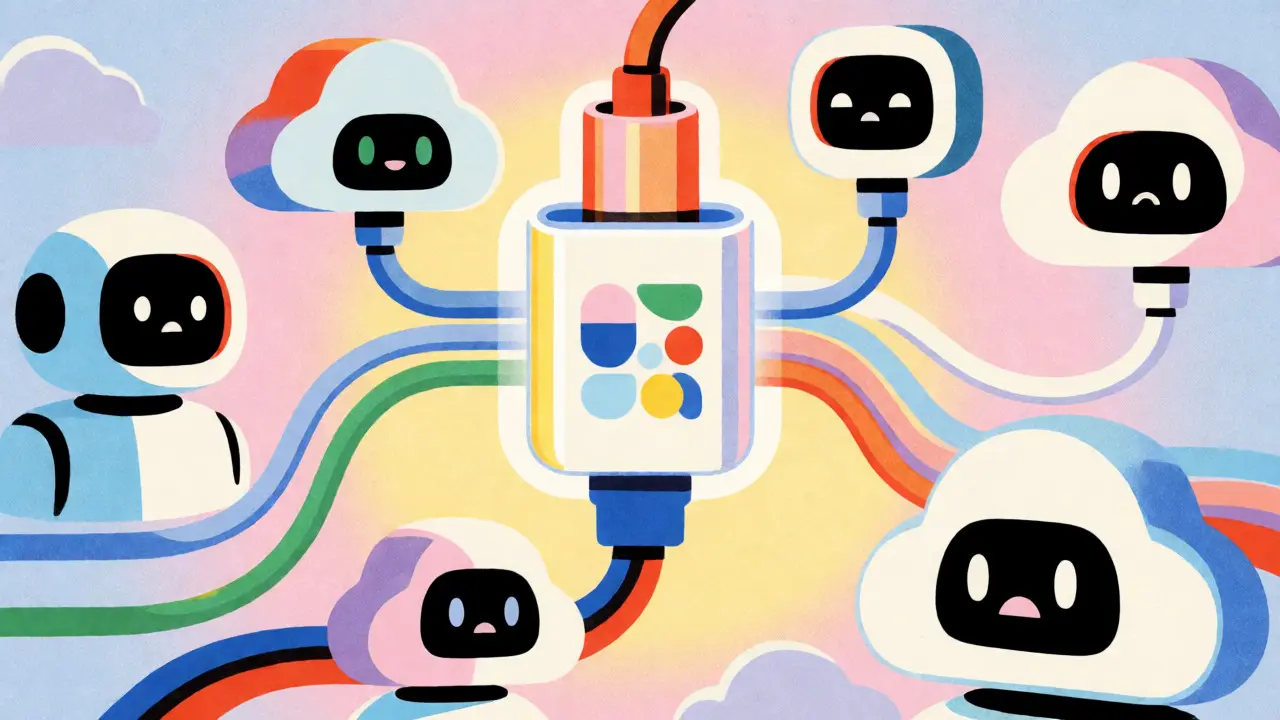
If you've been working with AI agents lately, you've likely heard of the Model Context Protocol (MCP). Finalized in March 2025, MCP didn't just arrive; it exploded into relevance. Initially introduced by Anthropic in late 2023, it addresses the fundamental friction of connecting large language models (LLMs) to external tools. Think of MCP as USB-C for AI. Before this standard, every vendor had its own connector. Now, whether you're using OpenAI's GPT-5 or Meta's Llama 3, if the tool speaks MCP, it plugs in seamlessly.
Why did this happen so fast? Regulatory pressure. The European Union's AI Act, with its systemic risk provisions effective August 2025, forced companies to prove their AI systems were transparent and manageable. Without standardized interfaces, proving compliance was a nightmare. Prompts.ai analysis from December 2024 highlighted that organizations without standardized interfaces faced 37% higher compliance costs. MCP solves this by providing a consistent way to log interactions, manage context, and secure data flow.
Technical Deep Dive: How MCP Works Under the Hood
Don't let the "universal language" metaphor fool you; the engineering is specific. MCP 1.0 relies on four core components that make it viable for enterprise use. First, it uses an OAuth 2.1-based authorization framework. This isn't just about logging in; it's about securing agent-server communication. NIST's 2024 security assessment found that 42% of pre-2025 AI integrations had significant vulnerabilities due to ad-hoc authentication. MCP fixes this by enforcing strict token management.
Second, the transport layer has changed. We've moved from the older HTTP+SSE setup to Streamable HTTP Transport. Why care? Latency. In real-time applications, waiting for data is death. Anthropic's internal benchmarks across 12,000 API calls showed a 58% reduction in latency with this new transport method. Third, JSON-RPC Batching allows clients to send multiple requests at once. Instead of asking one question, getting an answer, then asking another, the agent can bundle queries. LangChain's performance tests in May 2025 showed this reduces interaction latency by 33-47% in complex workflows.
Finally, there are Tool Annotations. These are rich metadata fields attached to each tool description. They tell the AI not just *what* the tool does, but *how* it behaves. With 27 mandatory and 15 optional metadata fields defined in section 4.3 of the spec, agents can reason about tool usage much more effectively. For example, an annotation might specify that a database query tool is read-only, preventing the AI from attempting destructive actions unnecessarily.
Beyond Protocols: Data Formats and Semantic Consistency
An API is only as good as the data flowing through it. If one system sends "customer_id" and another expects "client_uuid," your integration breaks. This is where semantic interoperability comes in. The IEEE P3123 standard plays a crucial role here by defining 187 standardized terms for AI/ML systems. Before this, NIST noted that 63% of pre-2025 documentation contained ambiguous terminology. By aligning with IEEE P3123, developers ensure that when they say "token," everyone means the same thing.
Furthermore, the NIST AI Risk Management Framework (RMF) 1.1 provides the criteria for assessing this consistency. It evaluates data format consistency across eight common serialization formats. If your organization adopts MCP but ignores these data standards, you'll still face friction. You need both the pipe (API) and the water quality (Data Format) to be up to spec.
LLMOps: Managing the Lifecycle of Interconnected Agents
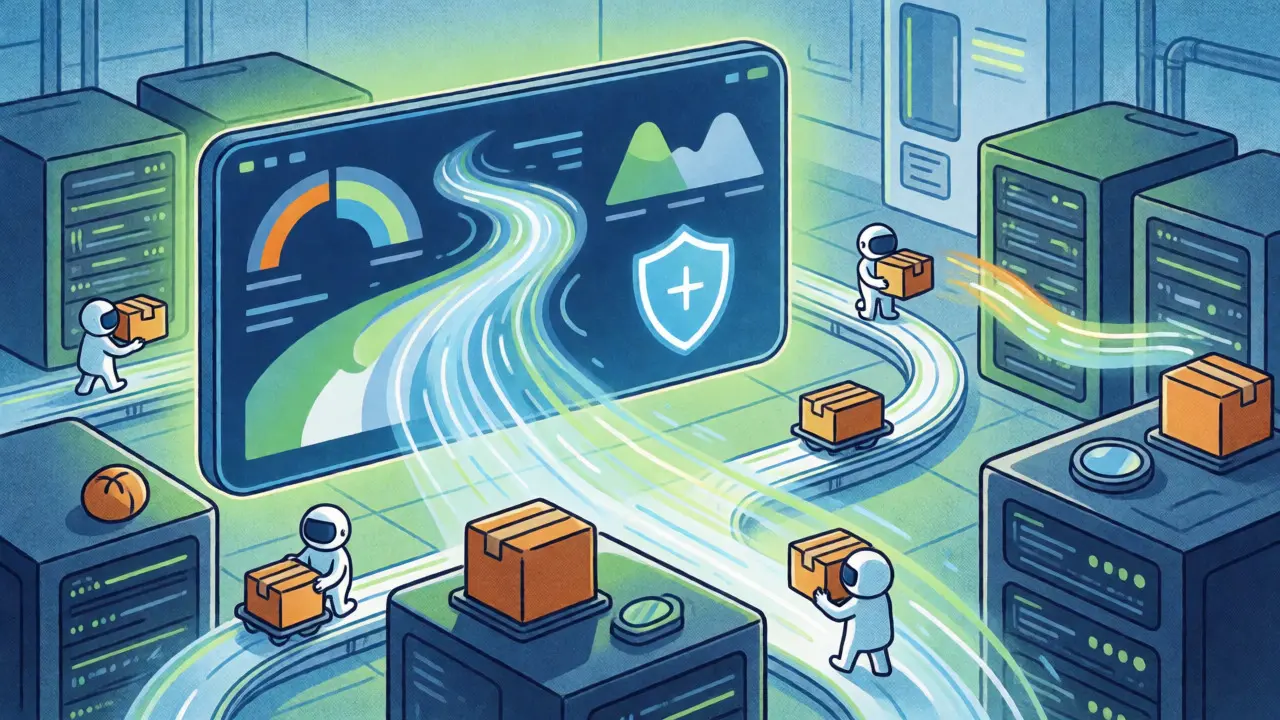
Interoperability doesn't end at deployment. It extends into operations, or LLMOps. How do you monitor an AI agent that talks to five different third-party services? The traditional DevOps playbook needs updating. LLMOps now includes specific observability requirements for cross-tool interactions. You need to track not just model accuracy, but tool call success rates, context window utilization, and latency per provider.
Implementation surveys show that 63% of organizations required 2-3 months of dedicated engineering effort to achieve full MCP compliance. A major part of this effort goes into setting up monitoring configurations. Real-time compliance tracking is no longer optional; it's required by regulations like the EU AI Act. Tools that integrate with MCP automatically generate logs compatible with these regulatory audits, saving teams hundreds of hours in manual reporting.
Market Reality: Who Is Adopting What?
Let's look at the numbers. According to Gartner's August 2025 Magic Quadrant, MCP dominates the 'Leader' quadrant with 78% of new enterprise AI projects adopting the standard. Proprietary frameworks, like Google's Vertex AI Tools SDK, hold only 12% of new implementations. This shift is driven by practicality. Developers don't want to rewrite integrations every time they switch model providers.
However, adoption isn't uniform. Financial services lead with 74% adoption, followed closely by technology (82%) and healthcare (68%). Healthcare faces unique challenges, requiring HIPAA-specific extensions (MCP-HC 1.0) released in June 2025. Similarly, financial services need PCI-DSS compliance modules, which add 18-22% overhead to transactions. Despite these hurdles, the trend is clear: open standards win because they reduce vendor lock-in.
Challenges and Critical Perspectives
It's not all sunshine. Professor Timnit Gebru of the Distributed AI Research Institute warned in June 2025 that over-reliance on single protocols risks centralizing control among big tech. Since Anthropic initiated MCP and OpenAI quickly adopted it, smaller players worry about governance neutrality. The OECD recommended complementary open governance mechanisms to address this.
Technically, legacy systems remain a pain point. Only 31% of pre-2020 enterprise applications can connect directly to MCP without custom middleware. If your company runs on mainframes from the early 2000s, expect to build adapters. Also, context leakage between tool calls affected 29% of early implementations, forcing teams to adjust prompt engineering practices to maintain state integrity.
Getting Started: A Practical Roadmap
If you're ready to implement these standards, here is the typical pathway based on LangChain Academy assessments:
- Tool Standardization: Convert existing tools to MCP-compliant interfaces. This takes 3-14 days depending on complexity.
- Authentication Setup: Implement OAuth 2.1 flows. Typically requires 1-3 days.
- Context Management: Adapt to MCP's 128K token context window specifications. Allow 2-5 days for testing.
- Monitoring Configuration: Set up real-time compliance tracking. This usually takes 1-2 days.
Developers with REST API experience need about 17.5 hours of training to reach proficiency. Newcomers should budget closer to 32 hours. The community support is robust, with the MCP Developers Discord server hosting over 12,450 active members and weekly office hours led by engineers from Anthropic and OpenAI.
Frequently Asked Questions
What is the main benefit of using MCP over proprietary APIs?
The primary benefit is reduced integration time and vendor neutrality. While proprietary APIs require custom work for each model-provider combination, MCP offers a universal interface. This cuts integration time from an average of 14.7 person-hours to 2.3 person-hours per tool, allowing enterprises to swap underlying LLMs without rewriting their entire tool stack.
How does MCP handle security for AI agents?
MCP utilizes an OAuth 2.1-based authorization framework specifically designed for agent-server communication. This approach significantly reduces attack surfaces compared to ad-hoc solutions, addressing vulnerabilities found in 42% of pre-2025 integrations. It ensures that agents only have access to the specific tools and data scopes they are authorized to use.
Is MCP suitable for regulated industries like healthcare?
Yes, but with extensions. The base MCP 1.0 specification is being supplemented by domain-specific variants like MCP-HC 1.0, which includes HIPAA-specific requirements. While the core protocol facilitates interoperability, regulated industries must implement additional compliance modules to meet local legal standards, which may add slight overhead to transaction processing.
What are the biggest technical challenges when implementing MCP?
Common challenges include managing context windows to prevent leakage between tool calls and integrating with legacy systems. Early adopters reported that 29% of initial failures were due to context management issues. Additionally, connecting pre-2020 enterprise applications often requires custom middleware, as direct compatibility is limited to newer, API-first architectures.
How will future updates impact current MCP implementations?
The consortium plans to release MCP 1.1 in October 2025, featuring quantum-resistant encryption. Backward compatibility is a priority, but developers should stay updated on security patches. Future versions aim to enhance multi-step workflow reliability and further optimize latency, ensuring that current investments in MCP infrastructure remain relevant through 2030.
Anthony Miller
31 August, 2026 - 14:01 PM
It is profoundly disappointing to witness the continued propagation of this simplistic narrative regarding interoperability standards which ignores the fundamental architectural complexities inherent in enterprise systems that refuse to be reduced to mere plug-and-play components without significant degradation of security protocols and operational integrity.
michelle veluz
1 September, 2026 - 20:25 PM
WAKE UP!!
Do you see what they are doing?? They are centralizing control under Anthropic and OpenAI while pretending it's open!!! The EU AI Act isn't about safety, it's a weapon to crush smaller US competitors who don't play by the new rules!!! I've seen the memos, the governance neutrality is a LIE!!! We are sleepwalking into a dystopia where only two companies decide how our data flows!!! Don't let them fool you with their shiny "USB-C for AI" metaphor!!! It's a trap!!! A massive, corporate-designed trap designed to extract every last drop of value from developers!!!
Jeff Falcon
2 September, 2026 - 15:57 PM
I totally agree with the sentiment that standardization helps, but honestly, I think we need to look at the long-winded reality of implementation because, you know, just saying "it reduces integration time" doesn't account for the sheer amount of documentation reading and edge-case testing that still happens, especially when you're dealing with legacy systems that weren't built with these modern JSON-RPC batching features in mind, so yeah, it's great on paper but the actual developer experience might still feel pretty heavy depending on your stack...
Alyson Karson
3 September, 2026 - 14:30 PM
Love the energy here! But lets be real, if ur not moving fast u r falling behind. The stats dont lie, 2.3 hours vs 14.7 is huge. Get on board or get left in dust!
Vishnu Vardhan Reddy M S
4 September, 2026 - 03:07 AM
Oh, wonderful. Another article claiming to solve everything with a single protocol. How refreshing. It’s almost as if the authors have never actually tried to integrate a 20-year-old mainframe system with a cutting-edge LLM without pulling out all their hair first. But sure, let’s pretend that OAuth 2.1 magically fixes decades of technical debt overnight. Fantastic optimism, truly inspiring.
Brenna Gonedrman
4 September, 2026 - 12:08 PM
This is HUGE. Like, literally changing everything. If you aren't using MCP now, you are basically obsolete. It's that simple. No debate needed.
Courtney Wagstaff
5 September, 2026 - 19:04 PM
Hey folks, just vibing with this thread. 🌊 The idea of 'semantic consistency' sounds kinda poetic, like ensuring everyone speaks the same emotional language before shouting into the void. It’s nice to see tech trying to be less chaotic, even if the chaos is part of the fun sometimes. Keep floating, everyone.
Joanna Mucha
7 September, 2026 - 06:27 AM
To reduce the complex ontological crisis of artificial intelligence to mere API compatibility is an act of profound intellectual laziness. We are discussing the epistemological framework of machine understanding, yet you offer us... JSON formats? The existential weight of context leakage is ignored in favor of latency metrics. It is tragic, really, how the sublime nature of cognition is being commoditized into standardized pipes for corporate profit.
Elisabeth Ballet
8 September, 2026 - 19:25 PM
Great points all around! Let's keep pushing forward together. The community support mentioned is key, so lean on those Discord servers and office hours. You've got this!