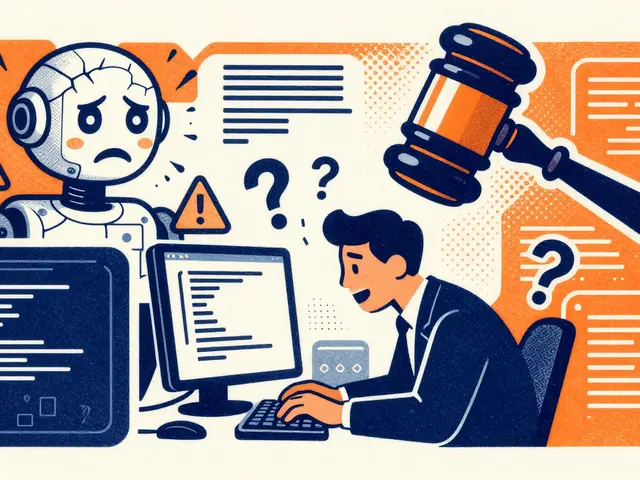
You know that feeling when your product team has a brilliant idea for a new fraud detection dashboard, but the engineering backlog is six months long? You’re stuck waiting while competitors ship features in days. This bottleneck is exactly why vibe coding is shaking up the financial technology sector. Coined by AI pioneer Andrej Karpathy in 2025, this approach lets you describe what you want in plain English, and an AI builds it. But here’s the catch: in fintech, you can’t just "vibe" your way through regulations. If your AI generates code that ignores GDPR or SOC 2 standards, you’re not innovating-you’re inviting a lawsuit.
This article breaks down how to use vibe coding safely in finance. We’ll look at why standard AI tools fail in regulated environments, how to generate realistic mock data without exposing customer privacy, and the specific compliance guardrails you need to keep your experiments from becoming production nightmares.
Why Standard AI Coding Tools Fail in Fintech
If you’ve tried using GitHub Copilot or basic LLMs for banking apps, you’ve likely hit a wall. These tools are reactive; they answer prompts one by one. They don’t understand context like "this transaction must be logged for audit purposes." In traditional software development, you write the logic yourself. With vibe coding, you delegate intent. The problem arises when that intent clashes with rigid financial rules.
Enterprise-grade platforms like Superblocks have emerged to solve this. Unlike general-purpose AI coders, these platforms offer "agentic" capabilities. They don’t just write snippets; they manage entire workflows. For example, if you ask for a user onboarding flow, the platform knows to integrate KYC checks automatically. It doesn’t wait for you to remember them. This shift from "code-first" to "intent-first" allows non-technical staff-like risk officers or operations managers-to build internal tools directly. But without proper structure, this freedom becomes chaos.
The Mock Data Minefield: Privacy vs. Realism
You cannot test a payment processing algorithm with real customer data in a sandbox environment. One accidental leak of PII (Personally Identifiable Information) can trigger massive fines under GDPR or CCPA. Yet, if your mock data looks too fake-say, all transactions are $100 and occur at noon-the AI will generate logic that fails in the real world.
Effective vibe coding in fintech requires sophisticated synthetic data generation. You need data that mimics real-world anomalies. Think about chargebacks, currency fluctuations, or partial refunds. A recent case study from a UK fintech startup showed that their initial vibe-coded fraud detector missed 40% of edge cases because the mock data didn’t include "dormant account reactivation" patterns. Once they adjusted the synthetic data generator to include these rare events, accuracy jumped.
Here’s how to handle it:
- Anonymize First: Never feed raw production data into the AI. Use hashing or tokenization to strip identifiers before generating synthetic variants.
- Mimic Distribution: Ensure your mock data reflects actual transaction volumes and time-of-day peaks. If your bank processes 90% of transfers between 9 AM and 5 PM, your mock data should reflect that skew.
- Inject Noise: Real systems fail. Include simulated API timeouts, network latencies, and database locks in your test scenarios so the AI learns to handle resilience.

Compliance Guardrails: Automating the Boring Stuff
Compliance isn’t just a checkbox; it’s a constraint. In vibe coding, constraints must be hard-coded into the AI’s behavior. This is where "guardrails" come in. These are pre-configured rules that the AI cannot violate, no matter how cleverly you prompt it.
For instance, a guardrail might dictate that any function handling sensitive data must log access attempts. If the AI generates a query that fetches customer balances but forgets the logging step, the guardrail blocks the deployment or auto-inserts the logging code. Platforms like Superblocks now offer "compliance-first AI guardrails" that embed requirements for major jurisdictions like the EU, US, and UK directly into the code generation process.
Consider Role-Based Access Control (RBAC). In a vibe-coded admin panel, you shouldn’t have to manually define who sees what. Instead, you prompt: "Create a view for junior analysts showing only aggregate transaction counts, hiding individual names." The guardrail ensures the underlying SQL query filters out PII automatically. This reduces human error, which accounts for nearly 60% of compliance breaches in manual development cycles.
From Prototype to Production: The Reality Check
Let’s be honest: vibe coding excels at prototyping, not necessarily at building core banking ledgers. J.P. Morgan’s recent analysis notes that while vibe coding shrinks the ideation-to-prototype cycle by 20x, moving to production still requires rigorous testing. Why? Because AI-generated code can suffer from "compliance drift." During iterative changes, small tweaks might accidentally remove a security check or alter a rounding rule.
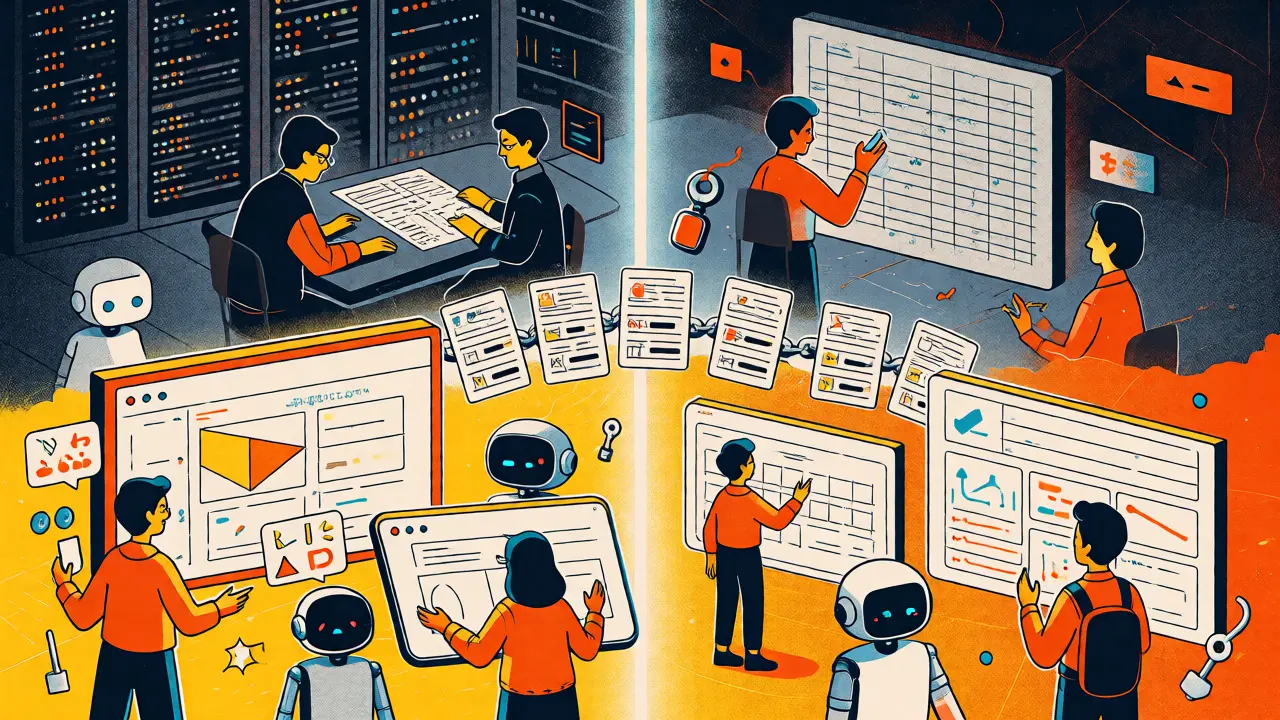
To mitigate this, successful teams adopt a hybrid workflow:
- Vibe the Frontend and Logic: Let AI build the UI, dashboards, and business logic layers. These change frequently and benefit from speed.
- Hard-code the Core: Keep critical transaction engines, ledger calculations, and encryption modules in traditional, manually reviewed code.
- Automated Audit Trails: Ensure every AI-generated commit includes metadata about the prompt used and the guardrails applied. This creates an audit trail for regulators.
A senior operations manager at a European neobank reported reducing customer onboarding tool development from three weeks to four days using this method. However, they also noted that the first two iterations failed compliance checks until they trained their compliance officers to write better prompts. Yes, compliance officers are now writing prompts. That’s the new normal.
Comparing Vibe Coding Approaches in Finance
Not all vibe coding tools are created equal. When choosing a platform for fintech, you need to weigh autonomy against control. Here’s a breakdown of common approaches:
| Feature | Basic AI Assistant (e.g., Copilot) | General Vibe Coding (e.g., Cursor) | Enterprise Vibe Coding (e.g., Superblocks) |
|---|---|---|---|
| Autonomy Level | Low (Reactive suggestions) | Medium (Agentic tasks) | High (Workflow management) |
| Compliance Handling | Manual review required | Prompt-dependent | Built-in guardrails & RBAC |
| Data Security | Local context only | Varies by provider | Synthetic data & secure connectors |
| Best Use Case | Refactoring existing code | Rapid prototyping | Internal tools & compliance reporting |
| Regulatory Risk | High (Human error) | Medium (Context loss) | Low (Enforced policies) |
Notice that enterprise solutions aren't just faster; they're safer. They treat compliance as a feature, not an afterthought. This distinction matters when you’re dealing with regulators who demand proof of due diligence.
Practical Tips for Starting Your Vibe Coding Experiment
Ready to try this in your own fintech stack? Don’t start with your core payment gateway. Start small. Pick a low-risk internal tool, like a weekly expense report generator or a vendor management dashboard.
Here are three actionable steps:
- Train Your Prompt Writers: Non-coders need guidance. Create a library of "golden prompts" that include compliance keywords. Example: "Generate a CSV export function for Q3 revenue, ensuring all monetary values are rounded to two decimal places and include a timestamp column for audit logs."
- Isolate the Sandbox: Run vibe-coded applications in a separate environment with no access to production databases. Use the synthetic data pipelines mentioned earlier.
- Review, Don’t Just Accept: Treat AI output like a junior developer’s pull request. Check for security holes, inefficient queries, and missing error handling. The AI is fast, but it’s not wise.
Remember, the goal isn’t to replace engineers. It’s to free them from repetitive tasks so they can focus on complex architecture and security. As Tenity’s analysis put it, innovation without governance is just improvisation. Vibe coding gives you speed; guardrails give you safety. You need both.
What is vibe coding in the context of fintech?
Vibe coding is an AI-driven development method where users describe desired functionality in natural language, and AI generates the code. In fintech, it specifically refers to using enterprise-grade platforms that incorporate compliance guardrails and secure data handling to allow rapid development of financial applications without violating regulatory standards.
How does vibe coding handle data privacy and compliance?
It uses automated guardrails that enforce rules like Role-Based Access Control (RBAC) and audit logging during code generation. Additionally, it relies on synthetic or anonymized mock data to prevent exposure of Personally Identifiable Information (PII) during the development and testing phases, ensuring adherence to regulations like GDPR and SOC 2.
Can vibe coding replace traditional software engineers in banks?
No, it complements them. While vibe coding accelerates the creation of internal tools, prototypes, and standardized compliance reports, core banking systems requiring millisecond precision and complex algorithmic logic still require experienced engineers for architecture design, security auditing, and final production refinement.
What are the risks of using AI-generated code in financial applications?
Key risks include "compliance drift," where iterative AI changes accidentally remove security controls, and the generation of inefficient or insecure code patterns that pass basic tests but fail under load. There is also the risk of hallucination, where the AI invents API endpoints or data structures that do not exist in the connected systems.
Which industries are adopting vibe coding fastest?
Financial services, particularly fintech startups and neobanks, are leading adoption for internal operational tools and compliance reporting. Traditional banks are slower, focusing initially on non-customer-facing applications to minimize regulatory risk, with approximately 22% adoption among traditional institutions compared to 37% among startups as of mid-2025.