Most enterprise AI projects fail not because the model is bad, but because the context is wrong. If your Retrieval-Augmented Generation (RAG) system pulls outdated contracts or ignores access controls, your Large Language Model (LLM) will confidently generate expensive errors. The gap between a demo that works in a notebook and a production system serving thousands of employees is massive. It requires moving beyond simple keyword matching to sophisticated architectural patterns that balance speed, security, and accuracy.
You don't need to reinvent the wheel, but you do need to choose the right building blocks. Whether you are dealing with legal documents requiring strict compliance or real-time financial data needing sub-second latency, the architecture dictates your success. Here is how to structure an enterprise-grade RAG system that actually holds up under pressure.
Core Components of a Production-Ready RAG Pipeline
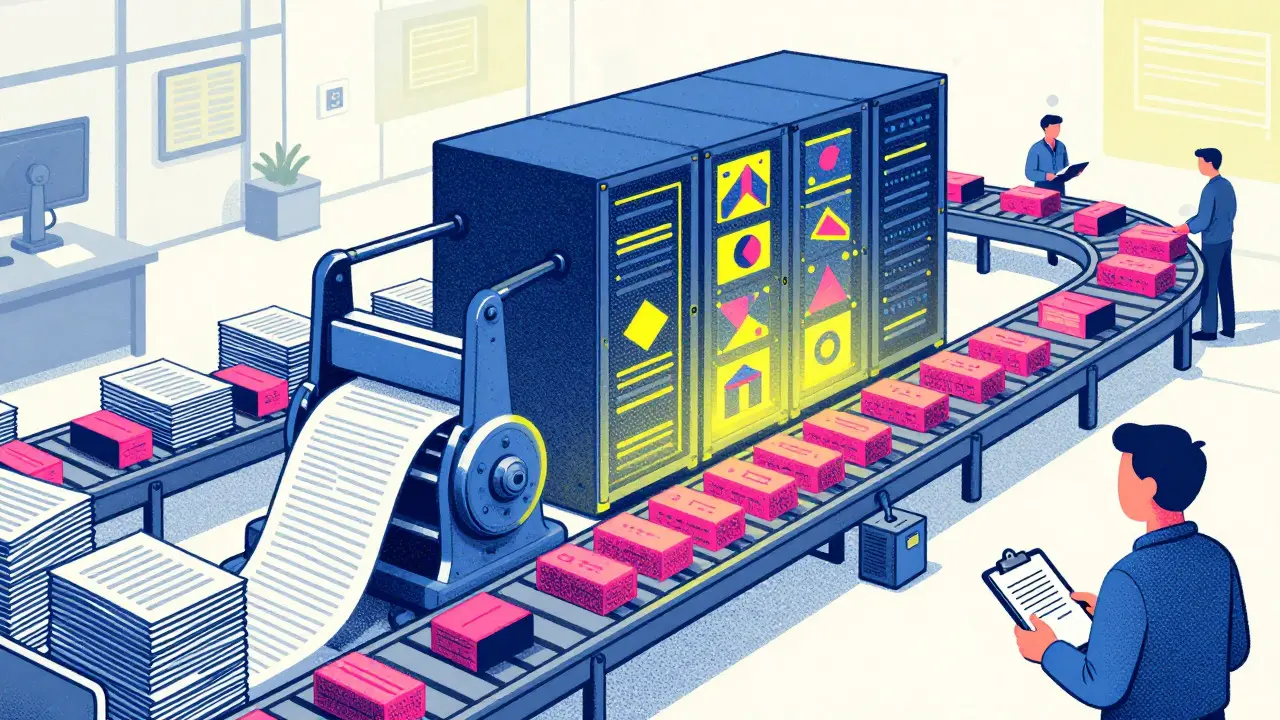
A basic RAG setup involves chunking documents, embedding them, and querying a vector store. Enterprise-grade systems require more robust components to handle scale and complexity. The pipeline typically flows through four critical stages:
- Ingestion & Chunking: This isn't just splitting text by word count. You need semantic chunking that preserves document structure. For legal or medical docs, breaking a paragraph mid-sentence destroys context. Modern pipelines use recursive character splitters or even LLM-based summarization for chunks to ensure meaning remains intact.
- Embedding Generation: You need high-quality embeddings that capture semantic similarity. Models like Cohere Embed v3 support over 100 languages in a single encoder, eliminating the need for separate models per language. This reduces infrastructure overhead significantly.
- Vector Storage & Indexing: This is where performance lives or dies. You need a database that can handle millions of vectors with metadata filtering. HNSW (Hierarchical Navigable Small World) indexes are standard for fast approximate nearest neighbor searches.
- Retrieval & Re-ranking: Initial retrieval might return 50 candidates. A cross-encoder re-ranker then evaluates these against the query to pick the top 3-5 most relevant ones. This step dramatically improves precision.
The key insight here is that each component must be independently scalable. If your user base grows, you shouldn't have to rebuild your entire ingestion pipeline. Microservices architecture allows the retrieval service to scale horizontally without touching the generation layer.
Choosing the Right Vector Database
The choice of vector database is often the most debated decision in RAG architecture. There is no single "best" option; it depends on your data volume, latency requirements, and existing tech stack.
| Database | Scalability Model | Latency Profile | Best For |
|---|---|---|---|
| Postgres (PGVector) | Vertical scaling (compute tied to storage) | <2s for 500K embeddings (P50) | Organizations already using Postgres; smaller-to-medium datasets; simpler ops |
| LanceDB | Horizontal scaling (storage separated from compute) | Similar speeds at 15M rows with metadata filtering | Large-scale unstructured data; cloud-native deployments; cost optimization via object storage |
| Pinecone | Fully managed serverless | Low latency, optimized for API calls | Teams wanting zero infrastructure management; rapid prototyping |
If you are already running Postgres, PGVector is a pragmatic choice. It keeps your operational footprint small. However, if you are dealing with terabytes of unstructured data, LanceDB's ability to store vectors in cheap object storage (like S3) while maintaining fast query times makes it financially attractive. The trade-off is operational complexity-you're managing a distributed system rather than a single database instance.
Architectural Patterns: Centralized vs. Federated
How you organize your knowledge bases matters as much as the tools you use. Two dominant patterns emerge in enterprise settings:
Centralized Architecture
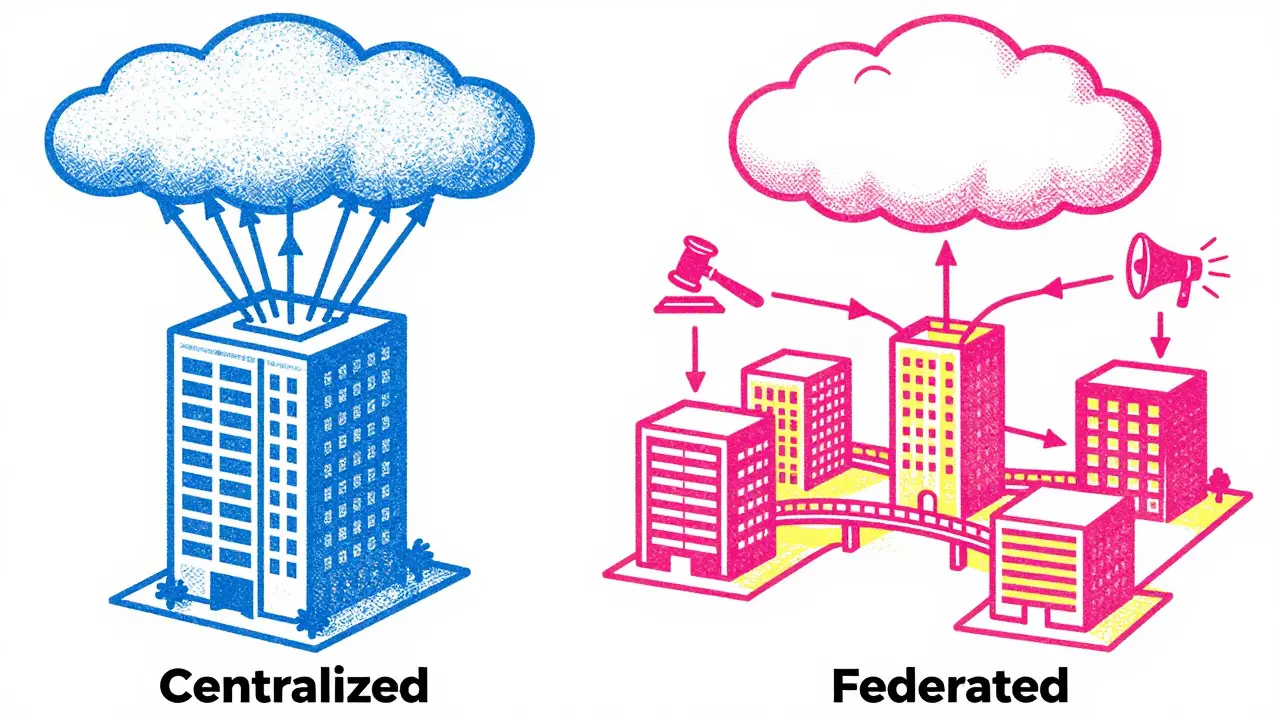
This approach uses a single retrieval and generation pipeline for all applications. It’s ideal when your knowledge base is uniform-for example, a company-wide HR policy portal. The benefits are simplicity and lower maintenance costs. However, it struggles when different departments need different access levels or specialized indexing strategies. If Legal needs strict redaction rules but Marketing wants broad creative freedom, a centralized system becomes a bottleneck.
Federated Architecture
In a federated setup, multiple domain-specific retrievers route queries to a shared LLM layer. Each department maintains its own vector index and access controls. This allows for customization-Legal can use a stricter re-ranker, while Sales can prioritize recent deals. The downside is complexity. Deployment times can stretch from 3-6 months (centralized) to 6-9 months (federated) due to the need for domain-specific tuning and integration work.
Which should you choose? If your organization has distinct data silos with different compliance requirements, go federated. If you’re starting out and want quick wins, start centralized and plan to decouple later.
Hybrid Search and Advanced Retrieval Strategies
Dense vector search alone isn't enough. It excels at semantic similarity but can miss exact keywords or specific IDs. Enterprise RAG systems increasingly use Hybrid Search, which combines dense vector search with sparse keyword matching (like BM25).
Here’s why this works:
- Coverage: If a user searches for "Error Code 402," vector search might miss it if the training data didn't emphasize that code. Keyword search finds it instantly.
- Recall vs. Precision: Hybrid approaches allow you to tune the balance. You can retrieve a broader set of candidates using both methods and then let the re-ranker decide what’s truly relevant.
Additionally, consider Cascading RAG. Use a lightweight, cheap model for initial retrieval and only escalate to a larger, more expensive LLM if the confidence score is low. This can reduce LLM API costs by 60-80% for routine queries, reserving your budget for complex reasoning tasks.
Security, Governance, and Compliance
This is where many RAG projects stumble. A great answer is useless if it leaks confidential data. Enterprise RAG must treat data governance as a first-class feature, not an afterthought.
- Role-Based Access Control (RBAC): Implement RBAC at the retrieval level. Ensure that a junior analyst only retrieves documents they are authorized to see. This prevents the LLM from hallucinating based on forbidden context.
- Audit Trails: Log every retrieval event. Who asked what question, which documents were retrieved, and what was the final answer? This is critical for GDPR and SOC 2 compliance.
- PII Masking: Automatically mask Personally Identifiable Information before sending context to the LLM, especially if using third-party APIs.
- Data Freshness: Stale data leads to stale answers. Implement streaming updates to your vector database so that new documents are indexed within minutes, not days.
For industries like healthcare (HIPAA) or finance (SOC 2), these controls aren't optional. They are the difference between a viable product and a liability.

Evaluation and Continuous Improvement
Building the system is only half the battle. You need to know if it’s working. Don't rely on gut feeling. Implement an evaluation pipeline that tracks:
- Relevance Score: How well does the retrieved context match the query?
- Faithfulness: Does the LLM answer strictly based on the provided context, or is it hallucinating?
- Latency: Target sub-second response times for user-facing apps. Track P50 and P95 latencies separately.
- User Feedback: Thumbs up/down ratings from end users provide ground truth that automated metrics miss.
Use these metrics to iterate. If faithfulness scores drop, tighten your prompting. If relevance is low, improve your chunking strategy or switch to a better embedding model. Continuous improvement is the hallmark of a mature RAG system.
When Not to Use RAG
Not every task requires RAG. If your task involves static knowledge that rarely changes, fine-tuning a smaller model might be cheaper and faster. If you need stylistic consistency (like brand voice), prompt engineering or fine-tuning is often superior. RAG shines when you need up-to-date, external, or large-scale knowledge. Know when to apply it and when to hold back.
Frequently Asked Questions
What is the main difference between RAG and fine-tuning?
RAG augments a general-purpose LLM with external knowledge at inference time, allowing for easy updates without retraining. Fine-tuning adjusts the model's weights to learn specific patterns or styles, which is better for static knowledge or consistent output formats but requires significant compute resources to update.
How do I handle large PDF files in a RAG pipeline?
Use a document parser that preserves structure, such as PyMuPDF or Unstructured.io. Avoid simple text extraction. Instead, parse tables, headers, and footers separately. Then, apply semantic chunking that respects these structural boundaries to maintain context integrity during retrieval.
Is hybrid search always better than pure vector search?
Not always, but it is generally recommended for enterprise environments. Pure vector search can miss exact matches (like part numbers or error codes). Hybrid search combines the semantic power of vectors with the precision of keyword matching, improving recall for diverse query types. The added complexity is usually worth the accuracy gain.
How long does it take to deploy an enterprise RAG system?
A centralized architecture typically takes 3-6 months for full deployment, including integration and testing. A federated architecture, which involves multiple domain-specific retrievers, can take 6-9 months. Timelines vary based on existing infrastructure, data quality, and compliance requirements.
What are the biggest security risks in RAG systems?
The primary risks are data leakage through improper access controls and prompt injection attacks. If a user can retrieve unauthorized documents, the LLM may expose sensitive info. Prompt injection occurs when malicious content in a retrieved document manipulates the LLM's behavior. Mitigate these with RBAC, input validation, and output monitoring.