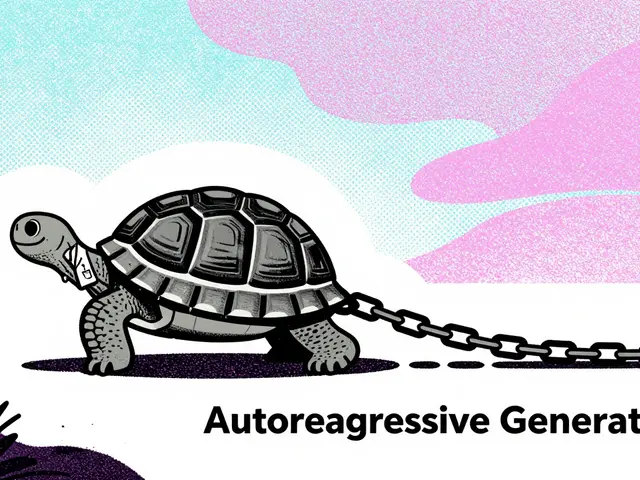
You send the same prompt to an AI model twice. The first time, it gives you a perfect answer. The second time, it hallucinates a fact or changes the tone completely. This isn't a bug in your code; it's a feature of how Large Language Models work. They are probabilistic engines, not lookup tables. For developers building production systems, this unpredictability is a nightmare. You can't test what you can't predict. That's where deterministic prompts come in. They aren't magic spells that force total consistency, but they are rigorous techniques to minimize variance and make LLM outputs reliable enough for real-world applications.
The Root Cause: Why LLMs Are Naturally Unpredictable
To fix the problem, you have to understand the source. An LLM doesn't "know" the next word. It calculates a probability distribution for every possible next token. If the model thinks there is a 40% chance the next word is "apple," a 35% chance it's "orange," and a 25% chance it's "pear," it has to pick one. In creative writing, picking "pear" might be interesting. In data extraction, picking "pear" when you wanted "apple" breaks your pipeline.
This selection process is called sampling. Even if the probabilities are identical every time, the act of choosing introduces randomness. Think of it like rolling dice. The dice (the model weights) don't change, but the roll (the sampling step) does. Nick Lucas, a developer who analyzed this deeply in 2023, noted that while the model "knows statically everything it wants to say" via its probability tree, the path taken through that tree varies with each run. This inherent non-determinism means that without intervention, your API calls will yield different results even with identical inputs.
Temperature: The Primary Knob for Determinism
The most direct way to control this randomness is by adjusting the temperature parameter. Temperature scales the probability distribution before sampling occurs. At high temperatures (like 1.0), the differences between high-probability and low-probability tokens are flattened. The model feels more free to choose less likely words, leading to creative but varied outputs. At low temperatures (approaching 0.0), the sharp peaks of the probability distribution remain sharp. The model becomes greedy, almost always picking the single highest-probability token.
Setting temperature=0 is the standard first step for deterministic behavior. However, many developers assume this guarantees identical outputs. It doesn't. As documented in a 2024 analysis by Unstract, even at temperature 0, tiny numeric drifts in floating-point calculations can cause divergence. If two candidate tokens have probabilities of 0.499999 and 0.499998, a minor hardware difference might flip which one gets selected. Once that first token diverges, the rest of the generation cascades into a completely different response. So, while temperature 0 reduces variance significantly, it doesn't eliminate it entirely on distributed cloud infrastructure.
Top-P Sampling: Narrowing the Field
If temperature flattens the curve, Top-P sampling (also known as nucleus sampling) cuts off the tail. Instead of considering all tokens, Top-P restricts selection to the smallest set of tokens whose cumulative probability exceeds a threshold P. For example, if top_p=0.1, the model only considers the top 10% of probability mass. All other tokens are ignored.
This is powerful for determinism because it removes the "long tail" of unlikely options that often cause weird outliers. If the top token has a 60% probability and the second has 30%, a top_p=0.5 setting would force the model to pick the first token, ignoring the second. This creates a hard constraint. However, a critical rule from the Prompt Engineering Guide states: do not adjust both temperature and top-p aggressively at the same time. Doing so compounds effects in unpredictable ways. For strict factual tasks, stick to low temperature and low top-p. For balanced tasks, choose one lever to pull.
| Use Case | Temperature | Top-P | Expected Consistency |
|---|---|---|---|
| Factual QA / Data Extraction | 0.0 - 0.2 | 0.1 - 0.3 | High (but not 100%) |
| Code Generation | 0.0 - 0.3 | 0.2 - 0.5 | Medium-High |
| Creative Writing | 0.7 - 1.0 | 0.9 - 1.0 | Low (Intentional) |
The Cascade Effect and Floating-Point Drift
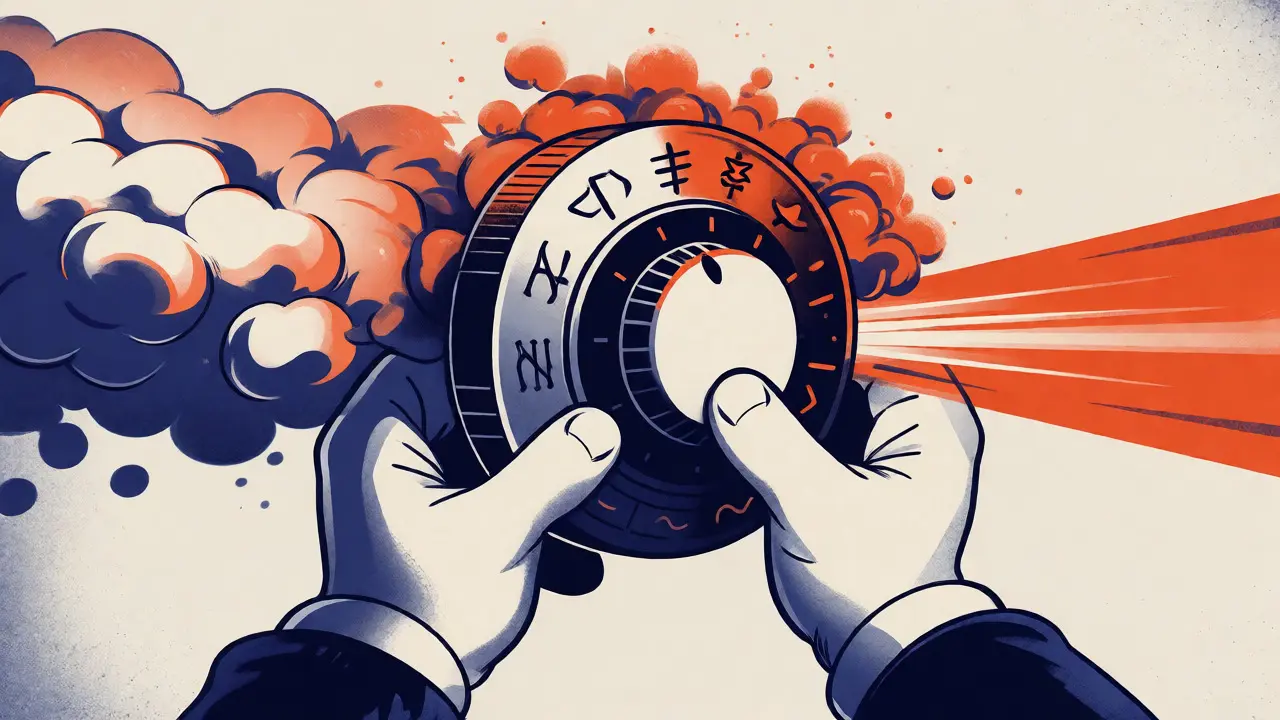
Why does temperature=0 still fail sometimes? It comes down to how computers handle math. LLMs run on GPUs using floating-point arithmetic. These numbers are approximations, not exact values. When two tokens have nearly identical probabilities, the decision of which one is "higher" can depend on the specific GPU architecture, driver version, or even background processes running on the server. This is the cascade effect. One small deviation in the first token shifts the context window for the second token, which shifts the third, and so on. By the tenth token, you're looking at a completely different sentence.
Martin Fowler highlighted this in 2025, noting that LLMs introduce a "non-deterministic abstraction." You cannot simply store prompts in Git and expect the same result forever because the underlying compute environment changes. Developers on Stack Overflow frequently report cases where top_p=0.1 still produced variable outputs across API calls. The solution isn't just better parameters; it's understanding that perfect determinism in cloud-based LLMs is practically impossible due to these hardware-level nuances.
Prompt Structure: Chain-of-Thought as a Stabilizer
Beyond parameters, the structure of your prompt plays a huge role in reducing variance. A vague prompt leaves too much room for interpretation. A structured prompt constrains the model's search space. Research from Google in 2022 showed that Chain-of-Thought (CoT) prompting-asking the model to "think step by step"-can reduce variance by up to 47% on complex reasoning tasks. But there's a catch: CoT only helps models with over 62 billion parameters. Smaller models actually get worse with CoT because they lack the capacity to follow the steps reliably, adding noise instead of clarity.
For smaller models, explicit instructions work better. Instead of asking "Summarize this text," ask "Extract the three main bullet points from this text. Use the exact wording from the source." By limiting the output format and requiring verbatim extraction, you reduce the degrees of freedom the model has to wander. Fewer choices mean less variance.

Infrastructure Solutions: Local vs. Cloud
If your business logic depends on 100% reproducibility, cloud APIs might not be enough. Running models locally allows you to control the environment. Setting environment variables like PYTHONHASHSEED=0 and enabling deterministic operations in frameworks like TensorFlow or PyTorch can achieve near-perfect consistency. A popular GitHub gist demonstrated that local deployments with fixed seeds could hit 99.8% output consistency. The trade-off is cost and complexity. You need powerful hardware, and you lose the scalability of cloud providers.
Cloud providers are responding. AWS Bedrock introduced a "Determinism Mode" with a 15% price premium, and Azure launched "Consistency Tiers." OpenAI’s recent updates also hint at stricter determinism guarantees, though often with higher latency. If you are building a critical financial or legal tool, paying for these tiers might be cheaper than debugging random failures in production.
Practical Checklist for Stable Outputs
- Set Temperature to 0: Start here. It’s the biggest lever.
- Lower Top-P: Set it to 0.1 or lower to cut off low-probability tails.
- Fix the Seed: If your API supports it, pass a static seed value.
- Constrain Format: Force JSON or XML output to limit structural variation.
- Avoid Ambiguity: Remove subjective adjectives from your prompt.
- Monitor Log Probs: Check if the top two tokens have a probability gap < 0.5%. If so, expect variance.
Final Thoughts: Design for Variance
Stop chasing perfect determinism. It’s a moving target. Instead, design your system to tolerate slight variations. Use validation layers that check if the output meets schema requirements before passing it downstream. If the LLM returns a slightly different phrasing but the same semantic meaning, your system should accept it. Deterministic prompts get you close, but robust engineering keeps you online.
Does setting temperature to 0 guarantee identical responses?
No. While it makes the model highly consistent, floating-point precision errors and backend infrastructure changes can still cause divergence, especially if multiple tokens have very similar probabilities.
Should I use both low temperature and low top-p?
It is generally recommended to adjust one or the other. Using both extremely low settings can compound effects unpredictably. For most factual tasks, low temperature is sufficient. Use top-p if you want to explicitly exclude low-probability outliers.
How does chain-of-thought affect determinism?
Chain-of-thought prompting can reduce variance by guiding the model through a logical path, but it increases non-determinism in intermediate steps. It works best on large models (62B+ parameters). On smaller models, it may increase error rates and variance.
Can I get deterministic outputs from OpenAI or Anthropic APIs?
You can get highly consistent outputs, but not strictly deterministic ones due to their shared infrastructure. Some providers offer specific "determinism modes" or consistency tiers for a fee, which improve stability but do not guarantee byte-for-byte identical responses in all cases.
What is the best way to ensure reproducible results in development?
Run the model locally with fixed random seeds and deterministic operation flags enabled. This gives you full control over the environment and eliminates the variability introduced by remote server load balancing and hardware differences.