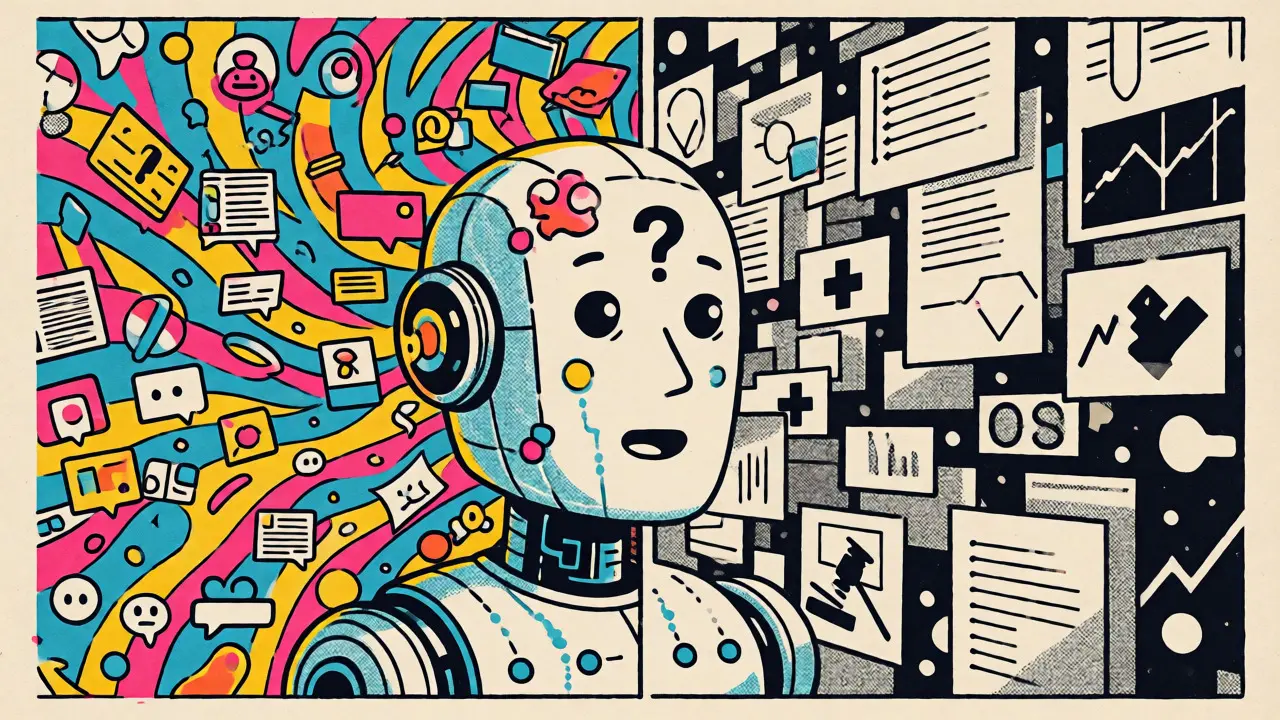
You trained a massive Large Language Model on the entire internet. It writes poetry, codes in Python, and summarizes news with ease. Then you feed it a dense radiology report or a complex derivative contract, and it starts hallucinating. Why? Because general knowledge doesn't equal domain expertise. The gap between "knowing English" and "understanding oncology protocols" is vast. This is where domain adaptation comes in-the process of tweaking these giants so they speak the specific dialect of your industry.
If you're working in healthcare, law, or finance, you know that generic AI models often miss critical nuances. A slight misinterpretation of a drug interaction or a legal clause isn't just an error; it's a liability. But retraining a model from scratch costs millions. So, how do you bridge this gap efficiently? Let's break down the technical strategies and real-world applications that make domain adaptation viable for specialized fields.
The Core Problem: Distribution Shift
Standard LLMs are trained on broad datasets like Common Crawl or Wikipedia. These sources are noisy, diverse, and mostly conversational or encyclopedic. Specialized domains, however, have strict structures and unique vocabularies. When you deploy a general model on medical data, you face a distribution shift. The statistical properties of the input data (the target domain) differ significantly from what the model saw during pre-training (the source domain).
This mismatch causes performance drops. The model might understand the words but miss the context. For instance, in legal texts, the phrase "shall not be construed" has a rigid meaning that differs from everyday usage. If the model treats it casually, its output becomes unreliable. Domain adaptation aims to reduce this discrepancy without discarding the model's general linguistic capabilities.
Technical Strategies for Adaptation
There isn't one silver bullet. Different problems require different tools. Here are the three most effective methodologies used today.
Distribution Alignment
This technique focuses on making the internal representations of source and target data look similar to the model. One common method uses Maximum Mean Discrepancy (MMD). MMD measures the difference between two probability distributions in a high-dimensional space. During training, a regularization term penalizes differences between the features extracted from both domains. Essentially, you force the model to ignore domain-specific noise while preserving task-relevant information. This works best when you have ample unlabeled data from the target domain and the domains aren't radically different in structure.
Adversarial Training
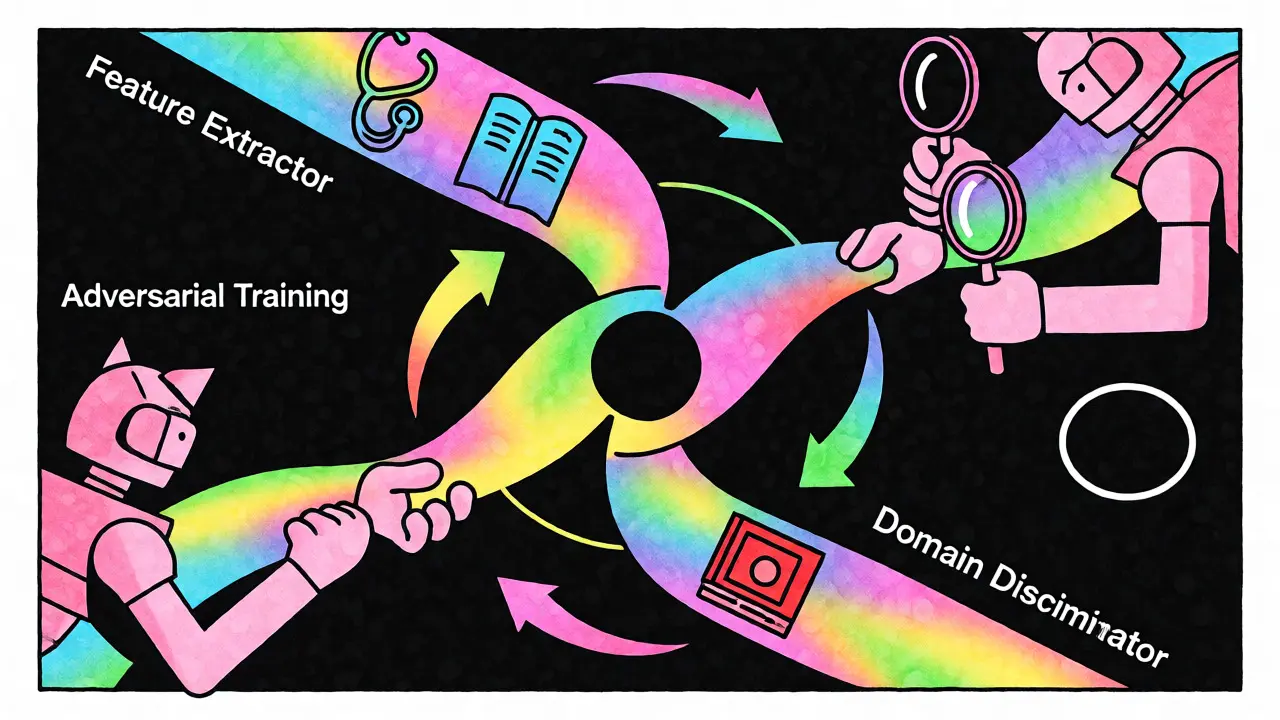
Think of this as a game of cat and mouse. You introduce two neural networks: a feature extractor and a domain discriminator. The extractor tries to generate features that look identical regardless of whether they came from medical or general text. The discriminator tries to guess the origin. The Domain-Adversarial Neural Network (DANN) framework uses a gradient reversal layer to flip gradients during backpropagation. This forces the extractor to learn domain-invariant features. Conditional Domain Adversarial Networks (CDAN) take this further by conditioning the discriminator on task predictions, which is crucial for complex language tasks where context matters more than raw vocabulary.
Self-Supervised Learning
Labeled data is expensive and rare in specialized fields. Self-supervised learning leverages the structure of language itself. Techniques like Masked Language Modeling (MLM) mask words in target domain text and ask the model to predict them. This helps the model grasp domain-specific collocations-like how "myocardial infarction" almost always follows "acute" in cardiology notes. Similarly, Next Sentence Prediction helps models understand document flow, which is vital for legal contracts with their clause-based structure.
Medical Domain: Precision Over Creativity
In medicine, accuracy is non-negotiable. General models often struggle with abbreviations (e.g., "ASAP" can mean "as soon as possible" or "aortic stenosis assessment protocol") and standardized phrasing. Radiology reports, for example, follow strict templates. A model adapted via self-supervised learning on thousands of anonymized radiology reports learns these patterns quickly.
Consider a case where a hospital wants to automate triage summaries. Using Parameter-Efficient Fine-Tuning (PEFT) methods like LoRA allows the hospital to adapt a base model like Llama 3 or Med-PaLM 2 without freezing all weights. However, recent research shows that naive fine-tuning can lead to "catastrophic forgetting," where the model loses general reasoning skills. To combat this, many institutions now combine PEFT with Retrieval Augmented Generation (RAG). RAG inserts relevant clinical guidelines into the prompt, reducing hallucinations even if the model's weights haven't been fully updated.
Legal Domain: Structure and Logic
Legal documents are long, structured, and logically dense. A general LLM might summarize a 50-page merger agreement by missing key exclusions. Legal domain adaptation requires models to understand hierarchical structures-clauses within sections within articles.
Here, adversarial training shines. By training a discriminator to distinguish between legal briefs and news articles, the model learns to focus on legal syntax rather than topical content. Synthetic data generation also plays a huge role. Since labeling thousands of cases is costly, firms use LLMs to generate synthetic legal scenarios based on existing precedents. This creates a larger training set that mimics the distribution of real legal queries, improving the model's ability to handle edge cases in contract analysis.
Finance Domain: Volatility and Terminology
Financial data changes rapidly. A model trained on 2020 earnings calls might fail in 2026 due to new regulatory terms or market conditions. In finance, domain adaptation isn't just about vocabulary; it's about temporal relevance. Continued Pre-training on recent financial filings ensures the model stays current.
For tasks like sentiment analysis on earnings transcripts, distribution alignment helps map the neutral tone of SEC filings to the nuanced language of analyst reports. Financial institutions often invest heavily in this area. Shell, for instance, collaborated with NVIDIA to adapt LLMs for energy sector specifics, proving that industry leaders see clear ROI in customized models. The goal here is often risk mitigation-ensuring that automated compliance checks don't miss subtle regulatory violations hidden in jargon.
| Strategy | Best Use Case | Data Requirement | Complexity |
|---|---|---|---|
| Distribution Alignment (MMD) | Similar domains with minor stylistic shifts | High volume of unlabeled target data | Moderate |
| Adversarial Training (DANN) | Bridging large structural gaps (e.g., News vs. Law) | Source + Target unlabeled data | High |
| Self-Supervised (MLM) | Vocabulary acquisition in niche fields | Raw target text only | Low |
| RAG Integration | Factual accuracy and up-to-date info | Knowledge Base + Query Logs | Low (No weight updates) |

Pitfalls and Practical Advice
Don't fall into the trap of assuming more data equals better results. Research indicates that simply throwing a customer dataset at a model via supervised fine-tuning cannot inject new factual knowledge if it wasn't already latent in the model. You need continued pre-training or RAG for that.
Also, watch out for hyperparameter sensitivity. Finding the right balance between adapting to the new domain and retaining general abilities requires experimentation. Start with small learning rates for PEFT adapters. Monitor for "source-domain forgetting"-if your medical model suddenly forgets how to write a simple email, you've over-adapted.
Finally, consider the cost. Full fine-tuning is expensive. Parameter-Efficient Fine-Tuning (PEFT) keeps foundational parameters frozen, adding only small trainable components. While cheaper, PEFT has limits; it may struggle to learn deep semantic shifts compared to full fine-tuning. For highly specialized tasks like diagnosing rare diseases, you might need to bite the bullet and do full fine-tuning, accepting the higher compute bill.
Frequently Asked Questions
Do I need labeled data for domain adaptation?
Not necessarily. Unsupervised Domain Adaptation (UDA) techniques rely on unlabeled data from the target domain. Methods like Masked Language Modeling allow the model to learn from raw text structure without human annotations, which is ideal for expensive-to-label fields like law or medicine.
What is the difference between fine-tuning and domain adaptation?
Fine-tuning adjusts model weights to perform a specific task (like summarization). Domain adaptation specifically targets the reduction of distribution shift between general training data and specialized target data. Often, domain adaptation is a prerequisite step before task-specific fine-tuning to ensure the model understands the domain's language first.
Can RAG replace domain adaptation?
They serve different purposes. RAG provides external facts to the model at inference time, reducing hallucinations. Domain adaptation modifies the model's internal understanding of language patterns and style. For best results, many enterprises use both: adapt the model to the domain's style and use RAG to provide accurate, up-to-date facts.
Which industries benefit most from LLM domain adaptation?
Industries with high stakes, specialized vocabulary, and structured data benefit most. Healthcare, legal services, and finance are top examples because errors in these fields carry significant financial or safety risks, and generic models lack the necessary precision.
Is LoRA enough for medical LLMs?
LoRA (Low-Rank Adaptation) is efficient and often sufficient for style and basic terminology adjustments. However, for deep semantic understanding required in diagnosis support, full fine-tuning or combining LoRA with RAG is often recommended, as LoRA may limit the model's ability to learn entirely new conceptual frameworks.