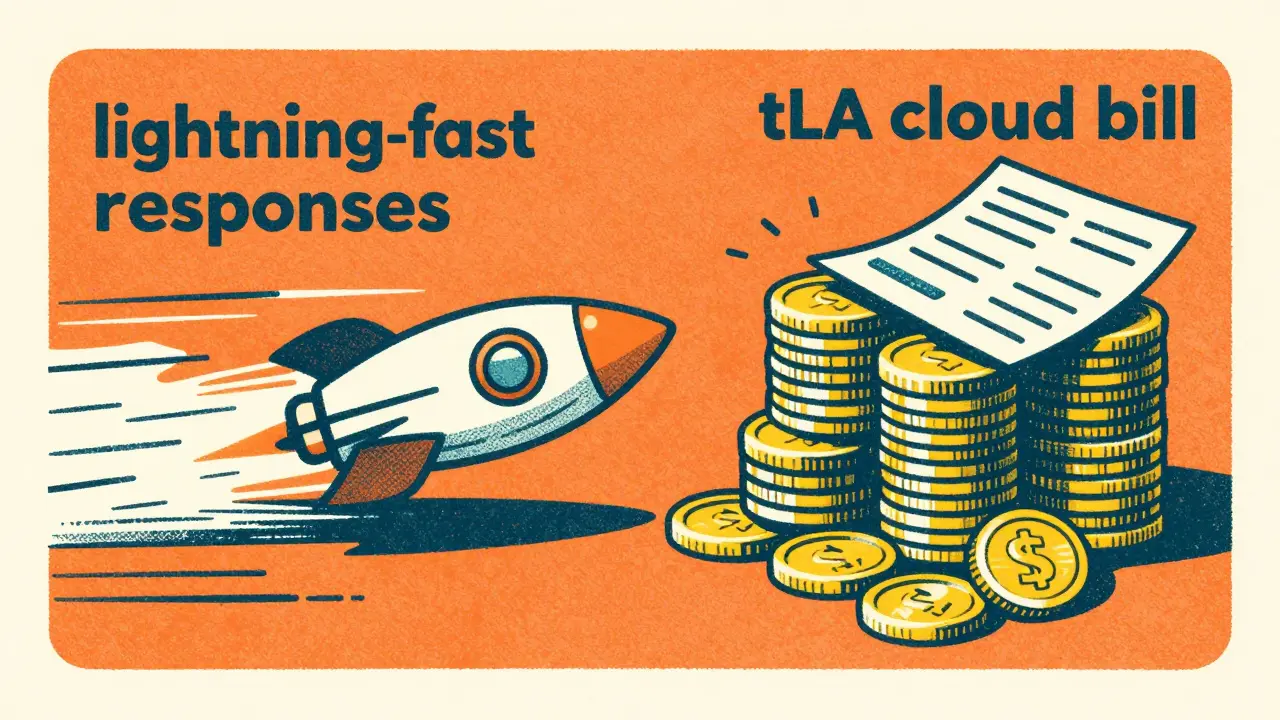
Running a Large Language Model (LLM) in production is essentially a battle between two opposing forces: the need for lightning-fast responses and the crushing weight of the cloud bill. Most teams start by throwing more GPUs at the problem, but that's a strategy with a ceiling. The real challenge isn't just making the model run; it's managing cost-aware scheduling so you aren't paying for idle silicon while your users suffer through high tail latency.
If you've used standard frameworks, you know they're great at throughput but terrible at balancing budgets. When you're dealing with varying request lengths and strict Service Level Objectives (SLOs), a simple first-come-first-served approach leads to "head-of-line blocking," where a massive prompt stalls a hundred tiny queries. You end up over-provisioning your infrastructure just to keep the p99 latency under control, which is a fast track to burning through your venture capital.
The Breaking Point of Traditional Scheduling
Most deployment pipelines rely on basic load balancing or simple round-robin distributions. While these work for static web pages, LLM inference is a different beast. Because tokens are generated one by one, the resource load is dynamic and unpredictable. A single request might take 10 tokens or 2,000, and the GPU memory requirements shift in real-time.
The core problem is that traditional schedulers ignore the joint optimization of cost and performance. You might optimize for the lowest latency, but that often requires keeping expensive GPU instances warm 24/7, leading to massive waste. Conversely, if you prioritize cost by using serverless options, you hit the "cold start" wall, where the first few requests take seconds to initialize, shattering your SLOs. We need a system that knows exactly how much a request "costs" in terms of compute and time before it decides where to send it.
Modern Frameworks for Resource Optimization
To solve this, the industry is moving toward specialized frameworks that treat scheduling as a mathematical optimization problem rather than a queue. One standout is DeepServe++, which handles elastic scheduling in multi-tenant environments. Instead of following a static rulebook, it treats the problem as a contextual bandit problem. It looks at the current state of the GPU cluster-considering memory fragmentation and inter-tenant contention-and makes a real-time bet on which instance will satisfy the SLO at the lowest cost.
Then there are systems built specifically for multi-SLO scenarios. Imagine a world where a "Premium" user gets a 200ms response time guarantee, while a "Free" user is okay with 2 seconds. A specialized SLO-aware scheduler uses simulated annealing to sequence requests. By analyzing the input length and predicting the output length, the scheduler can slot small, high-priority tasks around larger, lower-priority ones. This doesn't just save money; it actually improves the user experience by reducing average latency by over 30% compared to standard tools like vLLM.
| Method | Core Strategy | Cost Efficiency | SLO Attainment | Best For |
|---|---|---|---|---|
| Round Robin | Sequential distribution | Low | Poor (High Variance) | Simple, low-traffic apps |
| vLLM / LMDeploy | PagedAttention/Throughput | Medium | Moderate | High-throughput batches |
| DeepServe++ | Contextual Bandit RL | High | Very High | Serverless multi-tenancy |
| Simulated Annealing | Priority Sequence Mapping | High | Highest | Strict, diverse SLOs |

Solving the "Tool Cost" Paradox
It's not just about where the model runs; it's about what the model *does*. When LLMs use tools (like searching a database or running code), the execution cost of those tools is often ignored. You might have a model that generates a perfect plan, but that plan requires ten expensive API calls to a third-party service. If the cost of the tool execution outweighs the value of the task, the plan is a failure.
This is where CATP-LLM (Cost-Aware Tool Planning) comes in. Instead of sequential planning, it uses a tool planning language to create branched, concurrent execution paths. By using an Offline Reinforcement Learning (ORL) algorithm, the model is fine-tuned to recognize the price tag of its own tools. It effectively learns a trade-off: "Do I use the expensive, highly accurate tool, or the cheap, slightly less accurate one?"
The results are surprising. Even when using a smaller backbone like Llama2-7B, a cost-aware approach can outperform GPT-4 in plan efficiency, reducing costs by up to 45% while maintaining similar performance. This proves that smart scheduling and planning can actually compensate for a lack of raw model scale.
Strategies for Multi-Cloud Orchestration
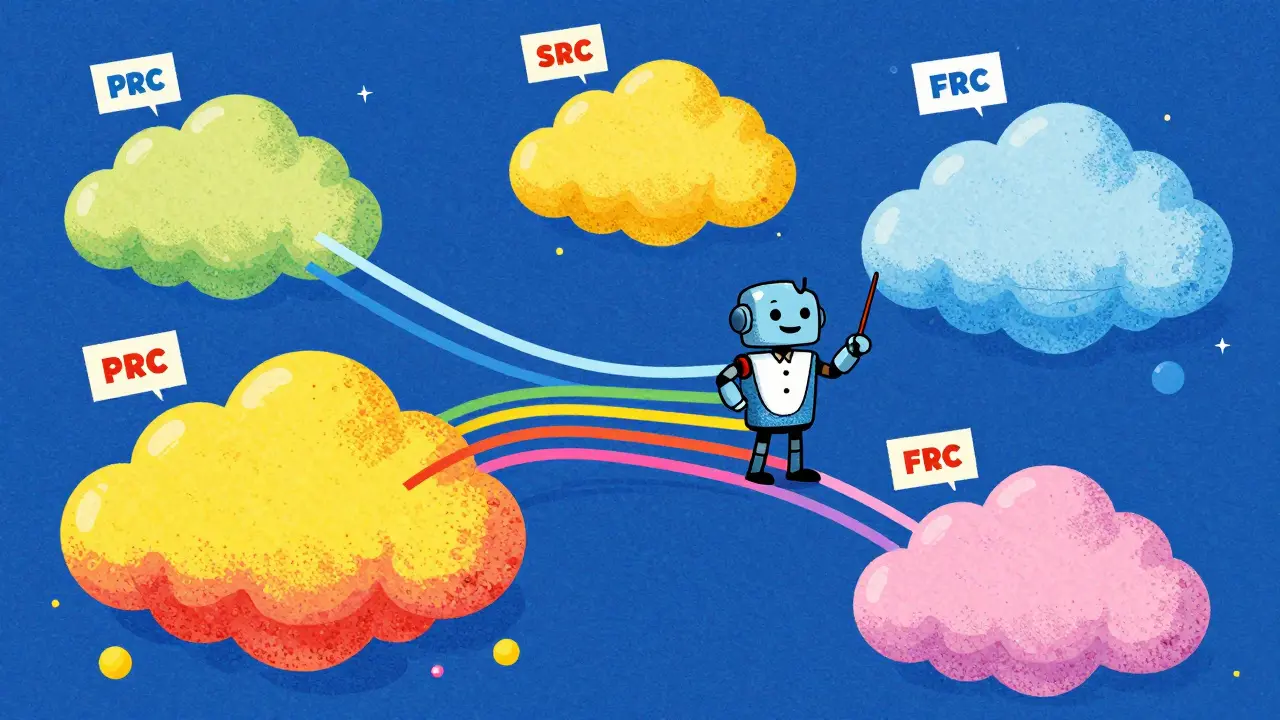
For those operating across multiple cloud providers, the complexity doubles. You're no longer just managing GPUs; you're managing spot instances, regional pricing differences, and data egress fees. Static rules fail here because cloud pricing changes by the hour.
The modern play is to use Proximal Policy Optimization (PPO), a deep reinforcement learning algorithm, to create an intelligent workflow scheduler. This system treats the multi-cloud environment as a dynamic map. It assigns tasks based on a reward function that penalizes CPU cost and rewards SLA fulfillment. If AWS is seeing a price spike in us-east-1, the scheduler automatically shifts non-urgent workloads to a cheaper GCP region, all while ensuring the user doesn't feel the latency hit.
Practical Implementation Pitfalls
When you start building a cost-aware system, avoid the temptation to make the scheduler too complex. If your scheduling logic takes 100ms to decide where a request goes, you've already lost the latency battle. The goal is a "lean" scheduler. The simulated annealing approach mentioned earlier is a great example-it achieves high-quality sequencing with an overhead of only 1 millisecond.
Another common mistake is neglecting GPU memory fragmentation. If your scheduler ignores how KV caches are stored, you'll end up with "swiss cheese" memory-lots of small gaps that aren't large enough for a new request, forcing the system to trigger expensive re-computations or unnecessary instance boots. Your scheduler must be aware of the physical memory state, not just the logical queue.
The Road Toward Holistic Optimization
We are moving toward a future where cost-awareness is baked into every layer of the stack. It starts at the model level with sparse activations, moves to the planning level with frameworks like CATP-LLM, and ends at the infrastructure level with PPO-based multi-cloud schedulers. The trend is clear: the competitive advantage in AI is shifting from who has the biggest model to who can run that model most efficiently.
For developers, the next step is moving beyond basic deployment scripts and toward an "observable" infrastructure. You can't optimize what you don't measure. Start by tracking your "cost per 1k tokens" alongside your p99 latency. Once you see the correlation between specific request types and cost spikes, you'll have the data needed to implement a priority-mapping algorithm that actually moves the needle on your bottom line.
What is the difference between standard scheduling and cost-aware scheduling?
Standard scheduling typically focuses on throughput or fairness, using methods like Round Robin or First-Come-First-Served. Cost-aware scheduling treats resource allocation as an optimization problem, balancing Service Level Objectives (SLOs) with operational expenses. It considers variables like GPU memory fragmentation, instance pricing, and predicted token length to minimize costs without violating latency guarantees.
How does DeepServe++ reduce LLM inference costs?
DeepServe++ uses a contextual bandit framework to optimize elastic scheduling in serverless, multi-tenant environments. It specifically targets the "hidden" costs of LLM deployment, such as cold start latencies and resource contention between users. By learning the best instance allocation for specific workload patterns, it maximizes GPU utilization and reduces the need for expensive over-provisioning.
Can a smaller model outperform a larger one with cost-aware planning?
Yes. Research using the CATP-LLM framework has shown that a Llama2-7B model, when fine-tuned with a cost-aware offline reinforcement learning algorithm, can achieve better plan performance and significantly lower costs (up to 45% lower) than GPT-4. This happens because the model learns to optimize the trade-off between tool accuracy and execution cost, proving that strategic planning can compensate for lower parameter counts.
What is the impact of "cold starts" in cost-aware scheduling?
Cold starts occur in serverless environments when a new GPU instance must be initialized, causing a massive spike in latency for the first single request. Cost-aware schedulers mitigate this by predicting upcoming demand and intelligently keeping a minimum number of instances "warm" or by routing sensitive, high-priority SLO requests to already-active instances while sending flexible requests to new ones.
How is simulated annealing used in LLM scheduling?
Simulated annealing is used as a low-overhead optimization technique to decide the priority sequence of requests. It evaluates a request's SLO, input length, and possible output length to find a sequence that maximizes the number of satisfied SLOs while keeping average latency low. It provides a near-optimal solution with only about 1ms of computational overhead, making it viable for real-time production use.





Michael Thomas
18 April, 2026 - 23:53 PM
vLLM is the standard for a reason. Most of these "advanced" frameworks are just academic fluff that falls apart in a real production environment with actual traffic.
Frank Piccolo
19 April, 2026 - 07:31 AM
Imagine thinking a 7B model can actually compete with GPT-4 just because you tweaked the scheduler. Absolutely laughable. We're seeing a massive decline in engineering standards when people start praising "efficiency" over raw power. Most of these benchmarks are probably cherry-picked by some grad student trying to get a paper published in a mid-tier journal. It's typical of the current state of AI research where the marketing exceeds the actual utility. Give me a cluster of H100s and let the brute force do the work, because at the end of the day, quality doesn't come from a fancy scheduling algorithm, it comes from parameters and data. This whole "cost-aware" trend is just a cope for people who can't afford the compute. It's frankly embarrassing to even suggest that a Llama2-7B can outperform a frontier model in complex planning tasks just by being "cheap". Pure fantasy.
Buddy Faith
20 April, 2026 - 12:22 PM
bet the cloud providers are just using this to hide the fact they are throttling us anyway
nothing is actually efficient just more ways to track our usage patterns
Scott Perlman
22 April, 2026 - 09:33 AM
this is really helpful stuff thanks for sharing
Abert Canada
23 April, 2026 - 10:29 AM
Actually a solid point on the KV cache fragmentation. If you aren't managing the physical memory state, you're basically just gambling with your uptime. I've seen systems crash purely because the scheduler thought there was room but the memory was just too fragmented to actually allocate anything useful. It's a nightmare to debug when it happens in the middle of the night.
Xavier Lévesque
24 April, 2026 - 20:17 PM
Wow, another revolutionary way to save five bucks a month while adding ten layers of complexity to the stack. Truly inspiring stuff.
Thabo mangena
26 April, 2026 - 00:35 AM
It is truly commendable to see such a detailed analysis of infrastructure optimization. The integration of Proximal Policy Optimization for multi-cloud orchestration represents a sophisticated leap forward in operational excellence.
Karl Fisher
26 April, 2026 - 20:00 PM
Oh darling, the drama of the "cloud bill battle" is just so relatable! I simply adore how we've turned GPU orchestration into a high-stakes game of mathematical chess. It's just so chic to be cost-aware these days, isn't it?