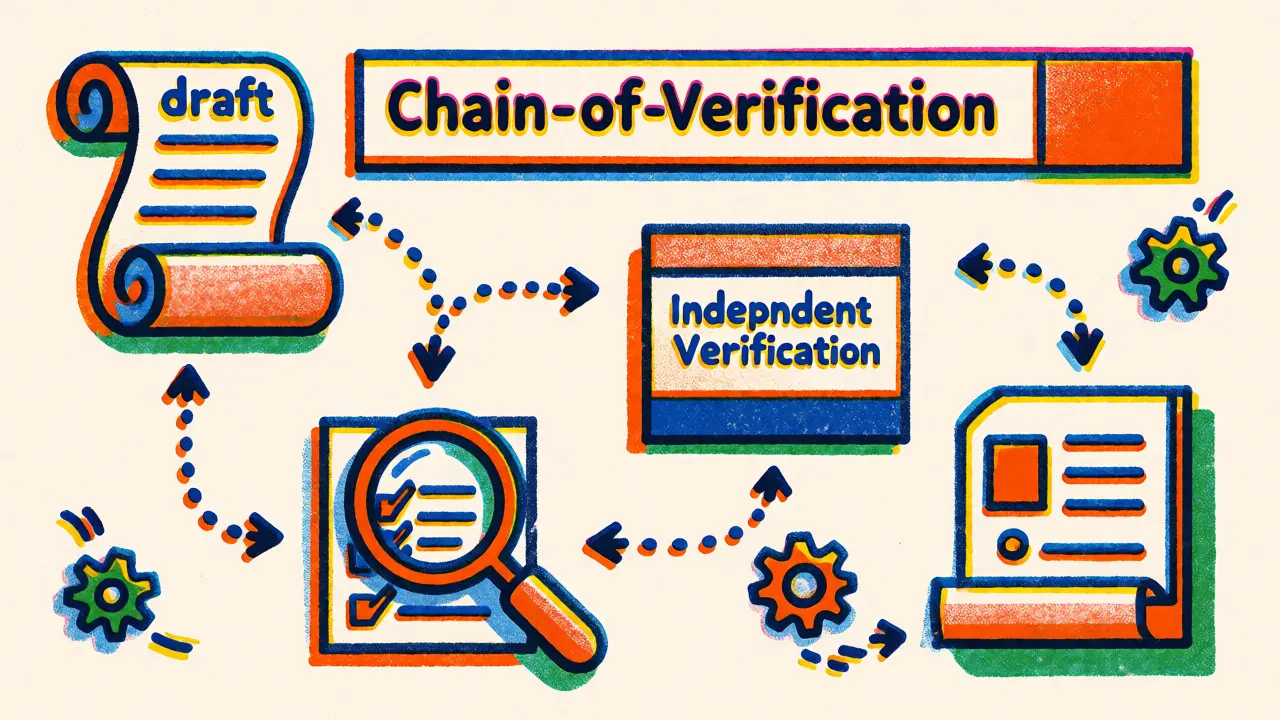
You ask a large language model a factual question. It gives you a confident, well-written answer. But is it true? Often, no. This is the hallucination problem that plagues even the most advanced AI systems. You might think bigger models or more data solve this, but they often just make the errors sound more plausible. So, how do we get reliable outputs without retraining massive neural networks from scratch? The answer lies in changing how the model thinks before it speaks. Enter Chain-of-Verification (CoVe), a four-stage prompting framework designed to reduce hallucinations by forcing an LLM to draft, plan checks, verify independently, and revise its own work.
This isn't about magic. It's about structure. Introduced in a key paper at ACL 2024, CoVe treats the initial output of a model not as truth, but as a first draft. By breaking the generation process into distinct steps, we allow the model to catch its own mistakes. If you are building applications where accuracy matters-like medical advice, legal research, or financial reporting-you need techniques like CoVe. Let's look at how it works, why it beats standard methods, and when you should actually use it.
The Core Problem with Standard Reasoning
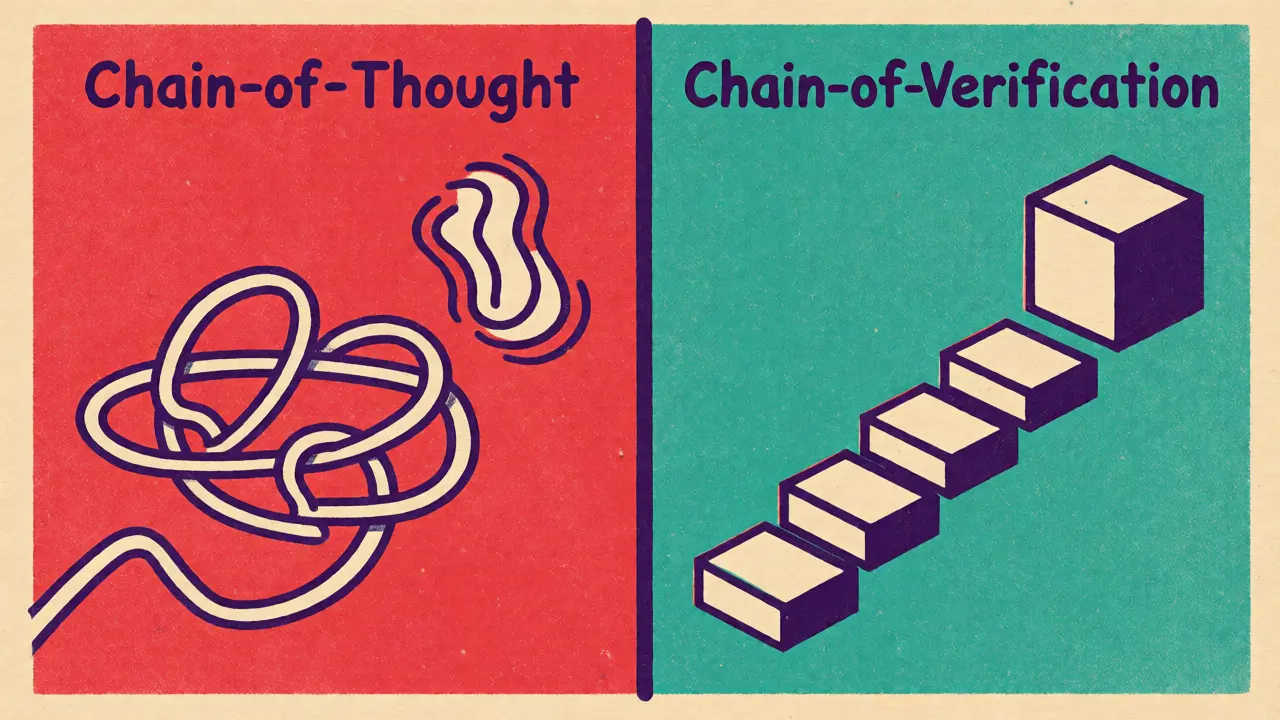
Most modern LLMs use a technique called Chain-of-Thought (CoT) prompting. This asks the model to "think step by step." While CoT helps with logic puzzles and math, it doesn't necessarily stop the model from making up facts. A model can follow a logical path perfectly while using false premises. For example, if asked about the capital of Australia, a model might reason: "Australia is a country in Oceania. The largest city is Sydney. Therefore, the capital is Sydney." The logic is smooth, but the fact is wrong (it's Canberra). CoT validates the flow, not the facts.
Earlier attempts to fix this relied on confidence scores or external databases like Retrieval-Augmented Generation (RAG). RAG is powerful, but it requires a separate retrieval system and clean data sources. What if you don't have a perfect database? Or what if the error is in the model's internal knowledge? That's where CoVe shines. It uses the model's own capacity for self-critique. It doesn't need new weights or external tools to start working. It just needs better prompts.
How Chain-of-Verification Works
CoVe is not a software product you buy. It's a workflow pattern. Think of it as a checklist the AI runs through internally. The framework consists of four distinct stages. Each stage feeds into the next, creating a loop of scrutiny that filters out errors.
- Drafting: The model generates an initial response to your query. This is exactly what happens in a standard chatbot interaction. It might be good, or it might be full of subtle errors. At this stage, we treat it as a candidate, not the final word.
- Planning Verification Questions: The model looks at its own draft and creates a list of questions that would help check the accuracy of specific claims. Instead of asking "Is this right?", it breaks the answer down. If the draft mentions a date, a name, and a cause, the model plans three separate questions to verify each one.
- Independent Verification: This is the crucial step. The model answers those verification questions *independently*. It does not look at the original draft while answering them. This prevents confirmation bias. If the model sees its own previous mistake, it might just double down on it. By isolating the verification, we force the model to retrieve the fact fresh.
- Revision: Finally, the model compares the independent answers with the original draft. If there's a mismatch, it corrects the draft. If the verification confirms the draft, it keeps it. The result is a revised, verified response.
Why does this work? Because generating a short, factual answer to a simple question is easier for an LLM than generating a long, complex narrative. Errors often creep in during the synthesis of long texts. By breaking the task into smaller, verifiable chunks, we lower the cognitive load on the model's attention mechanism.
CoVe vs. Chain-of-Thought vs. RAG
It’s easy to confuse these terms. They all aim to improve reliability, but they attack the problem from different angles. Here is a quick comparison to help you decide which tool fits your stack.
| Feature | Chain-of-Thought (CoT) | RAG | Chain-of-Verification (CoVe) |
|---|---|---|---|
| Primary Goal | Improve logical reasoning | Ground answers in external data | Reduce internal hallucinations |
| Data Source | Model's internal weights | External documents/database | Model's internal weights (self-check) |
| Complexity | Low (single prompt) | High (requires retrieval infra) | Medium (multi-step prompting) |
| Latency | Standard | Variable (network dependent) | Higher (multiple passes) |
| Best For | Math, coding, logic puzzles | Facts that change frequently | Factual QA, long-form generation |
Notice that CoVe and RAG aren't mutually exclusive. In fact, some of the best results come from combining them. You can use RAG to pull context, then use CoVe to verify that the model interpreted that context correctly. However, if you lack a robust retrieval system, CoVe offers a way to boost accuracy using only the model itself.
Real-World Performance and Results
Does this actually work, or is it just theoretical fluff? The researchers behind CoVe tested it against several benchmarks, including Wikidata queries and closed-book question answering. The results were striking. On tasks where the model had to list items from a category (like "list all planets"), CoVe variants doubled the performance compared to baselines.
In evaluations comparing CoVe against popular models like InstructGPT and ChatGPT, the CoVe-enhanced models consistently showed higher precision. They didn't just guess better; they caught their own mistakes. One key finding was that instruction tuning alone-the process of teaching a model to follow directions-did not significantly reduce hallucinations. Adding explicit verification steps did. This suggests that simply telling a model to "be accurate" isn't enough. You have to give it a mechanism to check its work.
However, there is a trade-off. Because CoVe requires at least four passes through the model (draft, plan, verify, revise), it consumes more tokens and takes longer. If you are building a real-time chatbot where speed is critical, CoVe might feel sluggish. But for a report generator or a research assistant, waiting an extra few seconds for a verified answer is usually worth it.
When Should You Use CoVe?
You shouldn't apply CoVe to every single request. It’s overkill for simple greetings or creative writing where strict factuality isn't required. Use it when the cost of being wrong is high.
- Medical and Legal Queries: If an AI suggests a drug interaction or a legal precedent, you need verification. A small error here can have big consequences.
- Long-Form Content Generation: When generating articles or summaries, facts can drift. CoVe helps keep the core claims anchored.
- Closed-Book QA: If you don't have access to a search engine or database, CoVe is your best bet for squeezing accuracy out of the model's training data.
Conversely, avoid CoVe for tasks requiring immediate responses, such as live customer support chats where sub-second latency is expected. Also, be cautious with very open-ended creative tasks. Asking an LLM to "verify" the creativity of a poem can lead to sterile, overly corrected outputs.
Implementation Tips for Developers
If you're ready to try CoVe, keep these practical tips in mind. First, the quality of your verification questions matters. Generic questions like "Is this correct?" yield poor results. Prompt the model to generate specific, atomic questions. For example, instead of "Check the dates," ask "What is the exact year mentioned in the draft?" and "What is the historically accepted year for this event?"
Second, ensure independence. When implementing the verification step, clear the context window or explicitly instruct the model to ignore the previous draft. If the model sees its own wrong answer, it tends to rationalize it rather than correct it. This is known as answer leakage.
Finally, monitor token usage. Since CoVe multiplies the number of calls, your API costs will rise. Profile your application to see if the accuracy gain justifies the expense. For many enterprise applications, a 10% increase in cost for a 30% reduction in errors is a great deal.
Is Chain-of-Verification a type of fine-tuning?
No, CoVe is primarily a prompting strategy used at inference time. It does not require modifying the model's weights. However, the concepts can be used to create datasets for fine-tuning later, but the standard implementation relies on multi-step prompting.
Can I combine CoVe with Retrieval-Augmented Generation (RAG)?
Yes, and it is often recommended. You can use RAG to provide context and CoVe to verify that the model accurately interprets that context. This combination addresses both external knowledge gaps and internal reasoning errors.
Why does CoVe increase latency?
CoVe requires multiple sequential calls to the LLM: one for drafting, one for planning questions, one for verifying, and one for revising. Each call adds processing time and network overhead, resulting in slower overall response times compared to single-pass generation.
Does CoVe work with multimodal models?
Yes, recent adaptations extend CoVe to multimodal settings. For example, a model describing an image can generate verification questions about specific visual elements and then re-examine the image to confirm those details, reducing visual hallucinations.
Is CoVe better than Chain-of-Thought?
They serve different purposes. CoT improves logical reasoning steps, while CoVe focuses on factual accuracy and self-correction. For factual tasks, CoVe generally outperforms CoT because it explicitly checks for inconsistencies between the draft and independent verification.