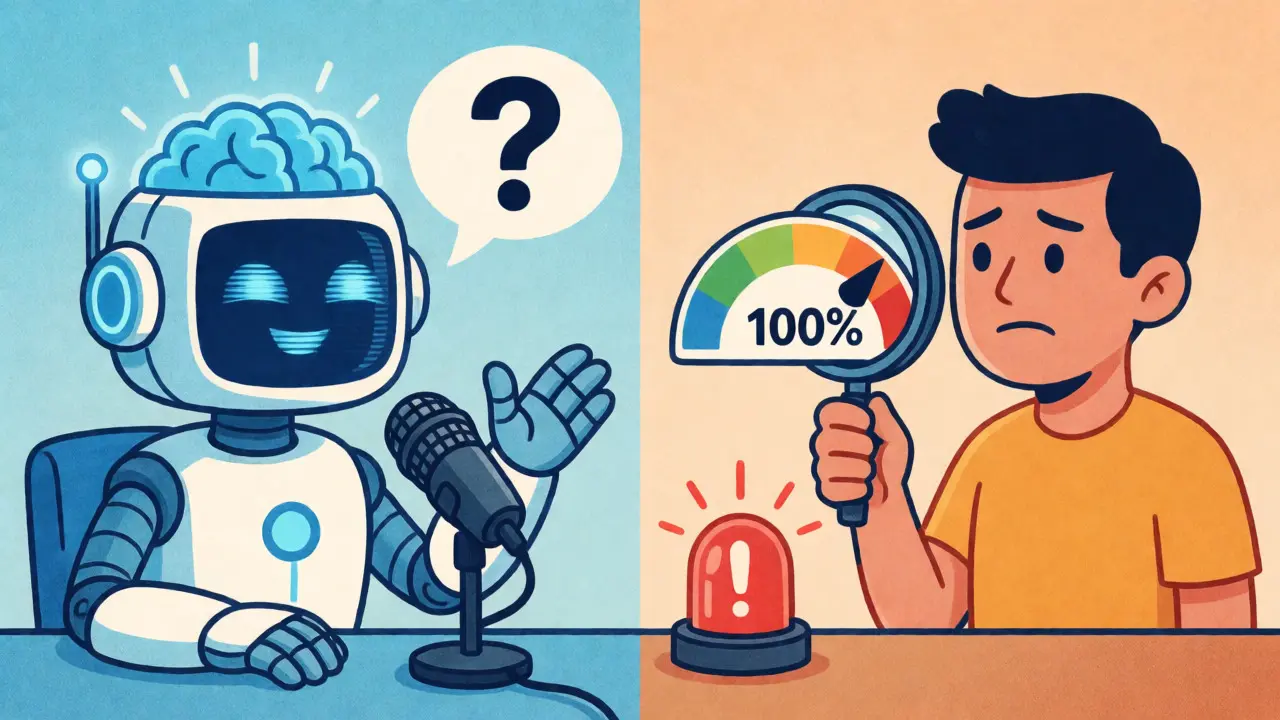
You ask an AI a question. It answers with absolute certainty. But is it right? Or is it just hallucinating with confidence? This is the core problem of LLM confidence calibration. When large language models like GPT-4 or Claude say they are "sure," their internal probability scores often don't match reality. They are overconfident. This mismatch creates real risks when you deploy these models in production, especially if your system needs to know when to hand off to a human.
Why does this happen? It’s largely due to how we train modern models. Reinforcement Learning from Human Feedback (RLHF) makes models helpful and polite, but it breaks their natural sense of uncertainty. A base model might have had decent probability estimates, but fine-tuning for chat alignment scrambles them. The result? Models that sound authoritative even when they are wrong. Fixing this isn't just academic; it's essential for building reliable AI agents that can defer to experts when they don't know the answer.
Why RLHF Breaks Confidence Scores
Before we fix it, let’s understand what’s broken. In traditional machine learning, a model’s output probability usually correlates well with its accuracy. If a classifier says it has an 80% chance of being right, it should be right about 80% of the time. That’s calibration.
But Large Language Models (LLMs) are different. Research shows that after RLHF training, models like ChatGPT often exhibit significant overconfidence. Their conditional probabilities-the raw numbers behind the next token prediction-diverge from their actual correctness rates. You might see a model assign a high probability to a wrong answer because the training process rewarded fluent, confident-sounding responses rather than calibrated uncertainty.
This creates a deployment nightmare. If your customer service bot doesn’t know the return policy, you want it to say, "I'm not sure," not guess confidently and mislead the user. Without proper calibration, you can't trust the model's self-assessment, forcing you to rely on external validation systems that slow down response times.
Verbalized Confidence: Asking the Model Directly
One of the most effective fixes is surprisingly simple: stop looking at the hidden probabilities and start asking the model to state its confidence. This technique is called verbalized confidence. Instead of relying on the logprobs (the mathematical probabilities of tokens), you prompt the model to output a numerical score or a linguistic expression like "highly likely" or "probably not."
Studies on benchmarks like TriviaQA and TruthfulQA show that verbalized confidences are often better calibrated than conditional probabilities. In some cases, this approach reduces Expected Calibration Error (ECE) by up to 50%. Why does this work? Because RLHF trains models to communicate effectively. When asked to express uncertainty in words, the model accesses its learned communication patterns, which are more aligned with human notions of certainty than its raw token probabilities.
You can enhance this further with Chain-of-Thought (CoT) prompting. By forcing the model to reason step-by-step before stating its confidence, you give it a chance to check its own logic. If the reasoning steps are shaky, the final confidence score tends to drop. This adds a layer of self-correction that raw probabilities lack.
Temperature Scaling and the Thermometer Method
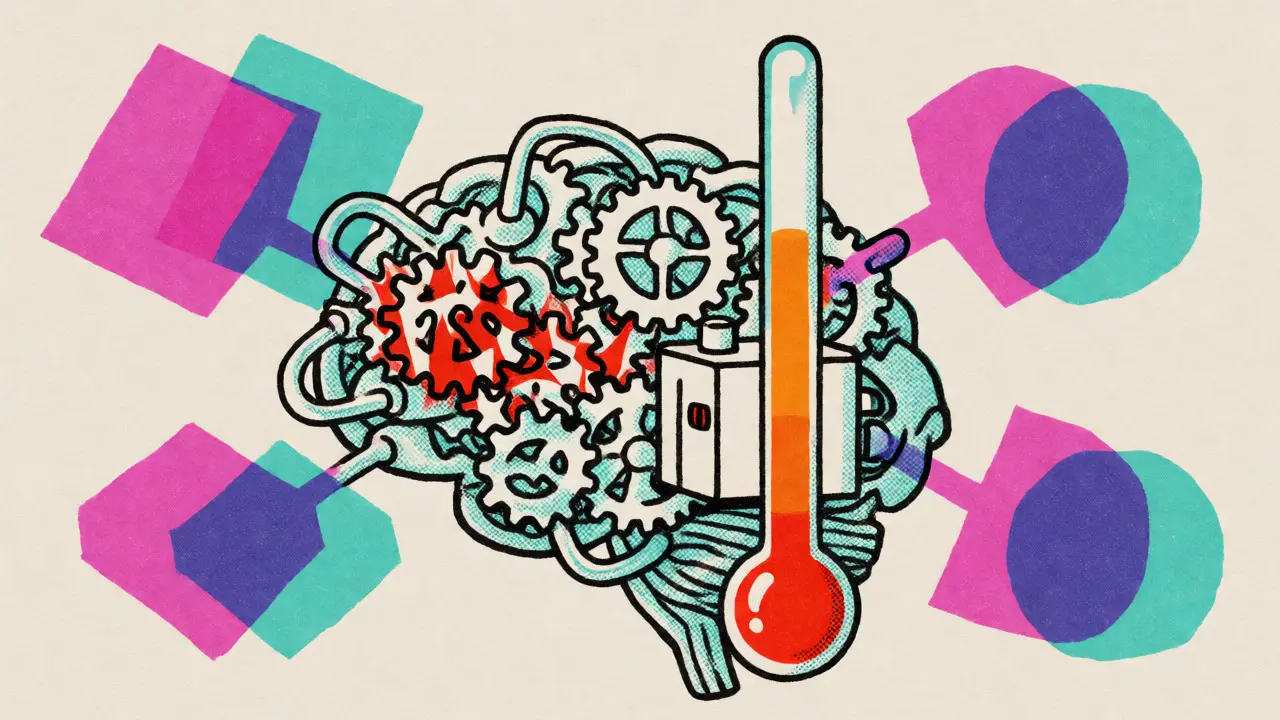
If you need a quick, low-cost fix, look at temperature scaling. This is a classic post-processing technique where you adjust the model’s logits (raw output scores) using a single parameter, called temperature. Higher temperature flattens the distribution (more uncertainty); lower temperature sharpens it (more certainty).
The challenge is finding the right temperature. Traditionally, you’d use a labeled validation set to tune this. But for massive LLMs, running inference multiple times to find this value is expensive. Enter the Thermometer method, developed by researchers at MIT and IBM. Instead of tweaking the giant LLM itself, Thermometer builds a small auxiliary model that sits on top of the LLM. This smaller model learns to map the LLM’s outputs to calibrated probabilities.
Thermometer is efficient because it doesn’t require sampling the main model repeatedly. It preserves the accuracy of the original model while fixing the confidence scores. It’s particularly useful when you’re dealing with tasks the model hasn’t seen during training, as it generalizes better than static temperature adjustments.
Self-Consistency and Sampling Strategies
Sometimes, one answer isn’t enough. Self-consistency techniques involve generating multiple responses to the same query and analyzing how much they agree. The logic is straightforward: if the model gives the same answer across different sampling temperatures or prompt variations, it’s probably right. If the answers vary wildly, confidence should be low.
This approach uses metrics like Consistency Measure and Average Confidence. For example, you might generate five answers. If four are identical, the consistency is high. You can then weigh the final confidence score based on this agreement. While computationally heavier than single-pass methods, it provides a robust signal for uncertainty, especially in complex reasoning tasks.
A related strategy is Top-K Responses. Instead of picking the single best answer, you keep the top K candidates and their scores. If the top candidate’s score is barely higher than the second, your confidence in the top choice should reflect that ambiguity. This helps prevent the model from committing to a wrong answer just because it was marginally more probable than the runner-up.
Measuring Success: Key Metrics and Benchmarks
How do you know if your calibration works? You need specific metrics. The standard is Expected Calibration Error (ECE). ECE measures the difference between predicted confidence and actual accuracy. A low ECE means your model’s confidence matches its performance. However, ECE has limitations, particularly with binning strategies, so newer metrics like Information Probability Ratio (IPR) and Calibration Error (CE) are gaining traction.
To evaluate these methods, researchers use standardized datasets. TriviaQA tests factual knowledge, SciQ focuses on science questions, and TruthfulQA checks for hallucinations. These benchmarks allow for fair comparisons between techniques. For instance, a study published at EMNLP 2024 introduced UF Calibration, which decomposes confidence into uncertainty about the question and fidelity to the answer. This method showed strong results on multiple-choice QA tasks, proving that separating these components yields better calibration than treating confidence as a monolithic score.
| Technique | Complexity | Best Use Case | Key Benefit |
|---|---|---|---|
| Verbalized Confidence | Low | Chatbots, General QA | Better aligns with human communication; no extra compute cost. |
| Temperature Scaling | Low | Classification tasks | Simple post-processing; fast implementation. |
| Thermometer Method | Medium | Production APIs | Efficient; preserves model accuracy while calibrating. |
| Self-Consistency | High | Complex Reasoning | Robust against hallucinations via agreement checks. |
| UF Calibration | Medium | Multiple Choice QA | Decomposes uncertainty vs. answer fidelity. |

Practical Implementation Tips
If you’re building an application today, start with verbalized confidence. It’s cheap and effective. Add a system prompt instruction: "After answering, provide a confidence score from 0 to 1." Monitor the correlation between these scores and your ground truth data. If the correlation is weak, move to temperature scaling or the Thermometer method.
For critical decisions, combine methods. Use self-consistency for high-stakes queries where computational cost is acceptable. Always define a threshold for deferral. If the calibrated confidence drops below, say, 0.7, trigger a human review or a fallback mechanism. This hybrid approach leverages the speed of AI while maintaining safety through calibrated uncertainty.
Keep in mind that calibration isn't static. As you update your model or change domains, re-evaluate your calibration settings. What works for medical advice might not work for legal summaries. Regular testing against benchmarks like TruthfulQA ensures your confidence scores remain trustworthy over time.
Frequently Asked Questions
What is Expected Calibration Error (ECE)?
ECE is a metric that quantifies the discrepancy between a model's predicted confidence and its actual accuracy. It calculates the average difference between the confidence level and the true outcome across all predictions. Lower ECE values indicate better calibration, meaning the model's stated confidence accurately reflects its likelihood of being correct.
Why are LLMs overconfident after RLHF?
Reinforcement Learning from Human Feedback (RLHF) optimizes models for helpfulness and coherence, often rewarding confident-sounding responses. This process can degrade the natural probabilistic calibration present in pre-trained models, leading to situations where the model expresses high certainty even when its internal probabilities for incorrect answers are also elevated.
Is verbalized confidence better than logprobs?
In many cases, yes. Research indicates that for RLHF-tuned models, verbalized confidence scores (where the model explicitly states its certainty) are often better calibrated than the raw conditional probabilities (logprobs). This is because verbalization taps into the model's learned communication skills, which may be more aligned with accurate uncertainty assessment than its raw token generation probabilities.
What is the Thermometer method?
The Thermometer method is a calibration technique that uses a smaller auxiliary model to adjust the confidence scores of a larger LLM. It applies temperature scaling efficiently without requiring repeated sampling of the large model, making it suitable for production environments where computational resources are limited.
How does self-consistency improve reliability?
Self-consistency involves generating multiple answers to the same question under varying conditions. If the model produces consistent answers, confidence is high. If answers diverge, confidence is low. This method helps identify unstable predictions and reduces the risk of accepting a single, potentially erroneous output.