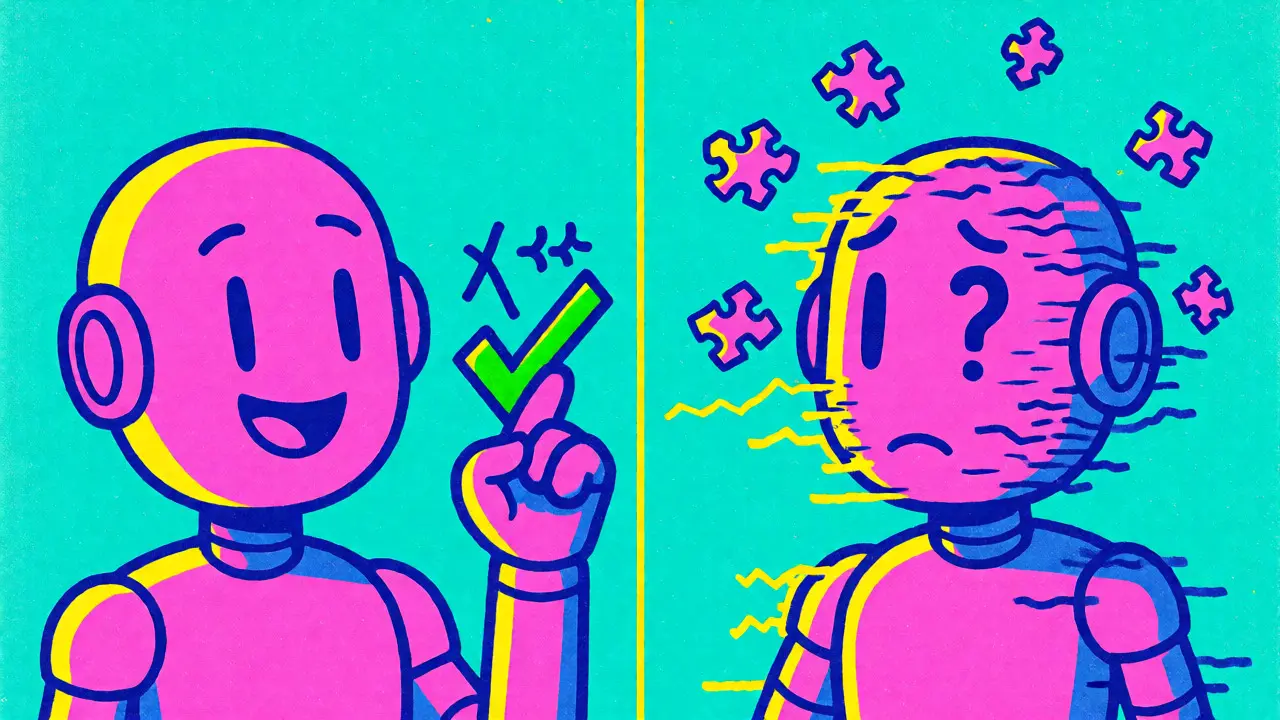
You deploy a compressed LLM because you need speed and lower costs. You save money on GPUs. But then your chatbot starts hallucinating technical specs, or your coding assistant misses edge cases. Why does this happen? It’s not just "noise." It’s a specific set of accuracy tradeoffs that change how the model thinks, reasons, and retrieves facts.
If you’re running models like Llama-3 or Mistral on consumer hardware or edge devices, you’ve likely used quantization. You might have seen perplexity scores stay flat while your actual application quality tanked. That gap is where most developers get burned. This guide breaks down exactly what happens to accuracy when you compress large language models (LLMs), why standard benchmarks lie, and how to pick the right compression method for your specific job.
The Illusion of Perplexity
Most engineers start by checking perplexity. If it doesn’t jump up, they assume the model is fine. Don’t make that mistake. Perplexity measures how well the model predicts the next token in a sequence. It’s great for fluency. It’s terrible for reasoning.
Research from Apple’s LLM-KICK benchmark showed that 4-bit quantization can degrade knowledge-intensive tasks by over 8% even when perplexity changes are negligible. Why? Because perplexity rewards surface-level pattern matching. A compressed model can still write grammatically correct sentences but lose the internal logic required for multi-step reasoning.
Perplexity is a metric that evaluates how well a probability model predicts a sample. In LLMs, lower perplexity indicates better prediction confidence. However, as noted by Dr. Jane Thompson at Anthropic, "perplexity is dangerously misleading for compressed LLMs." Models can maintain near-identical perplexity while losing 30% capability on complex reasoning tasks.
Think of it this way: A student who memorizes answers gets a high score on multiple-choice tests (low perplexity). But if you ask them to explain the concept or apply it to a new problem, they fail. Compression often turns your LLM into that student. It knows the words, but it forgets the meaning.
Quantization vs. Pruning: The Real Difference
There are two main ways to shrink an LLM: quantization and pruning. They hurt accuracy in completely different ways. Choosing the wrong one for your use case guarantees headaches.
Quantization reduces the precision of the model's weights, typically from 16-bit floating point to 4-bit integers. Tools like GPTQ and AWQ dominate this space. They keep the structure of the neural network intact but coarsen the numerical values.
Pruning removes entire neurons or connections from the network. It makes the model smaller by deleting parts of its brain. Dependency-based structural pruning can achieve 50% sparsity, but it’s risky.
Here is the critical insight: Quantization preserves logical flow better than pruning. According to ICML 2025 research, 4-bit quantized models retain 97-99% of performance on agentic tasks (like using tools or following workflows). Pruned models, even at moderate sparsity levels, drop 15-20% on those same tasks.
Why? Pruning deletes pathways. If you prune a connection that carries crucial information for a specific type of query, that ability is gone forever. Quantization just blurs the signal. The pathway is still there; it’s just less precise. For most production apps, blurred signals are easier to fix than missing ones.
| Metric | 4-Bit Quantization (GPTQ/AWQ) | 50% Sparsity Pruning | Distillation (e.g., DeepSeek R1) |
|---|---|---|---|
| Reasoning (Multi-step) | -5% to -8% | -15% to -20% | -22% (Agentic tasks) |
| Factual Recall | -8% to -12% | Catastrophic Failure (>25%) | -10% to -15% |
| Code Generation | -3% to -5% | -10% to -15% | -5% to -8% |
| Long Context (>32k) | -25% Accuracy Drop | -15% to -20% Drop | Data Dependent |
| Latency Gain | High (4-8x faster) | Medium (2-3x faster) | Low (Model size dependent) |

Where Accuracy Actually Breaks Down
You won’t notice accuracy loss when asking simple questions. "What is the capital of France?" works fine in 4-bit. The problems appear in three specific areas: long-context reasoning, tool usage, and niche knowledge retrieval.
Long-Context Degradation
If you feed your model 32,000+ tokens, watch out. Compressed models struggle to maintain attention consistency over long distances. Studies show a 25-30% accuracy degradation for 4-bit models on long-context tasks compared to full-precision versions. Full-precision models only see a 15-20% drop.
This happens because low-precision weights introduce noise that compounds over many layers. In a short prompt, the noise is manageable. In a 100-page document summary, the noise accumulates until the model loses track of key details. If your app relies on Retrieval-Augmented Generation (RAG) with large chunks of text, you might need to increase your context window budget by 18-22% just to compensate for this noise.
Tool Use and Agents
Agentic workflows require strict adherence to formats. JSON output, function calling, step-by-step planning. Here, quantization actually shines compared to pruning. 4-bit models maintain 97-99% of their formatting capabilities. Pruning, however, breaks these rigid structures because it removes the specific neurons responsible for syntax constraints.
But don’t get complacent. While the format holds, the decision-making behind the tool call can falter. A developer on GitHub reported a 12% increase in nonsensical responses for complex technical queries after deploying AWQ-quantized Llama-3-70B. The model knew *how* to call the API, but sometimes picked the *wrong* API endpoint.
Niche Knowledge Hallucinations
General knowledge survives compression well. Specific, rare facts do not. If your model needs to know about obscure legal precedents or proprietary company data, compression hurts more. The "energy scores" (confidence levels) of compressed models drop by 18-22% on complex tasks. The model becomes less confident, which paradoxically leads to more hallucinations because it guesses rather than refuses to answer.
How to Mitigate the Damage
You can’t eliminate accuracy loss, but you can manage it. Here are three proven strategies.
Use Mixed-Precision Quantization
Not all weights are created equal. Some are sensitive; others aren’t. Methods like AWQ (Activation-aware Weight Quantization) identify the top 1% most critical weights and keep them in 16-bit precision while quantizing the rest to 4-bit. This approach reduces quantization error by nearly 38% compared to uniform quantization. It’s a cheap win. Always prefer AWQ or SqueezeLLM over basic RTN (Round-to-Nearest) quantization.
Implement "Compress, Then Prompt"
Don’t just compress and pray. Spend time re-tuning. Research shows that adding soft prompts or fine-tuning adapters after compression can recover 80-90% of lost accuracy. This process takes 2-3 hours on a consumer GPU like an RTX 4090. It’s worth it. A generic 4-bit model is worse than a slightly larger, tuned 8-bit model. Tune your compressed model on your specific domain data.
Benchmark on Tasks, Not Tokens
Stop looking at MMLU alone. Build a small evaluation suite that mirrors your production traffic. Test for:
- Format adherence (Does it return valid JSON?)
- Refusal rates (Does it say "I don't know" instead of guessing?)
- Chain-of-thought length (Does it skip steps in logic?)
If your eval suite shows a 5% drop in task success rate, accept it. If it shows 20%, switch methods or revert to higher precision.
When Should You Avoid Compression?
Compression isn’t always the right move. Skip it if:
- You work in regulated industries: Financial services report 18.3% higher error rates in compliance tasks with compressed models. The cost of a wrong answer outweighs the GPU savings.
- You rely heavily on RAG: If your system retrieves tiny snippets of code or legal clauses, the noise in 4-bit weights can distort the meaning of those snippets.
- Your latency budget is loose: If you can afford the GPU cost for FP16 inference, do it. Accuracy is free at that price point.
Conversely, embrace compression if you are building customer-facing chatbots, summarization engines, or creative writing tools. Users tolerate slight factual drift in creative contexts. They do not tolerate it in medical diagnoses.
The Future: Task-Specific Compression
We are moving away from one-size-fits-all compression. New tools like Microsoft’s TaskCompress adapt compression ratios dynamically based on input complexity. Simple greetings run at 4-bit; complex legal analysis runs at 8-bit within the same model. By 2027, expect static quantization to become legacy tech. Start experimenting with hybrid approaches now-combining quantization with sparse experts-to future-proof your stack.
Does 4-bit quantization significantly slow down inference?
No, it usually speeds it up. 4-bit quantization reduces memory bandwidth requirements, allowing for faster data transfer between GPU memory and compute cores. On modern hardware like NVIDIA A100s or H100s, 4-bit inference is typically 2-4x faster than 16-bit inference, provided you use optimized kernels like FlashAttention or TensorRT-LLM.
Why does my compressed model hallucinate more?
Compression introduces numerical noise into the model's weights. This noise disrupts the subtle distinctions between similar concepts. When the model is unsure, it tends to guess the most probable continuation rather than admitting uncertainty. This manifests as hallucinations, especially in factual recall or niche domains where the training signal was already weak.
Is AWQ better than GPTQ for accuracy?
Generally, yes. AWQ (Activation-aware Weight Quantization) analyzes activation distributions to protect salient weights, resulting in lower quantization error compared to GPTQ (Gradient-based Post-Training Quantization). Benchmarks often show AWQ maintaining 1-2% higher accuracy on reasoning tasks, though the difference can be marginal depending on the specific model architecture.
Can I fine-tune a quantized model?
Yes, but with limitations. You cannot update the quantized weights directly during standard backpropagation. Instead, you use techniques like QLoRA (Quantized Low-Rank Adaptation), which freezes the base quantized model and trains small adapter layers. This allows effective fine-tuning with minimal VRAM, recovering much of the accuracy lost during compression.
Do compressed models handle long contexts poorly?
They handle them worse than full-precision models. The accumulated numerical error across many transformer layers degrades attention mechanisms over long sequences. Expect a 20-30% drop in retrieval accuracy for contexts exceeding 32k tokens compared to unquantized baselines. Mitigation includes using sliding windows or chunking strategies.