AI Policy: Rules, Compliance, and Governance for Responsible AI Deployment
When you deploy AI policy, a set of rules and practices that govern how artificial intelligence is used, monitored, and held accountable. Also known as AI governance, it's what stops your chatbot from leaking customer data, your image generator from creating deepfakes, or your cost estimates from exploding because no one tracked token usage. It’s not a legal document buried in HR files—it’s the living framework that decides who can use what model, when to audit outputs, and how to respond when something goes wrong.
Enterprise data governance, the system for tracking, controlling, and securing the data used to train and run AI models is one of the biggest pieces. Without it, you’re flying blind: you don’t know if your LLM was trained on private emails, copyrighted books, or patient records. Tools like Microsoft Purview and Databricks help map where data comes from, who touched it, and whether it meets GDPR or CCPA rules. And it’s not optional anymore—generative AI laws, state-level regulations like California’s transparency rules or Illinois’ deepfake restrictions are already in force. If you’re building anything public-facing, you need to know what your state requires, what your customers expect, and how to prove you’re following it.
Then there’s AI compliance, the ongoing process of aligning AI use with legal, ethical, and business standards. This isn’t just about avoiding fines. It’s about building trust. If your AI gives wrong answers, you need to know why—and how to fix it. Truthfulness benchmarks like TruthfulQA show even top models hallucinate. Safety classifiers block harmful content, but they’re not perfect. That’s why you need review coverage metrics, MTTR (mean time to resolve), and clear escalation paths. And if you’re scaling across borders, export controls and deemed export rules can shut down your team if you’re not careful.
Most teams treat AI policy as an afterthought—something to handle before launch. But the posts below show it’s the opposite. The companies that succeed don’t just deploy models. They build guardrails before the first line of code. They measure policy adherence like a KPI. They use confidential computing to protect data during inference. They abstract providers to avoid vendor lock-in and reduce risk. They calculate risk-adjusted ROI, not just raw savings. And they don’t wait for a breach to act.
What follows isn’t theory. These are real setups from teams running AI in production—how they lock down data, cut costs without cutting corners, and keep their systems safe, legal, and predictable. You’ll see exactly how to turn policy from a checklist into a competitive advantage.
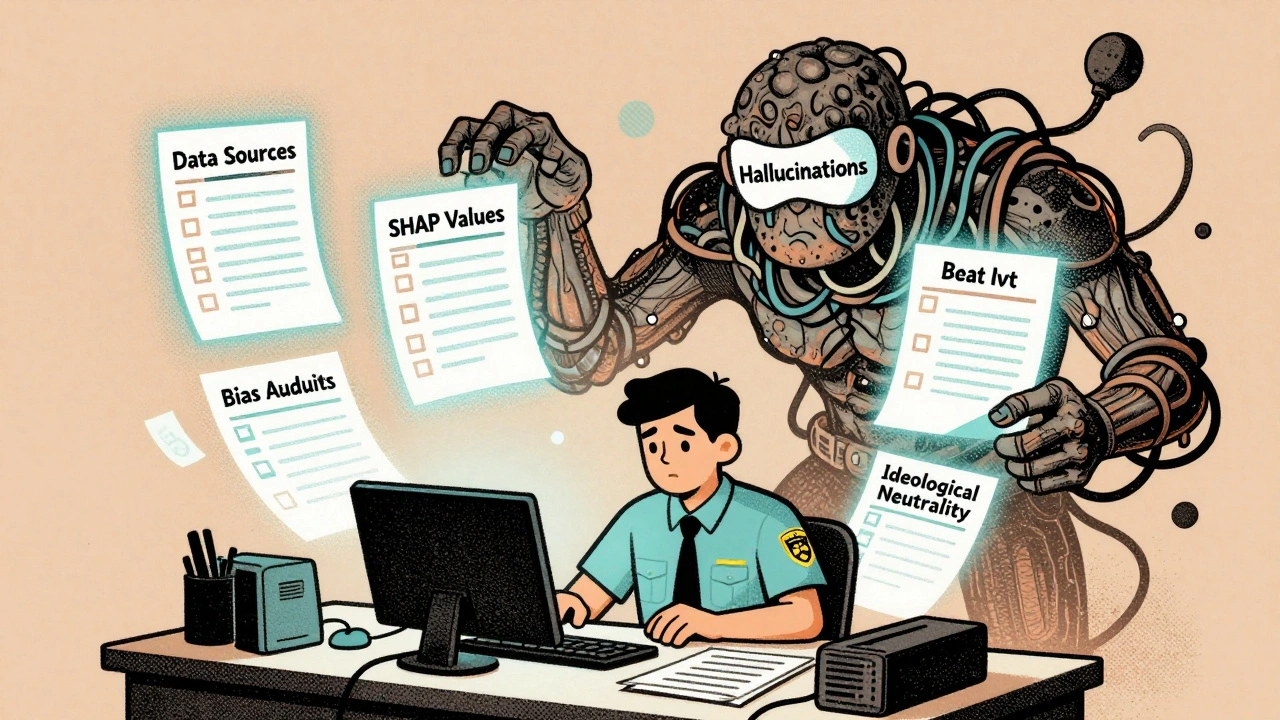
Governance Policies for LLM Use: Data, Safety, and Compliance in 2025
In 2025, U.S. governance policies for LLMs demand strict controls on data, safety, and compliance. Federal rules push innovation, but states like California enforce stricter safeguards. Know your obligations before you deploy.
Read More
Community and Ethics for Generative AI: How to Build Transparency and Trust in AI Programs
Learn how to build ethical generative AI programs through stakeholder engagement and transparency. Real policies from Harvard, Columbia, UNESCO, and NIH show what works-and what doesn’t.
Read More