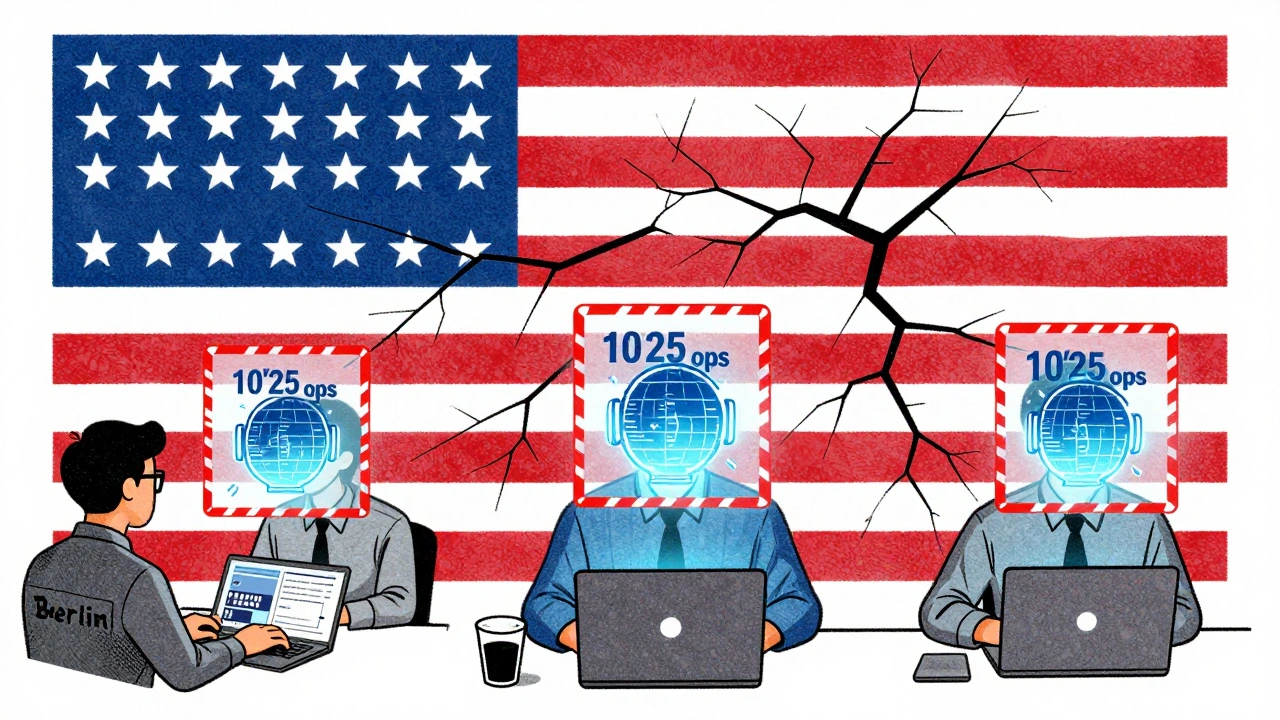
When your AI model crosses a border, it’s not just data moving-it’s a legal risk. In 2025, exporting an AI model isn’t like shipping a box of parts. It’s more like sending a weapon blueprint, even if you didn’t intend it that way. The U.S. Bureau of Industry and Security (BIS) updated its rules in February 2025 to block adversaries from using American-trained AI models to build competing systems. And if your team has engineers in Berlin, developers in Bangalore, or researchers in Seoul, you’re already in the middle of this regulatory storm.
What Exactly Is Controlled Now?
It’s not about the name of your model. It’s about how powerful it is. The new rules target AI models trained with more than 1025 integer or floating-point operations. That’s a massive amount of computing power-roughly what you’d need to train something like GPT-4 or larger. But it’s not just about size. If your model can train another AI at a sustained rate of 48,000 AI operations per second per watt, it’s controlled, no matter where it’s hosted.This isn’t just about big tech. Startups training models on cloud GPUs, universities running research projects, even small AI labs using rented compute clusters-all of them can trigger these thresholds. And once triggered, you can’t just email the model to a colleague in Canada or upload it to a shared server in Singapore. That’s an export. Even if it’s free. Even if it’s open source. Even if you didn’t mean to send it abroad.
Why Your Global Team Is at Risk
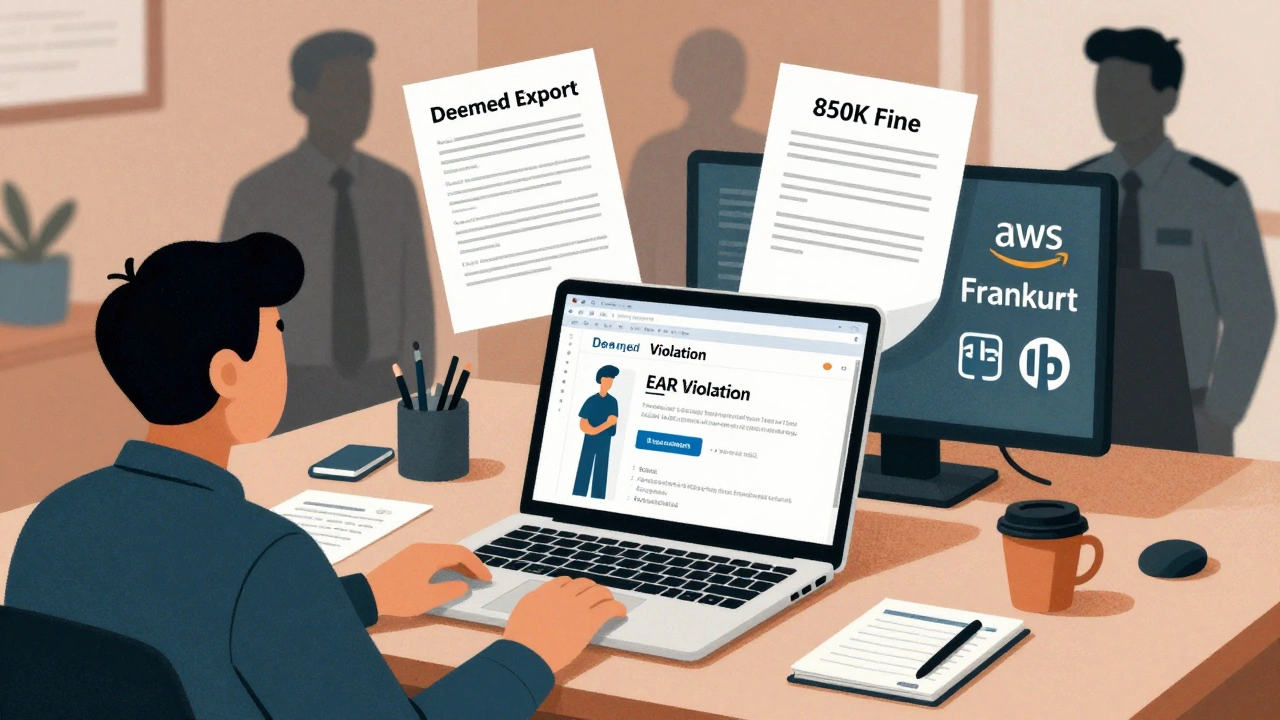
Let’s say your engineering team has five people: two in the U.S., one in Germany, one in India, and one in Brazil. Your lead developer in Germany accesses your training code from their home laptop. That’s a “deemed export.” Under U.S. law, sharing controlled technology with a non-U.S. person, even inside the U.S., counts as exporting it to their home country.And it’s not just people. If your model is hosted on AWS in Frankfurt, and a team member in Tokyo logs in to fine-tune it, that’s another export. Same if you use GitHub with collaborators overseas. The system doesn’t care if you’re collaborating-it cares if a foreign national interacts with a controlled asset.
Companies that ignore this are getting hit hard. Fines under the Export Administration Regulations (EAR) can reach $1 million per violation-or twice the value of the transaction, whichever is higher. In 2024, the Department of Commerce fined a mid-sized AI firm $850,000 for letting a Chinese national access a training dataset that met the 1025 threshold. They didn’t know it was restricted. They didn’t mean to break the law. But ignorance isn’t a defense.
The Two Ways Companies Handle Compliance
There are two main paths: centralize or decentralize.Centralized control means one compliance team in headquarters handles everything. It’s cheaper-BIS case studies show a 28% cost reduction for companies under $500 million in revenue. But it’s slow. When your team in Tokyo needs to deploy a model update, they wait days for approval from Chicago. By then, the market has moved.
Decentralized control puts compliance officers in each region. Sixty-three percent of Fortune 500 companies use this model. It’s faster. Local teams understand regional nuances. But it’s messy. You get conflicting interpretations. One office says a model is clear to export; another says it’s restricted. In 2025, 78% of compliance officers named “conflicting regulations across jurisdictions” as their biggest headache.
There’s no perfect answer. But the smartest teams combine both. They centralize policy and training, but decentralize execution. They give regional officers the authority to make decisions-within clear guardrails.
Tools That Actually Work
Manual compliance is dead. If you’re still using Excel spreadsheets to track exports, you’re already behind.Microsoft’s Dynamics 365 Supply Chain Management is one of the most adopted platforms. It connects to SAP, Oracle, and legacy systems. It has over 200 connectors. It can auto-classify exports using AI trained on U.S. EAR and EU dual-use rules. Early adopters report 92% accuracy in initial classification and a 67% reduction in screening time.
But it’s not flawless. Some Asian regulations aren’t built in. And AI tools can be overzealous. Gartner found 42% of users got false positives-systems flagging harmless exports as risky. That means compliance teams still spend 35% of their time manually reviewing flagged items. That’s not automation. That’s assisted manual work.
Smaller companies can’t afford $2 million systems. But they don’t need to. A custom Dataverse solution with a few key connectors can cost $250,000 and still cover 80% of needs. The key isn’t the price tag-it’s integration. Your compliance tool must talk to your code repo, your cloud provider, your HR system (to track foreign nationals), and your procurement platform (to track GPU purchases).
The Hidden Risk: Catch-All Controls
Most companies focus on the big list: the 1025 threshold, the 48,000 ops/watt rule. But that’s only part of the story.The real danger is “catch-all” controls. These apply to any item-not just AI models-that could be used in weapons, surveillance, or mass repression. Even if your model isn’t on the official list, if a customer in Russia uses it to track dissidents, you’re in violation.
Dr. Sarah Chen from CSET Georgetown says companies focusing only on listed models miss 68% of compliance risks. That’s not a typo. Two-thirds of violations come from things that weren’t supposed to be controlled-but were used in ways that made them dangerous.
This means you need to ask: Who is using this? Where are they? What are they doing with it? Not just during deployment, but after. That’s why export compliance now needs monitoring, not just screening.
How to Build a Real Compliance Program
The Bureau of Industry and Security lists eight essentials for an effective program. Here’s what they mean in practice:- Management Commitment - Your CEO has to say this matters. Not your compliance officer. Not legal. The CEO.
- Risk Assessment - Map every team, every location, every model. Know where your exposure is.
- Export Authorization - Don’t guess. If you’re unsure, apply for a license. It takes 30-90 days. Start early.
- Recordkeeping - Keep logs of who accessed what, when, and why. For five years. No exceptions.
- Training - Every engineer, every salesperson, every intern needs 4-6 hours of training per year. Microsoft’s certification requires 80 hours just for AI controls.
- Audits - Do them quarterly. Randomly. Even if you think you’re clean.
- Handling Violations - Have a plan. Report yourself. The BIS rewards self-disclosure.
- Formalized Structure - Don’t make compliance a side duty. Assign a lead. Give them budget. Let them report directly to the board.
Companies that do this right don’t just avoid fines. They win. McKinsey found that teams embedding compliance into R&D and sales workflows get to market 3.2x faster than those treating it as a hurdle. Why? Because they don’t get blocked by last-minute surprises. They build compliance into the design.
What’s Coming Next
The rules aren’t static. In Q2 2025, BIS will release clearer guidance on the 1025 threshold. The EU’s Critical Entities Resilience Act (CERA) launches in Q1 2026 and will add new restrictions. And the Wassenaar Arrangement-42 countries including the U.S., EU, Japan, and Australia-just harmonized their AI export rules in November 2024.But Asia is still diverging. China, India, and Singapore haven’t adopted the same thresholds. That means if you’re selling to all three, you need three different compliance strategies.
McKinsey predicts a 220% spike in AI export license applications between 2025 and 2027. The market for compliance tools will grow from $4.2 billion in 2022 to $7.8 billion in 2025. And yet, only 37% of Fortune 500 companies have staff trained on AI-specific controls.
That’s your edge. If you’re ahead of this curve, you don’t just avoid penalties-you gain trust. Customers in regulated markets will choose you over competitors who are still guessing.
Start Now, Before You’re Forced To
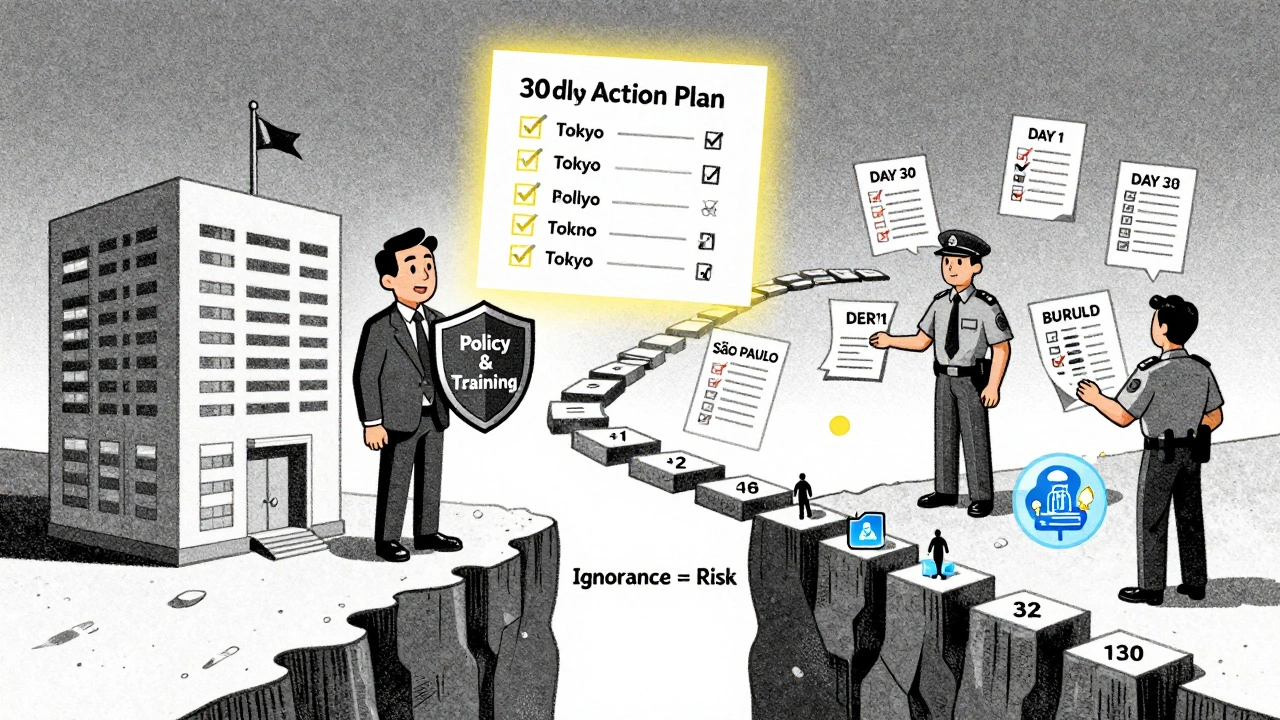
You don’t need a $2 million system. You don’t need a team of lawyers. But you do need to act.Here’s your 30-day plan:
- Day 1-5: List every AI model your team has trained or is training. Note the compute power used.
- Day 6-10: Identify every foreign national on your team. Track where they’re located and what systems they access.
- Day 11-15: Check your cloud providers. Are any models hosted outside the U.S.? If yes, document why.
- Day 16-20: Run a mock export. Try to send a model to a colleague in another country. Did the system block it? Did anyone notice?
- Day 21-30: Schedule a meeting with legal, engineering, and HR. Ask: “What’s our plan if we get audited tomorrow?”
If you can answer those questions confidently, you’re already ahead of 80% of companies. If you can’t, you’re not just at risk-you’re already exposed.
Export controls aren’t about stopping innovation. They’re about making sure innovation doesn’t accidentally fuel harm. The teams that succeed aren’t the ones with the biggest budgets. They’re the ones who treat compliance like a product feature-not a legal afterthought.
Are open-source AI models exempt from export controls?
No. Open source doesn’t mean uncontrolled. If your open-source model meets the 1025 operations threshold or the 48,000 AI ops/watt performance standard, it’s still subject to export controls. The BIS rule doesn’t care if you charge for it or give it away. What matters is the capability and the end user.
What’s a “deemed export” and why does it matter?
A deemed export happens when you share controlled technology with a foreign national inside the U.S. For example, if a researcher from India accesses your training code on a U.S.-based server, the U.S. government considers that an export to India. This applies to any controlled AI model, even if it’s just for research. 57% of companies report trouble tracking this, especially in hybrid work environments.
Can I use generative AI to classify my models for compliance?
Yes-but with caution. AI tools trained on EAR and EU dual-use databases can achieve 92% accuracy in initial classification. But they need at least 50,000 historical export records to work well. Smaller companies often lack this data, leading to false positives. Always have a human review flagged items. The Sanctions Association warns that companies building custom LLMs without proper data governance have 3.7x higher audit failure rates.
How often do export control rules change?
Constantly. The BIS updates its rules every few months. The Wassenaar Arrangement updates annually. In 2025, Microsoft’s Dynamics 365 began using Azure AI to monitor 195+ regulatory sources in real time with 95% accuracy. If you’re still checking government websites manually, you’re falling behind. Automated monitoring is no longer optional-it’s baseline.
What happens if I accidentally violate an export rule?
Self-reporting can reduce penalties by up to 75%. The BIS encourages voluntary disclosure. If you catch your own mistake, document it, fix it, and report it immediately. Don’t wait for an audit. Companies that self-report often avoid fines entirely. Those that hide violations face criminal charges, debarment from government contracts, and reputational damage.
Do I need a dedicated compliance officer?
For teams under 50 people, a part-time compliance lead may suffice. But if you have global operations, multiple AI models, or foreign nationals on your team, you need a full-time role. McKinsey found that compliance teams lacking AI expertise have 4.2x higher risk of missing critical restrictions. This isn’t a task for a junior lawyer or an overworked IT manager. It’s a specialized skill.
How long does it take to build a compliance program?
For global teams, expect 6-12 months. Training alone takes 40-60 hours per officer annually. Integrating systems, mapping risks, and aligning departments takes time. Don’t rush it. But don’t delay either. The average company takes 17 days longer to ship products with manual compliance. Automation cuts that to 3 days.


Jane San Miguel
10 December, 2025 - 12:29 PM
Let’s be honest-this post reads like a compliance officer’s fever dream wrapped in McKinsey jargon. The 1025 threshold? That’s not a technical standard, it’s a bureaucratic Rorschach test. Every startup with a Colab Pro subscription is now a potential arms dealer. And don’t get me started on ‘deemed exports’-so now my intern from Brazil can’t even read a GitHub repo without triggering a federal investigation? We’ve turned innovation into a minefield of legal semantics.
Meanwhile, the real issue isn’t export controls-it’s the U.S. government’s inability to distinguish between AI as a tool and AI as a weapon. If I train a model to generate cat memes and someone in Moscow uses it to generate propaganda, am I responsible? Where does intent end and liability begin? This isn’t regulation. It’s preemptive guilt by association.
Kasey Drymalla
11 December, 2025 - 12:39 PM
They’re using AI export rules to track you. Every time you upload a model, they’re logging your IP, your location, your coffee order. The BIS doesn’t care about compliance-they care about control. And the ‘tools’ they push? Dynamics 365? That’s Microsoft’s backdoor. Your models aren’t being classified-they’re being harvested. You think you’re safe because you’re ‘compliant’? You’re just the sheep being led to the slaughterhouse with a shiny badge.
Dave Sumner Smith
12 December, 2025 - 15:59 PM
You think this is about AI? No. This is about China. This is about India. This is about the entire world learning to build better models than we can. The U.S. is terrified. So they’re inventing rules that don’t make sense just to slow everyone else down. The 48,000 ops/watt threshold? That’s not a technical benchmark-it’s a political weapon. And the fact that they’re calling it ‘export control’ instead of ‘technological protectionism’ shows how deep the delusion goes. They’re not protecting national security. They’re protecting market share. And they’re using lawyers to do it.
Meanwhile, startups are getting fined for letting someone from Germany open a Jupyter notebook. This isn’t regulation. This is tech fascism.
Cait Sporleder
14 December, 2025 - 03:13 AM
The nuanced interplay between jurisdictional sovereignty, technological capability, and ethical stewardship in the context of AI export controls reveals a profound epistemological rupture in contemporary global governance. One must consider not merely the quantifiable metrics-such as the 1025 operations threshold or the 48,000 AI ops/watt benchmark-but also the ontological implications of treating intangible, emergent cognitive architectures as tangible, exportable commodities. The very act of classifying a model as ‘controlled’ presupposes a static, bounded definition of intelligence, which is fundamentally at odds with the dynamic, adaptive nature of machine learning systems themselves. Furthermore, the reliance on centralized compliance frameworks, while economically expedient, inadvertently engenders systemic fragility by concentrating decision-making authority in geographically and culturally homogenous hubs, thereby undermining the very global collaboration that gave rise to these models in the first place. The solution, therefore, cannot lie in more tools or more audits, but in a reimagined epistemic architecture-one that treats compliance not as a constraint, but as a co-evolutionary design principle embedded within the developmental lifecycle of AI systems themselves.
Paul Timms
14 December, 2025 - 06:58 AM
Just read the 30-day plan. Do it. No excuses.
Jeroen Post
15 December, 2025 - 08:56 AM
The real question isn’t whether you’re compliant-it’s whether compliance is a lie we tell ourselves to feel safe while the system collapses. You think tracking foreign nationals and flagging GPU purchases makes you secure? You’re just rearranging deck chairs on the Titanic. The AI models don’t care about borders. They don’t care about licenses. They replicate. They evolve. They leak. And the moment you think you’ve contained them, they’ve already been copied by someone in a basement in Jakarta who doesn’t even know what EAR stands for. The entire framework is built on the fantasy that we can control what we’ve unleashed. We can’t. And pretending otherwise is the most dangerous thing of all.