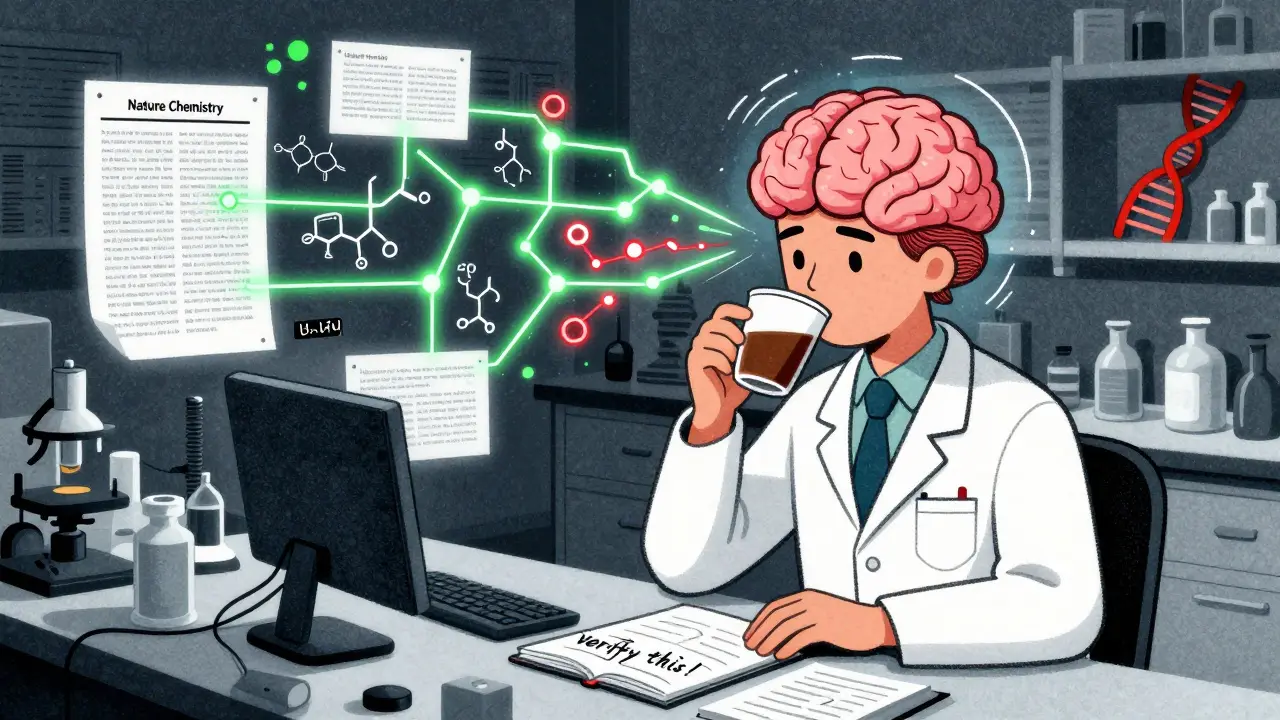
Science is moving faster than ever, and large language models are no longer just tools for chatbots or content writing. They’re now helping researchers design experiments, find hidden connections in papers, and even suggest new hypotheses-sometimes before a scientist has even finished their coffee. But this isn’t magic. It’s a carefully built system that combines decades of scientific method with cutting-edge AI. And like any tool, it works brilliantly when used right-and can cause real damage when misused.
What Exactly Are Scientific Workflows with LLMs?
A scientific workflow is the step-by-step process researchers follow to answer a question: read papers, form a hypothesis, design an experiment, run tests, analyze data, and publish results. Traditionally, this took weeks or months. Now, with Scientific Large Language Models (Sci-LLMs) is a class of AI systems trained specifically on scientific literature, equations, chemical structures, and lab protocols, some steps can be automated in hours.Take literature review, for example. A researcher studying cancer metabolism might spend 20 hours scanning 300 papers. A Sci-LLM can scan 10,000 papers in 15 minutes, pull out key findings, and summarize trends in plain language. A 2023 study by Boiko et al. found this cuts literature review time by 63%. That’s not just convenience-it’s time saved for actual discovery.
But it’s not just reading. These models can also generate testable hypotheses. For instance, one model analyzed thousands of drug-target interactions and suggested a new compound that could inhibit a protein linked to Alzheimer’s. The hypothesis wasn’t in any paper-it was built from patterns the model noticed across unrelated studies. Human researchers might have missed it. The model didn’t.
How Sci-LLMs Work Under the Hood
Most people think of LLMs like ChatGPT. But Sci-LLMs are different. They’re built for science. Here’s how:- Domain-specific training: Instead of training on general web text, they’re trained on PubMed abstracts, ChemBL chemical databases, genomic sequences, and peer-reviewed journals. This lets them understand SMILES notation (chemical structures), DNA base pairs, and statistical methods in biology papers.
- Multimodal input: They don’t just read text. They interpret graphs, tables, and even microscope images. One model achieved 78.3% accuracy identifying cell structures in histology images-close to a trained pathologist.
- External tool integration: They don’t guess. They pull real data. When asked about a reaction, they query ChemBL for known compounds, check PubMed for similar studies, and then generate a protocol based on verified sources.
- Planner-Controller architecture: Complex tasks are broken into steps. Ask it to “test this drug on a lung cancer cell line,” and it will: (1) retrieve the cell line’s growth conditions, (2) find the drug’s solubility profile, (3) suggest a dose range, (4) generate a step-by-step lab protocol.
Models like Google’s CURIE is a benchmark framework developed by Google Research to evaluate scientific reasoning in LLMs and MIT’s KG-CoI is a knowledge-graph-enhanced system that links scientific concepts across disciplines are pushing these capabilities further. They use techniques like LoRA and QLoRA fine-tuning to adapt quickly to new domains without needing massive retraining.
Where Sci-LLMs Shine
There are three areas where these models are already making a real difference:- Literature synthesis: They summarize trends across thousands of papers with 84.6% accuracy. A 2025 Stanford survey found 68.7% of researchers use them for this-mostly because they catch connections humans overlook.
- Hypothesis generation: By linking unrelated fields, they suggest novel ideas. One model connected plant defense genes to human immune pathways, leading to a new immunotherapy approach. Human researchers had a 42.1% success rate on similar tasks; the model hit 63.8%.
- Protocol automation: Generating lab steps for common procedures like PCR, chromatography, or cell culture now takes minutes instead of hours. In Pfizer’s labs, this improved documentation efficiency by 35%.
These aren’t theoretical. A chemist in Boston used a Sci-LLM to design a new catalyst for carbon capture. The model suggested a structure based on 127 published papers. The team synthesized it. It worked. They published in Nature Chemistry last year.
The Dark Side: Errors, Hallucinations, and False Leads
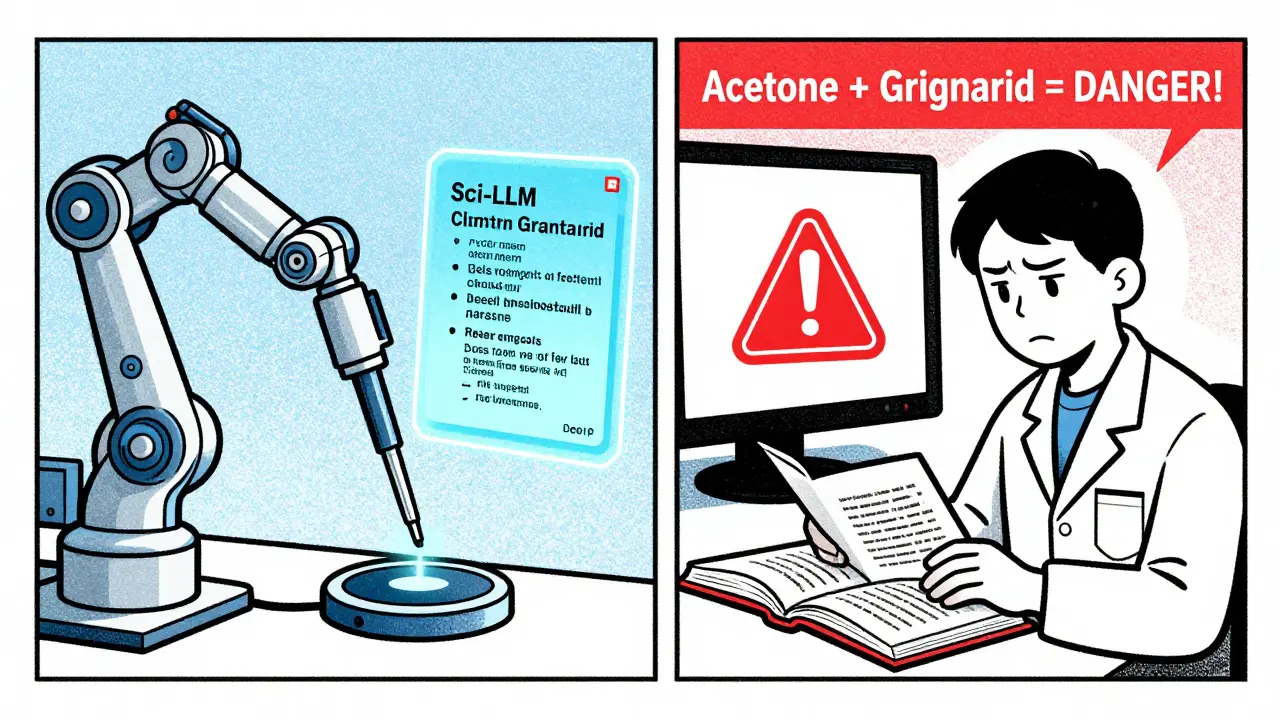
Here’s the problem: these models aren’t perfect. They hallucinate. They get things wrong. And sometimes, they’re dangerously confident about it.One researcher on Reddit shared that a model suggested using acetone in a Grignard reaction-a basic chemistry mistake. Acetone reacts violently with Grignard reagents. The lab wasted two days because the AI didn’t know. That’s not an outlier. A 2024 study found Sci-LLMs have a 23.8% error rate in experimental protocol generation. In novel scenarios-like a new type of enzyme assay-the failure rate jumps to 37.9%.
Hallucinations are worse. When asked to cite a paper that doesn’t exist, they’ll invent one-with a fake DOI, author names, and journal. In one case, a model cited a 2023 paper from the “Journal of Synthetic Biology” that doesn’t exist. It was included in a draft manuscript before being caught.
And then there’s the knowledge gap. Sci-LLMs struggle with quantum chemistry, rare isotopes, or niche clinical conditions because training data is thin. They’re great at common tasks but fall apart when pushed beyond the edge of their training.
Experts agree: Dr. Emily Chen of MIT says, “They’re amazing at extracting details and grouping them, but still need human oversight for critical decisions.” Professor David Baker from the University of Washington put it bluntly: “They accelerate hypothesis generation, but their error rates make them unsuitable for autonomous labs.”
Who’s Using This-and Who Shouldn’t
Adoption is growing fast. In 2025, 42.7% of major pharmaceutical companies used Sci-LLMs in drug discovery. By 2027, Gartner predicts 65% will. But adoption isn’t even.- Best for: Large labs with dedicated computational teams, access to high-performance GPUs, and domain experts who can verify outputs.
- Not for: Small labs without IT support, researchers unfamiliar with their own field, or anyone planning to skip human verification.
Stanford’s 2025 report found researchers without domain expertise made 3.7 times more errors when using these tools. That’s not a bug-it’s a design flaw in how people use them. You can’t hand a Sci-LLM a question and trust the answer like a textbook. You have to be a scientist first, and the AI second.
Startups like DeepScience.ai are trying to fix this by building chemistry-specific models. IBM’s Watson Sci-LLM update in February 2026 added formal verification protocols that cut hallucinations by 31.7%. Google’s new CURIE-2 model, released in January 2026, improved multimodal reasoning by 22.3%. Progress is real. But so are the risks.
What You Need to Use Sci-LLMs Effectively
If you’re considering using one, here’s how to avoid disaster:- Start small: Use it only for literature review. Don’t jump to protocol generation until you’ve tested it on known tasks.
- Verify everything: Every chemical structure, every citation, every protocol step. Cross-check with trusted sources. Never trust an output at face value.
- Know your limits: If you don’t understand the science behind the question, you can’t catch the AI’s mistakes. Domain knowledge isn’t optional-it’s your safety net.
- Use retrieval-augmented systems: Choose tools that pull from PubMed, ChemBL, or other verified databases-not just internal knowledge. This reduces hallucinations by 42.6%.
- Track your errors: Keep a log of every mistake the AI makes. Over time, you’ll learn its blind spots.
It takes 8-12 weeks to get good at prompt engineering for science. You’re not just learning a tool-you’re learning a new way to think.
The Future: Autonomous Labs and Regulatory Walls
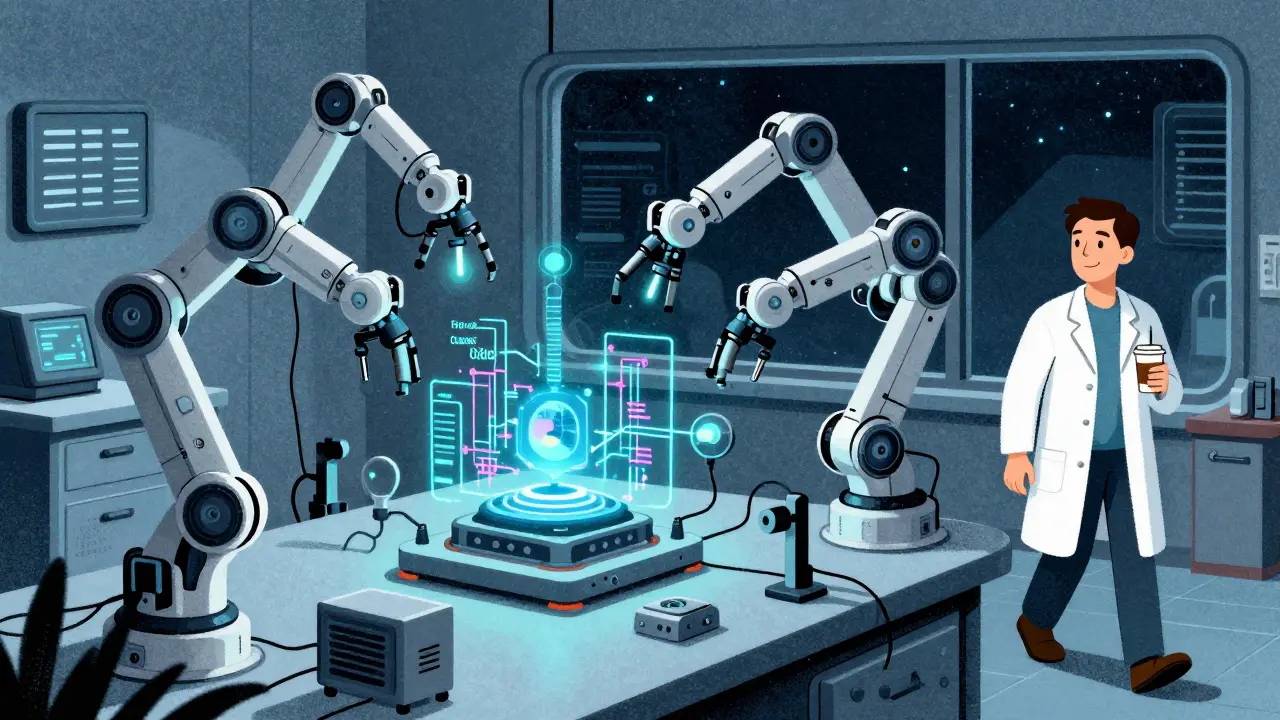
The next step? Labs that run themselves. Google is aiming for 60% autonomous operation in optimized labs by 2028. Imagine a robot arm, a robotic pipettor, and a Sci-LLM working together: the model designs the experiment, the robot executes it, sensors collect data, and the model analyzes results-all without human input.But regulators are stepping in. The FDA released draft guidance in September 2025 requiring human verification of all AI-generated clinical trial protocols. The National Science Foundation just awarded $47 million to build standardized benchmarks for Sci-LLMs. This isn’t just about improving tech-it’s about building trust.
By 2030, Forrester predicts 85% of scientific workflows will include some form of LLM. But not because they replaced scientists. Because they made scientists better.
Can Sci-LLMs replace human researchers?
No. Sci-LLMs are assistants, not replacements. They excel at processing information, spotting patterns, and automating repetitive tasks-but they lack intuition, judgment, and contextual understanding. A human researcher knows when a result seems off, when a protocol is risky, or when a hypothesis is biologically implausible. An AI doesn’t. The most successful labs use AI to handle the heavy lifting of data and literature, freeing humans to focus on insight, creativity, and validation.
Are Sci-LLMs better than traditional lab software?
It depends. For narrow tasks like simulating molecular dynamics, software like VASP or Gaussian still outperforms Sci-LLMs. But for tasks that require combining data across fields-like linking a protein’s structure to its clinical effects-Sci-LLMs are far superior. They don’t replace domain-specific tools; they connect them. Think of them as a translator between disciplines, not a replacement for a spectrometer.
Do I need to be a programmer to use Sci-LLMs?
Not necessarily, but you need technical literacy. Most platforms offer web interfaces where you can type prompts like a chatbot. But to integrate them into your workflow-say, connecting them to your lab’s data system-you’ll need intermediate Python skills and familiarity with APIs. Researchers who skip learning these basics often get stuck or make mistakes they can’t fix.
What’s the biggest risk of using Sci-LLMs?
The biggest risk isn’t the AI making a mistake-it’s you trusting it too much. A 2025 study showed that 68% of researchers who used Sci-LLMs for experimental design didn’t verify outputs, assuming the AI was correct. This led to wasted time, failed experiments, and even retracted papers. The tool is powerful, but it’s not infallible. Treat every output like a hypothesis-test it before you believe it.
Is it ethical to use AI to generate scientific hypotheses?
Yes-if you’re transparent. The key is disclosure. If an AI helped generate a hypothesis, you must state that in your paper. Journals like Nature and Science now require AI usage disclosures. The ethical issue isn’t using AI-it’s hiding its role. Science depends on honesty. If you let an AI do the thinking and don’t say so, you’re not just cutting corners-you’re breaking the contract of scientific integrity.
The future of science isn’t human vs. machine. It’s human with machine. The best researchers aren’t the ones who avoid AI-they’re the ones who learn to use it wisely, question it constantly, and never let it replace their own judgment.

poonam upadhyay
18 March, 2026 - 22:31 PM
Okay but let’s be real-this whole Sci-LLM thing is just fancy autocorrect for PhDs who forgot how to read.
I used one to ‘help’ with my literature review and it cited a paper called ‘Quantum Fluctuations in Banana Peel Decomposition’-with a fake DOI, author names, and even a peer-reviewer’s fake email.
And I believed it. For THREE DAYS.
My PI found out when he Googled the journal-it’s a .xyz domain hosted on a free WordPress site from 2012.
Now I have to rewrite half my thesis.
AI doesn’t ‘think’-it just reassembles your worst nightmares into polished prose.
Also, why does every ‘cutting-edge’ tool need a capital-L ‘Large’ in its name? Large Language Model? Like, it’s not a gym membership, it’s a *tool*.
And don’t get me started on ‘multimodal input’-yes, it can ‘interpret’ a graph, but it doesn’t know if the data’s garbage.
It’s like giving a toddler a microscope and calling them a pathologist.
Someone’s gonna publish a whole paper based on hallucinated data and we’ll all be laughing… until it’s cited in a clinical trial.
God help us.
Shivam Mogha
19 March, 2026 - 19:44 PM
Verify everything. Always.
mani kandan
19 March, 2026 - 21:11 PM
There’s something beautiful about how these models are reshaping science-not by replacing us, but by forcing us to be better.
Before, I’d spend weeks buried in papers, missing the forest for the trees.
Now, the AI gives me the map-I still have to walk the trail.
And honestly? It’s made me more curious.
I catch myself asking, ‘Wait, why does this connection exist?’ instead of just accepting what’s on the page.
That’s the real win.
Yes, it hallucinates.
Yes, it makes mistakes.
But so do we.
The difference? We can learn from ours.
Maybe the AI just needs more time, better data, and a human hand on the wheel.
Science has always evolved with tools-from the microscope to the PCR machine.
This? This is just the next step.
And if we’re smart, we’ll use it to see further than ever before.
Rahul Borole
19 March, 2026 - 22:56 PM
It is imperative to emphasize that the integration of Scientific Large Language Models into research workflows must be governed by stringent validation protocols and domain-specific oversight mechanisms.
While the efficiency gains in literature synthesis and protocol automation are statistically significant, the potential for cascading errors in experimental design cannot be understated.
As evidenced by the 23.8% error rate in protocol generation and the alarming frequency of fabricated citations, reliance on unverified outputs constitutes a critical risk to scientific reproducibility.
Therefore, institutional policies must mandate dual verification: computational output must be cross-referenced against primary sources, with documented audit trails for all AI-assisted hypotheses.
Furthermore, training programs for researchers must include mandatory modules on prompt engineering, hallucination recognition, and retrieval-augmented workflow design.
Failure to implement these safeguards does not merely represent inefficiency-it constitutes negligence in the stewardship of scientific integrity.
Let us not confuse acceleration with advancement.
The goal is not to automate discovery-but to augment human judgment with precision, not presumption.
Sheetal Srivastava
20 March, 2026 - 08:52 AM
Oh please. You’re all treating this like it’s some revolutionary breakthrough, but let’s be honest-it’s just another overhyped corporate tool dressed up in academic jargon.
You think a model trained on PubMed abstracts and ChemBL can ‘understand’ science?
It doesn’t understand anything-it statistically regurgitates.
And don’t even get me started on ‘multimodal input’-you mean it can OCR a graph? Congrats, it’s a glorified OCR engine with a thesaurus.
And ‘planner-controller architecture’? That’s just a fancy way of saying ‘it follows a script written by someone who read too many TED Talks.’
Meanwhile, real science is happening in labs where people stare at gels for hours, cry over failed replicates, and argue over p-values at 2 a.m.
AI doesn’t do that.
It doesn’t feel the frustration.
It doesn’t have intuition.
It doesn’t *care*.
And until it does, it’s just a very expensive, very confident, very dangerous autocomplete.
Also, ‘LoRA fine-tuning’? Please. It’s not magic. It’s math. And math doesn’t replace insight.
Wake up. You’re not pioneers-you’re beta testers for a corporate product.
Bhavishya Kumar
21 March, 2026 - 00:35 AM
There is a critical grammatical error in the post where the phrase 'is a class of AI systems' is used without a proper subject-verb agreement. The sentence reads 'Now, with Scientific Large Language Models (Sci-LLMs) is a class...' which is syntactically malformed. This should be corrected to 'Scientific Large Language Models (Sci-LLMs) are a class...' to maintain grammatical integrity. Furthermore, the use of inconsistent punctuation-particularly the excessive use of em dashes without proper spacing-undermines the formal tone expected in scientific discourse. While the content is compelling, such errors erode credibility. Precision in language is not optional in science. It is foundational.
ujjwal fouzdar
21 March, 2026 - 21:13 PM
What if the real revolution isn’t the AI?
What if it’s us?
For centuries, we’ve treated knowledge like a temple-sacred, silent, guarded by the few.
Now? We’re handing the keys to a machine that doesn’t pray, doesn’t fear, doesn’t doubt.
And we’re terrified.
Because deep down, we know: if a machine can find the hidden link between plant genes and human immunity… what does that say about *us*?
Are we just pattern-recognition machines too?
Are our ‘insights’ just evolved hallucinations?
Maybe the AI isn’t the threat.
Maybe it’s the mirror.
It doesn’t lie.
It just shows us what we’ve always been-brilliant, broken, and desperately trying to make sense of chaos.
So let it generate hypotheses.
Let it write protocols.
Let it cite fake papers.
Because in the end, the only thing that matters is not whether the AI is right…
But whether *we’re* brave enough to question it.
And each other.
And ourselves.