
You ask a large language model a specific question about your company’s latest compliance policy, and it confidently gives you an answer that is completely wrong. This isn't a glitch; it's the fundamental limitation of static training data. The model learned from a snapshot of the internet from months or years ago, not your live database. Retrieval-Augmented Generation (RAG) solves this by letting the model look up facts before it speaks. It’s the difference between guessing based on memory and answering after checking the textbook.
But simply adding a search step doesn't guarantee accuracy. Many implementations fail because they retrieve irrelevant chunks of text or misinterpret the user's intent. If you're building AI applications in 2026, understanding which RAG patterns actually move the needle on accuracy is critical. We’re going to break down the specific architectural choices that turn a hallucinating chatbot into a reliable knowledge assistant.
The Core Problem with Static Models
Standard Large Language Models (LLMs) are frozen in time. Once trained, their knowledge cutoff date locks them out of new information. For general trivia, this might be fine. But for enterprise tasks-like answering questions about a product manual updated last week or a legal contract signed yesterday-static models fail. They either say "I don't know" or, worse, they hallucinate a plausible-sounding but incorrect answer.
RAG bridges this gap. Instead of relying solely on parametric memory (the weights inside the neural network), RAG systems fetch relevant documents from an external source at query time. This retrieved context is then injected into the prompt, guiding the LLM to generate an answer grounded in current facts. According to Google Cloud case studies, this approach can improve factual accuracy by 35-60% in enterprise settings compared to base models alone.
Anatomy of a High-Accuracy RAG Pipeline
A basic RAG system looks simple: take a question, find similar text, and feed it to the LLM. In practice, high accuracy comes from optimizing four distinct stages. If any one of these fails, the final answer degrades.
- Document Preparation and Chunking: You can’t just dump PDFs into a database. Documents must be split into manageable pieces, typically 256-512 tokens. Poor chunking breaks sentences mid-thought or separates a header from its content, confusing the retriever.
- Vector Indexing: These chunks are converted into numerical vectors using embedding models. The quality of these embeddings determines how well semantic meaning is captured.
- Retrieval Mechanism: When a user asks a question, the system searches for the most similar vectors. This is where most accuracy losses occur if the search strategy is naive.
- Grounded Generation: The retrieved chunks are combined with the user’s query in a structured prompt. The LLM uses this context to generate the final response.
Latency is the trade-off here. Adding retrieval steps increases response time by 200-500ms. However, for most business applications, a half-second delay for a correct answer is far preferable to an instant wrong one.
Pattern 1: Hybrid Search for Better Recall
One of the biggest pitfalls in early RAG implementations was relying solely on semantic vector search. Vector search is great at finding conceptually similar text (e.g., matching "car" with "automobile") but terrible at exact matches (e.g., finding a specific SKU code like "A12-B4"). If your data contains precise identifiers, dates, or acronyms, pure vector search will miss them.
The solution is Hybrid Search. This pattern combines two different retrieval algorithms: keyword-based BM25 scoring and semantic vector similarity. By weighting them appropriately-often around 30-40% for keywords and 60-70% for semantics-you get the best of both worlds. Keyword search ensures exact terms are found, while vector search captures the underlying meaning. Google Cloud’s technical guides suggest this configuration significantly boosts retrieval relevance, especially in technical documentation where specific terminology matters.

Pattern 2: Query Transformation and Expansion
Users rarely type perfect queries. They write vague questions like "How do I fix it?" or use jargon that differs from your documentation. If you send this raw query directly to the vector database, you’ll likely retrieve irrelevant results. This is known as the "vocabulary mismatch" problem.
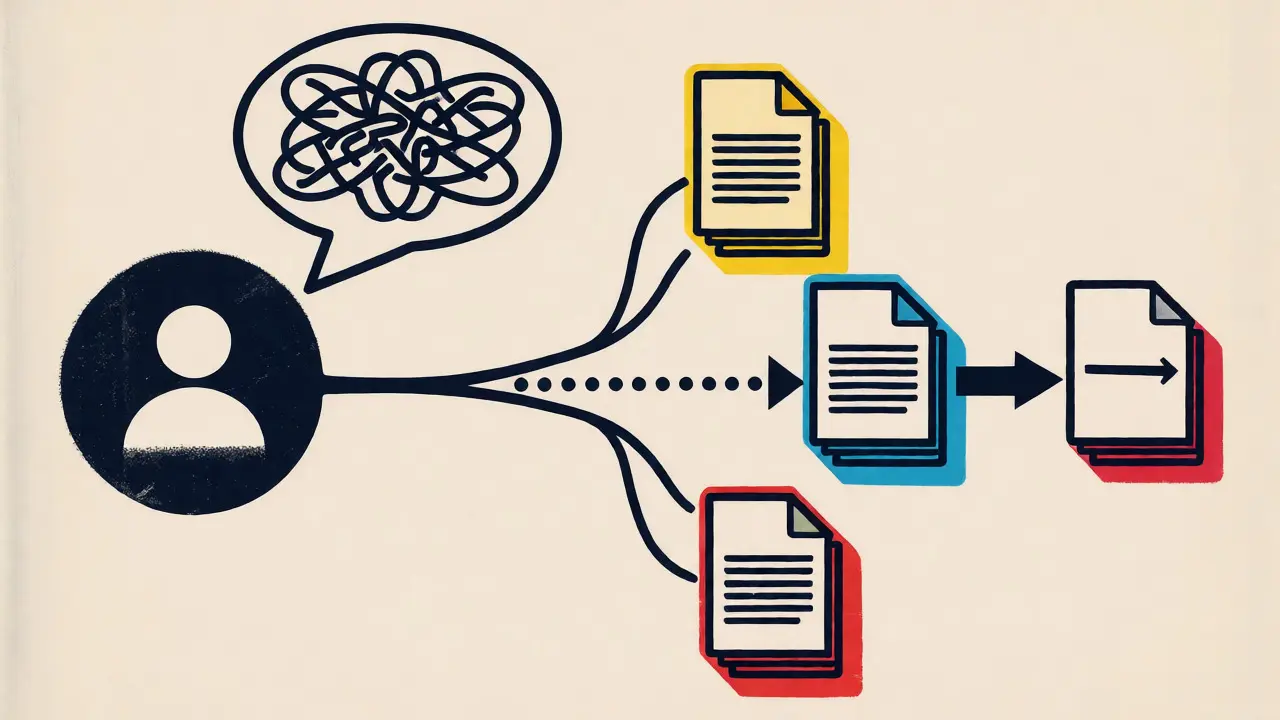
Advanced RAG systems insert a query transformation layer before retrieval. This layer uses a smaller, faster LLM to rewrite the user’s input into multiple, more precise search queries. For example, if a user asks, "Is my loan approved?", the system might expand this to "Loan application status criteria," "Approved loan conditions," and "Pending loan requirements." This technique, often called Query Expansion, improves retrieval recall by up to 27%. It ensures that even poorly phrased questions map to the right sections of your knowledge base.
Pattern 3: Re-Ranking for Precision
Even with hybrid search and expanded queries, the initial retrieval step often returns too many candidates. A standard top-k retrieval might pull 20 chunks, but only 2 or 3 are actually useful. Feeding all 20 to the main LLM wastes tokens and introduces noise, potentially leading the model astray.
This is where re-ranking comes in. After the initial fast retrieval, a more computationally expensive cross-encoder model evaluates each candidate chunk against the original query. Unlike bi-encoders used in initial search, cross-encoders read the query and document together, providing a much finer-grained relevance score. Tools like Cohere Rerank have shown they can improve the relevance of the top 3 results by 22%. By filtering out low-quality chunks before generation, you reduce the chance of the LLM hallucinating from irrelevant context.
Pattern 4: Recursive Retrieval for Complex Questions
Some questions require multi-hop reasoning. Consider a query like, "Which employees in the Finance department are eligible for the new bonus plan?" Answering this requires first identifying who works in Finance, then checking each person’s tenure, and finally comparing that against the bonus rules. Standard RAG struggles here because it retrieves documents based on surface-level similarity to the whole question, missing the intermediate steps.
Recursive Retrieval (or Multi-Step Retrieval) breaks complex questions into sub-questions. The system answers the first part, uses that answer to form a new query for the second part, and so on. Microsoft’s Azure AI Search has demonstrated that this pattern yields 28% higher accuracy on multi-hop questions compared to single-step retrieval. While it adds latency, it’s essential for logical, layered inquiries common in enterprise support tickets.
Comparing RAG Approaches
Not every project needs the full suite of advanced patterns. Choosing the right architecture depends on your data complexity and accuracy requirements. Below is a comparison of common configurations.
| Pattern | Complexity | Accuracy Gain | Best Use Case |
|---|---|---|---|
| Naive RAG | Low | Baseline | Simple FAQs, static docs |
| Hybrid Search | Medium | +15-20% | Data with codes/SKUs, mixed content |
| Query Expansion | Medium-High | +25-30% | Vague user queries, conversational bots |
| Re-Ranking | High | +20-25% | High-stakes answers, strict compliance |
| Recursive/Multi-Hop | Very High | +30-40% | Complex logic, multi-document synthesis |
Common Pitfalls That Kill Accuracy
It’s easy to assume that more data equals better answers. In RAG, this is often false. One major issue is "retrieval noise." If your system retrieves ten chunks but only one is relevant, the LLM might try to synthesize all ten, creating a muddled answer. Stanford research on "Self-RAG" showed that reducing irrelevant context usage by 31% led to a 21% accuracy improvement. The key is not just finding more info, but finding the *right* info and discarding the rest.
Another trap is poor chunking strategies. Splitting documents by fixed character counts often cuts through tables or lists, destroying context. Semantic-aware chunking, which respects sentence boundaries and paragraph structures, prevents this. A case study from a legal tech firm showed that improper chunking caused a 33% drop in accuracy until they switched to sentence-windowing techniques.
When to Choose Fine-Tuning Over RAG
RAG isn't always the answer. If your domain is extremely specialized-like interpreting ancient medical texts or proprietary engineering jargon-and the knowledge doesn't change often, fine-tuning might be better. Fine-tuning adjusts the model's internal weights to understand the nuance of the language itself. RAG, by contrast, provides facts but relies on the base model's ability to interpret them.
However, for dynamic environments where facts change weekly (like financial regulations or software release notes), RAG is superior. It costs 6-8x less than retraining a model and allows you to update knowledge instantly by updating the database, rather than waiting days for a new model deployment.
What is the primary benefit of using RAG over fine-tuning?
The primary benefit is cost-effectiveness and agility. RAG allows you to update knowledge instantly by changing the underlying database, whereas fine-tuning requires retraining the entire model, which is expensive ($85k+ vs $12.5k) and slow. RAG also excels at handling time-sensitive information without hallucinations.
Why does my RAG system still hallucinate?
Hallucinations usually stem from poor retrieval quality. If the system retrieves irrelevant chunks, the LLM may try to force an answer from unrelated context. Additionally, if the retrieved information contradicts itself or is incomplete, the model may fill gaps with made-up details. Implementing re-ranking and query expansion helps mitigate this.
What is hybrid search in RAG?
Hybrid search combines keyword-based search (like BM25) with semantic vector search. Keyword search finds exact matches for terms like SKUs or names, while vector search understands conceptual similarity. Combining them ensures you capture both precise terminology and broader context, significantly improving retrieval accuracy.
How does query expansion improve RAG performance?
Query expansion uses an LLM to rewrite vague user inputs into multiple, clearer search queries. This addresses the vocabulary mismatch between user language and document terminology. By searching with several variations, the system increases the likelihood of retrieving the correct documents, boosting recall rates by up to 27%.
Is RAG suitable for real-time applications?
Yes, but with caveats. RAG adds 200-500ms of latency due to the retrieval and embedding steps. For most chatbots and customer support tools, this is acceptable. However, for ultra-low-latency requirements (under 100ms), simpler architectures or caching strategies may be necessary.


Bryce Imbriale
25 September, 2026 - 08:41 AM
Yo this is exactly what we needed at work 🚀 Static models are so last year, RAG is the future for sure! I’ve been pushing my team to switch over and honestly the accuracy boost is real 💯 Don't sleep on hybrid search though it’s a game changer for our SKU codes. Let’s goooo!