You build an AI agent that works flawlessly for ten minutes. Then you ask it to remember what it learned in minute one, and it looks at you like you just spoke Klingon. This is the context window problem. Large Language Models are essentially goldfish with high IQs. They process information, generate brilliant outputs, and then forget everything once the conversation scrolls out of their immediate view. For a chatbot, this might be annoying. For a persistent LLM agent tasked with complex, multi-day workflows, it’s fatal.
The difference between a toy demo and a production-ready agent often comes down to one thing: how you handle memory and state management. It’s not just about storing text; it’s about building a brain that can encode, store, retrieve, and-crucially-forget. If you’re trying to move beyond simple prompt chaining into true agentic behavior, you need to understand the architecture behind persistent memory. Let’s break down how modern systems solve the amnesia problem without turning your database into a junk drawer.
Why Stateless Interactions Fail Complex Tasks
Standard LLM interactions are stateless by design. You send a prompt, get a completion, and the model has no internal record of the exchange unless you explicitly resend the history. This works fine for answering "What is the capital of France?" But try asking an agent to "Debug the Python script we started working on three hours ago, keeping in mind the API constraints we discussed earlier." Without external state management, the agent fails because it lacks the temporal context.
Persistent memory solves this by decoupling knowledge storage from the model’s inference engine. Instead of relying solely on the limited token count of the context window (typically 4k to 128k tokens depending on the model), the agent offloads historical data to external systems. When needed, it retrieves relevant snippets, injects them back into the prompt, and proceeds. This shifts the paradigm from "remembering everything in the prompt" to "knowing where to look for what matters."
This distinction matters because context windows are expensive and finite. Stuffing every past interaction into the prompt increases latency and cost linearly. Worse, as the context grows, the model’s attention mechanism dilutes. The "lost in the middle" phenomenon shows that LLMs struggle to recall information buried deep within long contexts. Effective state management isn’t just about storage; it’s about precision retrieval.
The Three-Tier Memory Architecture
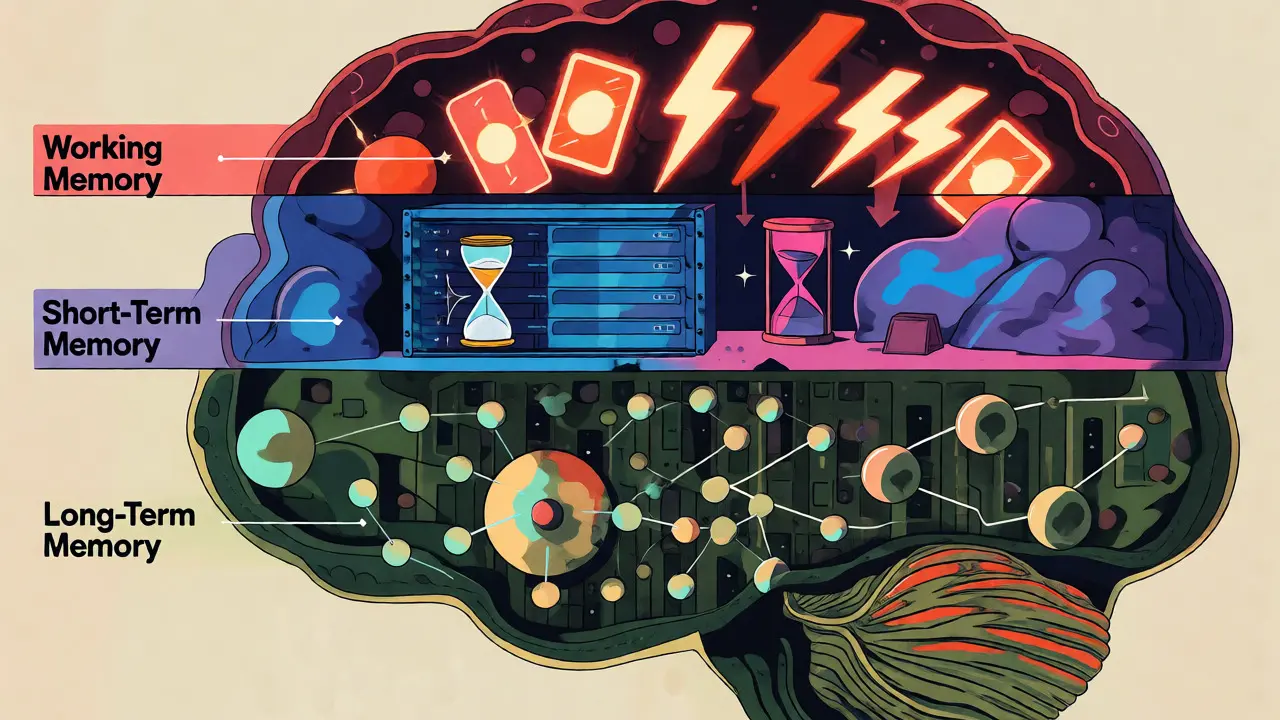
Think of agent memory like human cognition, but implemented in code. Most robust frameworks, such as LangChain or AutoGen, adopt a hierarchical approach. You don’t treat all memories equally. You segment them based on volatility and access patterns.
- Working Memory: This is your RAM. It holds the immediate context-the last few turns of conversation, current task instructions, and active variables. It lives in ephemeral storage, often just a list of message objects in your application logic. Speed is critical here. You want sub-millisecond access because the agent consults this constantly during reasoning loops.
- Short-Term Memory: Think of this as the cache layer. It stores recent interactions that are no longer in the immediate working set but might be relevant soon. Systems often use Redis or similar key-value stores for this. Data here has a Time-To-Live (TTL). If an agent hasn’t accessed a specific piece of context in 24 hours, it gets evicted or moved to long-term storage. This prevents your fast-access layers from bloating with stale data.
- Long-Term Memory: This is the archive. It’s where you store facts, user preferences, and historical outcomes that should persist indefinitely. Because retrieval speed is less critical than capacity, this layer typically relies on vector databases like Pinecone, Weaviate, or Chroma.
The magic happens in the transitions between these tiers. An agent doesn’t just dump everything into the vector DB. It uses summarization techniques to compress working memory into short-term summaries, which are then distilled into long-term semantic embeddings. This tiered approach ensures that the most relevant, high-fidelity data is always closest to the model’s attention span.
Vector Databases and Semantic Retrieval
If long-term memory is the archive, vector databases are the librarian. Traditional SQL databases search for exact matches. If you ask for "apple," they find rows containing "apple." They miss "fruit" or "red snack." Vector databases work differently. They convert text into numerical embeddings-lists of numbers representing semantic meaning using models like E5 or OpenAI’s ada-002.
When an agent needs to recall something, it converts its current query into a vector and searches for the closest matches in the database using cosine similarity. This allows for fuzzy, conceptual retrieval. If the agent asks, "How did we fix the login bug?", it can retrieve memories tagged with "authentication error," "OAuth failure," or "session timeout," even if those exact words weren’t used in the original log.
However, raw vector search has pitfalls. It ignores time and causality. A memory from 2023 might be semantically similar to a query today but factually obsolete. To combat this, advanced systems implement hybrid search, combining vector similarity with metadata filtering (e.g., date ranges, source IDs) or keyword matching. This ensures the agent retrieves not just *similar* information, but *relevant* and *current* information.
| Feature | In-Memory (List/Dict) | Cache (Redis) | Vector DB (Pinecone/Chroma) |
|---|---|---|---|
| Primary Use Case | Current turn context | Recent session history | Semantic long-term recall |
| Retrieval Method | Index access | Key lookup / TTL | Cosine similarity |
| Data Persistence | Volatile | Configurable TTL | Durable |
| Complexity | Low | Medium | High |
| Cost Efficiency | Free (RAM) | Low | Variable (Storage + Compute) |
The Danger of Memory Bloat and Error Propagation
Here is the counter-intuitive truth: more memory does not always mean better performance. Research published in May 2025 highlights a phenomenon called error propagation. If your agent writes bad experiences to long-term memory, it will retrieve them later and act on flawed logic. Imagine an agent that successfully completes a task by accident due to a lucky guess. If it logs this as a "successful strategy," future attempts may fail when the luck runs out.
Indiscriminate writing strategies degrade performance over time. Studies show that utility-based deletion strategies-where the system actively removes low-value or contradictory memories-can yield up to 10% performance gains compared to naive append-only approaches. You need a garbage collector for your agent’s brain.
Effective state management requires selective addition. Before writing to long-term memory, the agent should evaluate the utility of the new information. Did this interaction change the world state? Was there a novel insight? Or was it just another routine confirmation? Frameworks like MemEngine decompose this into pluggable modules for encoding, retrieval, and forgetting. They employ reinforcement learning signals (like Q-values) to score memories. High-reward actions get reinforced; low-reward or noisy observations get pruned.
Graph-Based Memory and Temporal Awareness
Vector search is powerful, but it struggles with relationships. If Agent A knows that "John is Mary's boss" and "Mary is on vacation," vector search might retrieve both facts separately. It doesn't inherently know that John is currently covering for Mary. This is where graph-based memory architectures like Mem0 or Nemori come into play.
These systems represent memories as nodes and edges in a graph. Nodes are entities (people, projects, tasks); edges are relationships (manages, depends-on, completed-by). This structure allows for multi-hop reasoning. The agent can traverse the graph to answer complex queries like, "Who is responsible for the project John is managing while he is away?"
Furthermore, graph structures naturally handle temporal dependencies. You can tag edges with timestamps or validity periods. This prevents the agent from applying outdated rules. For example, if a policy changed in June, the graph can mark the old rule as "superseded" rather than deleting it entirely, allowing the agent to understand the history of decisions without confusing past and present states.

Implementation Strategies for Developers
So, how do you actually build this? Don’t start by buying a $500/month Pinecone subscription. Start simple.
- Define Your Memory Scope: What exactly needs to be remembered? User preferences? Task steps? External facts? Be ruthless. If it doesn’t impact future decisions, don’t store it.
- Choose the Right Granularity: Storing entire transcripts is usually inefficient. Break conversations into semantic chunks. Summarize each turn or session before embedding it. This reduces noise and improves retrieval precision.
- Implement a Reflection Loop: Periodically, have the agent review its own recent memories. Ask it: "Is this still accurate? Does this contradict previous knowledge?" This self-correction mechanism, seen in Reflective Memory Management (RMM) systems, helps maintain consistency.
- Monitor Retrieval Quality: Log every retrieval event. Did the agent use the retrieved memory? Did it improve the outcome? If a memory is never cited in responses, it’s dead weight. Delete it.
Tools like LangChain and CrewAI abstract much of this plumbing. They provide interfaces for `add_memory`, `search_memory`, and `clear_memory`. But abstraction hides complexity. You must still configure the underlying vector store, choose the embedding model, and define the similarity threshold. A threshold too low brings in irrelevant noise; too high misses subtle connections.
Future Outlook: Lifelong Learning Agents
We are moving toward agents that learn continuously without retraining the base model. The REMEMBERER system, for instance, demonstrates that agents can improve success rates by 2-4% in navigation tasks simply by maintaining a well-curated episodic memory table, updated via reinforcement learning principles. This suggests that the next breakthrough in AI won’t necessarily come from larger models, but from smarter state management.
As context windows expand to millions of tokens, some argue memory management becomes trivial. But cost and latency remain barriers. You cannot put a million-token context in every single API call. Therefore, efficient state management remains the bottleneck for scalable, persistent agents. The winners in this space will be those who master the art of forgetting as much as remembering.
Do I need a vector database for my LLM agent?
Not always. For simple chatbots with short histories, keeping conversation history in a standard JSON file or database column is sufficient. However, once your agent needs to recall information from days or weeks ago, or across different sessions, a vector database becomes essential for semantic search capabilities that traditional SQL queries cannot provide efficiently.
How do I prevent my agent from hallucinating based on old memories?
Use metadata filtering and temporal decay. Tag every memory with a timestamp and a confidence score. When retrieving, prioritize recent and high-confidence memories. Additionally, implement a reflection step where the agent verifies retrieved facts against current context before acting on them, ensuring that outdated information doesn't drive incorrect actions.
What is the difference between working memory and long-term memory?
Working memory is volatile, fast-access storage for the current task and immediate conversation context, typically held in RAM. Long-term memory is durable, slower-access storage for historical data, user preferences, and learned patterns, usually backed by vector databases or persistent disk storage. Working memory handles 'now'; long-term memory handles 'always'.
Can LLM agents learn from their mistakes?
Yes, through experience replay and reinforcement learning signals. By storing failed attempts alongside successful ones and assigning lower utility scores to failures, agents can avoid repeating errors. Systems like REMEMBERER update memory values based on outcomes, effectively allowing the agent to 'learn' which strategies work without changing the underlying model weights.
Is graph memory better than vector memory?
Neither is universally better; they serve different purposes. Vector memory excels at semantic similarity and fuzzy matching (finding things 'like' X). Graph memory excels at relational reasoning and structured queries (finding things 'connected to' X). Many advanced systems use a hybrid approach, leveraging vectors for initial retrieval and graphs for contextualizing relationships.