Imagine asking your company's internal chat tool, "How many vacation days do I have left?" and getting an instant answer that cites the exact paragraph in your employee handbook. No waiting for an email response. No digging through a PDF from 2019. This is the promise of HR Knowledgebots, which are AI-powered assistants designed to answer employee questions about HR policies using Large Language Models (LLMs) and Retrieval-Augmented Generation (RAG). These systems are rapidly becoming the new standard for workplace support, shifting HR departments from answering repetitive queries to handling complex human issues.
By mid-2024, early adopters in tech, finance, and healthcare were already seeing significant results. A case study by deepsense.ai showed these bots could reduce HR workload by up to 50% on routine tasks. But building one isn't just about plugging a chatbot into Slack. It requires careful architecture, clean data, and a clear understanding of where AI ends and human judgment begins.
What Exactly Is an HR Knowledgebot?
An HR Knowledgebot is not a simple FAQ page. It is a dynamic system that reads, understands, and retrieves information from your specific internal documents. Unlike generic chatbots that might hallucinate answers based on general training data, an HR Knowledgebot is grounded in your company's actual policies.
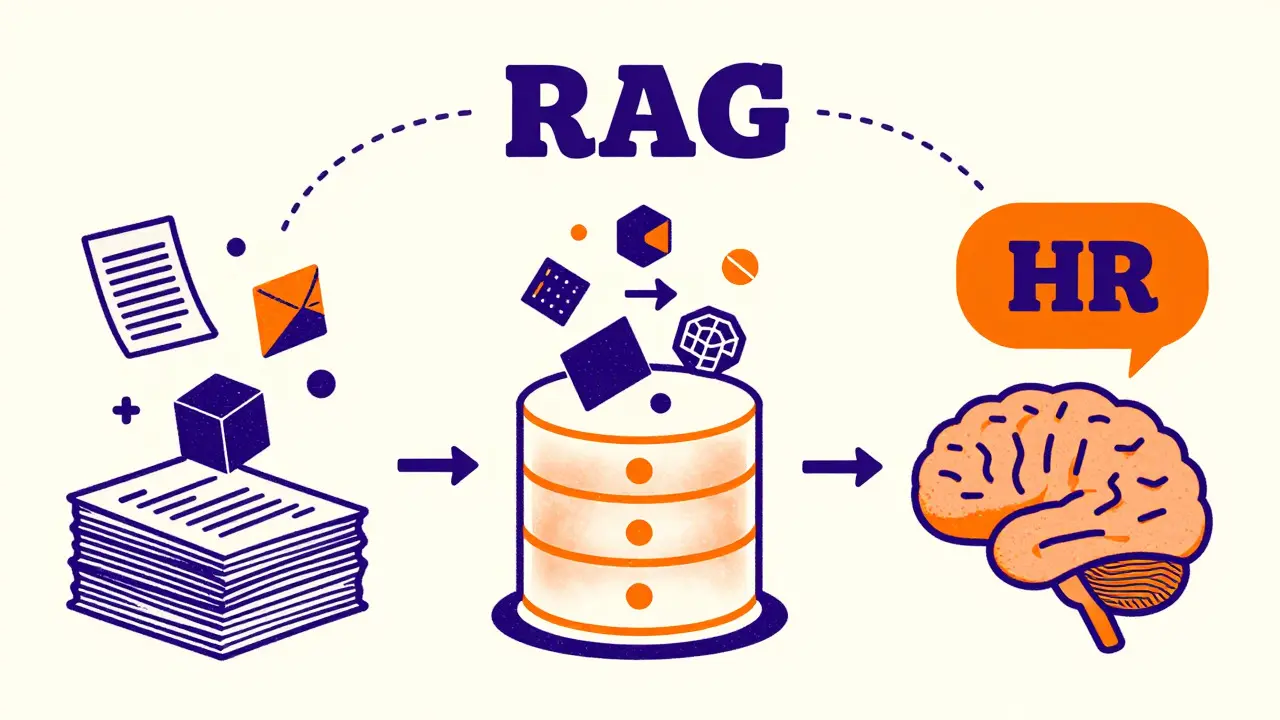
The technology relies on a method called Retrieval-Augmented Generation (RAG), which is a technique that combines large language models with external knowledge bases to provide accurate, source-backed responses. Here is how it works in plain English:
- Ingestion: Your HR handbooks, policy PDFs, and intranet pages are uploaded to the system.
- Chunking & Embedding: The text is broken into small segments (usually 512-1024 tokens). These segments are converted into numerical vectors-mathematical representations of meaning-and stored in a vector database like Pinecone or ChromaDB.
- Retrieval: When an employee asks a question, the system searches the vector database for the most relevant policy excerpts.
- Generation: An LLM, such as Llama 3 or GPT-4o, takes those excerpts and generates a clear, natural language answer, citing the source document.
This architecture ensures the bot only says what is written in your policies. If the policy doesn't exist, the bot should say so, rather than making something up.
Why Companies Are Switching to AI-Powered HR Support
The shift toward HR Knowledgebots is driven by efficiency and employee experience. Traditional HR support has two major pain points: slow response times and inconsistent information. Human agents work during business hours, and their availability fluctuates. Static FAQ pages become outdated quickly and are hard to search.
Knowledgebots solve this by offering 24/7 availability. According to Gartner's Q4 2024 report, the broader HR technology market is valued at $22.3 billion, with LLM-powered assistants being a fast-growing segment. In practice, this means:
- Faster Answers: Employees get immediate responses to questions about PTO, benefits, or remote work policies.
- Reduced Ticket Volume: A Fortune 500 tech company reported a 47% drop in HR ticket volume in Q1 2024 after deploying a Knowledgebot, as measured by ServiceNow analytics.
- Consistency: Every employee gets the same answer based on the latest policy version, reducing confusion and disputes.
However, the real value lies in freeing up HR professionals. Instead of spending hours answering "What is the maternity leave policy?", HR staff can focus on strategic initiatives, conflict resolution, and employee development.
Technical Architecture: Building a Reliable System
Building an HR Knowledgebot requires more than just an API key. You need a robust technical stack that prioritizes accuracy and security. Here is a breakdown of the key components:
| Component | Function | Common Tools/Models |
|---|---|---|
| Vector Database | Stores semantic embeddings of policy documents for fast retrieval | Pinecone, ChromaDB, Weaviate |
| Embedding Model | Converts text chunks into numerical vectors | text-embedding-ada-002, BGE-large |
| Large Language Model | Generates natural language responses based on retrieved context | Llama 3 (internal), GPT-4o (Azure OpenAI) |
| Integration Layer | Connects the bot to employee communication platforms | Slack API, Microsoft Teams, Workday |
Security is paramount. Since HR data often contains personally identifiable information (PII), many enterprises opt for internally hosted LLMs like Llama 3. This keeps data within the company firewall, satisfying GDPR and CCPA requirements. Additionally, role-based access controls ensure employees only see policies relevant to their location or department.
Implementation Challenges and Pitfalls
Despite the benefits, implementing an HR Knowledgebot is not without risks. The biggest hurdle is data quality. As Dr. Elena Rodriguez, Chief AI Officer at Capella Solutions, noted in June 2024, "Success depends entirely on the quality and consistency of underlying policy documentation."
If your HR documents are outdated, contradictory, or scattered across different departments, the bot will reflect that chaos. For example, a manufacturing client documented by TechMobius found their bot giving conflicting answers about parental leave because regional variations weren't properly consolidated in the source material.
Other common challenges include:
- Hallucination Risk: Even with RAG, LLMs can occasionally misinterpret context. Gartner analyst Michael Kim warned in September 2024 about early-generation chatbots generating incorrect policy interpretations.
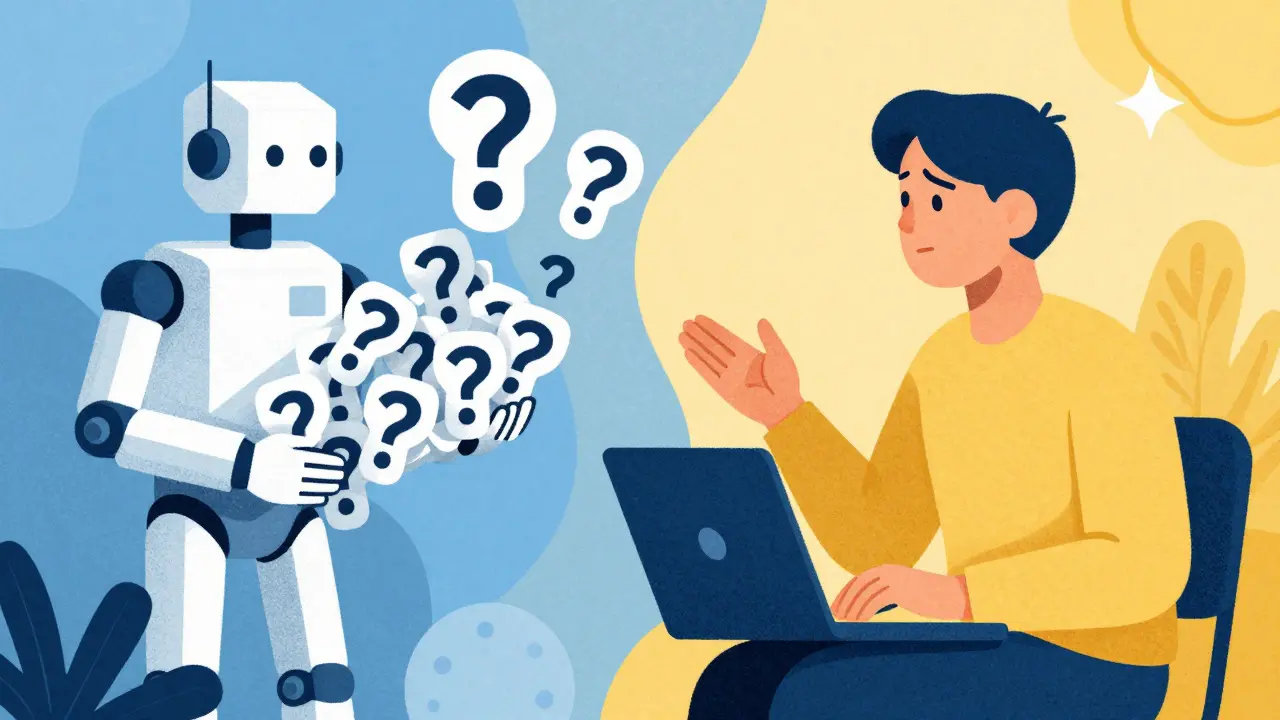
- Complex Queries: Bots struggle with multi-step workflows or highly personalized cases requiring empathy. A Reddit thread from March 2024 revealed that while 78% of users liked the bot for routine questions, 67% still preferred humans for sensitive issues.
- Maintenance Overhead: Policies change. Forrester analyst Sarah Chen highlighted that 68% of early implementations required weekly updates to maintain accuracy above 90%.
To mitigate these risks, organizations must establish a clear governance process. This includes assigning dedicated policy owners (recommended ratio: one owner per 500 employees) to review and update documentation regularly.
ROI and Future Outlook
The financial argument for HR Knowledgebots is strong. The deepsense.ai case study calculated a 228% return on investment within 12 months for a typical deployment. For companies with over 500 employees, payback periods typically range from 6 to 9 months, according to Capella Solutions' analysis of 17 implementations.
Looking ahead, the technology is evolving rapidly. Microsoft announced Copilot for HR integration with Azure AI Studio in November 2024, while Workday launched its "Workday Assist" beta in October 2024. Gartner predicts that by 2026, 70% of enterprise HR platforms will incorporate LLM-powered policy assistants, up from 25% in late 2024.
Future developments may include deeper integration with desktop automation frameworks, allowing bots to not just answer questions but also execute simple tasks, such as updating time-off requests directly in the HRIS. However, the core principle remains: AI handles the routine, humans handle the exceptional.
Best Practices for Deployment
If you are considering an HR Knowledgebot, start small. Identify 5-10 high-volume use cases, such as PTO balances, benefit enrollment, or code of conduct questions. Ensure your documentation is digital, structured, and consistent before ingestion. Finally, always provide a clear escalation path to human HR staff. The goal is not to replace HR, but to augment it.
What is the difference between an HR Knowledgebot and a standard chatbot?
A standard chatbot often relies on pre-defined scripts or general training data, which can lead to inaccurate or generic answers. An HR Knowledgebot uses Retrieval-Augmented Generation (RAG) to pull answers directly from your company's specific policy documents, ensuring responses are accurate, up-to-date, and cited.
Are HR Knowledgebots secure for handling employee data?
Yes, if implemented correctly. Many enterprises use internally hosted LLMs like Llama 3 to keep data within their own servers. Additionally, vector databases can be configured to anonymize personally identifiable information (PII), and role-based access controls ensure employees only see relevant information.
How long does it take to implement an HR Knowledgebot?
For organizations with well-structured digital policies, a functional prototype can be built in 3-4 weeks. However, companies with legacy or inconsistent documentation may require 8-12 weeks for knowledge base preparation and cleanup before deployment.
Can HR Knowledgebots handle complex or emotional employee issues?
Not effectively. While they excel at factual policy lookups, studies show that 67% of employees prefer human interaction for complex or emotionally sensitive issues. Best practice is to design the bot with a clear escalation path to human HR staff for nuanced cases.
What is the expected ROI of an HR Knowledgebot?
Case studies indicate a 228% return on investment within 12 months. Organizations typically see a payback period of 6-9 months due to reduced HR ticket volumes and increased efficiency in handling routine inquiries.