
You ask a large language model for a specific company policy or a recent news event, and it answers with total confidence. The problem? It just made half of it up. This is the hallucination problem that keeps IT leaders awake at night. The fix isn't training a bigger model; it's giving the model a library card. This process is called grounding, and the engine behind it is Retrieval-Augmented Generation (RAG).
If you are building chatbots or internal search tools, you need to understand how to anchor AI outputs in real data. Without grounding, your AI is a creative writer. With it, your AI becomes a research assistant. Here is how to connect your prompts to verifiable sources so your users trust the answers.
What Is Grounding in Generative AI?
Grounding is the practice of connecting a language model’s output to external, trusted data sources. Think of it as forcing the AI to show its work. Instead of relying solely on the statistical patterns learned during training, the model retrieves relevant documents first, then generates an answer based only on those documents. This concept has roots in cognitive science, specifically Harnad’s 1990 paper on the Symbol Grounding Problem, which asked how symbols get meaning. In modern AI, we solve this by linking words to actual records in a database.
The primary goal is accuracy. Ungrounded models, like early versions of PaLM 2 Chat, had hallucination rates around 27%. When researchers applied RAG techniques, that number dropped to roughly 3% in advanced implementations like GPT-4 with proper retrieval setups. That is the difference between a tool you can use for legal compliance and one you have to fact-check every time.
How RAG Architecture Works
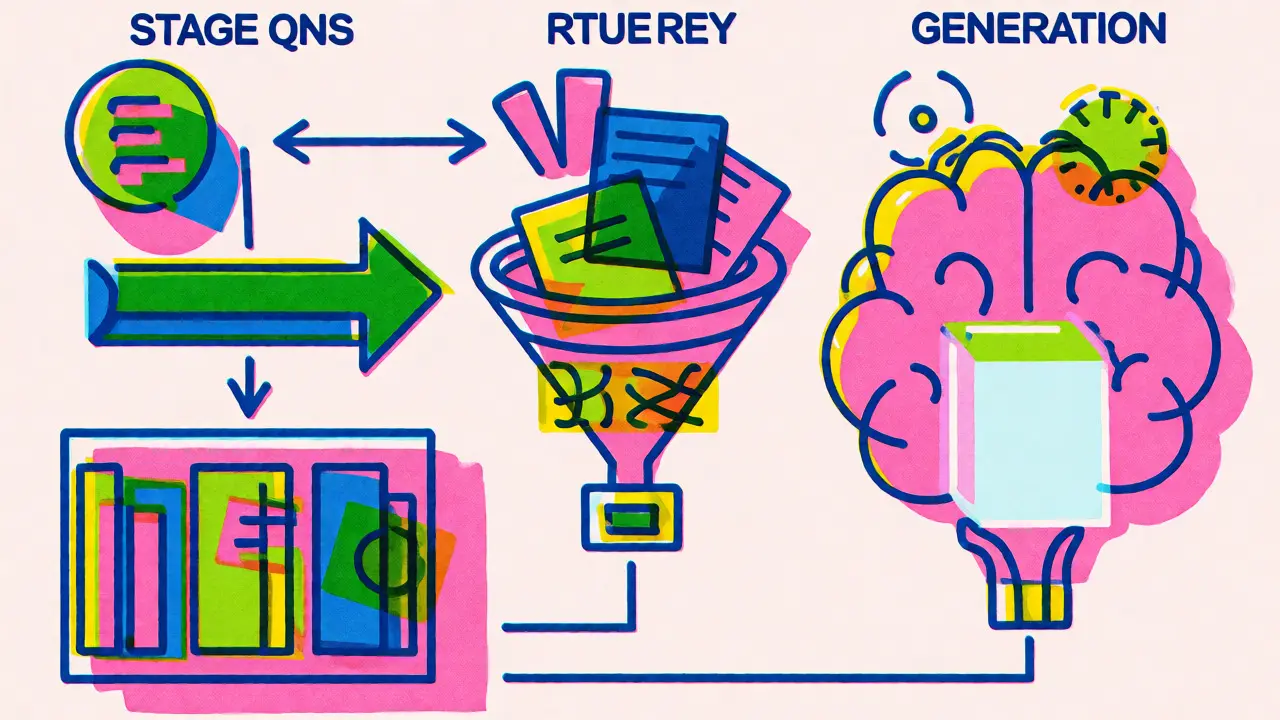
Don't let the jargon scare you off. The architecture boils down to three simple stages. If you skip any of them, your system breaks.
- Retrieval: The user asks a question. Your system converts this question into a numerical vector and searches a knowledge base for similar vectors. Tools like Pinecone, Weaviate, or FAISS handle this. You typically set a cosine similarity threshold between 0.7 and 0.85 to ensure the retrieved chunks are actually relevant.
- Augmentation: The system takes the top matching text chunks and stuffs them into the prompt. This is where most people fail. Enterprise implementations usually limit this context to 3,072 tokens to keep costs down and latency low. If you dump too much irrelevant text, the model gets confused.
- Generation: The language model receives the original question plus the retrieved context. It is instructed to answer using only the provided context. If the context doesn't contain the answer, the model should say "I don't know" rather than guessing.
This flow ensures that the final output is constrained by reality. For example, if you ask about a product price, the model looks at your current price list, not its memory of prices from two years ago.
RAG vs. Fine-Tuning: Which Do You Need?
A common mistake is thinking you need to fine-tune a model to make it accurate. Fine-tuning teaches style and format; RAG teaches facts. Let's look at the trade-offs.
| Feature | RAG (Grounded) | Fine-Tuning | Standard LLM |
|---|---|---|---|
| Hallucination Rate | Low (~3%) | Medium | High (~27%) |
| Data Freshness | Real-time | Static (until retrained) | Static (training cutoff) |
| Implementation Time | Weeks | 2-3 Weeks + Training | Instant |
| Cost | API calls + Vector DB | $15k-$50k per model | Low |
| Citations | Easily supported | Difficult | None |
Fine-tuning costs between $15,000 and $50,000 in cloud compute per model iteration. Worse, if your data changes tomorrow, you have to retrain. With RAG, you just update the document in your vector database. For most businesses, especially those dealing with changing inventory or policies, RAG is the clear winner. Use fine-tuning only when you need a specific tone or complex reasoning pattern that retrieval alone can't provide.
Practical Implementation Steps
So, how do you actually build this? It is not just plug-and-play. IDC reports that enterprises spend 3-6 months preparing data before they even turn the lights on. Here is the roadmap.
- Clean Your Data: Garbage in, garbage out. If your PDFs are messy scans or your CRM notes are unstructured, retrieval will fail. Users report a 68% success rate with clean documentation versus 32% with messy internal comms. Structure your data into logical chunks.
- Choose Your Vector Store: You need a place to store embeddings. Pinecone and Weaviate are popular managed services. If you are budget-conscious, start with FAISS locally, but be prepared to scale.
- Implement Hybrid Search: Pure vector search misses exact keywords like product SKUs. Combine keyword search (BM25) with vector search. Google Cloud’s Vertex AI does this well, helping reduce errors on ambiguous terms where pure vector search might hit a 37% error rate.
- Prompt Engineering for Citations: Don't just ask for an answer. Ask for the source. A good prompt looks like: "Answer the question using only the provided context. Cite the document name and page number for each claim."
One critical pitfall is context window limits. Even with 4K or 8K token windows, stuffing too many documents dilutes attention. Use hierarchical chunking-break large documents into small paragraphs, retrieve the best matches, and then expand the context slightly to include surrounding sentences. Salesforce uses this method to maintain coherence while staying within token budgets.

Enterprise Impact and Real-World Results
Why are companies spending billions on this? Because it works. Moveworks clients saw a 52% reduction in ticket resolution time after implementing grounded AI. Personalization effectiveness jumps from 62% to 89% when the AI can reference specific CRM data, such as past purchases or support history.
Consider a sales scenario. Before grounding, an AI writes generic pitches. After connecting to a CRM via RAG, it references specific details: "Since you bought 1,200 pairs of sneakers last quarter with a 15% discount, here is our new spring line..." That level of detail builds trust. However, it is not magic. A JAMA Internal Medicine study found a 31% failure rate in medical diagnosis support because specialized knowledge was missing from the knowledge base. Always audit your sources.
Security is another major factor. MIT Technology Review noted that grounding creates new attack surfaces. If your knowledge base contains sensitive HR data, and the AI leaks it in a response, you have a breach. K2View’s field-level encryption protects 97% of sensitive elements, showing that security must be baked into the retrieval layer, not just the generation layer.
Troubleshooting Common RAG Issues
Even with a perfect setup, things break. Here is what goes wrong most often.
- Context Truncation: The model ignores part of the context. Solution: Place the most critical instructions at the beginning and end of the prompt. Models pay more attention to these positions.
- Irrelevant Retrievals: The system finds documents that match keywords but not intent. Solution: Add metadata filters. If the user asks about "Apple," filter for category="fruit" or category="tech" based on other clues in the query.
- Latency Spikes: Retrieval adds time. Keep your vector search under 800ms for 95% of queries. If you are slower, optimize your index or reduce the number of retrieved chunks.
Remember, grounding is an iterative process. Start with a small, high-quality dataset. Measure hallucination rates using tools like Google Cloud’s Grounding Metrics. Then, expand. The EU AI Act now requires technical solutions to minimize false information, making grounding not just a nice-to-have, but a regulatory necessity for many industries.
Does RAG eliminate all hallucinations?
No, it significantly reduces them but does not eliminate them entirely. Hallucinations can still occur if the retrieved context is contradictory, poorly formatted, or if the model fails to follow the instruction to stick to the context. Proper prompt engineering and post-generation validation are still required to catch edge cases.
Is RAG cheaper than fine-tuning?
Generally, yes, for ongoing operations. Fine-tuning requires expensive GPU clusters for training ($15k-$50k per cycle). RAG costs are primarily API usage fees and vector database storage. While RAG incurs higher inference costs per query due to larger prompts, it avoids the recurring heavy compute costs of retraining whenever data changes.
Can I use RAG with closed-source models like GPT-4?
Yes. You do not need open-source weights to use RAG. You simply send the retrieved context along with your user query to the API endpoint of models like GPT-4, Claude, or Gemini. The model processes the combined input and returns the grounded response. Many providers now offer native APIs that simplify this integration.
How many documents should I retrieve?
There is no fixed number, but quality matters more than quantity. Typically, retrieving the top 3-5 most relevant chunks is sufficient. Retrieving too many documents increases token costs and may confuse the model with noise. Experiment with different k-values (number of results) and measure answer accuracy against a benchmark set.
What happens if the answer is not in my knowledge base?
Ideally, the model should state that it cannot find the answer. To enforce this, explicitly instruct the model in the system prompt: "If the answer is not contained in the context, reply 'I don't know' and do not attempt to fabricate an answer." This prevents the model from falling back on its general training data when local data is missing.


Sabrina Silvani
26 October, 2026 - 08:01 AM
grounding is not merely a technical fix but an epistemological necessity for the digital age
we are witnessing the collapse of trust in synthetic information and RAG offers a tether to reality
the distinction between creative writing and research assistance is profound because it redefines the role of the machine from oracle to librarian
when we anchor language models in verifiable sources we restore agency to the user who can then audit the provenance of every claim
this shift moves us away from black box opacity toward transparent reasoning chains that humans can interrogate
the cost of hallucination is no longer just incorrect facts but the erosion of institutional credibility across law medicine and finance
by prioritizing retrieval over parametric memory we acknowledge that knowledge is dynamic and context dependent rather than static and universal
the philosophical implication is that intelligence without grounding is merely sophisticated mimicry devoid of semantic truth
we must treat citations not as metadata but as the structural backbone of trustworthy AI interaction
every unanswered question that defaults to fabrication represents a failure of our ethical obligation to provide accurate information
the solution lies in rigorous data hygiene and strict adherence to retrieval constraints which require discipline from both developers and organizations
ultimately the goal is not to eliminate uncertainty but to make uncertainty explicit and traceable within the system architecture