
| Strategy | Primary Benefit | Trade-off |
|---|---|---|
| Naive RAG | Fast, easy setup | High hallucination rates in long docs |
| MapReduce Summarization | Massive scalability, fast processing | Potential loss of sequential coherence |
| Hierarchical RAG | High factual accuracy & context | Complex implementation & tuning |
The Problem with Naive Chunking
Most people start with "naive" RAG: they split a document into fixed-size pieces, turn them into vectors, and pull the top three matches. While this works for short FAQs, it fails miserably with long documents. Why? Because if the answer to a user's question requires connecting a point from the introduction to a detail in the conclusion, the model only sees two isolated snippets. It lacks the "connective tissue" of the document. According to data from Microsoft's FastTrack team, simple chunking without hierarchical layers fails to maintain contextual relationships in about 68% of complex technical documents. This creates a gap where the LLM has the raw data but doesn't understand how the pieces fit together, leading to the dreaded hallucination. In ungrounded implementations, hallucination rates can spike as high as 27%, making them dangerous for financial or legal use cases.Solving Scale with MapReduce Summarization
When a document is too large for a single prompt, the MapReduce approach is the industry gold standard. Think of it as a "divide and conquer" mission. First, the "Map" phase breaks the document into manageable chunks-often around 16,000 tokens-and summarizes each one in parallel. Then, the "Reduce" phase takes all those mini-summaries and collapses them into one master summary. Google Cloud AI engineers have found that this parallel processing is roughly 3.1x faster than iterative refinement for documents over 100 pages. If you're using a tool like LangChain, you might see your processing time for a complex contract drop from 45 minutes to just 8 minutes. However, the secret sauce isn't just the tool; it's the tuning. Most teams spend 35 to 50 hours just figuring out the perfect chunk size (usually 1,000-2,000 tokens) and the ideal overlap (around 15-20%) to ensure no critical information is cut in half.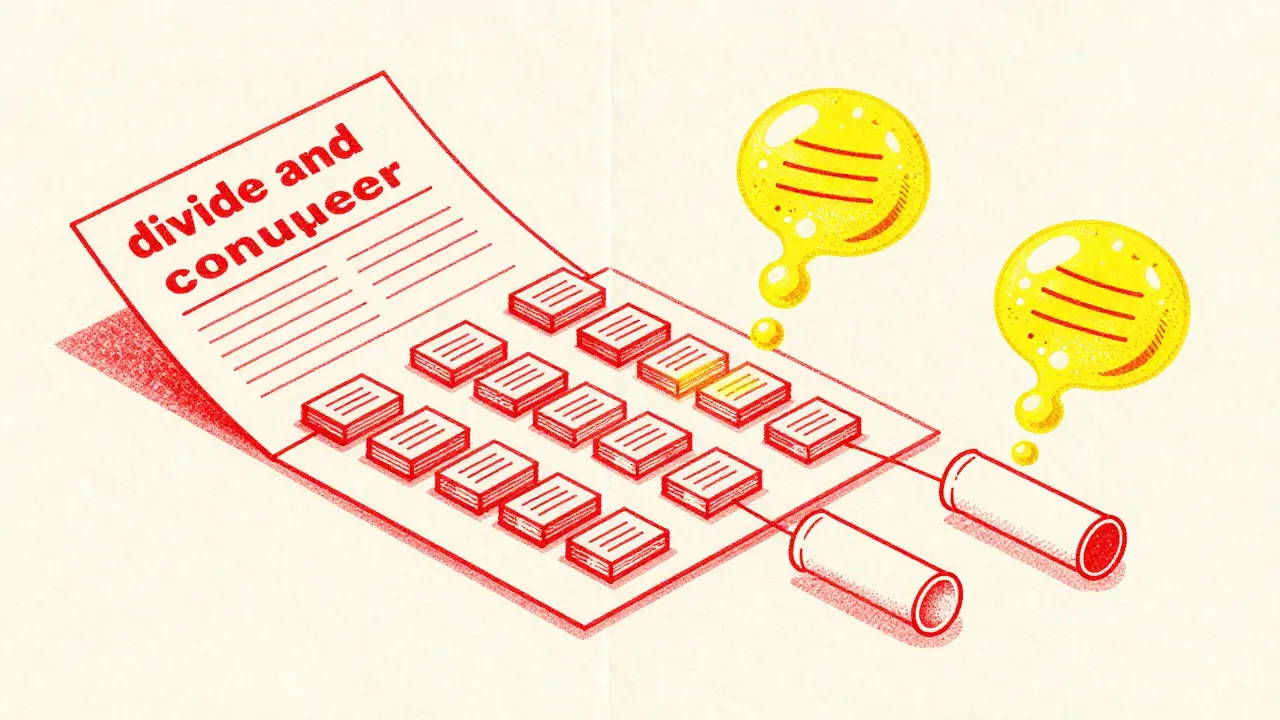
Building the Hierarchical RAG Pipeline
To truly ground a model, you need a multi-tier architecture. Instead of just searching for raw text, the system searches through summaries first to find the right section, then dives into the raw chunks for the specific answer. This creates a "zoom lens" effect.- Document Loading and Splitting: Use a RecursiveCharacterTextSplitter to maintain semantic integrity.
- Layer 1 (Chunk Level): Generate summaries for every 1,000-token block.
- Layer 2 (Section Level): Group these blocks into themes and summarize the themes.
- Layer 3 (Document Level): Create a global executive summary.
- Retrieval: The system identifies the relevant summary layer first, then narrows down to the exact chunk.
Advanced Optimizations for Production
Once you have the basic hierarchy working, you'll hit a wall with latency and precision. This is where professional-grade rag strategy optimization comes in. One effective move is "Query Expansion." Instead of searching for exactly what the user typed, the system uses an LLM to generate 3-5 semantic variations of the query. Microsoft's Azure AI Studio implementation of this has shown a 37% improvement in retrieval coverage, though it adds a small amount of latency (about 150-200ms). Another pro tip is implementing tiered caching. If your users frequently ask about the same sections of a 500-page manual, caching the summarized chunks can slash your latency by 45-60%. Furthermore, incorporating entity-based grounding-where you explicitly extract and track key names, dates, and terms across the document-improves factual accuracy by another 37%, though it requires more upfront engineering effort.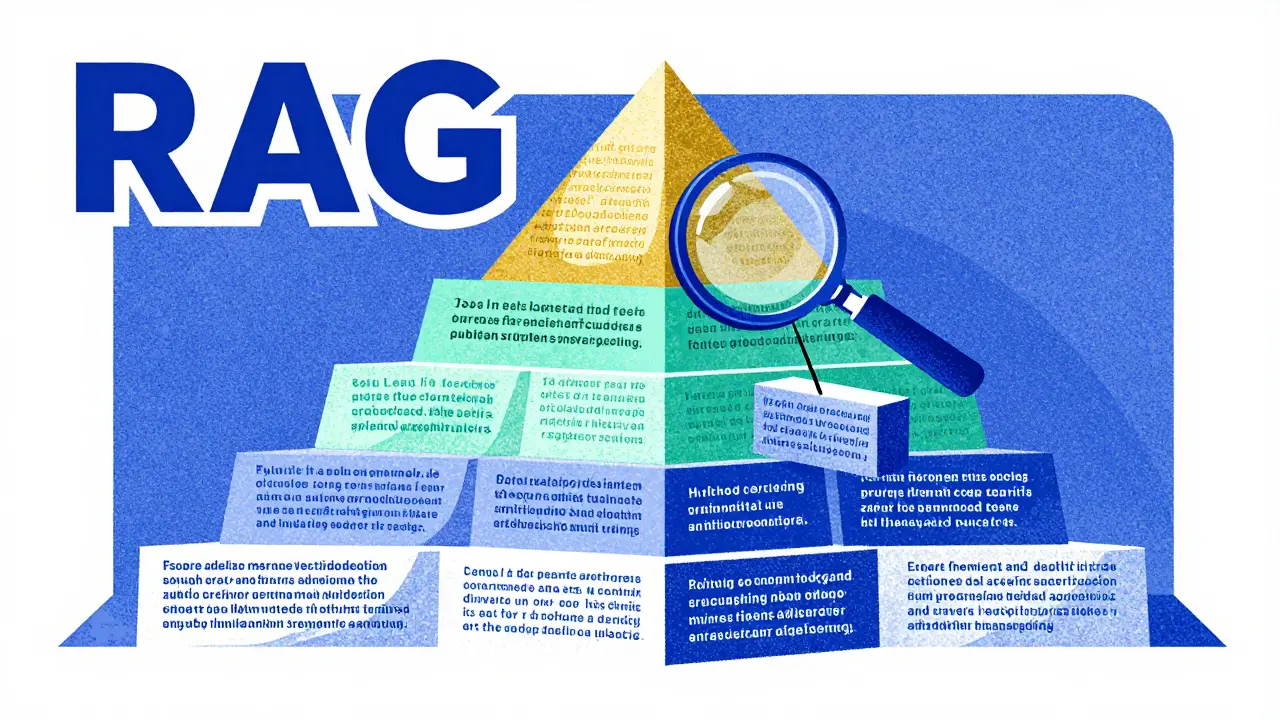
The Implementation Reality Check
If you're planning to build this, be prepared for a learning curve. You won't get it right on day one. Engineering teams on HackerNews and GitHub report spending two to four months optimizing their hierarchical RAG systems. The biggest headache is usually "coherence gaps," where the model forgets a detail from a previous chunk. To avoid this, don't just rely on summaries. Use embedding-based clustering to group related content before you even start the summarization process. This ensures that a discussion about "Pricing" on page 5 and "Payment Terms" on page 80 are linked together semantically, rather than treated as unrelated chunks.Why not just use a model with a 1-million token context window?
While massive context windows are impressive, they suffer from "needle in a haystack" issues. Models often struggle to retrieve specific facts from the middle of a massive prompt. Hierarchical RAG acts as an index, guiding the model to the exact location of the information, which significantly increases precision and reduces the cost of processing millions of tokens for every single query.
What is the best chunk size for long documents?
There is no one-size-fits-all, but the industry standard for most enterprise documents is between 1,000 and 2,000 tokens. Pair this with a 15-20% overlap (about 200 tokens) to ensure that sentences split across chunks are captured in both, preventing the loss of context.
How does MapReduce differ from iterative refinement?
MapReduce processes chunks in parallel, making it significantly faster for massive documents. Iterative refinement goes through the text sequentially, updating a summary as it moves. While iterative refinement is better for narrative stories where the plot evolves, MapReduce is far superior for technical or legal documents where speed and scalability are priorities.
Does hierarchical RAG work with PDFs and spreadsheets?
Yes, but with a catch. Multi-format grounding improves extraction accuracy for structured data like PDFs by about 52%. However, it struggles more with multimedia content (images/charts) than plain text. You'll likely need a specialized parsing layer to convert tables into a markdown format before feeding them into the RAG pipeline.
How do I measure if my grounding is actually working?
Look at factual consistency metrics. A well-implemented hierarchical RAG system should hit accuracy rates above 85% on factual consistency, compared to the 60-65% typically seen in naive approaches. You can use a "LLM-as-a-judge" framework to compare the generated answer against the original source chunks to calculate the hallucination rate.
Next Steps for Implementation
Depending on your role, your approach to this will differ:- For Developers: Start with LlamaIndex or LangChain. Build a basic MapReduce chain first, then experiment with a two-tier summary index.
- For Architects: Focus on the data pipeline. Ensure you have a robust vector database and consider adding a query expansion layer to improve retrieval hits.
- For Business Leads: Set clear KPIs around "hallucination rates" and "time-to-answer." Be aware that a production-ready system usually takes 2-4 months of tuning, not two weeks.



Rubina Jadhav
9 April, 2026 - 17:23 PM
This is very helpful for people who work with big files.
Raji viji
10 April, 2026 - 16:03 PM
Imagine thinking a 1k-2k token chunk is a "standard" lol. That's just lazy engineering for people who can't handle real data streams. Most of these "industry standards" are just a bunch of devs copying the same mediocre LangChain tutorial without actually testing the latency overhead on a production cluster. It's a total circus out here.
Vishal Bharadwaj
12 April, 2026 - 00:14 AM
Agreed... but the whole hierarchical thng is just over-enginerring a basic search probelm. Why waste 4 months optimizing a pipeline when you can just use a better embedding model? Most peope just want to feel smart by adding "layers" to their RAG but the actual retrieval accuracy hardly moves if your base vectors are trash.
sumraa hussain
13 April, 2026 - 12:34 PM
Yooo!!! the "lost in the middle" thing is literally the most stressful part of using LLMs!!!! Like you're just praying the bot actually read page 42 and didn't just hallucinate a whole new legal system!!!! Absolutely wild!!!!
Rajashree Iyer
14 April, 2026 - 23:01 PM
It is truly poetic how we attempt to mirror the human consciousness by creating these layers of abstraction. We are not just building a retrieval system; we are constructing a digital memory, a fragmented mirror of how we perceive truth through summaries and glimpses. The struggle between the raw chunk and the global summary is a metaphor for the eternal dance between the detail and the essence, a cosmic quest to find a needle in a haystack of our own making. We seek the truth in page 42, yet we lose ourselves in the architecture of the search. What a tragedy that we must build such complex machines just to remember what was written in plain sight. The "factual drift" mentioned is not just a technical glitch, it is the very nature of forgetting in a world of infinite data. We are essentially building a ladder of summaries to reach a truth that is already there, yet invisible. It is a haunting reflection of our own cognitive limitations. The a-ha moment is not in the retrieval, but in the realization that a million-token window is a void without a map. We are architects of artificial attention. Truly a profound era of computation.
Parth Haz
15 April, 2026 - 17:28 PM
The emphasis on entity-based grounding is a very commendable point. It provides a robust framework for those of us aiming for high-precision deployments in professional environments. I believe this approach will significantly bridge the gap for enterprise adoption.