You spent weeks curating data, running experiments, and finally got your Large Language Model to stop hallucinating on customer support tickets. It looks great in the demo. But how do you know it’s actually better than the base model? Or worse, how do you know it won’t fail spectacularly when real users start throwing weird edge cases at it?
Evaluating a fine-tuned model is tricky because there is no single "correct" answer for most generative tasks. You can’t just check if the output matches a database entry. The output might be correct but phrased differently, or it might be helpful but slightly biased. This article breaks down exactly what you need to measure, which metrics actually matter, and how to build an evaluation protocol that reflects reality, not just academic benchmarks.
The Core Problem with Standard Metrics
If you come from traditional machine learning, you’re used to accuracy, precision, and recall. These work great for classification tasks where the answer is binary or categorical. But for a chatbot or a summarization tool, these metrics often fall short. Why? Because language is non-deterministic. If you ask two different people to summarize the same news article, they’ll use different words, sentence structures, and even focus on different details. Both summaries could be excellent.
This variability means rigid metrics like Exact Match (EM) are usually useless for open-ended generation. If your model says "The capital of France is Paris" and the reference says "Paris is the capital of France," EM gives you a zero. That’s bad science. Instead, you need metrics that understand semantic similarity and functional equivalence.
Automatic Evaluation: Perplexity vs. Model-Based
There are two main ways to automate evaluation, and you likely need both depending on your task.
Perplexity-based evaluation is the old guard. It measures how well a model predicts a sequence of tokens. Lower perplexity generally means the model is more confident and consistent. Benchmarks like MMLU (Massive Multitask Language Understanding) rely heavily on this approach, using multiple-choice questions to test general knowledge. While useful for checking if fine-tuning broke the model’s basic reasoning capabilities, perplexity tells you almost nothing about whether the output is helpful, safe, or stylistically appropriate.
Model-based evaluation, often called LLM-as-a-Judge, is the modern standard for quality assessment. Here, you use a powerful, pre-trained LLM (like GPT-4o or Claude 3.5 Sonnet) to rate your fine-tuned model’s outputs against specific criteria. This method shines because it can handle nuance. It can detect sarcasm, identify subtle bias, or judge whether a code snippet is efficient, not just syntactically correct.
However, LLM judges aren’t perfect. They have their own biases. For instance, some models prefer longer answers, even if shorter ones are better. To mitigate this, researchers developed specialized judge models like Prometheus. Prometheus is trained specifically to evaluate other models using rubrics, scoring responses on a 1-5 Likert scale based on detailed descriptions of what constitutes a good answer. This reduces the arbitrary nature of using a general-purpose chatbot as a grader.
Key Metrics You Must Track
Don’t try to track everything. Pick the metrics that align with your product goals. Here are the heavy hitters:
- ROUGE Scores: Originally designed for summarization, ROUGE measures overlap between generated text and reference text. ROUGE-1 looks at unigrams (single words), while ROUGE-2 looks at bigrams. It’s a recall-oriented metric, meaning it checks if the model captured the important content, not if it repeated every word. Use this for factual summarization or translation tasks.
- BERTScore: Unlike ROUGE, which counts exact word matches, BERTScore uses contextual embeddings to measure semantic similarity. If your model paraphrases correctly, BERTScore will recognize it as accurate, whereas ROUGE might penalize it. This is crucial for creative writing or conversational agents.
- Helpfulness and Harmlessness: These are subjective but critical. Frameworks like HELM (Holistic Evaluation of Language Models) explicitly include fairness, bias, and toxicity metrics. You need to measure if your model refuses to answer inappropriate queries or if it generates toxic content when prompted aggressively.
- Instruction Following: Did the model actually do what was asked? If you told it to "list three bullet points," did it write a paragraph? Automated tests can check for format compliance, which is often easier to measure than content quality.

Structuring Your Evaluation Dataset
Your results are only as good as your data. A common mistake is evaluating on the training set. Never do this. You must split your data into Training, Validation, and Test sets. The Test set should remain completely untouched during the fine-tuning process. This prevents data leakage, where the model memorizes answers instead of learning patterns.
Furthermore, your test set needs to represent real-world distribution. If your app is for legal document analysis, don’t evaluate it on general trivia questions. Curate a dataset of actual user queries, including the messy, ambiguous, and out-of-distribution examples. Synthetic benchmarks are convenient, but they rarely capture the complexity of human interaction.
The Human-in-the-Loop Reality
No automated metric captures intent perfectly. At some point, you need humans to look at the outputs. But human evaluation is expensive and slow. How do you balance it?
Use a tiered approach. Start with automated filters to catch obvious failures (e.g., empty strings, extreme length deviations, or high toxicity scores). Then, send the remaining outputs to human annotators. Give them clear guidelines. Are you grading for factuality? Tone? Safety? Ambiguity in instructions leads to inconsistent labels, which makes your evaluation noisy.
Consider using pairwise comparison rather than absolute scoring. Ask annotators, "Which response is better, A or B?" Humans are much better at relative judgments than absolute ones. This data can then train your reward models or validate your LLM judges.

Comparison of Evaluation Approaches
| Task Type | Recommended Primary Metric | Secondary Check | Tool/Framework |
|---|---|---|---|
| Summarization | ROUGE-L / BERTScore | Factual Consistency | HuggingFace Evaluate |
| Code Generation | Pass@k (Unit Tests) | Human Readability | DeepEval |
| Chat/Assistant | LLM-as-a-Judge (G-Eval) | Toxicity/Bias | Prometheus / HELM |
| Classification | F1 Score / Accuracy | Confusion Matrix | Scikit-learn |
Common Pitfalls to Avoid
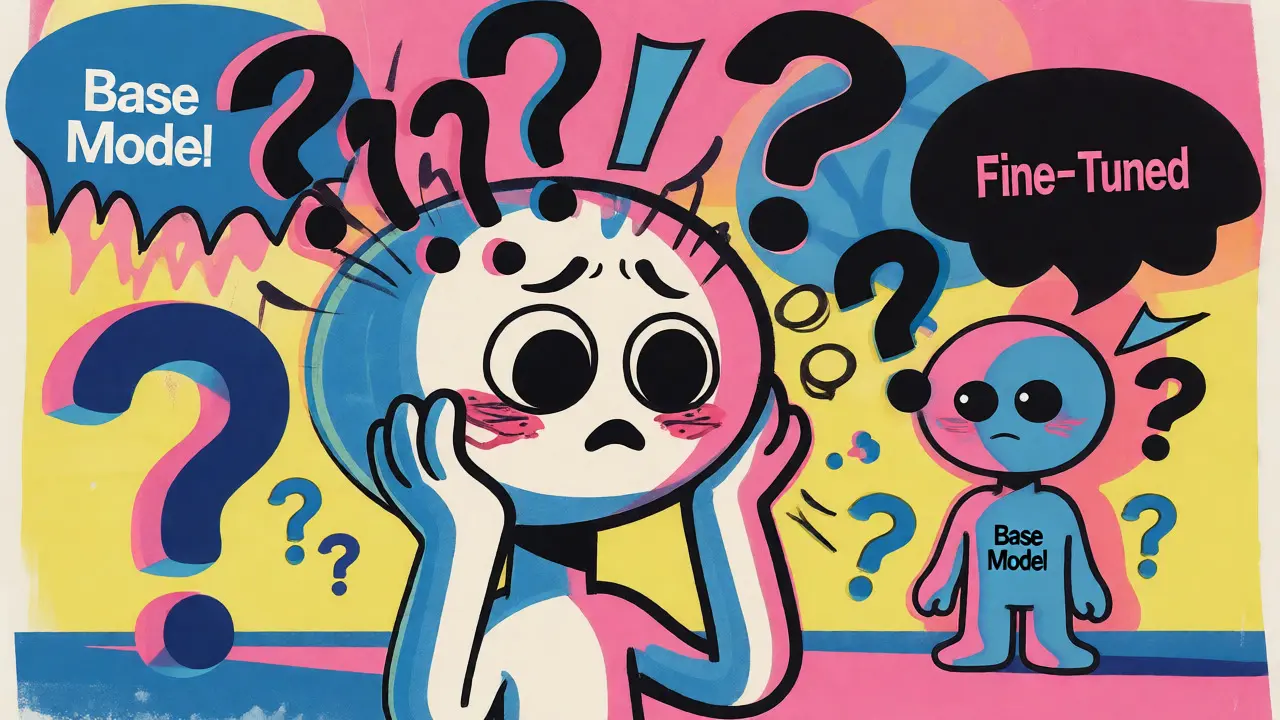
First, beware of the "Base Model Bias." If you compare your fine-tuned model against a different base model, you might attribute performance gains to fine-tuning when they’re actually due to the underlying architecture. Always compare apples to apples: Base Model vs. Fine-Tuned Version of the Same Base Model.
Second, ignore overfitting signals. If your validation loss goes up while training loss goes down, you’ve memorized the data. Your model might ace the test set but fail on new inputs. Regularization techniques and early stopping are your friends here.
Third, don’t forget latency and cost. A model that scores 99% on HELM but takes 10 seconds to generate a token might be unusable in production. Measure time-to-first-token and total generation time alongside quality metrics.
Building a Continuous Evaluation Pipeline
Evaluation isn’t a one-time checkbox. As you deploy updates, you need continuous monitoring. Set up a system that samples live traffic, runs those prompts through your evaluation suite, and flags drops in key metrics. If helpfulness scores dip by 5%, you need to know before your customers complain.
Tools like DeepEval or LightEval help integrate these checks into your CI/CD pipeline. Treat your evaluation dataset as a living artifact. As you encounter new failure modes in production, add them to your regression test suite. This ensures that fixing one bug doesn’t break another feature.
Why is perplexity not enough for evaluating fine-tuned LLMs?
Perplexity measures how predictable a text is, not whether it is correct or helpful. A model can have low perplexity (high confidence) but still generate factually incorrect or nonsensical information. For open-ended tasks, you need metrics that assess semantic quality, safety, and instruction adherence, which perplexity ignores.
What is the LLM-as-a-Judge paradigm?
LLM-as-a-Judge involves using a powerful, pre-trained Large Language Model to automatically evaluate the outputs of another model. The judge model is prompted with specific criteria (e.g., "Rate the helpfulness from 1-5") and compares the candidate output against a reference or simply rates its intrinsic quality. It scales evaluation but requires careful prompt engineering to avoid bias.
When should I use ROUGE versus BERTScore?
Use ROUGE when lexical overlap matters, such as in strict summarization or translation tasks where preserving specific terms is critical. Use BERTScore when semantic equivalence is more important than exact wording, such as in conversational AI or creative writing, where paraphrasing is acceptable and expected.
How do I handle non-deterministic outputs in evaluation?
Non-determinism means the same input can produce different outputs. To handle this, run multiple inference passes with different random seeds and average the metrics. Alternatively, use temperature=0 for deterministic evaluation during testing, though this may not reflect production behavior where diversity is desired. Semantic metrics like BERTScore are also more robust to minor variations than exact match.
Do I need human evaluation if I have automated metrics?
Yes. Automated metrics can miss nuanced issues like tone, cultural sensitivity, or complex logical errors. Human evaluation provides ground truth for calibrating your automated judges and catching systematic biases that algorithms overlook. A hybrid approach-automated screening followed by targeted human review-is the industry best practice.