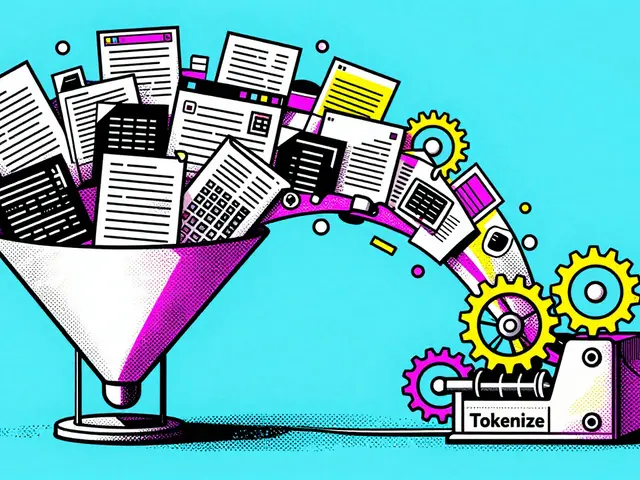
You have a massive language model. It’s brilliant, it’s accurate, and it absolutely refuses to fit on your GPU. You try loading 70B parameters into memory, and the CUDA out-of-memory error hits you like a wall. This is the reality for most engineers working with modern large language models (LLMs) in 2026. The solution isn't just buying bigger hardware-it's splitting the brain of the model across multiple devices. This process, known as Distributed Transformer Inference, allows us to shard model weights and computations across GPUs or even CPUs to serve requests efficiently.
But how do you split a neural network without breaking its math? There are two main strategies: Tensor Parallelism and Pipeline Parallelism. One slices layers horizontally; the other slices them vertically. Choosing the wrong one can tank your throughput by 60%. Let’s break down exactly how these work, when to use each, and what tools like vLLM and llm-d offer in late 2025.
Key Takeaways
- Memory Constraint: Models over 13B parameters generally require distributed inference because they cannot fit into the VRAM of a single consumer or even high-end data center GPU.
- Tensor Parallelism (TP): Splits individual matrix operations within a layer across devices. Best for low-latency single-request scenarios but suffers from high communication overhead.
- Pipeline Parallelism (PP): Splits different layers of the model onto different devices. Better for scaling to huge models and high batch sizes, but introduces "pipeline bubbles" that reduce efficiency.
- Hybrid Approach: Most production systems combine TP and PP. For example, using TP within a node (via NVLink) and PP across nodes (via Ethernet).
- KV Cache Bottleneck: Managing Key-Value caches across distributed systems is often the biggest performance hurdle, not the compute itself.
Why Single-GPU Inference Fails at Scale
Let’s look at the numbers. A standard FP16 model requires 2 bytes per parameter. For a 70B parameter model, that’s 140 GB just for the weights. Add the KV cache, which grows linearly with sequence length and batch size, and you’re looking at needing well over 200 GB of fast memory. A single NVIDIA H100 has 80 GB. Even an A100 tops out at 80 GB. You physically cannot load the model, let alone run it.
This isn’t just a storage problem; it’s a bandwidth problem. As models grow, the time spent moving data between memory and compute units dominates the execution time. Distributed inference addresses this by parallelizing the workload. Instead of one GPU doing all the heavy lifting while others sit idle, we distribute the computation. According to recent benchmarks from the Kempner Computing Handbook (2025), distributed setups can achieve 3-5x throughput improvements compared to naive single-device attempts, provided the parallelization strategy matches the hardware topology.
Tensor Parallelism: Slicing the Matrix
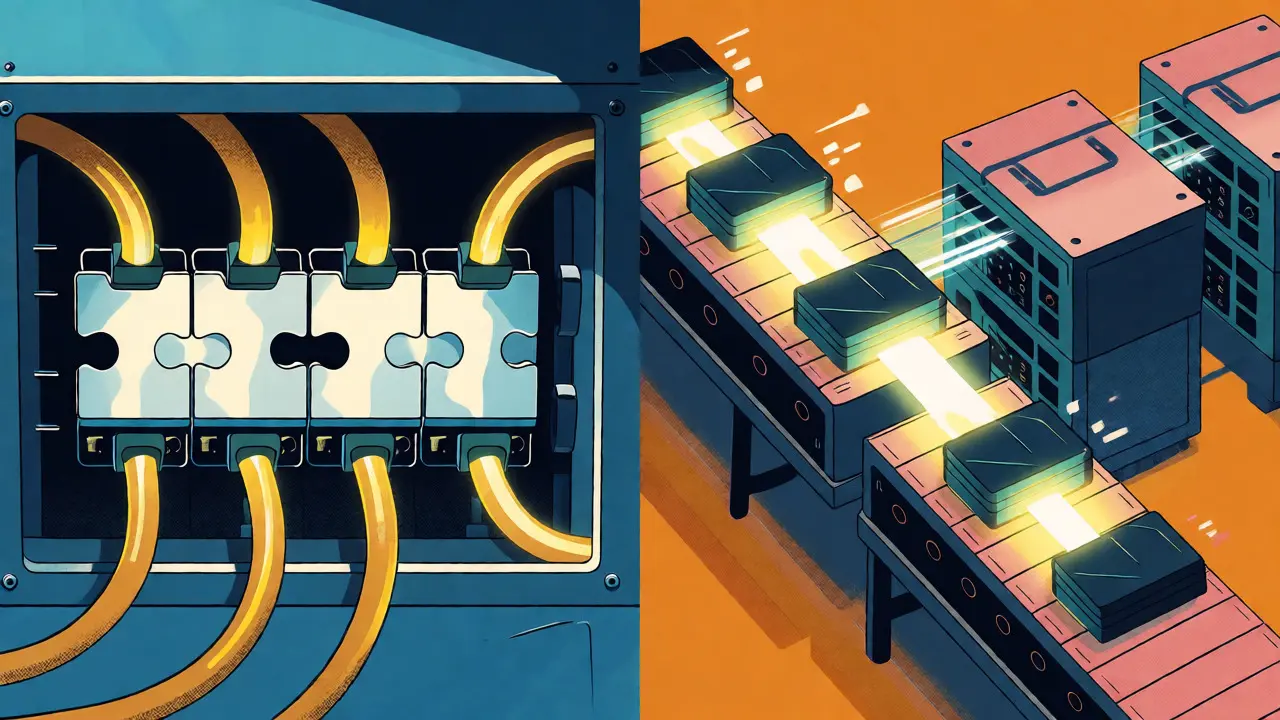
Tensor Parallelism works by splitting the weight matrices inside each transformer layer across multiple GPUs. Imagine a multi-head attention block. Normally, one GPU computes all attention heads. With TP, if you have 4 GPUs, each GPU computes only 1/4th of the heads. Then, they communicate their partial results via an All-Reduce operation to sum up the outputs before passing them to the next layer.
This method keeps latency low for individual requests because every part of the layer is processed simultaneously. However, it demands incredibly fast interconnects. If you try to run Tensor Parallelism across two different servers connected by standard Ethernet, the communication overhead will kill your performance. It really shines when used within a single server chassis where GPUs are connected via NVLink.
Here is the trade-off: TP reduces the memory footprint per GPU significantly, allowing larger models to fit. But it increases the number of synchronization points. Every layer requires an All-Reduce step. At scale, these tiny delays add up. NVIDIA’s Megatron-LM research showed that while TP enables massive model support, excessive partitioning can introduce non-trivial synchronization overhead that negates computational gains if not tuned carefully.
Pipeline Parallelism: Splitting the Layers
If Tensor Parallelism slices layers horizontally, Pipeline Parallelism cuts the model vertically. You assign the first 10 layers to GPU 1, the next 10 to GPU 2, and so on. Data flows through the pipeline like an assembly line.
The advantage here is minimal communication. GPUs only talk to their immediate neighbors in the pipeline chain. This makes PP ideal for scaling across multiple nodes where bandwidth is limited. You don’t need NVLink; standard InfiniBand or even high-speed Ethernet can suffice.
But there’s a catch: the "bubble." When the first GPU finishes its chunk, it sits idle waiting for the second GPU to finish before it can start the next batch. To mitigate this, frameworks like vLLM use micro-batching. They split the input batch into smaller chunks and feed them into the pipeline continuously. This keeps all GPUs busy. Harvard’s Kempner Institute noted in 2025 that vLLM’s implementation of PP achieves 45% higher throughput than older standards for 70B models, largely due to smarter scheduling that masks these bubbles.
Comparing Strategies: When to Use What?
Choosing between TP and PP isn’t about which is "better," but which fits your hardware and traffic patterns. Here is a practical breakdown based on current 2026 deployment trends.
| Feature | Tensor Parallelism (TP) | Pipeline Parallelism (PP) |
|---|---|---|
| Primary Goal | Low latency for single requests | High throughput for batched requests |
| Communication Overhead | Very High (requires NVLink) | Low (works over Ethernet/InfiniBand) |
| Hardware Scaling | Within a single node/server | Across multiple nodes/servers |
| Complexity | Hard to tune; sensitive to imbalance | Easier to scale; manages bubbles via micro-batching |
| Best For | Interactive chatbots, real-time apps | Bulk processing, high-concurrency APIs |
In practice, most enterprise deployments use a hybrid approach. For instance, you might use TP=4 within a single 8-GPU server (splitting layers across 4 GPUs) and then use PP to connect four such servers together. This leverages the high speed of NVLink for intra-node communication and the scalability of PP for inter-node expansion.
The Hidden Bottleneck: KV Cache Management
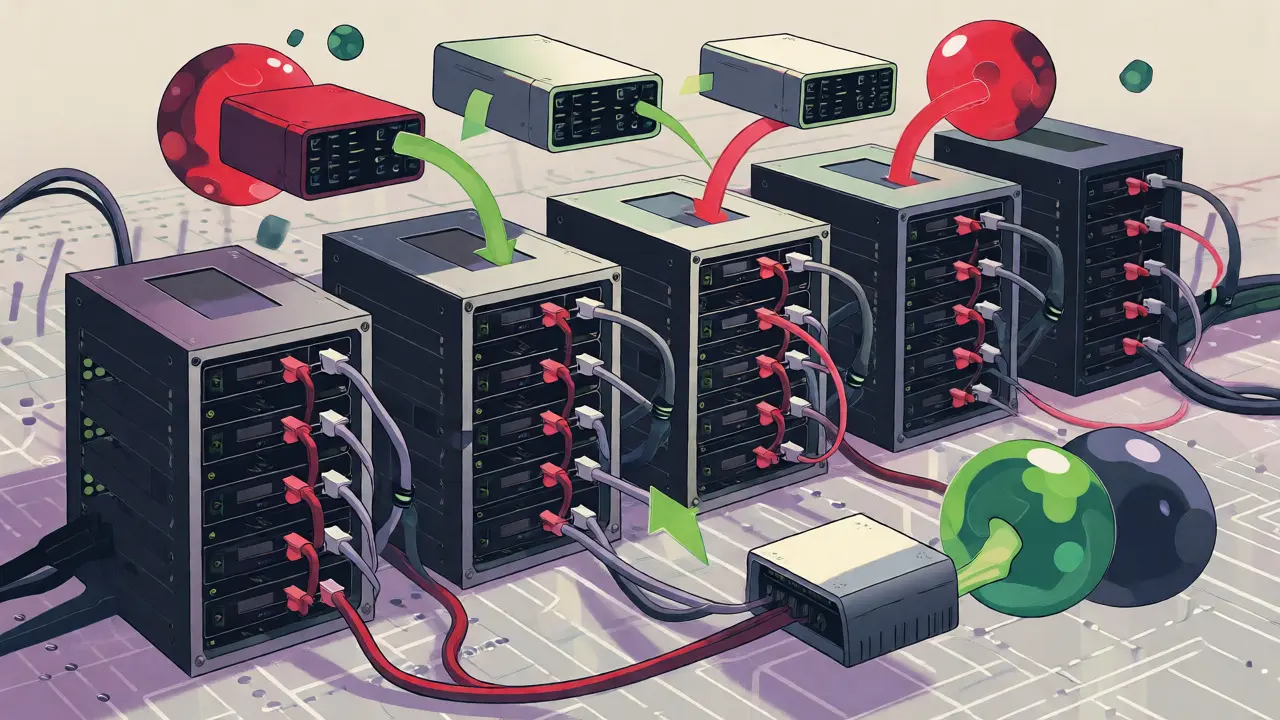
Compute is expensive, but memory movement is worse. In distributed inference, the Key-Value (KV) cache is the elephant in the room. During autoregressive generation, the model stores previous token keys and values to avoid recomputing them. In a distributed setting, this cache must be synchronized or accessed across devices.
A 2024 dissertation from the University of Chicago highlighted that decoupling KV caches from the serving engine improves performance by 22%. Traditional systems often suffer from redundant prefill computations because they can’t easily share cache states across pipeline stages. Newer frameworks like llm-d, released by Red Hat in late 2025, address this by disaggregating inference states. They allow CPU resources to handle prefill (where the cache is built) while GPUs focus on decode (token generation). This separation reduced hardware costs by 35% for beta testers by utilizing cheaper CPU instances for the less compute-intensive parts of the workflow.
Implementation Pitfalls and Real-World Tips
Setting up distributed inference is rarely plug-and-play. Users on GitHub frequently report cryptic errors during tensor parallelism setup. One common issue is misconfiguring the `tensor_parallel_size` parameter. If you set it incorrectly relative to your number of attention heads, performance can degrade by 30-50% because the workloads become unbalanced.
Another trap is device heterogeneity. If you mix different types of GPUs (e.g., A100s and H100s) in a pipeline, the slower card becomes the bottleneck. The entire pipeline waits for the slowest stage. Research from arXiv (2025) suggests adaptive partitioning-assigning more layers to faster nodes-is critical for edge environments or mixed clusters. Without this, you might see 37% higher latency than theoretically possible.
Debugging is also harder. When a request hangs, is it a deadlock in the All-Reduce operation? Or is a pipeline stage stuck? Tools like DeepSpeed and vLLM provide profiling tools, but interpreting them requires deep knowledge of CUDA kernels and network topologies. Expect to spend 2-4 weeks tuning a production-grade distributed setup, not just days.
Future Trends: MoE and Edge Deployment
The landscape is shifting toward Mixture of Experts (MoE) models like DeepSeek-R1. These models activate only a subset of parameters for each token, offering higher throughput. However, they introduce routing complexity. Frameworks supporting expert parallelism, such as vLLM’s February 2025 update, enable 120B+ parameter MoE models to run on commodity hardware with 83% scaling efficiency.
Edge deployment is another frontier. Running LLMs on Raspberry Pi clusters or edge servers requires Model-Distributed Inference (MDI). Unlike data-center setups, edge devices have volatile connectivity. Recent papers demonstrate that dynamic layer allocation-reallocating model parts based on real-time device availability-improves resilience by 28%. If a node drops offline, the system reshuffles the pipeline rather than failing entirely.
What is the difference between training and inference parallelism?
Training parallelism focuses on gradient synchronization and optimizer state sharding (like ZeRO), whereas inference parallelism focuses on minimizing latency and maximizing throughput for forward passes. Inference doesn't need backward passes, so the communication patterns are simpler but still critical for memory management.
Can I use Tensor Parallelism across different machines?
Technically yes, but it's usually inefficient. Tensor Parallelism relies on frequent, small communications (All-Reduce) between GPUs. Standard network interfaces (even 100GbE) have too much latency compared to NVLink. It is best reserved for within-node scaling. For cross-machine scaling, Pipeline Parallelism is preferred.
How does vLLM improve distributed inference?
vLLM uses PagedAttention to manage KV cache memory efficiently, reducing fragmentation. It also supports continuous batching and optimized implementations of both Tensor and Pipeline parallelism. Its Chunked Prefill feature specifically improves throughput for long-context requests by 35%.
Is Pipeline Parallelism bad for real-time applications?
Not necessarily. While PP introduces latency due to the pipeline depth, techniques like micro-batching and speculative decoding can mask this. For high-concurrency real-time apps, a hybrid TP+PP setup is often better than pure PP, balancing latency and throughput.
What hardware do I need for distributed LLM inference?
For optimal performance, you need GPUs with high-bandwidth interconnects like NVLink (for TP) and high-speed networking like InfiniBand or RoCE (for PP). Consumer GPUs (RTX 4090) can work for smaller models or hobbyist projects but lack the interconnect bandwidth for efficient large-scale tensor parallelism.