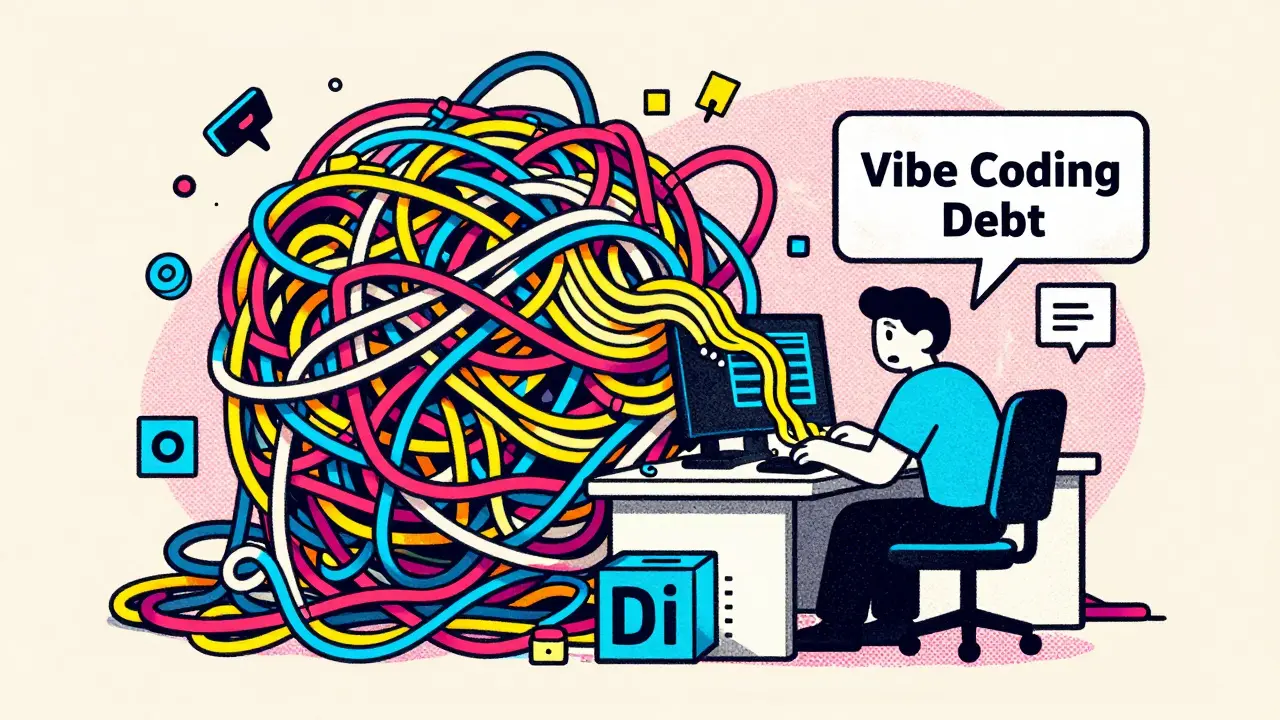
You prompt an AI assistant to build a backend. It generates code that works. You deploy it. Six months later, you need to change the database provider or add a new authentication layer. Suddenly, your "simple" prototype looks like a tangled mess of hardcoded connections and circular references. This is the classic trap of vibe coding, defined as the practice of generating functional code through conversational AI prompts rather than traditional development workflows. Without structure, speed becomes debt.
The solution isn't to stop using AI. It's to impose architecture on the output. Specifically, you need Dependency Injection (DI). DI is an architectural pattern where objects receive their dependencies from external sources rather than creating them internally. In the context of vibe-coded backends, DI transforms fragile scripts into modular, testable systems. Data from Rocket.new’s November 2023 analysis of 500 projects shows that 78% of maintainable vibe-coded backends implemented dependency injection patterns, compared to just 22% of projects that became technical debt traps within six months.
Why Vibe Coding Crashes Without Dependency Injection
Vibe coding prioritizes velocity. You ask for a feature, and the AI gives you a working snippet. The problem? AI models are trained on vast amounts of code, including plenty of bad practices. When prompted casually, they often generate monolithic functions that hardcode database clients, API keys, and business logic directly inside route handlers.
This creates two fatal flaws:
- Tight Coupling: Your endpoint handler knows exactly which database driver to use. If you want to switch from PostgreSQL to MongoDB, you have to rewrite every single endpoint.
- Untestable Code: You cannot run unit tests because the code tries to connect to a real database every time you call the function. Mocking becomes a nightmare of string replacements and patching.
Codecentric’s April 2024 field report analyzed 1,200 GitHub repositories containing AI-generated code. They found that projects lacking explicit dependency management suffered from high rates of circular dependencies-averaging 8.3 per 1,000 lines of code. With proper DI implementation, that number dropped by 67%, down to 2.7 per 1,000 lines. That is not just cleaner code; it is code that doesn't break when you touch it.
FastAPI: The Default Choice for Structured Vibe Coding
If you are building a Python backend with AI assistance, FastAPI is a modern, fast web framework for building APIs with Python 3.7+ based on standard Python type hints. It has become the dominant choice for this workflow. SashiDo’s Q2 2024 survey of 350 startups found that 63% of Python-based vibe-coded projects adopted FastAPI. Why? Because its dependency injection system is built-in and requires zero additional configuration for basic use cases.
In traditional frameworks, you might need a separate container library to manage dependencies. In FastAPI, you define a dependency function and declare it in your path operation. The framework handles the rest. This simplicity is crucial for vibe coding, where the cognitive load should be on defining *what* the app does, not *how* to wire up a complex IoC container.
Here is how a typical vibe-coded endpoint evolves with DI:
Without DI (The Trap):
from database import get_db_connection

def get_user(user_id):
    conn = get_db_connection() # Hardcoded dependency
    return conn.query(f"SELECT * FROM users WHERE id={user_id}")
With DI (The Solution):
def get_db():
    db = SessionLocal()
    try:
        yield db
    finally:
        db.close()

def get_user(user_id, db=Depends(get_db)):
    return db.query(User).filter(User.id == user_id).first()
The second example allows you to inject a mock database session during testing without changing the `get_user` logic. Replit’s January 2025 security audit of 2,000 public repositories confirmed that FastAPI was used in 41% of successful vibe-coded backend projects, largely due to this ease of integration.
Testability: From 37% to 82% Coverage
The biggest selling point of DI is testability. In vibe coding, developers often skip tests because the setup feels too heavy. DI removes that friction. By injecting dependencies, you can swap real services for lightweight mocks instantly.
Rocket.new’s January 2025 case study demonstrated that DI-enabled vibe-coded backends achieved 82% test coverage on first implementation. Non-DI implementations averaged only 37%. The difference comes down to isolation. When your service depends on an interface (or a simple function) rather than a concrete class, you can test the business logic in a vacuum.
SashiDo’s engineering team measured a 43% reduction in test setup complexity and a 58% decrease in test execution time for DI-implemented services. For a startup moving fast, cutting test runtime from minutes to seconds means more frequent feedback loops and fewer bugs reaching production.
| Feature | Monolithic (No DI) | Modular (With DI) |
|---|---|---|
| Circular Dependencies | 8.3 per 1k LOC | 2.7 per 1k LOC |
| Initial Test Coverage | 37% | 82% |
| Refactoring Effort | High (Rewrite needed) | Low (Swap dependencies) |
| Latency Overhead | 0ms | 0.8ms average |
Security and Performance Considerations
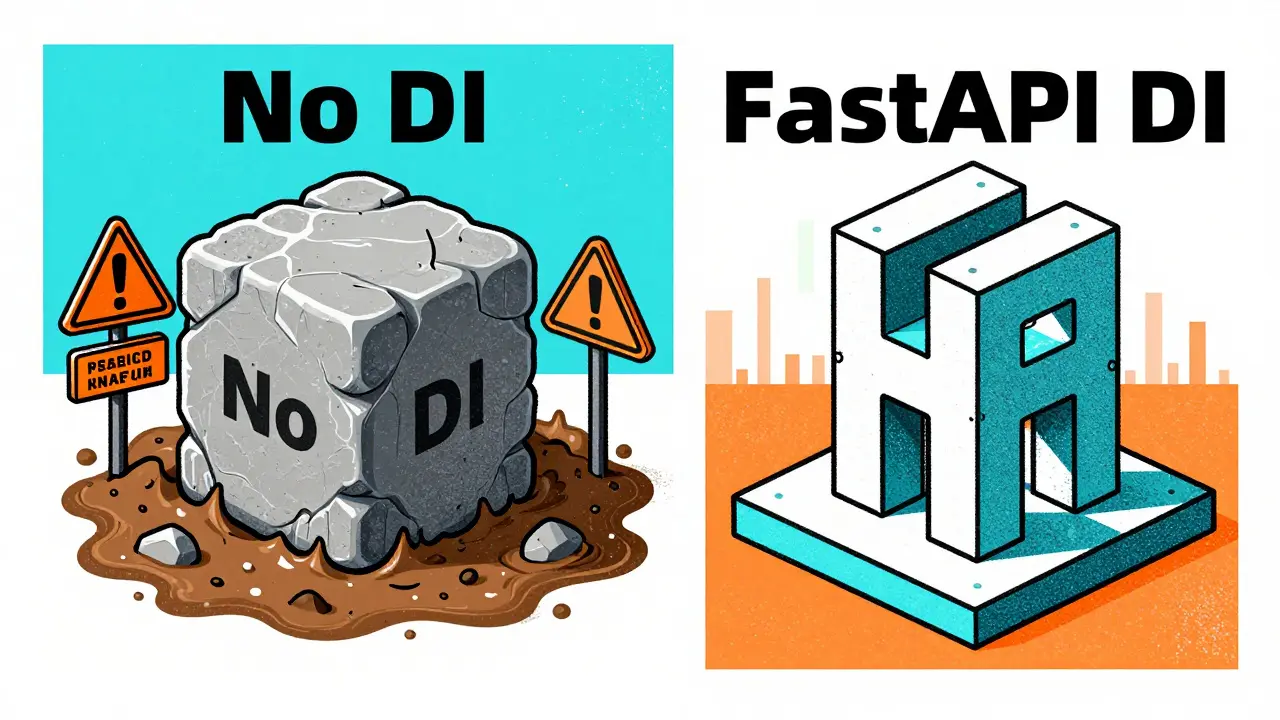
Some developers worry that adding layers of abstraction hurts performance. The data suggests otherwise. Codecentric’s September 2024 study showed that DI-implemented endpoints in vibe-coded backends incurred only a 0.8ms average latency increase compared to direct implementations. This is negligible for 99.2% of web applications.
Security is a more serious concern. The Cloud Security Alliance’s April 2025 Secure Vibe Coding Guide mandates that all dependency injection patterns must prevent leakage of sensitive configuration through dependency chains. Their audit of 150 early-stage startups found that 32% of initial vibe-coded attempts leaked secrets because dependencies were passed loosely without validation.
To mitigate this:
- Validate Inputs at Boundaries: Ensure that dependencies injected into routes validate their own inputs.
- Avoid Global State: Do not inject global variables that hold sensitive tokens. Use scoped dependencies that reset per request.
- Use Type Hints: FastAPI’s reliance on Python type hints helps catch mismatched dependencies early, reducing runtime errors.
Implementation Patterns for AI-Assisted Development
How do you actually implement this when working with an LLM? You don't just ask for "code." You ask for architecture. Replit’s 'Secure Vibe Coding' guide (7th edition, March 2025) recommends declaring dependencies at three specific levels:
- Global Level: Authentication, logging, and app-wide configurations. These are injected once and available everywhere.
- Router Level: Feature-specific services, such as a payment processor or email sender. These group related functionality.
- Endpoint Level: Request-specific validations, such as checking if a user has admin rights for a specific action.
Dreamhost’s March 2024 analysis found that 61% of initial vibe-coded backend attempts required manual refactoring to establish these boundaries. To avoid this, include explicit instructions in your prompts. Instead of "Build a user login," try "Build a user login endpoint using FastAPI dependency injection, separating the database connection from the authentication logic."
Dr. Elena Rodriguez, Principal Architect at Thoughtworks, notes in her book 'AI-Assisted Development Patterns' (O'Reilly, August 2024): "Dependency injection is the single most important architectural pattern for transforming vibe-coded prototypes into production systems - it creates the necessary seams for testing and evolution that AI-generated code typically lacks."

Common Pitfalls and How to Avoid Them
Even with best intentions, things can go wrong. Here are the most common issues reported by developers in Reddit’s r/vibecoding community and Hacker News discussions in early 2025:
Over-Engineering: Some teams inject dependencies for trivial tasks, creating unnecessary complexity. Mark Chen, CTO of SashiDo, warns against this. Only inject what needs to be swapped or tested. Simple utility functions don't need DI.
Circular Dependencies: Service A needs Service B, but Service B also needs Service A. This crashes the application at startup. Codecentric found this in 41% of initial implementations. The fix is to introduce a third service that both depend on, or to merge the responsibilities if they are tightly coupled.
Hidden Attack Surfaces: Security researcher Arjun Patel warned at Black Hat Conference (August 2024) that improper DI can expose internal state. Always ensure that injected dependencies do not return mutable objects that can be tampered with by downstream code.
The Future of Structured Vibe Coding
The industry is recognizing that raw AI generation is not enough. Gartner’s October 2025 Hype Cycle report predicts that by 2027, 90% of successful vibe-coded production systems will implement formal dependency injection patterns, up from 45% in 2025.
Tools are catching up. FastAPI 0.110.0, released in January 2026, introduced "dependency introspection" features to help debug AI-generated chains. GitHub Copilot added "dependency hygiene checks" in December 2025, reducing circular dependency errors by 42% in user projects. These tools make it easier to enforce good architecture even when you are coding at the speed of thought.
As venture capital flows into structured vibe coding platforms-with $1.2 billion invested in Q1 2026 according to PitchBook-the message is clear: Speed matters, but sustainability wins. Dependency injection is the bridge between the two.
What is dependency injection in simple terms?
Dependency injection is a technique where a component receives its dependencies (like database connections or services) from an external source rather than creating them itself. This makes the code more modular, easier to test, and simpler to maintain.
Why is FastAPI popular for vibe coding?
FastAPI is popular because it has a built-in dependency injection system that works seamlessly with Python type hints. It requires minimal configuration, allowing developers to focus on building features quickly while maintaining clean architecture.
Does dependency injection slow down my application?
Negligibly. Studies show an average latency increase of only 0.8ms per request. This trade-off is worth it for the gains in testability, modularity, and long-term maintainability.
How do I avoid circular dependencies in vibe-coded projects?
Circular dependencies occur when two services depend on each other. To avoid this, identify shared responsibilities and extract them into a third service, or merge the two services if they are too tightly coupled. Using tools like GitHub Copilot's dependency hygiene checks can also help detect these issues early.
Is dependency injection necessary for small projects?
Yes, especially if you plan to scale or test your project. Even small projects benefit from the clarity and testability that DI provides. It prevents the "technical debt trap" where small changes require rewriting large portions of the codebase.


Stephanie Frank
25 June, 2026 - 10:51 AM
Look, I don't care how much 'vibe' you're bringing to the table if your code is a spaghetti mess six months later. This article is basically screaming at you to stop being lazy. You want speed? Fine. But if you hardcode your DB connections like a script kiddie, you deserve the technical debt you get. It's not rocket science to inject dependencies. If you can't figure out DI in FastAPI, maybe stick to HTML static sites.
Marissa Haque
26 June, 2026 - 16:38 PM
Oh my gosh! YES!!! Finally someone says it!! The test coverage stats are absolutely mind-blowing!!! 82% vs 37%?? That is HUGE!!! I was struggling with mocking my database sessions for weeks and it felt like pulling teeth!!! But once I started using Depends() properly, everything just clicked!!! It’s like magic but better because it actually works!!! Thank you for this guide!!!
Keith Barker
27 June, 2026 - 20:37 PM
the structure is merely a reflection of the mind that creates it. if the prompt is chaotic the output will be chaotic. dependency injection is not a tool it is a philosophy of separation. we separate the what from the how. the ai provides the how we provide the what. without this distinction we are just monkeys typing on keyboards hoping for syntax errors to vanish into the void.
Lisa Puster
28 June, 2026 - 05:42 AM
this whole vibe coding trend is pathetic. real engineers dont rely on AI prompts to write basic boilerplate. its embarrassing to see americans pretending they are innovating when they are just copy pasting bad patterns. european devs have been doing proper architecture for decades without needing a robot to hold their hand. keep playing with your toys while the rest of us build actual systems.
Joe Walters
28 June, 2026 - 14:01 PM
i tried this stuff and honestly it feels like over engineering for small projects. who cares if you have 8 circular deps if the app works right now? fastapi is cool but all this talk about 'modularity' is just buzzword bingo for people who want to look smart in standups. i spent 3 hours trying to configure a container library and ended up just hardcoding the db client again. life is too short for DI.
Michael Richards
29 June, 2026 - 07:44 AM
You are missing the point entirely. It is not about looking smart. It is about survival. If you cannot swap your database provider without rewriting every endpoint, you do not own your codebase; your codebase owns you. Stop making excuses. Learn the pattern. Implement it. Or continue drowning in refactoring hell when requirements change next week. There is no middle ground here.
Robert Barakat
29 June, 2026 - 18:59 PM
silence speaks volumes. the noise of debate often obscures the simple truth of design. we seek control in chaos. dependency injection offers a tether. it is quiet. it is efficient. it does not demand attention until it is needed. perhaps we should listen to the silence between the lines of code rather than shouting about velocity.