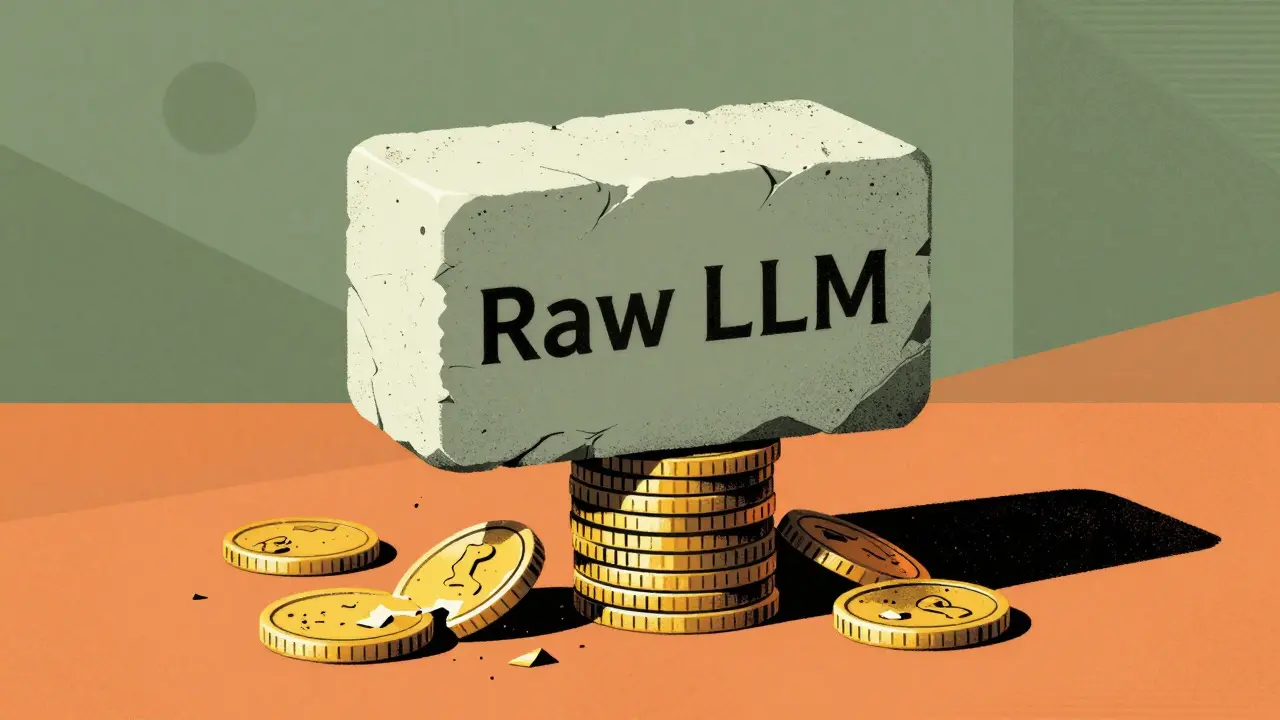
Running open-source large language models in production used to be a luxury reserved for tech giants with bottomless budgets. Today, it’s a standard requirement for startups and enterprises alike. But here is the catch: raw performance comes at a steep price. Without optimization, processing tokens on unoptimized infrastructure can cost up to $1.27 per 1,000 tokens, according to Predibase’s November 2024 benchmarks. That number doesn’t just hurt your wallet; it kills scalability.
This is where cost-performance tuning for open-source LLM inference becomes critical. It isn’t about squeezing out every last drop of speed at the expense of accuracy. It’s about finding the sweet spot where you maintain 95-99% of your model’s baseline performance while slashing operational costs by 70-90%. If you are deploying models like Llama-3 or Mistral, ignoring these techniques means leaving money on the table and potentially facing latency issues that frustrate users.
The Core Optimization Layers You Need to Know
Optimizing inference isn’t a single switch you flip. It involves stacking several technical layers that work together to reduce memory usage and increase throughput. Think of it like building a house: you need a solid foundation before you can add the fancy finishes.
First, there is Quantizationa technique that reduces the precision of model weights to save memory and compute resources. This is often the first step engineers take. By converting model weights from FP16 (half-precision floating point) to lower precision formats like INT4 or FP8, you drastically cut down the memory footprint. NVIDIA’s March 2024 benchmarks on Llama-3-70B showed that FP8 offers a 2.3x speedup with only a 0.8% accuracy drop, while INT4 provides a 3.7x speedup with a 1.5% accuracy drop. However, not all models react the same way. Mixture-of-Experts (MoE) models like Mixtral-8x7B see significantly less benefit-only 20-35% memory reduction with INT4 compared to 50-75% for dense models.
Next, consider Model Distillationthe process of training a smaller student model to mimic the behavior of a larger teacher model. While quantization shrinks the existing model, distillation creates a new, smaller one. These "student" models retain 92-97% of the original capabilities but use 60-80% fewer parameters. Professor Christopher Ré of Stanford University noted in January 2025 that this approach is underutilized because teams often jump straight to quantization without asking if a smaller model could do the job at a fraction of the cost.
Boosting Throughput with Advanced Serving Techniques
Once your model is leaner, you need to serve it efficiently. This is where serving frameworks come into play. The biggest bottleneck in LLM inference is GPU utilization. Traditional static batching leaves GPUs idle while waiting for long sequences to finish generating.
Enter Continuous Batchingan optimization technique that dynamically groups requests based on their current state rather than waiting for entire batches to complete. Frameworks like vLLMan open-source high-throughput and memory-efficient inference engine for LLMs (version 0.4.1, released January 2025) implement this by dynamically grouping requests. BentoML’s February 2025 analysis shows this boosts GPU utilization from 35% to 85%, increasing throughput from 52 to 147 tokens per second. For real-time applications, this difference is night and day.
Another powerful tool is KV Cachingstoring key-value pairs of previous tokens to avoid redundant computation during generation. Instead of re-computing the context for every new token generated, the system retrieves it from cache. Red Hat’s November 2024 study on OpenChat-3.6-104B deployment found this cuts latency by 30-60%. One senior ML engineer at a healthcare startup reported a 63% reduction in inference costs for clinical note generation after implementing KV caching with vLLM, with no noticeable quality loss.

Strategic Routing: Model Cascading and RAG
Sometimes, the best optimization isn’t changing the model itself, but deciding which model handles which request. Model Cascadinga strategy that routes simple queries to smaller, cheaper models and escalates complex ones to larger models is a game-changer for cost control. Koombea’s January 2025 analysis of 15 enterprise implementations showed an 87% cost reduction using this method. You route 90% of queries to efficient models like Mistral-7B ($0.00006 per 300 tokens) and only escalate the tricky stuff to premium options. The trade-off? You add 15-25ms of latency overhead for the routing logic, but the savings usually outweigh the delay.
For tasks requiring external knowledge, Retrieval-Augmented Generation (RAG)a technique that combines LLMs with external data retrieval to provide context-specific answers reduces the amount of text the model needs to process. DeepSeek’s October 2024 case study documented a 70-85% reduction in context-related token usage. Fewer tokens mean faster generation and lower costs, though you’ll need to invest engineering time into building robust retrieval systems.
Comparing Optimization Approaches
| Technique | Primary Benefit | Cost Reduction Potential | Implementation Complexity | Best Use Case |
|---|---|---|---|---|
| Quantization (INT4/FP8) | Reduced memory & faster compute | 50-75% memory savings | Low-Medium (2-3 weeks) | Dense models like Llama-3 |
| Continuous Batching | Higher GPU utilization | 2-3x throughput increase | Medium (requires framework switch) | High-concurrency APIs |
| Model Distillation | Smaller model size | 60-80% parameter reduction | High (training required) | Specialized vertical tasks |
| Model Cascading | Smart resource allocation | Up to 87% cost reduction | Medium (routing logic needed) | Mixed complexity workloads |
| KV Caching | Lower latency | 30-60% latency cut | Low (built into most servers) | Long-context conversations |

Pitfalls and Real-World Challenges
It’s easy to get excited about cost savings, but over-optimization carries risks. Dr. Soumith Chintala, former head of research at Hugging Face, warned in February 2025 that aggressive tuning can degrade model quality in subtle ways that standard benchmarks miss. A fintech company’s AI lead shared a stark example on G2 in February 2025: quantizing their fine-tuned Llama-3 model to INT4 caused hallucination rates to jump from 2.1% to 8.7% on financial compliance tasks. They had to revert to FP16, losing the potential savings but saving their reputation.
Another challenge is the "optimization debt" described by ML engineer Emily Kim in her viral February 2025 blog post. Short-term wins with complex distributed setups can create long-term maintenance nightmares. Distributed inference across multiple nodes introduces networking overhead that can increase latency by 20-40ms per hop, making it unsuitable for real-time apps unless carefully managed.
Documentation and community support vary wildly between tools. While vLLM scores highly for documentation (4.5/5 in BentoML’s survey), specialized tools like SGLang lag behind (3.2/5). When choosing a stack, consider not just the performance metrics, but how easy it will be to debug when things go wrong.
Future Trends in LLM Optimization
The landscape is evolving rapidly. By 2026, Gartner predicts 75% of enterprises will implement multiple cost-optimization techniques, up from 35% in 2024. We’re seeing a shift toward automated optimization systems. NVIDIA’s TensorRT-LLM 0.9, released in February 2025, includes integrated speculative decoding that reduces latency by 2.1-3.4x for certain workloads. Meanwhile, Red Hat’s AI Inference Server 2.0 features automatic workload disaggregation, separating prefill and decode phases for better resource allocation.
As models grow larger-with Claude-3.5 boasting a 1M+ context window-the pressure to optimize will only intensify. The future belongs to hybrid approaches: combining quantization, smart routing, and efficient serving frameworks to handle unprecedented scale without breaking the bank.
What is the most effective cost-reduction strategy for LLM inference?
According to Dr. Andrew Ng in December 2024, combining quantization with continuous batching is the single most impactful strategy for 80% of enterprise deployments. This dual approach addresses both memory constraints and GPU utilization inefficiencies simultaneously.
Does quantization always improve performance?
Not necessarily. While quantization generally speeds up inference, it can introduce accuracy drops. MoE models like Mixtral show limited benefits with INT4 quantization compared to dense models. Always validate performance on your specific dataset before deploying quantized models to production.
How much does model cascading reduce costs?
Koombea’s January 2025 analysis reports an average cost reduction of 87% for enterprises using model cascading. By routing simple queries to smaller, cheaper models and reserving expensive models for complex tasks, organizations achieve significant savings with minimal user-perceptible latency increases.
Which framework is best for continuous batching?
vLLM is currently the leading open-source framework for continuous batching, offering high throughput and strong community support. Its version 0.4.1, released in January 2025, significantly improved dynamic request grouping, boosting GPU utilization from 35% to 85% in benchmark tests.
Is model distillation worth the effort?
Yes, especially for specialized tasks. Although it requires more upfront engineering effort than quantization, distillation creates smaller models that retain 92-97% of original capabilities while using 60-80% fewer parameters. This leads to sustained lower inference costs over time.