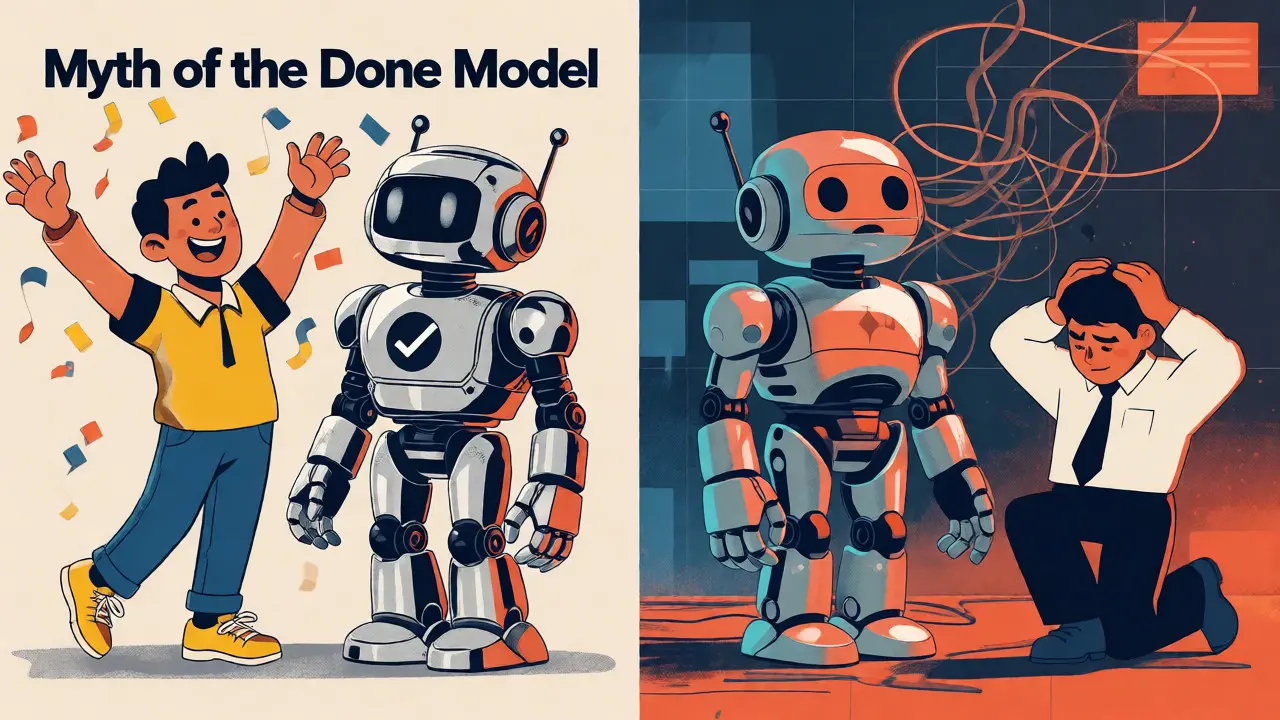
You shipped the model. It hit 95% accuracy in testing. You celebrated, closed the ticket, and moved on to the next sprint. Six months later, your support team complains that the chatbot is hallucinating, and your sales forecast is off by double digits. What happened? The world changed, but your model didn't.
This is the trap of treating machine learning deployment as a one-time event. In reality, data drifts, user behavior shifts, and edge cases pile up. If you aren't running continuous improvement loops, your AI system isn't just static; it's decaying. This guide breaks down how to build the feedback, retraining, and prompt update cycles that keep your models sharp and your operations smooth.
The Myth of the "Done" Model
Traditional software development often follows a linear path: design, code, test, deploy, maintain. Machine learning breaks this linearity. A model is a statistical approximation of reality at a specific point in time. As soon as you push it to production, reality starts moving away from that snapshot.
Think about a fraud detection model trained on pre-pandemic shopping habits. When online purchases skyrocketed and contactless payments became the norm, the old patterns vanished. Without a mechanism to notice this shift and adapt, the model either flagged too many legitimate transactions (false positives) or missed actual fraud (false negatives). Continuous improvement loops exist to close the gap between what the model expects and what actually happens.
These loops aren't just technical chores; they are strategic assets. Organizations that implement robust feedback mechanisms detect model drift early, automate retraining when needed, and incorporate human review where necessary. It’s the difference between having a tool that works today and having a system that evolves with your business.
Anatomy of a Continuous Improvement Loop
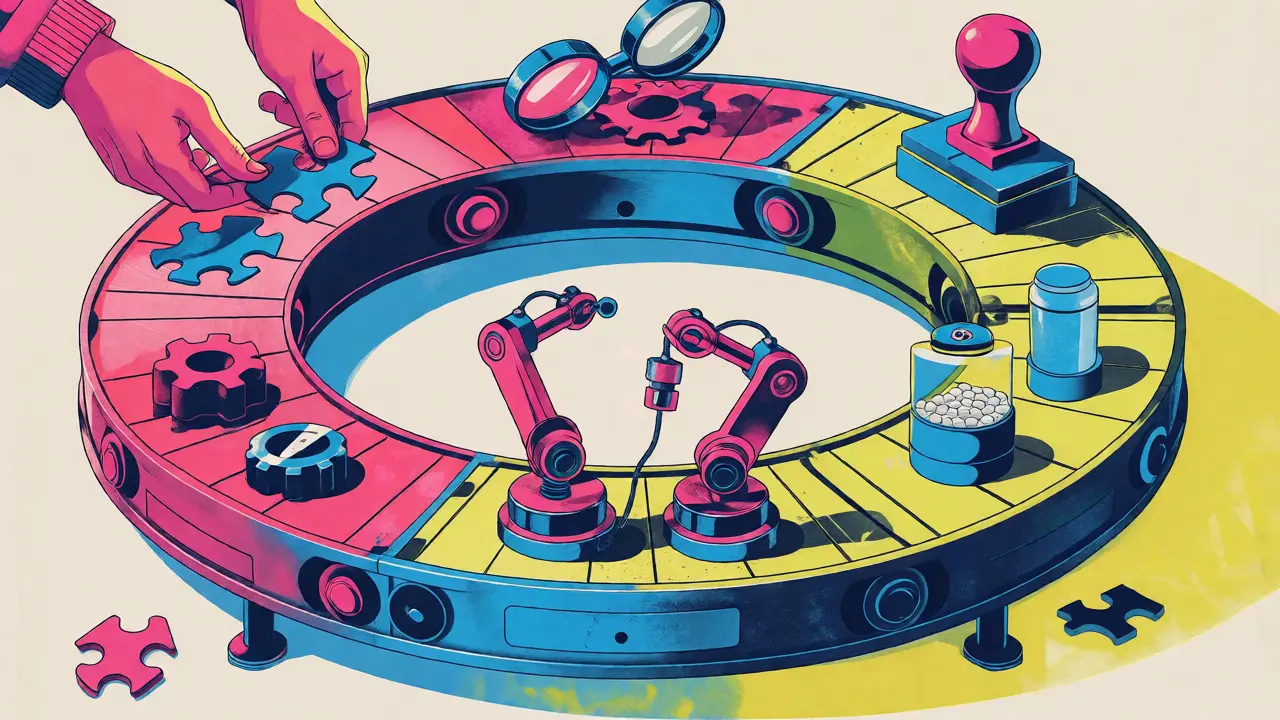
A continuous improvement loop in machine learning is a closed-loop system where outputs feed back into inputs to refine performance. It’s not magic; it’s engineering discipline. The architecture generally relies on four interconnected stages: gathering, analyzing, adapting, and validating.
1. Gathering Data: This is your sensory input. You collect predictions made by the model, the actual outcomes (if known), and explicit user feedback. For a recommendation engine, this might mean tracking which items users clicked after seeing a suggestion. For a customer service bot, it could be whether the user resolved their issue or escalated to a human.
2. Analyzing Performance: Raw data is noise until you process it. Here, you compare model predictions against ground truth. Are accuracy metrics dropping? Is there a new segment of users behaving differently? Tools like Prometheus or Grafana can visualize these trends, helping you spot anomalies before they become crises.
3. Adapting the System: Once you identify a problem, you fix it. This could involve updating training data, adjusting hyperparameters, or tweaking prompts for Large Language Models (LLMs). This stage is where MLOps pipelines shine, automating the heavy lifting so engineers don’t have to manually retrain every weekend.
4. Validating Changes: Never trust an untested change. Before pushing updates to all users, run them through shadow deployments or A/B tests. Does the new version actually perform better? If yes, promote it. If no, roll back and investigate. This cycle repeats continuously, creating a self-perpetuating engine of adaptation.
Feedback Mechanisms: Listening to Your Users and Systems
Feedback comes in two flavors: implicit and explicit. Implicit feedback is passive-users clicking links, staying on a page, or ignoring a notification. Explicit feedback requires effort-rating a response, flagging an error, or correcting a prediction.
Implicit feedback is high-volume but noisy. It tells you what people do, not why they do it. Explicit feedback is low-volume but high-signal. It tells you exactly where the model failed. The best systems balance both. For instance, if a user rates a search result as "helpful," that’s explicit. If they click the second result instead of the first, that’s implicit evidence that the ranking algorithm needs adjustment.
Don’t underestimate the value of human-in-the-loop reviews. Sometimes, the most valuable feedback comes from domain experts who spot subtle errors that metrics miss. A medical diagnosis model might have high statistical accuracy but fail on rare conditions that doctors recognize instantly. Capturing these expert corrections creates a goldmine for future retraining datasets.
Retraining Strategies: When and How to Update
Retraining is expensive. It consumes compute resources, storage, and engineer time. So, when should you pull the trigger? There are three common strategies:
- Schedule-Based: Retrain weekly or monthly regardless of performance. Simple, predictable, but potentially wasteful if the model hasn’t drifted.
- Threshold-Based: Trigger retraining only when key metrics (like accuracy or F1 score) drop below a set limit. Efficient, but requires robust monitoring infrastructure.
- Data-Volume Based: Retrain when a certain amount of new labeled data accumulates. Good for active learning scenarios where you’re actively seeking hard examples.
In practice, a hybrid approach often works best. Monitor performance daily. If drift exceeds a threshold, trigger an automated pipeline to ingest new data, retrain the model, and evaluate it against a holdout set. Only deploy if the new model beats the current champion. This ensures you’re not chasing noise but responding to genuine shifts in data distribution.
Consider the concept of continual learning. Unlike traditional retraining, which often wipes the slate clean, continual learning aims to teach a model new tasks while preserving previously learned knowledge. This prevents "catastrophic forgetting," where a model learns new patterns but forgets old ones. While still an active area of research, incorporating techniques like elastic weight consolidation can help stabilize models during frequent updates.
Prompt Updates: The New Frontier for LLMs
If you’re working with Large Language Models, your "model weights" might stay frozen, but your interface-the prompt-is dynamic. Updating prompts is faster and cheaper than retraining foundation models, making it a critical lever in your continuous improvement toolkit.
Prompt engineering isn’t a one-and-done task. As users interact with your LLM application, you’ll discover ambiguous instructions, missing context, or tone mismatches. A continuous improvement loop for prompts involves logging interactions, clustering failures, and iteratively refining instruction sets.
For example, if users frequently complain that your legal summary bot misses key clauses, you might add few-shot examples to the prompt showing how to extract those specific clauses. Or, if the bot sounds too robotic, you might adjust the persona instructions. These changes can be deployed instantly without touching the underlying model weights. Version control your prompts just like you version your code. Track which prompt versions correlate with higher user satisfaction scores.

Governance and Automation: Scaling the Loop
As you scale, manual intervention becomes a bottleneck. You need automation backed by governance. AWS Well-Architected Framework best practices emphasize establishing feedback loops across the ML lifecycle to enhance performance and adapt to changing data patterns. But automation without oversight is dangerous.
Implement guardrails. Define acceptable ranges for model confidence scores. If a model’s confidence drops below a threshold, route the request to a human reviewer instead of auto-retraining immediately. Document every experiment. Why did you change the feature set? What was the hypothesis? What was the outcome? This institutional memory prevents teams from repeating mistakes and helps new hires onboard quickly.
Also, consider the cost implications. Automated retraining can rack up cloud bills if not managed carefully. Use spot instances for training jobs, cache intermediate results, and schedule non-critical retraining during off-peak hours. Governance isn’t just about compliance; it’s about sustainability.
| Approach | Speed of Update | Cost | Complexity | Best For |
|---|---|---|---|---|
| Manual Retraining | Slow (Weeks/Months) | High (Labor) | Low | Small teams, stable data |
| Automated Pipeline | Fast (Hours/Days) | Moderate (Compute) | High | Dynamic environments, large scale |
| Prompt Tuning | Instant | Very Low | Low | LLM applications, style/tone fixes |
| Active Learning | Medium | High (Labeling) | Medium | Scarcity of labeled data |
Common Pitfalls to Avoid
Even with good intentions, teams stumble. Here are the most common traps:
- Ignoring Data Quality: Garbage in, garbage out. If your feedback loop ingests dirty data, your model will degrade faster. Implement data validation checks at the ingestion stage.
- Lack of Ground Truth: You can’t measure improvement if you don’t know the correct answer. Invest in labeling infrastructure or use proxy metrics wisely.
- Overfitting to Recent Data: If you retrain too aggressively on recent data, you might lose generalization ability. Balance recency with historical stability.
- Siloed Teams: Data scientists, engineers, and product managers must share ownership of the loop. If feedback sits in a ticket queue for weeks, the loop is broken.
Remember, the goal is to minimize the difference between predicted output and actual output. Every step in your loop should serve that objective. Start small. Pick one model, establish a basic feedback channel, and automate one part of the retraining process. Iterate from there.
What is the difference between model retraining and fine-tuning?
Model retraining typically involves training a model from scratch or continuing training on a significantly larger dataset, often changing the model's fundamental understanding. Fine-tuning usually refers to taking a pre-trained model and making smaller adjustments on a specific task or dataset, often requiring less computational power and time. In the context of LLMs, prompt updates are distinct from both, as they modify the input instructions rather than the model weights themselves.
How often should I retrain my machine learning model?
There is no one-size-fits-all answer. It depends on how fast your data changes. High-frequency trading models might retrain hourly, while retail demand forecasting might retrain weekly or monthly. The best approach is threshold-based: monitor performance metrics and trigger retraining only when accuracy drops below an acceptable level or when significant data drift is detected.
Do I need to retrain LLMs to improve their performance?
Not necessarily. Many improvements in LLM applications come from prompt engineering, retrieval-augmented generation (RAG) updates, or adding new context examples. Full retraining or fine-tuning of large models is expensive and slow. Start with prompt updates and RAG optimizations; only move to fine-tuning if these methods plateau in performance.
What tools are commonly used for MLOps feedback loops?
Popular tools include MLflow for tracking experiments and models, Kubeflow for orchestrating pipelines, and Prometheus/Grafana for monitoring. For data management, tools like DVC (Data Version Control) help track dataset changes. Cloud providers also offer integrated suites like AWS SageMaker or Azure ML that provide built-in monitoring and retraining capabilities.
How do I handle negative feedback from users?
Treat negative feedback as high-value signal. Categorize it to understand if it’s a data issue, a logic error, or a UX problem. Route severe complaints to human reviewers for immediate resolution and root cause analysis. Aggregate these insights to prioritize retraining efforts or prompt adjustments. Ignoring negative feedback leads to user churn and eroded trust in the AI system.