Transformers in AI: How Attention Mechanisms Power Modern Language Models
When you hear Transformers, a type of neural network architecture that uses attention mechanisms to process sequences of data, especially in language tasks. Also known as Transformer models, they're the reason your chatbot understands sarcasm, your search results feel intuitive, and AI can write code, summarize contracts, or draft emails without retraining from scratch. Before Transformers, AI struggled with long-range context—like remembering what was said five sentences ago. Transformers changed that by letting the model weigh every word’s importance in real time, not just follow a fixed order.
This isn’t just theory. The attention mechanism, the core innovation that lets AI focus on the most relevant parts of input text when generating output is why tools like RAG (Retrieval-Augmented Generation) work so well. Instead of guessing answers from memory, your LLM can pull in your company’s docs, check facts, and cite sources—all because attention lets it pick the right pieces from a sea of data. And multi-head attention, a technique that lets the model look at the same text through multiple lenses at once, like grammar, tone, and intent, makes this even smarter. One head catches slang, another spots contradictions, another tracks subject-verb agreement. Together, they turn raw text into meaning.
That’s why you’ll find posts here on everything from how Transformers cut cloud costs by making inference more efficient, to how they’re used in enterprise data governance to avoid legal risks. You’ll see how companies use them for content moderation, how developers avoid vendor lock-in by abstracting models, and why some teams now compress Transformers instead of switching to smaller ones. You’ll learn how to build domain-aware models, how to scale them across thousands of GPUs, and how to measure if they’re even telling the truth. This isn’t a collection of hype—it’s a practical toolkit for anyone deploying AI in real systems, whether you’re a founder, engineer, or compliance officer. What follows are the real-world strategies, benchmarks, and gotchas that matter when Transformers aren’t just a research paper, but your production engine.
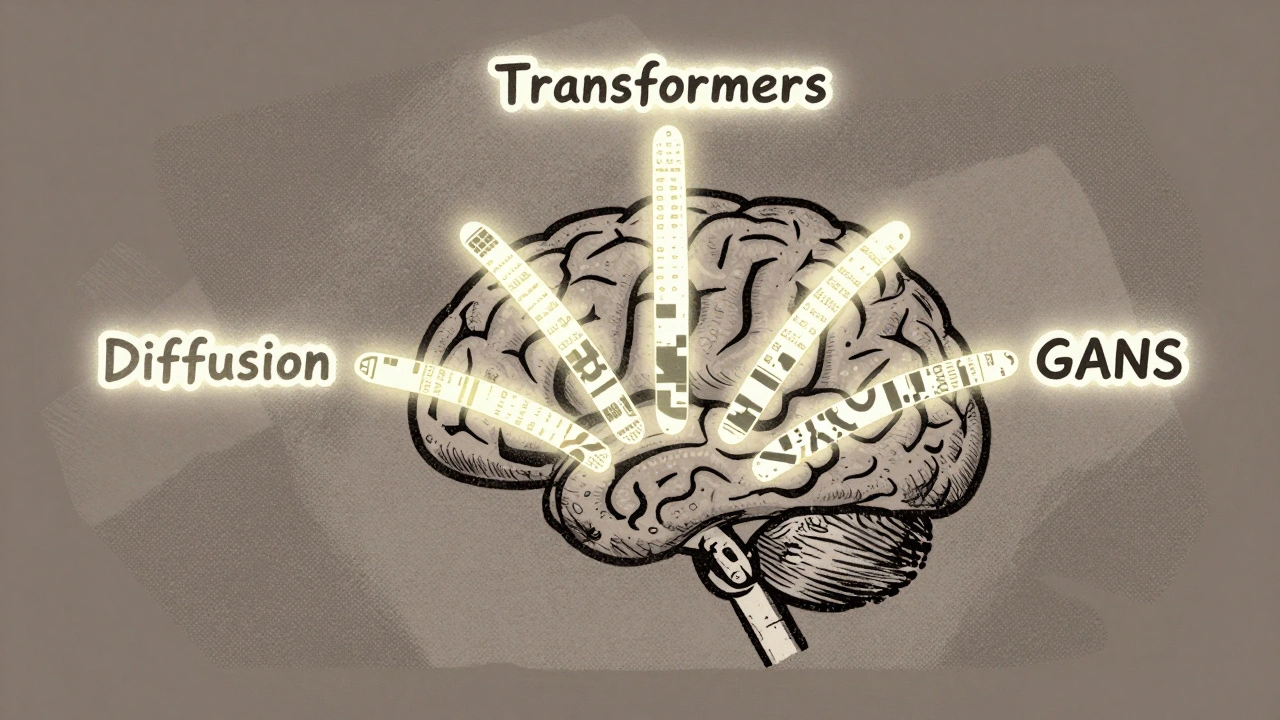
Foundational Technologies Behind Generative AI: Transformers, Diffusion Models, and GANs Explained
Transformers, Diffusion Models, and GANs are the three core technologies behind today's generative AI. Learn how each works, where they excel, and which one to use for text, images, or real-time video.
Read More