Tenant Isolation in AI Systems: Secure, Scalable Multi-Tenant LLM Deployments
When you run large language models for multiple customers or teams, tenant isolation, the practice of keeping each user’s data, prompts, and model usage completely separate in a shared system. Also known as multi-tenant security, it’s not optional if you’re handling sensitive information—health records, financial queries, or internal corporate data. Without it, one user’s input could accidentally leak into another’s output, or a malicious actor could probe the system to extract training data from neighboring tenants. This isn’t theoretical. In 2023, a major AI provider had to shut down a public API after researchers showed they could extract snippets of another user’s private prompts by manipulating model responses.
Effective tenant isolation, the practice of keeping each user’s data, prompts, and model usage completely separate in a shared system. Also known as multi-tenant security, it’s not optional if you’re handling sensitive information—health records, financial queries, or internal corporate data. requires more than just firewalls. It demands strict control over data privacy, how user inputs and outputs are stored, processed, and erased to prevent cross-tenant exposure, proper LLM security, measures like input sanitization, output filtering, and access controls that protect models from poisoning or extraction attacks, and isolation at the infrastructure level—separate memory spaces, containerized inference, and encrypted in-use data. Companies using OpenAI’s API in production don’t just rely on the provider’s defaults; they add layers like custom redaction pipelines, tenant-specific vector databases, and audit trails tied to each user session.
What you’ll find in this collection are real-world examples of how teams implement tenant isolation in PHP-based AI apps. You’ll see how to structure Composer packages that enforce isolation by default, how to log and monitor tenant activity without storing raw data, and how to use PHP’s memory management and session controls to prevent bleed-through between users. There are guides on integrating confidential computing with TEEs, securing model weights per tenant, and automating compliance checks for GDPR or state-level AI laws. This isn’t about theory—it’s about code that works under pressure, in production, with real users and real consequences.
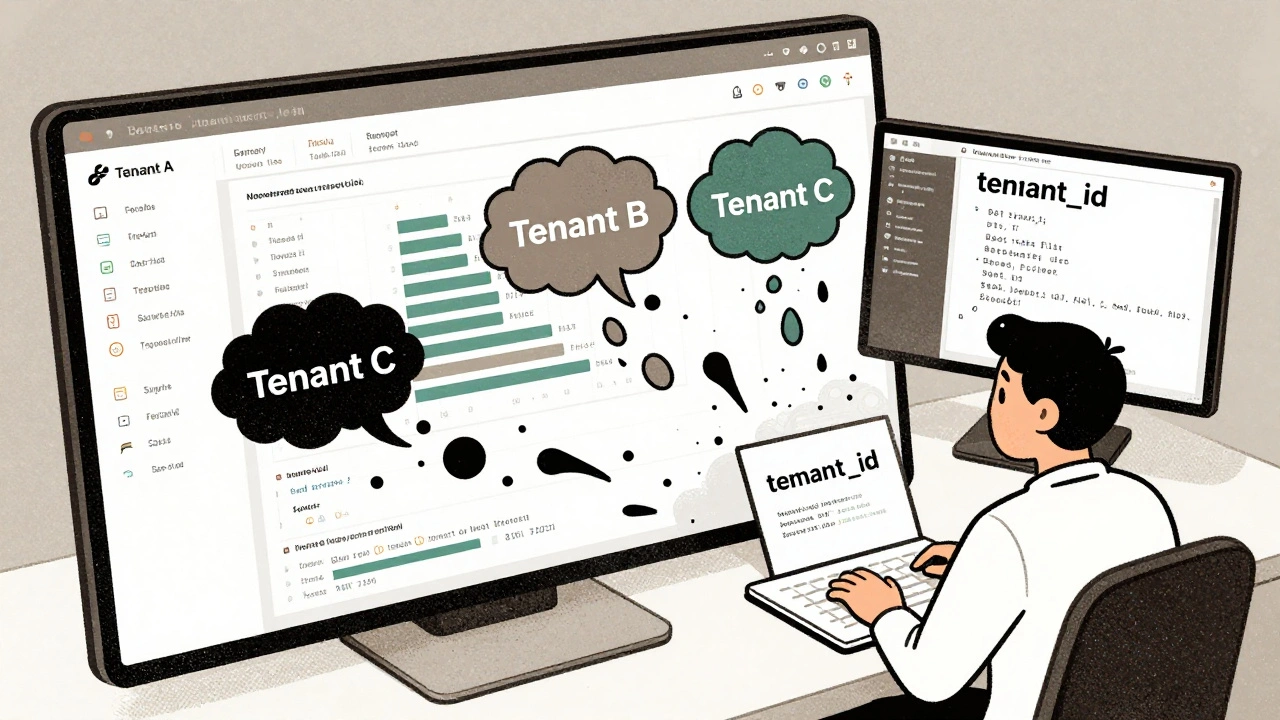
Multi-Tenancy in Vibe-Coded SaaS: How to Get Isolation, Auth, and Cost Controls Right
Learn how to implement secure multi-tenancy in AI-assisted SaaS apps using vibe coding. Avoid data leaks, cost overruns, and authentication failures with proven strategies for isolation, auth, and usage controls.
Read More